
 Deutsch
 Español
 Français
 Italiano
 Magyar
 Polski
 Slovenčina
 Čeština
Acquiring a new customer can cost five times more than retaining one. For small businesses, that gap matters because a small lift in loyalty often does more for profit than another round of expensive promotion. A 5% increase in retention can raise profits by 25% to 95%, which is why retention deserves more attention than it usually gets.
That pressure is even sharper in the UK. B2B client acquisition costs have risen by 60% over the past five years, with some industries seeing costs exceed £1,000 per client. Small operators don't have much room to waste money replacing customers who could have stayed.
Practical customer retention strategies for small businesses beat vague advice. Cafés, salons, restaurants and local retail shops need tactics that staff can run during busy shifts, not theory that sounds good in a boardroom.
BonusQR fits that reality well. It gives brick-and-mortar businesses a fast, QR-based loyalty setup without POS integration, extra hardware, or a long training curve. That matters because retention only works when the system is simple enough for staff to use consistently and clear enough for customers to understand at a glance.
The nine strategies below focus on what gets repeat visits moving. Each one includes a BonusQR campaign blueprint, useful KPIs, messaging templates, and a realistic scenario from a restaurant, café or salon. The aim isn't to launch everything at once. It's to pick one or two plays, run them properly, and build from there.
1. Loyalty Program Gamification with Point-Based Rewards
Gamification works because it makes progress visible. A customer doesn't just buy a coffee or book a treatment. They move closer to something.
That difference matters. A Caldere guide for UK small businesses says 78% of small businesses report that a loyalty programme is the most effective customer retention strategy, and points-based systems achieve 3.2x higher repeat visit rates than discount-only models. Discounts can create a habit of waiting for deals. Points create a habit of coming back.
For a café, a salon, or a casual restaurant, the simplest structure usually wins. Complicated conversion rules kill momentum.
BonusQR blueprint
Set up a points campaign in BonusQR with three actions:
- Visit reward: Give points on every qualifying visit.
- Spend boost: Add extra points when a customer crosses a target basket size.
- Milestone reward: Offer a reward that feels reachable within a handful of visits.
Use BonusQR's QR-based rewards experience so staff only need to scan and confirm. No manual card punching. No explaining five different exceptions at the till.
A strong café version looks like this in practice:
- Entry reward: Every hot drink earns points.
- Mid-level reward: A smaller reward arrives early so customers feel progress quickly.
- Top reward: A free drink or upgrade lands later and feels worth chasing.
Practical rule: If staff can't explain the reward in one sentence, customers won't remember it.
KPIs and messaging that matter
Track the basics first:
- Repeat visit frequency: Are members returning more often than non-members
- Reward redemption rate: Are people using rewards or just collecting points
- Time to first reward: How quickly a new member earns something meaningful
- Average basket after enrolment: Whether members add extras once they join
A practical message template for a coffee shop:
You're only a few points away from your next reward. Scan your BonusQR code on your next visit and unlock it faster.
A salon variation works well too. A customer books a blow-dry, earns points, then gets nudged towards a treatment add-on or future service. That keeps the programme tied to margin, not just footfall.
What doesn't work is making every reward a discount. That trains customers to expect price cuts. Better programmes mix free items, upgrades, member-only perks and occasional bonus-point windows during quieter periods.
2. Personalized Email and Push Notification Campaigns
Most retention messaging fails for one reason. It says the same thing to everyone.
A regular who visits twice a week shouldn't get the same message as someone who hasn't returned in a month. Better customer retention strategies for small business separate those groups and speak to each one differently.
A useful starting point is visit behaviour. New customer. Regular. High-value regular. At-risk. Lapsed. That's enough to build better campaigns without turning the system into a full-time admin job.
BonusQR blueprint
BonusQR includes news push notifications, which makes it easier to run targeted messages without relying on staff to remember manual follow-ups.
A simple campaign stack looks like this:
- New joiner message: Sent soon after sign-up with a clear first reward path
- Near-reward reminder: Triggered when a customer is close to redeeming
- We miss you message: Sent after a stretch of inactivity
- VIP early access: Sent to top regulars before a limited offer goes public
For a restaurant, one practical flow is to tag lunch regulars separately from weekend diners. Lunch guests get weekday offers. Weekend guests get table-booking prompts or seasonal menu previews.
KPIs and message templates
The numbers to watch are straightforward:
- Open or notification view rate
- Redemption rate by segment
- Reactivation count from dormant customers
- Unsubscribe or opt-out trend
One message for an at-risk café customer:
Haven't seen you in a while. Your points are still waiting, and your next visit could unlock a reward.
One for a salon regular:
Thanks for being one of our regulars. This week, loyal members can unlock an extra reward on their next service.
Send fewer messages with better timing. That's usually stronger than sending more messages with weaker offers.
What tends to fail is blasting promotions every few days. Customers tune it out, or they opt out. Another mistake is sending offers with no relevance to purchase history. If someone only books colour appointments, a generic nail discount won't bring them back.
The best automated campaigns feel helpful, not noisy. They remind customers what they already like, show them what's next, and give them a reason to act now.
3. Birthday and Seasonal Surprise Rewards
Birthday rewards work because they don't feel like standard marketing. They feel personal.
That's useful in sectors where customers can easily switch to the next café, salon or neighbourhood restaurant. A birthday perk gives them a reason to choose the familiar place over the convenient one.
Seasonal offers can do the same job when they're tied to real buying moments. A January fitness and wellness push for salons and gyms makes sense. A cold-weather hot drink campaign for cafés makes sense. A random "spring special" with no link to customer behaviour usually doesn't.
BonusQR blueprint
BonusQR supports special occasion marketing for cafes, and the same structure works well for salons and restaurants too.
A clean setup looks like this:
- Collect date of birth at sign-up: Keep the form light and explain why it's asked
- Send the reward in advance: Give enough time to redeem it
- Use a fixed redemption window: Long enough to be practical, short enough to create urgency
- Add a follow-up message: Remind customers before the reward expires
For cafés, a birthday drink or pastry add-on is often enough. For salons, a free upgrade, bonus points, or a treatment add-on tends to preserve value better than a broad discount.
A restaurant can pair the birthday reward with a booking prompt. That often turns a single redemption into a table for two or more.
KPIs and scenario ideas
Track:
- Birthday reward redemption
- Average spend on birthday visit
- Follow-up visits after birthday redemption
- Seasonal campaign participation
A salon message template:
Happy birthday month. Your BonusQR treat is ready and waiting. Book within the reward window to enjoy it on your next visit.
A café message template:
Birthday treat unlocked. Scan your BonusQR code this week and enjoy your reward with your usual order.
For businesses in large cities, pairing the offer with local occasion planning can help. A restaurant or café can connect birthday traffic with broader inspiration such as best birthday experiences in Manchester, then present its own reward as part of that celebration plan.
What doesn't work is being vague. "A surprise awaits" sounds clever but often underperforms against a clear reward. Customers respond faster when they know exactly what they'll get and exactly when it expires.
4. Tiered VIP Membership Tiers
Tiered programmes work because they give regulars status, not just savings. A customer who's close to the next tier has a reason to consolidate visits with one business instead of spreading spend around.
Loyal customers already carry a large share of revenue. Salesforce reports that about 61% of UK small businesses say repeat buyers make up more than half of their total revenue. If those customers feel recognised, the programme strengthens the part of the business that already pays the bills.
A café can turn this into member-only extras. A salon can make top tiers feel pampered. A restaurant can give early menu access, priority booking windows, or bonus rewards.
Building tiers that don't confuse people
The mistake is creating too many levels with tiny differences. Most small businesses need no more than three tiers.
A practical structure:
- Base tier: Standard points or visit rewards
- Mid tier: Bonus earning rate or occasional exclusive offers
- Top tier: Premium perks such as early access, birthday upgrades, or priority booking
The jump between tiers has to feel worth the effort. A slightly bigger discount usually isn't enough. A distinct experience is better.
Customers don't chase a tier because of the label. They chase it because life gets easier or better when they reach it.
BonusQR blueprint and KPIs
In BonusQR, a café might set this up as entry-level rewards for all members, bonus points for regulars after a threshold of visits, and a top level with preview access to seasonal drinks plus faster reward earning.
For a salon, the top tier can provide:
- Priority appointments: Early access to in-demand slots
- Exclusive service add-ons: Small upgrades that feel premium
- Member recognition: A visible status marker in the customer profile
The right KPIs are:
- Tier progression rate
- Spend per tier
- Visit frequency by tier
- Downgrade or inactivity among high-tier members
What fails is making top tiers reachable only by heavy spenders with no realistic path for strong regulars. Small businesses need aspiration, not impossibility. A customer should believe they can get there within a reasonable period if they keep choosing the business.
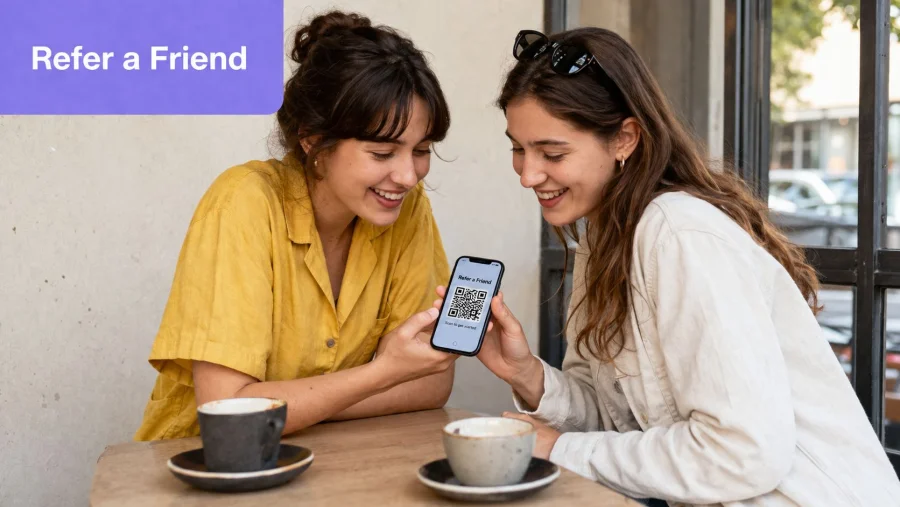
5. Referral and Word-of-Mouth Incentive Programs
Word of mouth usually brings in the cheapest new customer a small business can get. It also fails fast when the offer is vague, the claim process is clumsy, or staff need a script just to explain it.
The best referral programs feel easy enough to mention in a real conversation. A regular tells a friend. The friend scans, books, or visits. Both people get a reward they understand straight away. If any part of that chain is fuzzy, take-up drops.
That matters even more when paid acquisition keeps getting pricier. Existing customers already know the product, trust the team, and can describe the experience in a way no ad can match.
BonusQR blueprint
In BonusQR, keep the setup tight and visible at the point of sharing.
A referral campaign that works in practice usually follows this sequence:
- Set one clear trigger: First scan, first purchase, or first completed appointment
- Reward both sides: Give the referrer a reason to share and the new customer a reason to act now
- Issue the reward quickly: Instant or near-instant rewards beat delayed approval flows
- Train staff on one sentence: If the front-of-house team cannot explain it in 10 seconds, simplify it
- Add a time limit for the new customer: A short expiry helps convert interest into a visit
Here is how that looks by business type:
- Café: A regular shares their BonusQR referral. The friend scans on their first visit and both customers get a free add-on or points bonus
- Salon: The existing client refers a friend. Once the new client completes their first paid service and scans, both accounts receive bonus points or a service credit
- Restaurant: A weekday-focused referral gives both guests a member perk after the new diner joins and visits during quieter trading periods
The trade-off is simple. Rich rewards get attention, but they can wipe out margin if you pay them on low-value first visits. Smaller rewards protect margin, but they need to feel immediate and worth mentioning. In most small businesses, a modest reward claimed fast beats a larger reward wrapped in conditions.
KPIs, messaging templates and local scenarios
Track referrals like an acquisition channel, not a loyalty extra. The useful numbers are:
- Referral share rate
- First-visit conversion rate from referrals
- Cost per referred customer
- 30 to 60-day repeat visit rate of referred customers
- Average spend of referred customers versus other new customers
A restaurant message to regulars can stay direct:
Love eating here? Share your BonusQR code with a friend. When they join and visit, you both get a reward.
A salon version should match the service model:
Recommend us to a friend. When they book their first appointment and scan, both accounts receive a loyalty bonus.
A café can be even shorter at the till or in a post-visit message:
Bring a friend next time. If they scan on their first visit, you both get bonus points.
One tactic I see underused is the local partner referral. A salon and skincare boutique. A café and bookshop. A gym and juice bar. It works because the recommendation already fits an existing routine, but only if the customer journey is clear and the reward rules are shared by both teams. Without that coordination, staff confusion kills the idea before customers ever use it.
What usually underperforms is a one-sided reward. If only the referrer benefits, the new customer has no reason to try the business this week instead of someday.
6. Exclusive Flash Sales and Limited-Time Offers
Flash offers can bring people back quickly, but only when they serve a clear purpose. If every week is a flash sale, customers stop treating any of them as special.
The best use is operational. Fill quiet hours. Move slow stock. Create urgency around a new item. Give members first access to something limited.
For a local business, the sale window doesn't need to be dramatic. Even a same-day or next-day member offer can work if the message is tight and the reward is easy to redeem.
BonusQR blueprint
A strong BonusQR flash campaign follows a fixed pattern:
- Choose one target: Slow weekday traffic, ageing stock, or new launch uptake
- Limit the audience first: Loyalty members get the earliest access
- Add a short expiry: Long enough to use, short enough to matter
- Measure by visit lift, not just redemptions: Some offers raise baskets without many direct claims
A café could run a late-afternoon perk for loyalty members during the slow patch between lunch and commute time. A salon can use limited-time upgrade offers to fill quieter appointment gaps. A restaurant can send member-only prompts to increase off-peak covers.
KPIs and message examples
Track:
- Visits during offer window
- Redemption rate
- Average transaction during the campaign
- Whether the offer shifts traffic from peak to off-peak
Useful message templates:
Member-only offer. Scan today before closing and unlock a limited reward on your order.
Quiet-hour bonus is live. Loyalty members can redeem this offer during the campaign window only.
One operational rule matters here. Never discount the thing that already sells itself at full price if the core problem is a weak daypart somewhere else. Push the behaviour that needs changing.
What usually fails is vague urgency. "Limited time" means little if customers don't see the end point. A proper expiry, shown clearly in the app or message, does far more than hype-heavy wording.
7. Surprise and Delight Micro-Rewards
Predictable rewards build habits. Unexpected rewards build stories.
A surprise free add-on, a one-off bonus, or a thank-you perk after a run of visits often creates a stronger emotional response than another routine discount. Customers mention it to friends. Staff remember the interaction. The business feels human.
This strategy works especially well in hospitality and personal services because the reward can be small while the perceived value feels high.
Where surprise rewards fit best
Surprise rewards work in moments such as:
- After a streak of visits: Reward consistency without announcing the exact trigger
- During a rough day: Give staff room to recover a slightly poor experience
- After feedback or a referral: Thank the customer without turning every action into a formal campaign
A café can surprise a regular with a pastry add-on. A salon can add bonus points after a longer appointment. A restaurant can attach a dessert or upgrade to a loyal member's bill.
Small rewards feel bigger when customers didn't expect them.
BonusQR blueprint and KPI focus
BonusQR makes this easier because staff can scan and apply a reward without rewriting the whole loyalty structure. That keeps the programme controlled while still allowing flexible gestures.
A useful setup is to define a small pool of micro-rewards in advance:
- Free add-on: Extra shot, topping, or mini treatment upgrade
- Bonus points: Easy to apply and low-friction
- Thank-you coupon: Best used after feedback or issue recovery
The right KPIs are more behavioural than financial:
- Repeat visit after surprise reward
- Redemption of follow-up offers
- Staff usage consistency
- Customer feedback mentioning the experience
The common mistake is overdoing it. If every second customer gets an unexpected perk, it stops being unexpected and starts becoming an entitlement. Surprise rewards should support the main loyalty system, not replace it.
8. Customer Feedback and Review Incentives
Reviews don't only help attract new customers. They also reveal why existing customers stay, drift, or churn.
For small businesses, that's valuable because service problems often hide in routine details. Slow greeting. Confusing redemption. Hard-to-book slots. Offer fatigue. A structured feedback loop catches those issues before they become repeat-loss patterns.
This is one of the strongest customer retention strategies for small business because it improves the experience while also giving happy customers a prompt to speak publicly.
BonusQR blueprint
Use BonusQR after key moments, not randomly. The best timing is when the experience is still fresh.
A practical setup:
- Post-visit prompt: Ask for a quick rating after a completed visit
- Review incentive: Offer bonus points or a small loyalty benefit for submitted feedback
- Recovery route: Flag low scores for follow-up rather than treating all reviews the same
For a salon, the prompt can land after the appointment closes. For a restaurant, after the bill is settled. For a café, after a loyalty scan and purchase.
What to measure and what to avoid
KPIs worth watching:
- Feedback response rate
- Average rating trend
- Issue category frequency
- Repeat visits from customers who left feedback
A concise prompt works better than a formal survey invitation:
Thanks for visiting. Leave quick feedback in BonusQR and receive a loyalty bonus on your account.
Another option for a restaurant:
Tell us how today's visit went. Your feedback helps improve the experience, and your account will receive a small thank-you reward.
What doesn't work is bribing only for positive reviews. That damages trust and usually attracts the wrong kind of response. Reward the act of giving feedback, not the score.
One more operational point matters. If customers keep mentioning the same issue and nothing changes, asking for more feedback starts to irritate them. The loop has to close. Listen, fix, then show that the fix happened.
9. Community Building and Exclusive Member Events
Loyalty gets stronger when customers feel attached to more than the transaction. That's where community events help. A member tasting night, a mini workshop, a regular client evening, or a partner event with a nearby business gives people a reason to identify with the brand.
This matters most for businesses that compete in crowded local markets. A nearby rival can copy prices. It can't easily copy relationships, rituals and familiarity.
For cafés, events can centre on tasting, local makers, or seasonal launches. For salons, they can focus on skincare evenings, styling sessions, or wellness partnerships. Restaurants can host member previews or local food and drink collaborations.
BonusQR blueprint
Use BonusQR as the event access layer and reward engine.
A simple structure works well:
- Invite loyalty members first: Keep the event feeling earned
- Reward attendance: Add points or an event-only perk
- Capture preferences: Use follow-up messages to ask what people want next
- Extend the event into future visits: Offer a post-event member reward with a clear expiry
This turns one event into a retention sequence instead of a single-night activity.
Exclusive events work best when they're regular enough to build expectation, but not so frequent that they feel routine.
KPIs and realistic scenarios
Watch these numbers:
- Event sign-ups or attendance
- Repeat visit after attendance
- Spend from attendees over the following period
- Referral or guest participation linked to the event
A practical café example is a member-only tasting evening for a new seasonal roast, followed by a reward valid on the next purchase of that drink.
A salon could host a quiet evening for top-tier members with consultations and product sampling, then send a follow-up reward tied to the recommended service.
A restaurant might invite regulars to preview a new menu before public launch. That doesn't just drive another visit. It makes regulars feel included in the business.
9-Point Customer Retention Strategy Comparison
| Strategy | Implementation Complexity 🔄 | Resource Requirements ⚡ | Expected Outcomes 📊⭐ | Ideal Use Cases 💡 | Key Advantages |
|---|---|---|---|---|---|
| Loyalty Program Gamification with Point-Based Rewards | Moderate, rules, UI and tracking setup | Low–Moderate, platform, UX, notifications | Increased repeat visits & engagement; measurable retention (⭐⭐⭐⭐) | Small-to-medium retail & cafés needing repeat traffic | Encourages repeat visits without heavy discounts; behavioral data |
| Personalized Email and Push Notification Campaigns | Moderate–High, segmentation, triggers, testing | Moderate, clean data, automation tooling, content | High engagement / ROI; strong reactivation (⭐⭐⭐⭐⭐) | Businesses with customer data: e-commerce, restaurants, gyms | Timely, scalable outreach; high conversion per message |
| Birthday and Seasonal Surprise Rewards | Low, simple date-based automation | Low, coupons/content and scheduling; DOB data required | High redemption and emotional lift (⭐⭐⭐⭐) | Retail, cafés, service businesses with CRM profiles | Personal, low-cost promotions that strengthen affinity |
| Tiered VIP Membership Tiers | High, thresholds, benefit orchestration, policies | High, benefits provisioning, analytics, communications | Increased spend & loyalty; status-driven uplift (⭐⭐⭐⭐) | Businesses with scalable customer base & high-ticket spend | Drives higher lifetime value and premium segmentation |
| Referral and Word-of-Mouth Incentive Programs | Moderate, tracking, fraud controls needed | Low–Moderate, referral codes/QRs, rewards, analytics | Lower CAC; higher LTV for referred users (⭐⭐⭐⭐) | Growth-focused brands, local services, subscription apps | Cost-effective acquisition; measurable attribution |
| Exclusive Flash Sales and Limited-Time Offers | Moderate, timing, inventory & communications | Moderate, inventory planning, push/SMS campaigns | Immediate traffic and basket lift; short-term spikes (⭐⭐⭐⭐) | Clearance, off-peak traffic boosting, product launches | Urgency-driven conversions; boosts enrollment and visits |
| Surprise and Delight Micro-Rewards | Low, randomization rules and staff guidelines | Low, small-value rewards, staff training | Strong emotional loyalty & word-of-mouth (⭐⭐⭐⭐) | Hospitality, independent cafés, boutique retailers | High emotional ROI for minimal cost; boosts NPS |
| Customer Feedback and Review Incentives | Moderate, request workflows, moderation | Moderate, outreach system, response staffing, analytics | More reviews & actionable insights; better local SEO (⭐⭐⭐⭐) | Restaurants, local businesses, online sellers | Increases social proof and identifies service gaps |
| Community Building and Exclusive Member Events | High, event logistics, curation, partnerships | High, staff time, venue/partners, ongoing programming | Deep emotional bonds; high LTV among attendees (⭐⭐⭐⭐) | Brands seeking strong community (gyms, specialty retailers) | Builds identity and switching costs; generates UGC |
Putting These Strategies into Action
Retention improves when a business does a few things consistently, not when it launches a dozen ideas at once and manages none of them well.
That discipline matters because the upside is real. Earlier, the article noted that stronger retention can have a substantial profit impact. For many UK operators, that's reason enough to treat loyalty as an operating system rather than an occasional campaign.
A sensible starting point is one core loyalty mechanic and one follow-up communication layer. For most cafés, salons and restaurants, that means a points or visit-based programme plus timed push or email reminders. That combination is usually enough to spot whether customers are responding, whether staff can run the process smoothly, and whether rewards are worth the margin being given away.
BonusQR is particularly useful here because it removes most of the usual setup friction. Staff scan a QR code. Customers can see rewards and visit history in one place. The business can run stamps, points, cashback, visit thresholds, fixed discounts, birthday rewards, seasonal coupons and feedback requests without needing a POS integration or extra hardware. That keeps the barrier low, which is one of the biggest practical wins in small business retention.
The next step is choosing the right KPI for the tactic being tested. A flash offer should be judged by traffic during the target window. A birthday campaign should be judged by redemption and follow-up visits. A VIP tier should be judged by progression and member spend. Too many businesses look only at total sign-ups, which can hide a weak programme behind a healthy-looking enrolment count.
A useful rollout order for most operators looks like this:
- Start with the base programme: Points, visits, or stamps with a reward customers understand immediately
- Add triggered messaging: Near-reward nudges, dormant customer prompts, or birthday reminders
- Layer in one advanced tactic: VIP tiers, referrals, surprise rewards, or event-based loyalty
- Review monthly: Keep the rewards that change behaviour and remove the ones that only cut margin
This is also where simple A/B testing helps. Try two reward messages. Test a shorter versus longer expiry window. Compare a free add-on against bonus points. Small changes often improve performance more than a full redesign.
One overlooked trade-off is complexity. A loyalty programme can look clever on paper and still fail at the counter. If staff have to stop and explain the offer every time, redemption drops and queues slow down. If customers can't tell how close they are to a reward, motivation fades. BonusQR solves a lot of that by keeping the experience visual and mobile-first, but the campaign design still needs discipline. Simple beats clever nearly every time.
Another strong advantage is flexibility across sectors. A café can run stamps and off-peak offers. A salon can build appointment-linked rewards and birthday upgrades. A restaurant can combine visit rewards with event invitations and member-only previews. A gym or wellness studio can reward attendance, referrals and seasonal campaigns from the same platform. The mechanics don't have to be reinvented for each business type. They just need to match customer behaviour.
Retention also gets stronger when the business uses loyalty data to make operational decisions, not just marketing decisions. If regulars keep coming on Tuesdays, that's useful. If rewards get redeemed mainly on low-margin items, that needs adjusting. If one staff member signs up far more members than the rest, that person may have a script worth sharing across the team. BonusQR's analytics can help surface those patterns so the loyalty programme improves over time instead of sitting untouched.
The strongest customer retention strategies for small business are rarely flashy. They are consistent, easy to understand, and tied to real customer behaviour. That's why a QR-based loyalty platform is often the most practical fit for local operators. It keeps execution light, gives customers a reason to return, and gives the business enough data to improve without adding another layer of operational pain.
Ready to turn more first-time visitors into regulars. Explore BonusQR's loyalty platform and launch a QR-based retention campaign that fits the way cafés, salons, restaurants and local shops actually work.