
 Deutsch
 Español
 Français
 Italiano
 Magyar
 Polski
 Slovenčina
 Čeština
Loyalty programme gamification is the deliberate use of game design and behavioural science to turn passive reward collection into frequent, satisfying moments of progress. It works because it gives customers a reason to return that goes beyond the next discount. Research on gamified loyalty programmes confirms that gamified conditions produce higher loyalty and participation intention than conventional programmes, with playfulness acting as the key mediating factor. Across Europe, Mando/YouGov’s Understanding Loyalty in Europe 4.0 found that programme membership is high but emotional connection remains limited, and gamification is identified as one of the clearest levers to close that gap. Platforms like Bonusqr make it practical to pilot these mechanics quickly, with modular features covering points, missions, stamp cards, and push notifications, without requiring POS integration.
Key reasons gamification outperforms standard loyalty mechanics:
- It converts a single transaction into a sequence of micro-goals, each with its own small reward.
- Progress visibility (bars, levels, badges) triggers the goal-gradient effect: customers accelerate effort as they approach a target.
- Social and competitive elements (leaderboards, challenges) add a relatedness dimension that purely transactional programmes lack.
- Surprise rewards and instant-win mechanics sustain attention between purchase cycles.
Key takeaways
Gamification in loyalty programmes produces measurably higher engagement and retention than conventional programmes when it is treated as a continuous behavioural-design discipline rather than a one-off campaign.
| Point | Details |
|---|---|
| Start with one mechanic | Pick a single objective and one customer segment before adding complexity to your programme. |
| Pilot for 60–90 days | Run an A/B test long enough to avoid novelty bias and measure genuine frequency lift. |
| LiveOps beats one-off launches | Weekly content refreshes and real-time triggers sustain engagement after the initial spike fades. |
| Froggu proves regional impact | Żabka’s Froggu campaign achieved a 15% rise in app usage frequency and a 36% increase in daily loyalty coin usage in Poland. |
| Bonusqr accelerates pilots | Bonusqr’s modular platform lets you configure and launch gamified mechanics without POS integration or long development timelines. |
What does loyalty programme gamification actually cover?
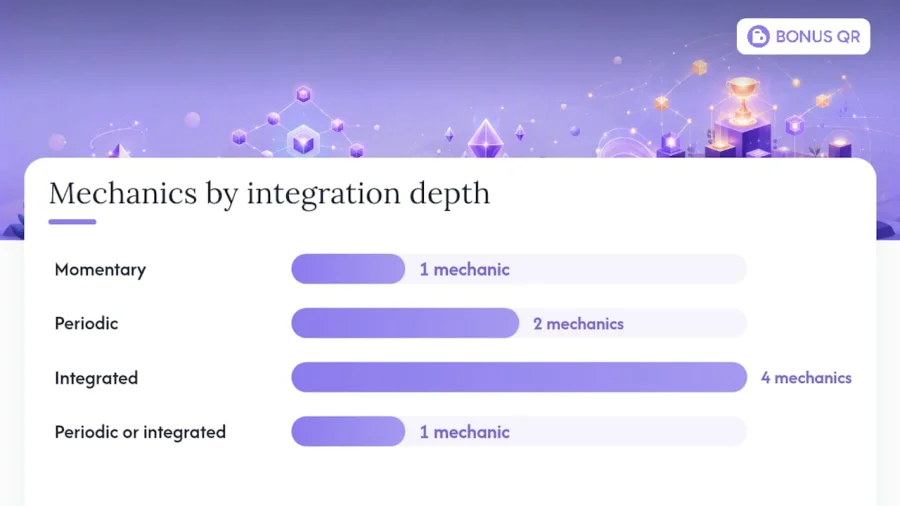
The term covers a wide range of mechanics, and conflating them leads to poor design choices. A useful way to organise them is by integration depth: momentary, periodic, and integrated.
Momentary gamification is a single-session mechanic with no persistent state. A scratchcard at the till, a spin-the-wheel offer after checkout, or an instant-win coupon all belong here. The objective is usually acquisition or a one-time frequency spike. The risk is that the novelty fades quickly.
Periodic gamification runs over a defined window, typically days or weeks. Seasonal advent calendars, weekly mission sets, and limited-time badge collections sit in this tier. Żabka’s Froggu campaign is a strong example: players progressed through 100 levels over roughly 130 days, with weekly resets keeping the mechanic fresh. Costa Coffee’s milestone challenges, where customers unlock a free drink after a set number of visits within a month, follow the same periodic logic.
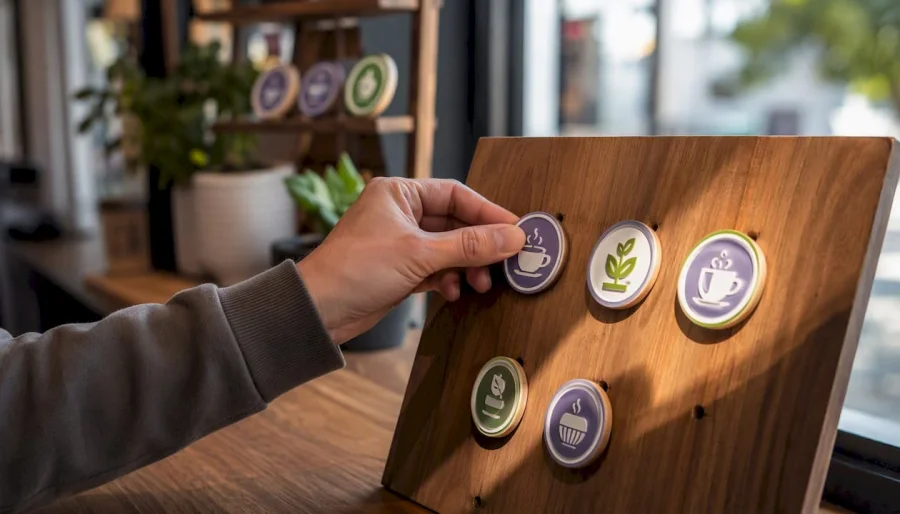
Integrated gamification is woven into the programme’s permanent architecture. Levels, persistent tiers, narrative characters, and long-running leaderboards all require ongoing content and LiveOps management. McDonald’s Monopoly (run across several EU and UK markets) and Miles & More’s tier structure are integrated by design: the mechanic is the programme, not a layer on top of it.
| Mechanic | Primary objective | Integration depth |
|---|---|---|
| Instant win / scratchcard | Acquisition, trial | Momentary |
| Seasonal calendar | Frequency, seasonal spend | Periodic |
| Mission sets | Frequency, AOV | Periodic |
| Badges / achievements | Emotional connection | Periodic or integrated |
| Progress bars | Frequency, habit | Integrated |
| Leaderboards | Social engagement | Integrated |
| Tiers / levels | Retention, spend uplift | Integrated |
| Narrative / character (e.g. Froggu) | Emotional connection, brand affinity | Integrated |
KFC’s Rewards Arcade, available in several European markets, blends periodic and integrated elements: customers earn arcade tokens through purchases and spend them on mini-games that unlock food rewards, keeping the mechanic tied directly to in-store behaviour.
Why does gamification work on a psychological level?
Gamification works because it converts passive incentives into frequent, satisfying micro-moments of progress and social proof. The psychological mechanism is well-documented.
Self-Determination Theory identifies three core needs that drive sustained motivation: competence (feeling capable and improving), autonomy (choosing how to engage), and relatedness (connecting with others). Well-designed gamification addresses all three. A progress bar satisfies competence. Letting customers choose which mission to complete satisfies autonomy. A team challenge or leaderboard satisfies relatedness.
The goal-gradient effect adds a second layer: people increase their effort as they get closer to a goal. A stamp card with eight stamps already collected motivates more than a blank one, even when the remaining effort is identical. This is why progress bars and “X points until your next reward” counters are so effective at driving the next visit.
There is a genuine risk, though. The same academic research on Self-Determination Theory found that highly salient rewards, those presented in a dominant, attention-grabbing way, can actually reduce intrinsic motivation. When the reward becomes the obvious point of the interaction, the enjoyment of the activity itself diminishes. Graphical feedback presented in a gamified form mitigated this effect in the experiments.
- Competence: use progress indicators, level-up moments, and skill-based mini-games.
- Autonomy: offer mission choice rather than a single mandatory path.
- Relatedness: add opt-in social features (team challenges, friend referrals) rather than forced leaderboards.
- Goal gradient: always show distance-to-next-reward, not just total accumulated points.
Pro Tip: When you introduce a tangible reward (a free product, a discount), frame it as recognition of the customer’s progress rather than the reason for engaging. “You’ve reached Gold status” lands better than “Collect 10 stamps to get a free coffee” because it centres the customer’s achievement, not the transaction.
Epsilon’s analysis of gamification in loyalty makes the same point from a practitioner angle: programmes that treat gamification as behavioural design and a continuous LiveOps capability outperform those that bolt on a game as a one-off campaign.
Which mechanics should you build, and when?
Choose mechanics to serve a single objective per activity. Trying to drive acquisition, frequency, and emotional connection with one mechanic usually achieves none of them well.
- Missions (complete three visits this week, try a new product category): best for frequency and AOV. Missions give customers a specific, time-bound goal and are the most direct lever for visit frequency.
- Tiers and levels: best for long-term retention and spend uplift. Customers who reach a higher tier have a sunk-cost incentive to maintain status. Miles & More’s tier structure is the clearest regional example.
- Progress bars: best for habit formation. Showing “4 of 8 stamps collected” is more motivating than showing a points balance, because the endpoint is concrete and visible.
- Badges and achievements: best for emotional connection and social sharing. They carry low redemption cost and high perceived value when tied to meaningful milestones (first purchase, one-year anniversary, sustainability action).
- Leaderboards: effective for high-frequency categories (coffee, fuel, grocery) where customers visit multiple times per week. Avoid them in low-frequency categories where most customers will always appear near the bottom.
- Instant wins and scratchcards: best for acquisition campaigns and re-engagement. The Coca-Cola Company has used instant-win mechanics in several EU loyalty initiatives to drive trial of new products.
- Streaks: powerful for daily-habit categories (fitness, coffee, news). A broken streak creates urgency to re-engage, but the mechanic can feel punitive if the streak window is too tight.
- Surprise rewards: effective for emotional connection and reducing churn. An unexpected reward after a customer’s fifth visit in a month costs little but generates disproportionate goodwill.
- Social challenges: team-based missions or friend-referral mechanics that satisfy the relatedness need. Optimove’s platform supports personalised social triggers that fire when a friend completes a challenge.
IGD’s retail analysis documents how leading retailers now use gamification not only for discounts but also for sustainability missions and retail media placements, turning the loyalty app into a multi-purpose engagement platform. This is noteworthy for Central-European grocery and convenience retailers planning their next app update.
For reward economics, the key guardrail is that the incremental revenue generated by a mechanic must exceed its redemption cost. Missions and badges carry near-zero redemption cost. Instant wins and tier benefits carry real cost and need modelling before launch. For gamified loyalty programmes, a pilot that tracks incremental visits against reward cost gives you the data to set sustainable redemption rates before scaling.
What are the design principles that separate good programmes from bad ones?
Prioritise behavioural clarity, progressive rewards, meaningful personalisation, and ongoing optimisation. Those four principles cover most of the common failure modes.
Do:
- Tie each mechanic to a single, measurable objective before you build it.
- Use progressive difficulty: early missions should be easy to complete, building confidence before harder challenges appear.
- Personalise mission content to customer segment. A customer who buys coffee every morning needs different missions than one who visits once a fortnight.
- Frame rewards as recognition of progress, not as the transaction’s purpose (see the SDT note above).
- Build in a LiveOps rhythm: weekly or fortnightly content refreshes keep the programme feeling alive.
- Test reward types. Research on reward types in loyalty shows that self-oriented rewards (personal discounts, free products) strengthen the playfulness-to-loyalty pathway, while altruistic rewards (charity donations, sustainability actions) can deepen emotional connection for specific segments.
Don’t:
- Use rank-only leaderboards in low-frequency categories. If most customers visit once a month, a leaderboard dominated by outliers is demoralising for the majority.
- Launch a gamified mechanic without a defined end state or refresh plan. A mission set that never changes becomes invisible within weeks.
- Over-gamify: stacking points, badges, missions, leaderboards, and streaks simultaneously creates cognitive overload. Start with one or two mechanics and add complexity only when the baseline is stable.
- Ignore reward economics. A mechanic that drives visits but costs more in redemptions than it generates in incremental revenue is a liability, not an asset.
- Treat GDPR as an afterthought. Personalised gamification requires behavioural data, and Central-European customers are increasingly aware of how their data is used.
Pro Tip: Resource a LiveOps team, even a small one, before you launch. A programme with a dedicated content calendar and a fortnightly review cadence will outperform a more technically sophisticated programme that nobody is actively managing. Epsilon’s guidance on gamification frames this as the difference between a gimmick and a genuine behavioural-design capability.
How do you move from pilot to scale?
Run a short, measurable pilot targeting one objective and one member segment before scaling. This is the single most reliable way to avoid expensive mistakes.
- Audit your baseline. Pull three to six months of transaction data. Identify your highest-value segment, your most common visit frequency, and your current redemption rate. These become your control benchmarks.
- Form a hypothesis. “Adding a weekly mission mechanic for our top-20% customers will increase visit frequency by at least one additional visit per month within 60 days.” Specific, falsifiable, and tied to a commercial outcome.
- Design the creative. Keep it simple for a pilot: one mission type, one reward, one clear visual. Complexity can come later.
- Build and configure. Use a platform that allows rapid configuration without custom development. Bonusqr’s modular setup means you can configure stamp mechanics, missions, and push notifications without touching your POS system.
- Run an A/B test. Split your target segment: half receive the gamified mechanic, half receive your standard programme. Run for 60–90 days to account for novelty bias.
- Evaluate against pilot metrics. Use the table below as your minimum measurement set.
- Iterate before scaling. Fix reward economics, messaging, and UX issues at pilot scale, not after a full rollout.
- Scale with a content calendar. Scaling without a LiveOps plan means the mechanic will stagnate within two months.
| Pilot metric | Definition | Minimum success threshold |
|---|---|---|
| Participation rate | % of target segment who engage with the mechanic at least once | 20% within 30 days |
| Completion rate | % of participants who complete at least one mission/challenge | 40% of participants |
| Frequency lift | Change in average visits per month vs control group | +0.5 visits per month |
| Redemption rate | % of earned rewards redeemed within the pilot window | 15–30% |
| Incremental revenue | Revenue from pilot group minus control group, net of reward cost | Positive by day 60 |
A 60–90 day pilot window is long enough to see genuine behavioural change and short enough to course-correct before a full launch. For a customer engagement playbook that maps these steps to specific retail contexts, the principles translate directly.
What should you require from a loyalty platform?
Require modular, testable features, real-time LiveOps controls, and GDPR-aware data handling. A platform that cannot support these three requirements will constrain your programme before it reaches maturity.
Core capability checklist:
- Event tracking: the platform must log every customer action (visit, purchase, mission completion, reward redemption) with a timestamp and customer ID. Without this, you cannot calculate completion rates or frequency lift.
- Segmentation engine: you need to target mechanics at specific customer cohorts, not just the full member base. Segment by recency, frequency, spend tier, and product category at minimum.
- Campaign orchestration: the ability to schedule, trigger, and retire mechanics without developer involvement. A marketing team should be able to launch a new mission set in hours, not weeks.
- Push notifications and email triggers: real-time or near-real-time messaging tied to customer behaviour (e.g. “You’re one stamp away from your reward”) is one of the highest-ROI features in gamified programmes.
- Apple Wallet and Google Wallet support: mobile devices account for a significant share of website traffic, and wallet passes reduce friction for customers who do not want to download a dedicated app.
- API and SDK access: for integration with your CRM, EPOS, or e-commerce platform. Not every business needs deep integration at pilot stage, but the option must exist for scale.
- Analytics dashboard: participation rates, completion rates, redemption rates, and revenue attribution should be visible in real time, not in a monthly report.
- GDPR-compliant data handling: for Central-European markets, confirm that customer behavioural data is stored within the EU, that consent is captured at enrolment, and that customers can request deletion. This is a legal requirement, not a nice-to-have.
Vendor evaluation questions to ask:
- Can I configure and launch a new mechanic without raising a development ticket?
- How does the platform handle consent management and data deletion requests?
- What is the minimum viable integration for a pilot (no POS required)?
- Does the platform support A/B testing at the mechanic level?
IGD’s analysis of retail loyalty apps highlights that the most effective programmes treat the app as a multi-purpose platform, not a digital stamp card. Your technology choice should support that ambition from day one.
What should you measure, and how do you report it?
Prioritise engagement metrics first (participation, completion, active members) and show commercial translation (frequency, AOV, customer lifetime value) afterwards. Stakeholders who see only commercial metrics will cut a programme that is building genuine behavioural change before it has time to compound.
KPI definitions:
- Participation rate: the percentage of enrolled members who engage with at least one gamified mechanic in a given period. This is your leading indicator of programme health.
- Completion rate: the percentage of participants who finish a mission or challenge. Low completion rates signal that the mechanic is too hard, the reward is not motivating, or the UX is unclear.
- Daily and weekly active members: the share of your member base who interact with the programme on a regular basis. This is the metric that separates a programme people use from one they signed up for and forgot.
- Average order value (AOV): track AOV for active gamification participants versus non-participants. A well-designed mission mechanic should lift AOV by encouraging customers to try new categories or increase basket size.
- Retention cohort lift: compare 90-day retention rates for customers enrolled in gamified mechanics versus those on the standard programme. This is the clearest commercial proof of gamification’s value.
- Redemption rate: the percentage of earned rewards that are actually redeemed. Very low redemption suggests the reward is not compelling; very high redemption may signal a reward economics problem.
- Cost per incremental visit: total reward cost divided by the number of visits above the control group baseline. This is the metric that tells you whether the programme is profitable.
Testing guidelines: run A/B tests with a minimum 60-day window to avoid novelty bias. Novelty bias is the tendency for any new mechanic to show inflated engagement in its first two to four weeks simply because it is new. Split your target segment randomly, not by geography or store, to avoid confounding variables. Set your minimum detectable effect before the test starts: a frequency lift of 0.5 visits per month is a reasonable threshold for most Central-European retail pilots.
Empirical research on gamified loyalty confirms that gamified conditions produce measurably higher loyalty and participation intention than conventional programmes, which gives you a credible benchmark to set against your pilot targets.
What can Central-European case studies teach you?
The regional evidence is specific enough to be genuinely useful, and the lessons translate directly into programme design decisions.
Żabka / Froggu (Poland)
Żabka’s Froggu mechanic is the most thoroughly documented gamification case in Central Europe. Players adopted a virtual frog character within the Żappka app and progressed through 100 levels over approximately 130 days, earning loyalty coins through in-store purchases and completing missions tied to Żabka’s product range. The Effie Europe case study reports a 15% rise in app usage frequency and a 36% increase in daily loyalty coin usage during reported phases. Critically, 158,085 players completed all levels, demonstrating that a well-designed integrated mechanic can sustain engagement over months, not just days.
The lesson: tying the character’s progress directly to in-store behaviour (buying specific products, visiting on specific days) created a feedback loop between the digital mechanic and physical footfall. The brand personality of the frog character also gave the programme an emotional dimension that a points balance cannot replicate.
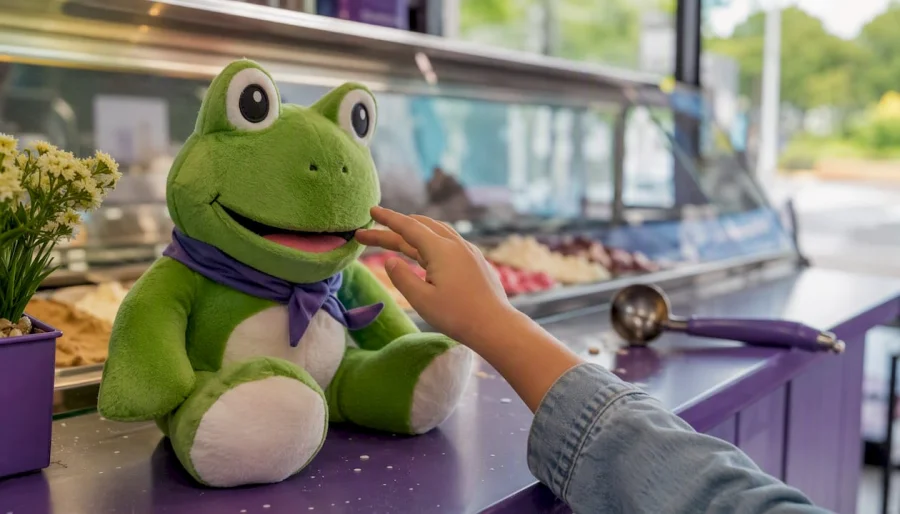
Żappka app: missions and weekly resets
Independent qualitative research on the Żappka app found that missions, progress cues, and weekly resets increase repeat interactions and emotional engagement when combined with a strong brand personality. The weekly reset mechanic is particularly instructive: it gives lapsed users a clean re-entry point every seven days, reducing the psychological cost of returning after a missed week.
Retail app gamification: sustainability and retail media
IGD’s retail analysis documents how Central-European and broader European retailers showcased at NRF 2026 are using gamification for sustainability missions (earn badges for choosing lower-carbon products) and retail media (sponsored missions tied to brand partners). This is a significant expansion of what loyalty gamification can do commercially: the programme becomes a revenue-generating media channel, not just a cost centre.
Coalition and airline programmes: Miles & More
Miles & More, the Lufthansa Group’s frequent-flyer programme with strong penetration across Central Europe (Germany, Austria, Switzerland, Poland, Czech Republic), uses tier-based gamification at scale. The tier structure (Member, Senator, HON Circle) creates a long-term retention mechanic where status maintenance drives repeat behaviour across a coalition of partners. The lesson for smaller programmes is that tier mechanics work best when the gap between tiers is achievable within a realistic timeframe and when the benefits at each tier are genuinely differentiated.
Actionable lessons from the regional evidence:
- Connect digital mechanics to physical in-store behaviour. The Froggu case shows that the strongest engagement comes when earning and spending loyalty currency requires a store visit.
- Use weekly resets to reduce re-entry friction for lapsed members.
- Design tier gaps that are achievable within 60–90 days for your median customer, not your top 5%.
- Consider sustainability missions as a low-cost, high-differentiation mechanic for grocery and convenience retail.
- Track loyalty coin or currency usage as a leading indicator of programme health, not just redemption.
For customer retention strategies that complement these mechanics, the same principles of frequency and habit formation apply across sectors.
Who needs to be in the room to make gamification work?
Gamification in loyalty programmes fails most often not because of bad mechanics but because of unclear ownership. The following roles are the minimum viable team for a pilot.
Programme owner (marketing lead): sets the objective, owns the hypothesis, and is accountable for commercial outcomes. This person decides which mechanic to test and signs off on reward economics.
Product or platform manager: configures the mechanics in the loyalty platform, manages the integration with CRM and EPOS, and owns the technical delivery timeline. In smaller businesses, this role is often shared with the marketing lead.
Data or analytics lead: designs the A/B test, monitors pilot metrics in real time, and produces the evaluation report. Without this role, you cannot distinguish genuine behavioural change from novelty bias.
Legal or compliance contact: reviews GDPR consent flows, data retention policies, and any promotional mechanic that may trigger consumer protection rules in your market. In Central Europe, this is particularly relevant for instant-win mechanics, which may be classified as a lottery in some jurisdictions.
Creative lead: produces mission copy, badge artwork, push notification text, and any character or narrative assets. Gamification is a content-intensive discipline: a programme that launches with placeholder copy and generic badge icons will underperform.
For larger organisations, a dedicated LiveOps manager who owns the content calendar and weekly refresh cadence is worth adding from the outset. For SMEs, the marketing lead often absorbs this role, but the calendar itself must still exist.
How should you segment customers for gamified mechanics?
Not every customer responds to gamification in the same way, and sending the same mission to your entire member base is one of the most common design mistakes.
A practical segmentation approach for gamified loyalty starts with three dimensions: recency, frequency, and spend tier. These give you four actionable cohorts.
High-frequency, high-spend customers are your most valuable segment. They are already engaged, so the risk of over-rewarding them is real. Use tier mechanics and exclusive badge collections to deepen emotional connection without eroding margin. Personalised missions tied to their specific product preferences work well here.
High-frequency, lower-spend customers visit often but spend less per visit. Missions that encourage basket expansion (try a product from a new category, spend above a threshold to unlock a bonus) are the right mechanic. AOV is the primary KPI for this cohort.
Low-frequency, high-spend customers are infrequent but valuable when they do visit. Streak mechanics and time-limited challenges (complete three visits this month) are effective for increasing visit frequency without requiring a permanent behaviour change.
Lapsed customers (no visit in 60–90 days) need a re-entry mechanic, not a complex mission. A surprise reward or a simple “welcome back” instant win lowers the psychological barrier to returning. Weekly resets, as seen in the Żappka case, serve this function at scale.
Local research on Central-European consumer behaviour notes that consumers in this region often respond well to instant gratification mechanics and tactile interactions (scratch, shake) that feel physically satisfying and link directly to in-store behaviour. This is a useful design signal when choosing between a progress-bar mechanic and an instant-win mechanic for re-engagement campaigns.
For luxury or premium segments, personalised, high-value reward strategies that emphasise exclusivity and recognition tend to outperform generic points accumulation, regardless of the gamification mechanic layered on top.
A pragmatic view on where most programmes go wrong
The most common mistake is treating gamification as a feature launch rather than a behavioural design discipline. A business adds a badge system or a mission set, sees a spike in engagement for three weeks, and then watches participation collapse because nobody refreshed the content or adjusted the reward economics.
The second mistake is skipping segmentation. A single mission sent to your entire member base will be too easy for your top customers and too hard for your occasional visitors. Neither group will find it motivating.
The third, and perhaps the most underappreciated, is the gap between programme membership and emotional connection that Mando/YouGov’s research documents across European markets. Membership numbers look good in a board presentation. Emotional connection is what drives the behaviour change that actually shows up in revenue. Gamification is one of the few mechanics that can move both simultaneously, but only if it is designed around the customer’s experience rather than the business’s convenience.
My practical advice for a marketing lead starting today: pick one mechanic, one segment, and one objective. Run it for 60 days. Measure it properly. Then decide whether to scale, adjust, or replace it. The programmes that compound over time are built on that discipline, not on the sophistication of the initial launch.
Bonusqr gives you a faster path from pilot to live programme
If the roadmap above looks right but the build timeline feels daunting, Bonusqr is worth a close look. The platform is built for exactly the kind of modular, test-and-learn approach this guide recommends: you can configure stamp cards, points mechanics, missions, coupon management, and push notifications without touching your POS system or waiting for a development sprint.
Relevant capabilities for a gamification pilot include visit-based rewards, digital stamp cards, tiered cashback, onboarding promos, real-time analytics, and Apple/Google Wallet support. For businesses that want a fully branded experience, Bonusqr also offers white-label loyalty apps with custom branding and e-shop integration.
A typical pilot path runs 30–90 days: configure one mechanic in week one, launch to a test segment in week two, review participation and frequency data at day 30, and make a scale or adjust decision at day 60. The Bonusqr loyalty platform supports each of these stages without requiring a long-term contract commitment at the outset. Start your pilot by registering at Bonusqr.