The best white label loyalty app for a small or mid-sized business is the one that puts your name and colors on the customer’s phone without a six-figure budget or a developer on staff. For most owners that means a platform with a flat monthly fee and a one-off setup cost, not an enterprise contract priced per month in the thousands. Below we compare the realistic routes, show what each costs where prices are public, and explain where BonusQR fits.
Key takeaways
- A white label loyalty app is a ready-made loyalty engine (points, stamps, cashback) released under your brand. You skip the build and keep the customer relationship.
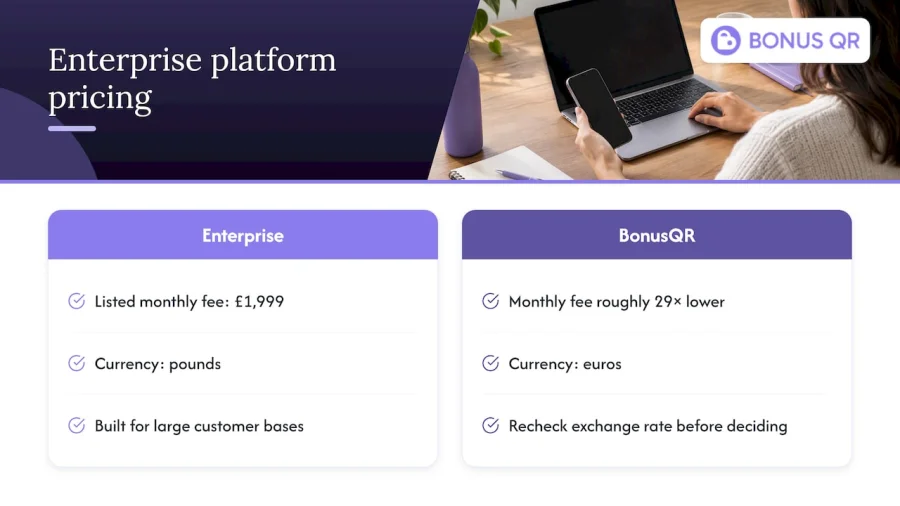
- Enterprise platforms exist, but one well-known option starts at £1,999 per month and is aimed at data-driven programs rather than simple stamp-card schemes. That is rarely the right size for a café, gym or shop.
- BonusQR offers a branded app for a 690 EUR one-off setup plus 69 EUR per month, with no POS integration required.
- Before you pay for a branded app, test your program on a lower tier. A free or 19 EUR per month plan shows whether your customers actually collect rewards.
- Choose on five criteria: total first-year cost, setup time, POS dependency, wallet and app support, and who owns your customer data.
What a white label loyalty app actually is
White label means the software is built and maintained by a vendor, while the customer sees only your brand. Your logo is on the app icon or the web app, your colors fill the screens, and the rewards belong to your business. The vendor keeps the servers, updates and reward logic running behind the scenes.
That differs from two neighbors that people often confuse with it:
- Shared-brand loyalty apps. Customers collect rewards inside a vendor’s app next to other merchants. Setup is fast, but your brand is a tile in someone else’s product.
- Custom-built apps. A developer designs everything from scratch. You get full control, and you pay for it in budget, time and ongoing maintenance.
A white label app sits in the middle: your brand, a proven engine, a predictable bill. For small businesses, that middle position is usually where the best return sits, because the value of loyalty comes from repeat visits, not from owning source code.
Why branded loyalty is worth the effort
Repeat customers are the lifeblood of a small business, and a branded app gives them a reason to come back and a place that carries your name. The evidence from local service businesses is encouraging, with one caveat: the study is small.
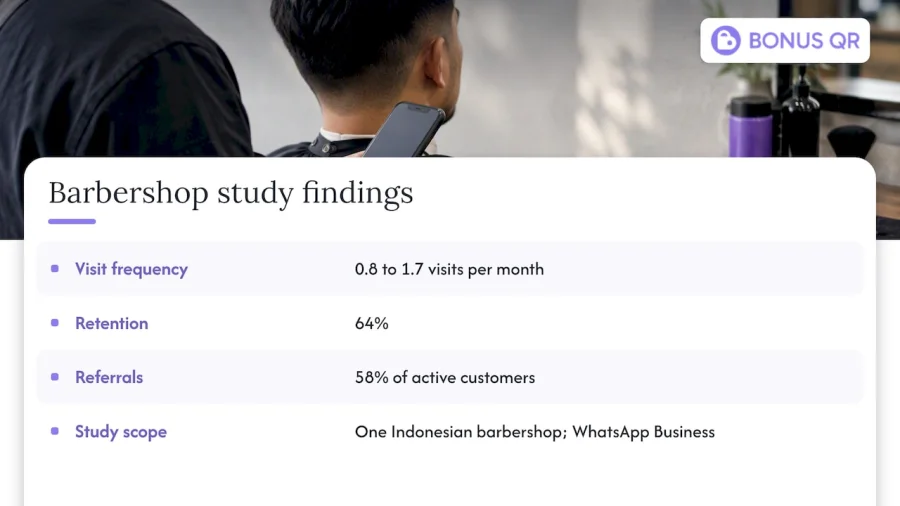
A 2025 study of a digital membership system at a single barbershop in Indonesia reported visit frequency rising from 0.8 to 1.7 times per month, with a 64% retention rate and 58% of active customers taking part in referrals. It covered one shop and used WhatsApp Business rather than a loyalty app, so treat it as a signal and not a promise. It does show what a simple, trackable membership can do for a local business, and the same logic applies to stamps and points.
If you want the retention side explained from the shop floor, this piece on client retention for a barbershop shows how repeat visits shape a service business. For the broader theory, relationship marketing strategies cover how to keep customers engaged after the first purchase.
The criteria that matter when comparing
Most comparison pages rank apps by feature count. A small business owner should rank them by what the app costs and demands. Use these five criteria.
- First-year cost. Add setup fees, the monthly subscription times twelve, and any maintenance. A low monthly price with a large setup fee can cost more in year one than a mid-priced plan.
- Time to launch. Can you print a QR code and start collecting stamps this week, or does an integration project come first?
- POS dependency. Many loyalty tools require a compatible point-of-sale system. If yours is a basic till, a tablet or no system at all, that can rule options out.
- Wallet and app support. Customers prefer to avoid downloading yet another app. Apple Wallet and Google Wallet passes, plus a web app, reduce that friction.
- Data ownership and insight. You should see who visits, how often, and which rewards work, and you should be able to message them with push or email.
The main options compared
The table below groups the realistic options by type. Prices are shown only where we can state them from published pages.
| Option | Best for | Published pricing | POS needed? | Branding level |
|---|---|---|---|---|
| BonusQR white-label app | Small and mid-sized businesses that want their own branded app | 690 EUR one-off setup, 69 EUR per month | No | Your brand on the app, with wallet support |
| BonusQR Free, Basic, Premium | Testing a loyalty program before branding it | Free; 19 EUR per month; 69 EUR per month | No | BonusQR platform with brand customization |
| Enterprise white label platform | High-growth startups and large programs with in-house developers | From £1,999 per month | Varies by integration | Full API-level control |
| Wallet-pass tools | Businesses with someone technical who can design the passes | Usage-based, see vendor | No | Apple and Google Wallet passes |
| Custom app development | Businesses with unusual requirements | BonusQR custom work: from 1500 EUR one-off | No | Fully bespoke |
We have left out ratings on purpose. Review scores on aggregator sites mix companies of very different sizes, and a 4.8 for an enterprise suite says little about whether a corner café can use it.
BonusQR: branded app without the enterprise bill
BonusQR is a QR-based loyalty platform built for small businesses. Customers scan a code to earn points, stamps or cashback, and the business does not need to connect a POS system. The platform handles reward distribution, customer insights and promotional notifications automatically, so staff do not manage a spreadsheet of who is owed a free coffee.
On the white-label route you get your own branded app. The white-label plan is a 690 EUR one-off setup fee and a monthly subscription of 69 EUR. Under that sits a ladder you can climb gradually: a Free plan, Basic at 19 EUR per month and Premium at 69 EUR per month, all listed on the pricing page.
What the platform covers:
- Digital stamp cards, points systems, tiered cashback and fixed discounts
- Onboarding promos and special occasion rewards, such as birthdays
- Coupon and reward management
- Push and email notifications and automated marketing
- Referral and review modules
- Analytics on customer behavior
- Apple Wallet and Google Wallet support
- Brand and app customization, mobile and web app integration
- Optional e-shop and booking widget features on branded and custom apps
Pros
- Fast setup with no POS requirement
- Several loyalty mechanics in one tool, so you can change the program without changing vendor
- A clear path from free test to branded app to custom build
- Prices published on the site
Cons
- The branded app carries a setup fee, so the white-label route suits businesses already sure they want a loyalty program
- Businesses needing deep custom integrations will want the custom development tier
Enterprise white label platforms
These are API-first platforms built for companies with developers and large customer bases. One widely listed example is White Label Loyalty. Its own listing describes a loyalty engine with campaign management, segmentation, fraud detection and API access, and pricing begins at £1,999 per month. The same listing notes it is aimed at data-driven loyalty programs rather than small businesses or simple stamp-card schemes.
That is an honest fit for a retail chain or a fintech. For a three-location coffee business it is more engine than you need, and the monthly fee alone would be roughly 29 times a BonusQR white-label subscription at current figures, before currency differences. Be aware the currencies differ (pounds and euros), so compare on the day you decide.
Wallet-pass tools
Some vendors, PassKit among them, specialize in the wallet layer: loyalty cards that live in Apple Wallet and Google Wallet. These are strong when you want a lightweight pass and have someone comfortable configuring templates, certificates and automation. Pricing is usage-based, so the bill moves with the number of active passes, which makes budgeting harder for a small business. If you want the wallet convenience plus stamps, points, referral and review tools in one place, an all-in-one platform with wallet support saves assembly work.
Digital loyalty card apps
Search results for this topic also surface digital stamp-card apps such as Loyally.ai and Clavaa, which offer automatic rewards and customer management. They are worth a look if all you need is a replacement for paper punch cards. If you want your own branded app, ask each vendor three questions: is the app under my name in the store or a web app, who owns the customer list, and what happens to my data if I leave?
Building a custom app
A fully custom build makes sense when your needs are unusual: a particular booking flow, a unique reward mechanic, or integration with software only you use. BonusQR offers custom app development from 1500 EUR one-off, with monthly maintenance from 69 EUR per month. For most small businesses, a white-label app covers 90% of the need at a fraction of the effort, but it is useful to know the upgrade path exists.
What the first year costs
Total first-year cost is the number that surprises owners most. Here is the arithmetic on BonusQR’s published prices, with no discounts or taxes assumed.
| Route | Setup | Monthly | First-year total |
|---|---|---|---|
| Free plan | None published | None published | No published price |
| Basic | None | 19 EUR | 228 EUR |
| Premium | None | 69 EUR | 828 EUR |
| White-label app | 690 EUR | 69 EUR | 1,518 EUR |
| Custom app | From 1500 EUR | From 69 EUR | From 2,328 EUR |
Those totals come from multiplying the listed monthly fee by twelve and adding the one-off fee. Check the current pages before budgeting, since plans can change.
For a sense of value, a white-label app at 1,518 EUR in year one pays for itself when the extra repeat visits it generates cover that sum. If your average ticket is 12 EUR and the margin is half, you need roughly 253 extra visits across the year, or about five a week. That is a budgeting example, not a forecast: plug in your own ticket and margin.
How to decide: a simple path
- Start with the mechanic, not the app. Decide whether stamps, points or cashback suits how your customers buy. A café with daily visits suits stamps. A salon with fewer, pricier visits suits points or tiered cashback. Our guide to loyalty program ideas for small businesses can help you choose.
- Run a test on a lower tier. Launch on the Free or Basic plan for a month or two. Watch enrollment, repeat rate and redemption.
- Move to a branded app when the program works. Once customers are collecting rewards, the branded app builds on that habit. Your brand becomes the product, and you can use loyalty program branding to keep colors, tone and rewards consistent.
- Automate the follow-up. Set up welcome offers, birthday rewards and win-back notifications so the system works while you serve customers. Our customer retention workflow walks through the sequence.
- Review the numbers monthly. Track visit frequency, redemption rate and which rewards drive repeat purchases, then adjust.
Who needs a white-label app, and who does not
A white-label app suits you if:
- You run several locations or a growing brand and want customers to associate the app with you
- You want an app-store or home-screen presence rather than a shared loyalty tile
- You sell directly and want an e-shop or booking widget connected to the loyalty experience
- You already have regulars and want to deepen the relationship
You can wait if:
- You are still testing whether customers will collect stamps at all
- You have a single small counter and a QR code on the till does the job
- Your budget is tight, in which case start with the Free or Basic plan
Industries differ too. Restaurants and cafés benefit from frequent, low-value visits and reward mechanics that favor streaks. Gyms and wellness centers gain from membership perks and referrals. Hotels and gas stations tend to value tiered rewards and cashback, because the visit pattern is irregular. For a food-service angle, see our restaurant customer retention strategies.
Our perspective
We built BonusQR because small businesses were being sold one of two things: a paper card that tells you nothing, or an enterprise platform that assumes a technical team. Neither helps the owner who wants more regulars by next month.
Our view is that loyalty software should earn its place gradually. Begin with a QR code, a clear reward and a free or low-cost plan. Learn what your customers respond to. Then, if the program is working, put your own brand on it. A branded app is a reward for a program that already works, not a substitute for one.
We also think the most important feature is the one that removes work. When the system handles reward distribution, notifications and reporting, the owner can stay on the floor. That is why we focus on automation and on avoiding POS dependencies, which are often the thing that delays a launch by weeks.
Whatever vendor you pick, ask for the full first-year cost in writing and ask who owns your customer data. Those two answers tell you most of what you need to know.
— Michal Palus
Launch your branded loyalty app with BonusQR
If you are ready for your own branded app, the white-label plan combines a 690 EUR one-off setup with a 69 EUR monthly subscription. If you would rather test first, start on the Free plan or move up to Basic or Premium, then upgrade when your customers are collecting rewards. You can read more about the platform at bonusqr.com.
Common mistakes to avoid
- Buying the app before the program. A beautiful app with a weak reward gives customers no reason to return. Settle the reward first.
- Making the reward too distant. If it takes 15 visits to earn something, many customers quit at visit four. Aim for a first reward within a few visits.
- Ignoring staff. The program works only if the team mentions it at the counter. A thirty-second script is enough.
- Skipping measurement. Without a baseline of repeat visits before launch, you cannot show the program works.
- Ignoring the platform comparison fine print. Check cancellation terms, data export and per-user or per-pass charges before you sign. For more on choosing software, see our loyalty program software guide for small business.
FAQ
Can I buy a white label app?
Yes. Vendors sell ready-made apps that you launch under your own brand, usually for a setup fee and a monthly subscription. With BonusQR, the setup is 690 EUR one-off and the subscription is 69 EUR per month, as listed on the white-label page.
Is there a free punch card app available?
Yes, several vendors offer free tiers, and BonusQR has a Free plan for digital stamp cards and loyalty basics. Free plans are best for testing whether customers use the program. Check the current limits on the pricing page before you rely on one.
What is the difference between a white label loyalty platform and a loyalty app?
The platform is the engine: rules, rewards, analytics and messaging. The app is what customers see on their phone. A white label platform lets you present both under your brand, so customers see your name and not the vendor’s.
Do I need a POS system for a loyalty app?
Not always. Some loyalty tools depend on POS integration, while QR-based systems such as BonusQR let customers scan a code to earn rewards without any additional POS system. If you have a POS and want deep integration, ask each vendor what it supports before you commit.


