The best retail loyalty app is the one your customers will actually use at the register and your team can run without a project plan. For most small and midsize shops, that means fast setup, no new POS hardware, a few flexible reward types (points, stamps, cashback), automated messages, and honest pricing with an easy exit. Below we explain how to judge the options, which trade-offs show up with well-known platforms, and where BonusQR fits.
Key takeaways
- A loyalty app is a finished product with a customer side and an admin side. Loyalty software is the engine behind a program. Many small retailers need the engine with a simple customer front end, not a custom build.
- Judge any platform on setup speed, reward flexibility, automation, analytics, and exit terms. Contract complexity and data-export rules matter as much as features.
- Published reviews of established platforms flag hidden fees, complex contracts and thin support after onboarding. Ask about all three before you sign.
- BonusQR works without a POS, starts with a free plan, and scales from 19 EUR per month to white-label and custom apps.
What a retail loyalty app is, and how it differs from loyalty software
The two terms get used interchangeably, and search results mix them. There is a useful distinction. Relia Software separates a loyalty app, a complete product with a customer-facing app and an admin side, from loyalty software, a ready-made engine that powers a program.
For a small retailer, the practical reading is this:
- Loyalty software handles the rules: how points are earned, when a stamp card completes, which tier a shopper sits in, who gets which message.
- A loyalty app is how shoppers see their balance, scan at the counter and redeem rewards.
- A custom app combines both under your own brand, usually with integrations to a POS, ecommerce store or CRM.
Most independent shops, boutiques, grocery stores and gas stations do not need to commission a custom product to start. They need a platform where the engine and the customer experience arrive together, and where a branded app is an upgrade path rather than a requirement.
What to look for in a retail loyalty app
Retail differs from a coffee counter. Baskets are larger and more varied, visits are less frequent, and shoppers often compare you with an online store. These criteria carry the most weight.
1. Reward models that match how your shoppers buy
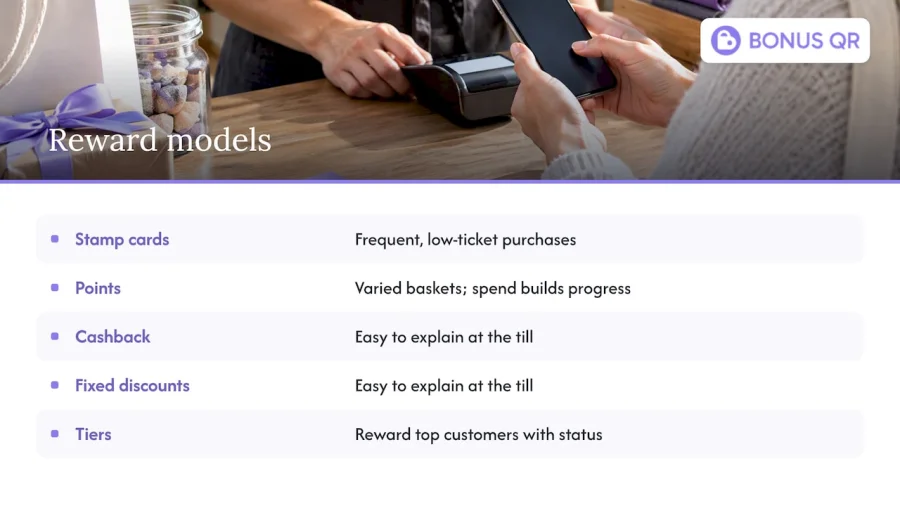
Stamp cards suit frequent, low-ticket purchases. Points suit varied baskets, where spend should translate into progress. Cashback and fixed discounts are easy to explain at the till. Tiers reward your best customers with status. A platform that supports several of these lets you start simple and change the mechanic later without switching vendors. If you want examples of what works in practice, our guide to loyalty program examples that actually grow your business walks through the common models, and hybrid loyalty program models explains how to combine them.
2. Setup that does not depend on your POS
Many loyalty tools assume integration with a specific point-of-sale system. That can mean waiting on a vendor, paying for a connector or changing hardware. A QR-based approach avoids this: the customer scans a code and the reward is recorded without touching your till software. If you already run a POS, deeper integration can still be valuable later, but it should not be the entry ticket.
3. Automation you will actually use
Small teams do not have time to send every birthday offer or win-back message by hand. Look for automated campaigns triggered by behavior: a welcome reward after sign-up, a reminder when a shopper has not visited in a while, a bonus on a special occasion. FiveStars, for example, offers VIP status and multiple tiers, along with automated campaigns that carry special rewards and incentives. That is the kind of capability worth benchmarking against. Our walkthrough on how to automate loyalty campaigns shows the first few automations most shops should switch on.
4. Analytics that change a decision
A dashboard of sign-ups is not insight. You want to see who returns, how often, what a loyalty member is worth compared with a one-time buyer, and which offers drive visits. ITQlick notes that FiveStars provides predictive analytics aimed at reducing churn, and also cautions that generic AI templates can limit true personalization. The lesson applies to any vendor: ask to see exactly what the reports show and whether you can segment on them. For a broader look at churn signals and personalization in loyalty tools, this guide on fostering customer loyalty is a helpful companion.
5. Customer sign-up with minimal friction
Every extra step costs you members. Ask whether shoppers must download an app, create an account, or can join from a QR code and add a pass to their phone wallet. Wallet support matters because shoppers already carry the phone and rarely want another icon on the home screen. Check how the vendor handles consent for email and push messages, and what customer data you can export.
6. Branding and growth path
A shared, vendor-branded app is the quickest start. As the program matures, a retailer may want its own logo, colors and app store presence, plus extras such as an e-shop or booking widget. Check that the upgrade is possible within the same platform and what it costs.
Contracts, fees and support: the questions that separate good from risky
Feature lists look alike. The differences appear after you sign. Published reviews of established platforms point to the same pitfalls:
- Cost transparency. ITQlick reports hidden fees and complex contracts at FiveStars, which undermine clarity on what you will pay.
- Support after onboarding. Reviews of TapMango describe strong setup support followed by silence, with gaps in ongoing integration help.
- Exit costs. The same review advises checking cancellation costs and data-export terms before signing.
- Pricing model. Some providers charge by monthly order volume, others per site, and pricing can depend on customer activity. A low entry price can climb as your program succeeds.
Turn these into a short checklist for every vendor demo:
- What is the total monthly cost at 500, 2,000 and 10,000 members?
- Is there a contract term, and what does cancelling cost?
- Can I export my customer list and reward balances in a standard format?
- Who answers my questions in month six, and how?
- Which features sit behind a higher tier or an add-on fee?
A vendor that answers these plainly in writing is usually one you can work with.
How the main options compare
We do not publish competitor price lists here, because they change and belong on each provider’s own site. Instead, this comparison frames the categories of option and what each is best at.
| Option type | Typical strength | What to watch | Fits best |
|---|---|---|---|
| POS-native loyalty add-ons | Tight integration with your till | Tied to one POS, so switching systems means rebuilding the program | Shops committed to a single POS |
| Established all-in-one platforms (such as FiveStars or TapMango) | Deep feature sets, VIP tiers, marketing and ordering tools | Contract complexity, fee transparency, support after setup | Multi-location operators with budget for onboarding |
| Wallet-pass tools | Fast, app-free sign-up | Often lighter on analytics and campaign automation | Very simple stamp or points programs |
| E-commerce loyalty plugins | Built into an online store | Less suited to in-store scanning | Mostly online retailers |
| BonusQR | QR-based, no POS required, several reward modules, automation, free entry plan, white-label path | Aimed at small and midsize businesses rather than enterprise IT projects | Independent retailers, grocery, gas stations, cafes, gyms, hotels and service businesses |
If you are currently weighing a specific vendor and want a retail-focused comparison, our piece on alternatives for retail managers seeking customized loyalty programs goes further.
BonusQR: what it does for retailers
BonusQR is a QR-based digital loyalty platform built for small businesses. Customers earn points, stamps or cashback by scanning, and you do not need an additional POS system to run it. The platform handles reward distribution, customer insights and promotional notifications automatically, so owners can stay on the shop floor.
Reward modules
- Digital stamp cards and points systems
- Tiered cashback and fixed discounts
- Onboarding promotions and special occasion rewards
- Coupon and reward management
- Referral and review modules
Marketing and insight
- Automated marketing with push and email notifications
- Analytics that track customer behavior so you can refine offers
- Brand and app customization, mobile and web app integration, and Apple and Google Wallet support
The design goal is flexible, scalable loyalty management without technical complexity. Because the platform is cloud-based, there is nothing to install. Our guide to cloud-based loyalty platforms explains what that means for day-to-day operation.
BonusQR pricing
Prices as published on our site:
| Plan | Price | Best for |
|---|---|---|
| Free | No published price | Testing a first stamp or points program |
| Basic | 19 EUR per month | A single shop that wants a working program with core modules |
| Premium | 69 EUR per month | Retailers that want the full automation and analytics toolset |
| White-label Setup | 690 EUR one-off | A branded app under your own name |
| White-label Monthly Subscription | 69 EUR per month | Ongoing access for the branded app |
| Custom App Development | From 1500 EUR one-off | Bespoke features, an e-shop or booking widget |
| Custom App Monthly Maintenance | From 69 EUR per month | Updates and support for a custom app |
See the current details on the pricing page, the white-label page and the custom app page.
Which setup fits which retailer
A neighborhood boutique or specialty shop. You want repeat purchases and a way to tell regulars about new arrivals. Start on the free or Basic plan with a points or cashback program, and add a welcome reward for new sign-ups.
A grocery store or gas station. Visits are frequent and margins thin. A simple stamp or fixed-discount mechanic is easy to explain at the till, and tiers reward your heaviest users. Scanning without POS changes keeps rollout fast.
A retailer with several staff and a growing list. Move to Premium for automation and analytics. Set up win-back messages, occasion rewards and review requests, then watch which ones lift return visits. Our customer retention workflow gives a structure to follow.
A brand with a following. If shoppers already identify with your name, a white-label app puts your logo on their home screen. Custom development makes sense when you need an e-shop or booking widget integrated into the loyalty experience. As Relia Software describes, a custom loyalty app is scoped around program rules and connections to POS, ecommerce or CRM, then designed, built, tested and launched, so budget time for that process.
Launching in a week: a practical sequence
- Pick one mechanic. Points for varied baskets, stamps for repeat low-ticket items.
- Set a reward customers can reach quickly. The first reward should arrive within a few visits.
- Place the QR code where the purchase happens. At the counter, on receipts and on bags.
- Train staff in one sentence. They should be able to say what the program gives and how to join.
- Switch on a welcome offer and one automation. Then review the numbers after a month.
- Adjust. Change thresholds and rewards based on what the analytics show.
For retention beyond the program itself, the link between service quality and returning customers is covered in customer satisfaction and customer retention, and engagement ideas for retail adds tactics for the shop floor.
Our perspective
We built BonusQR because repeat customers are the lifeblood of a small business, and the tools for keeping them were either too expensive, too technical or dependent on hardware that owners did not want to replace. Our view is that a loyalty program should be boring to run. The owner chooses the reward, the system records scans, sends the messages and reports what worked.
We also think the first version should be small. A free plan and a simple stamp or points rule teach you more about your customers in a month than a long vendor evaluation. When the program earns its place, you can add automation, a branded app or custom features without starting over. And whichever platform you choose, read the cancellation and data-export terms first. Your customer list is your asset, and you should be able to take it with you.
— Michal Palus
Try it on your own counter
If you want a retail loyalty program running without new hardware, you can start on the free plan and move up when you need automation, analytics or your own branded app. Compare the plans on the BonusQR pricing page or see more about us at bonusqr.com.
FAQ
What is the best retail loyalty app for a small shop?
The best fit is a platform your customers can join in seconds, that needs no new POS, and that offers more than one reward type. Look for automated campaigns, usable analytics and clear exit terms. BonusQR is built around those needs, starting with a free plan.
What is the difference between retail loyalty software and a loyalty app?
Software is the engine that runs rules, rewards and campaigns. An app is the complete product, with the customer-facing side and the admin side, as Relia Software describes. Many platforms bundle both, so you get the engine and a ready customer experience together.
Do customers need to download an app?
Not necessarily. With a QR-based platform, shoppers can scan a code to join, and Apple or Google Wallet support lets them keep their card on the phone without a separate download. A branded app is optional for retailers who want one.
How much does a retail loyalty app cost?
It depends on the model. Some providers charge by order volume, others per site, and cost can follow customer activity. BonusQR publishes its prices: Free, 19 EUR per month for Basic and 69 EUR per month for Premium, with white-label and custom options priced separately.
What should I check before signing a contract?
Ask about hidden fees, minimum terms, cancellation costs, data export and the level of support after onboarding. ITQlick flags contract complexity and hidden fees as issues at one major platform, so get answers in writing.


