Best Pharmacy Loyalty Apps for Independent Pharmacies in 2026
The best pharmacy loyalty app for an independent or small-chain pharmacy is one you can launch without replacing your register, that rewards front-store purchases, and that costs a flat monthly fee rather than a fee per user. On that test, BonusQR is our pick: it is a QR-based loyalty platform where customers collect points, stamps or cashback without any POS integration, and it starts with a Free plan. Below we compare it with the other kinds of options a pharmacy owner meets, show what the big pharmacy programs teach, and walk through what to check before you launch.
A note on scope. This guide is for pharmacy owners and managers who want to build their own customer rewards program. It is not about prescription discount cards or price-comparison apps that help patients find cheaper drugs. Those serve a different reader.
Key Takeaways
- A pharmacy loyalty app works best when it rewards front-store spending (vitamins, skincare, baby care, household goods) and keeps prescriptions out of the earning rules.
- QR-based apps like BonusQR need no POS integration, so a pharmacy can go live the same day it designs its rewards. The Free plan costs nothing, and paid plans run €19 or €69 per month.
- Per-user pricing, such as the RepeatRewards tiers listed on GetApp, grows with every terminal and employee. Flat plans are easier to budget for a small team.
- Chain programs such as Rexall Be Well and McCabes Plus show the mechanics worth copying: simple earn rates, a clear redemption value and a coupon scanned at checkout.
- Before launch, settle the legal limits on prescription rewards with a healthcare attorney, then measure repeat visits, not just sign-ups.
What a pharmacy loyalty app actually does
A pharmacy loyalty app gives customers a digital card on their phone. Each qualifying purchase adds points, a stamp or cashback. When the balance reaches a threshold, the customer redeems a reward at the counter. For the pharmacy, the app also records who comes back, how often and what they buy, which lets you send offers to the right people.
The mechanics are easy to see in the programs run by large pharmacy chains. In Canada, Rexall’s Be Well program pays 10 points per dollar spent, and every 25,000 points equals $10 in redeemable value. Customers show a physical or digital card at the register or redeem online. That works out to a return of about 0.4%, which tells you something useful: pharmacy rewards are small, steady and based on habit, not on big discounts.
In Ireland, McCabes Pharmacy’s app earns 1 point per euro spent on eligible in-person products. Prescription medication, dispensing services and online-store purchases earn nothing. Customers turn points into a product-specific coupon inside the app and scan its QR code at checkout. The coupon cannot be exchanged for cash.
Two lessons carry straight over to a small pharmacy:
- Reward the shelf, not the prescription. Both programs keep their earning rules on retail purchases.
- Use a scannable redemption. A QR code at checkout means staff do not have to calculate anything by hand.
How we compared the options
An independent pharmacy does not need the same tool as a national chain. We judged each option on the criteria that matter to an owner with one to ten locations:
- Setup speed. Can you launch without new hardware or a POS integration?
- Reward flexibility. Points, stamps and cashback, and the ability to decide which purchases earn.
- Pricing model. Flat monthly fees or per-user fees, and what is free.
- Marketing tools. Notifications, referrals, reviews and reporting that show whether customers return.
- Branding. Whether the app carries your pharmacy’s name and look.
Pharmacy loyalty apps compared
| Option | Best for | Pricing | Setup | Reward types |
|---|---|---|---|---|
| BonusQR | Independent pharmacies and small chains that want to launch fast | Free plan; Basic €19 per month; Premium €69 per month; white-label app €690 one-off setup plus €69 per month | QR-based, no POS required | Points, stamps, cashback, fixed discounts, coupons |
| RepeatRewards | Pharmacies that want a terminal-based program | Listed on GetApp at $69, $89 and $109 per user tiers | Terminal and POS integration on the top tier | Points and campaigns |
| hello again style bonus club | A single independent pharmacy that wants a simple app | Free to the customer; pharmacy terms vary | Customer scans receipts or refers friends | Points redeemed for vouchers and gifts |
| Chain programs (Rexall, McCabes) | Learning what customers expect | Not available to other businesses | Built on the chain’s own systems | Points to coupons or dollar value |
1. BonusQR: our pick for independent pharmacies
BonusQR is a SaaS loyalty platform built for small and medium-sized businesses, and a pharmacy’s front store fits that profile. Customers scan a QR code to join and earn, so you do not need an additional POS system or an integration project. That is the difference between launching this week and launching next quarter.
What you get:
- Several reward types in one place. Digital stamp cards, points systems, tiered cashback, fixed discounts, onboarding promos and special-occasion rewards. A pharmacy can reward a new customer’s first visit, a birthday or a basket of wellness products.
- Automated marketing. Push and email notifications go out through the system, so staff are not sending messages by hand.
- Referral and review modules. Customers who like the pharmacy can bring in neighbors and leave reviews.
- Analytics. The platform tracks customer behavior so you can see what brings people back.
- Wallet support and customization. Apple and Google Wallet support, plus brand and app customization.
Pricing. The Free, Basic and Premium plans cover most pharmacies. Basic is €19 per month and Premium is €69 per month. A pharmacy group that wants its own branded app can choose the white-label option: €690 one-off setup plus €69 per month. A pharmacy with a very specific idea can ask about custom app development, which starts from €1,500 one-off, with monthly maintenance from €69.
Best for: owners who want a working program quickly, who like flat monthly pricing, and who want the option to grow into a branded app. It is also the natural choice for any pharmacy that wants to start free and add features as the program proves itself.
2. RepeatRewards: a terminal-based program priced per user
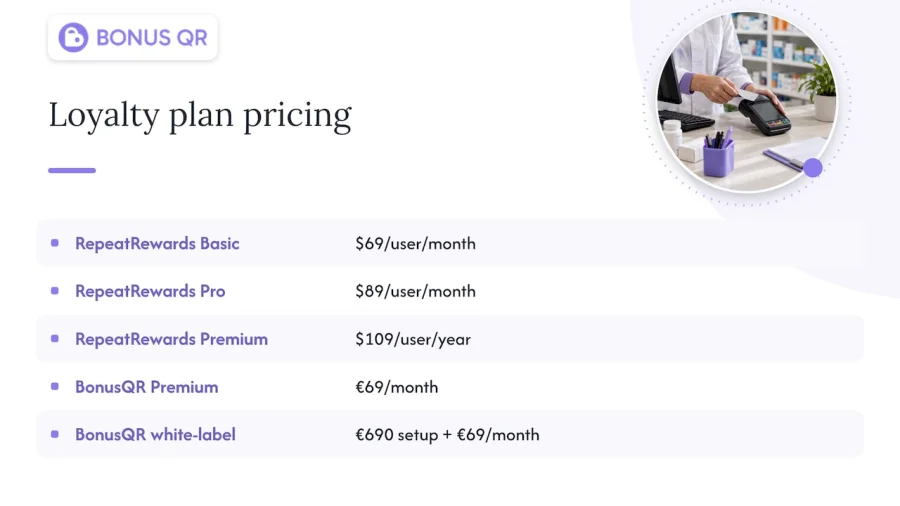
RepeatRewards is a loyalty system that serves pharmacies among other retail sectors. GetApp lists Basic at $69 per user per month, Pro at $89 per user per month and Premium at $109 per user per year. Pro adds campaigns, text messaging and an online enrollment template. Premium adds a terminal, a branded mobile app and POS integration.
The structure shows where per-user pricing matters. A pharmacy with a pharmacist, two technicians and two cashiers is paying for several seats, and the cost rises as staff are added. A flat plan such as BonusQR’s Premium at €69 per month does not change with headcount. Branded-app and POS features sit in the highest tier of that listing, whereas a BonusQR white-label app is available as a clearly priced setup and monthly fee.
3. Bonus-club apps for a single pharmacy
Some European independents run a simple bonus club on a shared app platform. Apotheke Graz in Austria, for example, uses a digital loyalty app from hello again. According to its Google Play listing, customers collect points by scanning receipts or referring friends, redeem them for vouchers, gifts and discounts, and receive push notifications about limited-time offers.
This model proves that customers will scan a receipt or refer a friend for a modest reward. It is the same mix of tools BonusQR offers through its points, referral and notification features, with the addition of stamps, cashback tiers, reviews and analytics in a single dashboard.
4. Chain programs as a benchmark
Rexall Be Well and McCabes Plus are not products you can buy. They matter because they set what customers expect: a card or app on the phone, points on every eligible purchase, a clear redemption value and a coupon that scans at checkout. Build your program to that standard and a customer who has used a chain app will understand yours instantly.
Why a no-POS, QR-based app suits a pharmacy
A pharmacy’s register is usually tied to the dispensing system, and swapping it or adding integrations is slow and expensive. A QR-based loyalty app sidesteps that problem. The customer scans a code at the counter, the purchase is recorded and the reward balance updates. Nothing in your dispensing workflow changes.
Three practical advantages follow:
- Speed. You can design the program, print the QR code for the counter and start enrolling customers the same day.
- Lower cost. There is no terminal to buy and no integration fee to negotiate.
- Less training. Staff learn one action: ask the customer to scan.
If you want to see how the retail side of this works in more detail, our guide to the best retail loyalty app for small businesses covers the same logic for shops, and our comparison of customer reward systems for small retail stores lines up the reward types side by side.
Designing rewards that work in a pharmacy
The app is only the delivery vehicle. The program decides whether customers come back. These choices matter most.
Pick the earning base
Follow the chain examples and reward front-store spending. Wellness products, vitamins, skincare, sun care, baby items and household goods are discretionary and repeat-purchase categories. A simple rate, such as one point per dollar, is easy for customers to remember. Our guide to a points reward system that actually works explains how to choose a rate and a redemption threshold.
Choose points, stamps or cashback
- Points suit a wide range of basket sizes. A customer buying a $9 lip balm and one buying a $60 supplement order both progress.
- Stamps suit a repeated, low-ticket purchase, for example a stamp for each visit to the vaccine or health-check desk if you charge for it, or for a monthly vitamin refill.
- Tiered cashback rewards your best customers and encourages a larger basket.
BonusQR supports all three, so you can start with one and add another later without changing platforms. If you want more background on the card format, read our digital loyalty card guide.
Add occasion-based rewards
Onboarding promos for a first scan, birthday rewards and a referral bonus give customers a reason to join and a reason to return. Pharmacies have an advantage here: customers visit for seasonal needs such as cold and flu season, allergy season and sun care, so a notification timed to the season arrives when it is useful.
Automate the follow-up
A loyalty program that depends on staff remembering to send messages will fade. Automated notifications and campaigns keep it running. The case for automating loyalty campaigns lays out how automated triggers support repeat purchases.
What to check before you launch
1. Settle the prescription rules first
This is the one check that is specific to pharmacy. Rules on rewards connected to prescriptions, especially for patients covered by federal programs such as Medicare and Medicaid, and state pharmacy rules can differ from ordinary retail rules. Privacy law also governs prescription data. The safe design, and the one the chain examples follow, is to earn on front-store purchases and keep prescriptions and dispensing services out of the earning and redemption rules, as McCabes does in its terms. Before launch, have a healthcare attorney or your state pharmacy association review your program terms for your state.
2. Keep health data out of the loyalty system
Collect only what a rewards program needs: a name or nickname, a phone number or email, and consent to receive messages. Do not link loyalty profiles to what a customer picks up at the dispensing counter.
3. Confirm what staff must do at the counter
The best program adds one step at checkout and nothing else. Run through a typical transaction with your team, including the busy 5 p.m. line, before you go live.
4. Plan how you will enroll customers
Put the QR code at the counter, on shopping bags and on receipts. Tell customers about the first reward as they pay. Enrollment at the moment of purchase beats any flyer.
5. Decide what success looks like
Track the share of transactions that come from members, the number of repeat visits per member per month and the redemption rate. Sign-ups alone say little. For ideas on engagement beyond the register, see our customer engagement guide for retail.
6. Think about how the app connects to payments
If you later add online ordering or a pharmacy web shop, the way payments connect to your site affects how rewards can be redeemed. A guide to online payment integration explains the basics of adding payments to a website. Starting with a QR-based program leaves you free to decide that later.
A simple 30-day launch plan
- Week 1: design. Choose the earning base, the rate and the first reward. Keep it to one reward type.
- Week 2: set up. Create your program in BonusQR, add your branding and print the counter QR code.
- Week 3: soft launch. Enroll regulars and ask staff to mention the program at every sale.
- Week 4: first campaign. Send a notification tied to the season and review which offers drew people back.
The discipline here comes from the customer-loyalty basics. A step-by-step approach to foster customer loyalty step by step emphasizes the same sequence of simple offers, consistent contact and measurement.
Perspective
Most pharmacy owners we talk to about loyalty share the same worry: a program sounds like a technology project, and the pharmacy already has enough of those. We built BonusQR to remove that worry. Customers scan a QR code, rewards are tracked, and nothing needs to be wired into the register.
We believe a small business should be able to start for nothing and grow into more only when the program earns it. That is why there is a Free plan, why Basic is €19 per month and why Premium is €69 per month, with analytics, automated marketing and review tools among the modules that help you see which customers return and why.
Pharmacies are a trust business. A loyalty program should feel like a thank-you from the people who know a customer’s name, not like a data-collection exercise. Keep the rewards on the front store, keep them simple and let automation handle the routine messages, so your team can spend their time with patients and customers.
Michal Palus
Start your pharmacy loyalty program
If you want to see how a QR-based program would look under your own pharmacy’s name, start with the BonusQR Free plan. When you are ready for a fully branded app, the white-label option costs €690 one-off for setup plus €69 per month.
FAQ
How do pharmacy loyalty programs work?
Customers join through an app or card and earn points, stamps or cashback on eligible purchases. When they reach a threshold they redeem a reward, such as a coupon scanned at checkout. Chain programs like Rexall’s Be Well and McCabes Plus follow this pattern.
Can a small pharmacy run a loyalty app without new POS hardware?
Yes. A QR-based platform such as BonusQR does not require an additional POS system. Customers scan a code, and the system records the activity and manages the rewards.
Should prescriptions earn loyalty points?
The chain examples keep prescriptions out: McCabes’ terms give no points for prescription medication or dispensing services. Rules on prescription-linked rewards can vary by state and by payer, so have a healthcare attorney review your terms before launch.
How much does a pharmacy loyalty app cost?
It depends on the pricing model. BonusQR has a Free plan, Basic at €19 per month and Premium at €69 per month. Some per-user systems list several price tiers, so check how many staff accounts you would need.
What is the best way to get customers to enroll?
Ask at the moment of purchase and show the first reward on the spot. A QR code at the counter and on bags makes enrollment a ten-second action.


