Best Omnichannel Loyalty Software for 2026: 8 Options Compared
The best omnichannel loyalty software for a small or mid-sized business is the one that lets customers earn and redeem rewards the same way everywhere they buy, without forcing you to replace your register or hire a developer. For most owners of cafes, shops, gyms, salons, hotels and grocery stores, that means BonusQR: a QR-based platform with points, stamps and cashback that needs no POS integration to start, with a free plan and paid plans from €19 per month. Below, we compare it with seven other platforms that regularly appear on shortlists, using published prices and features, so you can match a tool to your size and your channels.
Key Takeaways
- “Omnichannel” means one customer profile and one rewards balance across every place a customer buys: in-store, online, in an app or in a wallet pass. Judge a tool on that, not on the label.
- Many well-known platforms are built around Shopify or a specific POS. If you do not run on that stack, a QR-based platform such as BonusQR gets you live without any POS work.
- Published entry prices range from free to roughly $399 a month, and enterprise tools are quote-only. Per-location pricing can multiply quickly as you add outlets.
- Choose by business type: ecommerce-first brands, restaurants and cafes, and multi-outlet service businesses each need different things from a loyalty engine.
- BonusQR offers a Free plan, Basic at €19 per month and Premium at €69 per month, plus a white-label branded app for businesses that want their own app.
What omnichannel loyalty software actually has to do
A customer who buys a coffee at your counter on Monday and orders a bag of beans from your website on Friday should see one balance, one tier and one set of offers. That is the core of omnichannel loyalty. Software earns the label when it unifies customer data across channels, instead of running a separate program for each.
One review of loyalty tools, Guideflow’s August 2026 comparison, picks tools on four criteria: omnichannel support across POS, ecommerce, app and wallet; integration depth with CRM, marketing automation and the ecommerce stack; analytics that measure retention, redemption and attributable revenue; and pricing clarity. Those are sensible tests for any small business, and we use a similar set below:
- Channel coverage. Can customers earn and redeem in store, online and through a mobile or wallet pass?
- Rewards types. Points, stamps, cashback, tiers, coupons and referrals, ideally combinable.
- Automation. Birthday rewards, win-back messages and push or email notifications that run without daily effort.
- Analytics. Visit frequency, redemption rates and which customers are slipping away.
- Setup effort. What do you need to already own (a POS, a Shopify store, a developer) before day one?
- Cost as you grow. Flat monthly price, or a fee per location or per order?
The same Guideflow team argues that the unified customer profile across every store and the web is the piece that moves retention for multi-location retailers, and that keeping loyalty, segmentation and lifecycle messaging in one place beats exporting lists into separate tools. That is the right lens for the comparison that follows.
Quick comparison: eight platforms at a glance
Prices below are the published starting prices reported in the sources cited next to each platform, and they change. Treat them as a guide to the pricing model, and confirm the current figure on each provider’s pricing page before you decide.
| Platform | Best for | Starting price (as reported) | Setup dependency |
|---|---|---|---|
| BonusQR | Small and mid-sized businesses of any type, no POS needed | Free plan; Basic €19/month; Premium €69/month | None: QR-based |
| Square Loyalty | Businesses already on Square | $49 per location/month (Plus), $149 (Premium) | Square POS |
| Marsello | Omnichannel retail with POS plus ecommerce | $125/month | POS and store integrations |
| Smile.io | Shopify stores | Free to $999/month | Shopify |
| LoyaltyLion | Shopify brands with in-store sales | Free plan; paid from $199/month | Shopify |
| Yotpo | Ecommerce brands with reviews and SMS needs | Free under 100 orders/month; paid from $199/month | Shopify and ecommerce stack |
| Reelo | Multi-outlet businesses in India | Free plan; Growth $100 per outlet/month | POS integrations |
| Paytronix, PAR Punchh, Thanx and others | Large restaurant and enterprise chains | Quote-based | Enterprise implementation |
Sources for the figures: Statwharf’s October 2026 comparison, Shopify’s loyalty software guide and Opia’s comparison.
1. BonusQR: the pick for small businesses that need to be live fast
BonusQR is a digital loyalty platform built for small businesses. Customers scan a QR code to earn points, stamps or cashback, so you do not need a POS integration or extra hardware to begin. That one fact removes the biggest obstacle for the businesses in this article’s audience: the cafe on a basic till, the salon that books by phone, the gym with a reception desk, the grocery store or gas station whose register will never talk to a loyalty vendor.
What the platform includes:
- Rewards modules: customizable digital stamp cards, points systems, tiered cashback, fixed discounts, onboarding promos and special-occasion rewards.
- Automation: automated marketing, push and email notifications, and coupon and reward management, so rewards are distributed without manual tracking.
- Growth tools: referral and review modules to turn happy customers into new ones.
- Analytics: customer behavior tracking to see who comes back and which promotions work.
- Channels: mobile and web app integration, plus Apple Wallet and Google Wallet support, so the card lives on the customer’s phone.
- Branding: brand and app customization, with an optional white-label app and custom app development that can include an e-shop and a booking widget.
Pricing (published on bonusqr.com): the Free, Basic and Premium plans cost nothing, €19 per month and €69 per month respectively. A white-label branded app is a one-off €690 setup plus a €69 monthly subscription. Custom app development starts from €1500 one-off, with monthly maintenance from €69.
Best for: owners who want a working program this week, businesses in restaurants, retail, wellness, hotels and services, and brands ready to graduate to their own branded app. Because it is a freemium product, you can launch a program on the Free plan and move up when the program is earning its keep.
2. Square Loyalty
Square Loyalty is part of the Square ecosystem. According to Statwharf’s October 2026-checked comparison, it is included in Square Plus at $49 per location per month and in Square Premium at $149 per location per month, with a 30-day free trial, and it can award points by visit, spend or item even on cash sales.
The model fits a business that already runs its whole operation on Square. The per-location pricing is the number to model if you plan to open more outlets: three locations on the $49 tier is $147 a month before anything else. If you run a mixed set of registers, a platform that is not tied to one payment processor keeps your options open, which is the reason many owners with older tills look to a QR-based approach.
3. Marsello
Marsello targets retailers that sell both online and in physical shops. Per Shopify’s guide, it syncs ecommerce and POS transaction data into a unified customer view and includes RFM segmentation (grouping customers by how recently, how often and how much they buy), omnichannel reporting, digital wallet passes and loyalty automations. Its higher tier adds advanced segmentation, custom rewards, API access and deeper marketing automation.
Raft Labs’ November 2025 comparison lists Marsello at $125 per month, and Opia’s comparison reports the same price with a 14-day trial and calls it a strong choice for omnichannel retailers who want loyalty tied to marketing automation. It is a good fit for a retailer with a compatible POS and an online store. A shop without that stack will spend its first weeks on integration rather than on rewards.
4. Smile.io
Smile.io is a loyalty app for Shopify stores that runs points, referral, rewards and VIP-tier programs. Shopify’s guide notes support for Shopify Flow triggers, Klaviyo integrations, Shopify POS and multilingual loyalty, with higher plans adding subscription and gift-card rewards, bonus point events and loyalty experiences embedded in product and account pages.
Pricing runs from a free plan up to $999 per month for the Plus tier, per Statwharf. It suits an online-first brand with a Shopify store and a few retail touchpoints. A restaurant, gym or salon has little use for a tool designed around product pages and online orders.
5. LoyaltyLion
LoyaltyLion is a customizable, Shopify-focused platform with flexible rewards, Shopify Flow automation and omnichannel programs that connect online and in-store activity through Shopify POS. It also offers customer analytics and segmentation into groups such as loyal, at-risk and win-back customers. Higher tiers add VIP tiers, multilingual support, multilocation POS and AI-powered campaign recommendations, according to Shopify’s August 2026 guide.
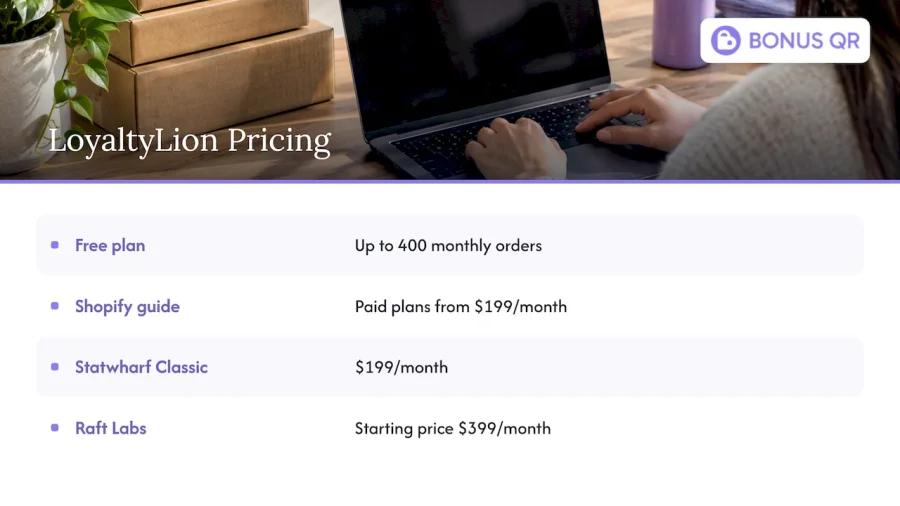
The same guide reports a free plan covering up to 400 monthly orders and paid plans from $199 per month. Statwharf lists the Classic plan at $199 per month, while Raft Labs’ comparison puts the starting price at $399. The gap shows why you should always read a vendor’s own pricing page for the current tier structure.
6. Yotpo
Yotpo lets businesses award points for purchases, referrals, product reviews, social engagement, SMS signups and charitable donations. Higher tiers add VIP tiers, points expiration rules, punch-card programs and advanced audience targeting. Per Shopify’s guide, it integrates with Shopify POS, Klaviyo and Recharge, is free to install for stores with fewer than 100 monthly orders, and paid plans start at $199 per month.
It is a natural choice for a growing ecommerce brand that wants loyalty tied to reviews and SMS. For a business whose customers mostly pay at a counter, the online-first feature set will go largely unused.
7. Reelo
Reelo is a multi-outlet option with a free plan and a Growth plan at $100 per outlet per month billed annually (INR 39,000 per outlet per year plus GST in India), as reported by Statwharf. That source is India-based, and the pricing is shown in rupees for its home market, so a US business should confirm availability and terms before shortlisting it.
8. Enterprise platforms: Paytronix, PAR Punchh, Thanx, Capillary, Antavo, Comarch
These platforms are quote-based, according to Statwharf. They are built for large restaurant groups, retail chains and hotel brands with dedicated marketing teams. The same source notes that Paytronix includes more than 450 integrations and messaging with every loyalty subscription. If you run dozens of locations with an IT department, this tier is relevant. If you run one to ten locations, the implementation overhead is usually larger than the problem you are trying to solve.
How to choose by business type
Cafes, restaurants and quick-service
The best loyalty mechanic here is simple and visible: a stamp card or points that customers can see after each visit. Speed at the counter matters more than deep integrations. A QR scan with no POS dependency is the fastest to roll out across shifts. See our restaurant loyalty program examples and the restaurant loyalty software comparison for specifics.
Retail and grocery
Retailers with an online store need the shop and the website to share a balance. If you sell on Shopify, our guide to Shopify rewards programs explains the options. If most sales are at the register, point-based or cashback rewards with wallet passes are the quickest win. We cover the shortlist in best retail loyalty app for small businesses.
Gyms, wellness centers and service providers
Your customers book appointments or memberships rather than buy products. Look for visit-based stamps, referral rewards, review prompts and birthday or anniversary offers. A booking widget in a branded app is a real advantage, and it is available as part of BonusQR’s custom app option.
Hotels and gas stations
Hotels benefit from tiered rewards that encourage direct bookings. Gas stations need very fast, low-friction earning, because the transaction is short. In both cases, a wallet pass that customers already carry on their phone beats a plastic card.
Several locations
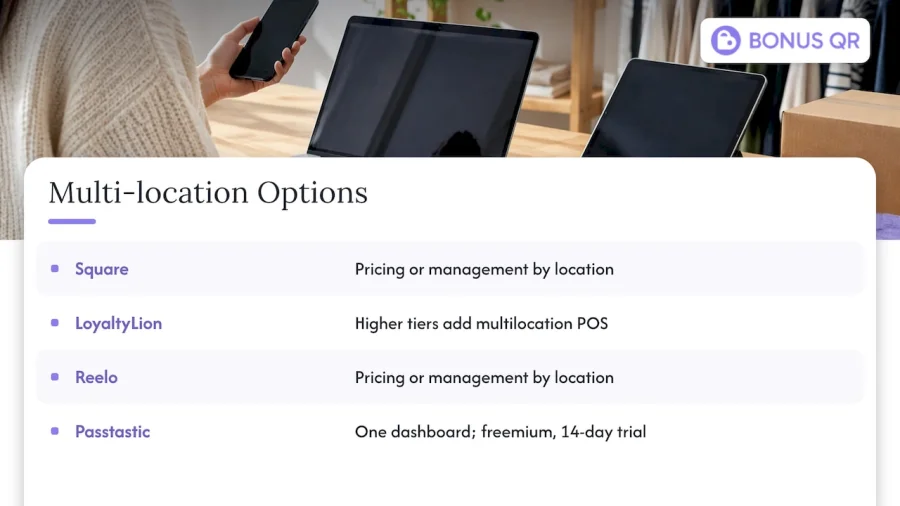
Multi-location loyalty comes down to three questions. Does one customer profile follow the customer from store to store? Is the price per location or flat? And can each location see its own results? Square, LoyaltyLion’s higher tiers and Reelo price or manage by location, while GetApp’s review of Passtastic describes multi-location management from one dashboard on a freemium model with a 14-day no-credit-card trial. Ask each vendor for the exact multi-location pricing in writing, because this is where bills diverge most.
What to verify before you commit
Before signing up for any platform, run through this list:
- Prerequisites. Does the tool require Shopify, Square or a specific POS? If so, the real cost includes that dependency.
- Pricing basis. Per month, per location, per order or per customer? Model your cost at twice your current size.
- Trial length. Published trials in the research range from 7 days (Loyalzoo, per Opia) to 14 days (Marsello) and 30 days (Square, Voucherify). A loyalty program needs a few weeks of real traffic to judge, so a free plan can be more useful than a short trial.
- Regional availability. Some platforms price in other currencies or serve specific countries. Confirm that your market and payment method are supported.
- Wallet support. Apple Wallet and Google Wallet passes keep your card on the customer’s phone without an app download. TechTarget’s 2025 list profiles Loopy Loyalty for exactly this kind of wallet stamp card, which shows how central wallets have become.
- Data ownership and export. Make sure you can export your customer list if you ever switch.
Measuring whether it works
A loyalty program is only worth keeping if repeat visits and spend go up. Track three numbers each month: the share of transactions linked to a loyalty member, the repeat-visit rate of members versus non-members, and reward redemption rate. For a wider look at measuring loyalty program performance, build the habit of reviewing these figures on a fixed day. Our guides on real-time analytics for loyalty and the customer retention workflow show how to turn those numbers into action.
Our perspective
Most small business owners we talk to about loyalty do not have an omnichannel problem on paper. They have a simpler one: customers come in, enjoy the visit, and nothing gives them a reason to return next week.
That is why we built BonusQR around the QR code. A customer scans, earns, and sees their progress, with no POS integration and no developer. Points, stamps and cashback are all modules you switch on, and automation handles rewards, notifications and customer insights so you can keep running your business.
Omnichannel does not have to start with a six-figure platform. It starts with one program customers understand, on the channels they already use: the counter, the phone, the wallet. When a business is ready for its own branded app, with an e-shop or booking widget, the white-label and custom app options are there to grow into.
Michal Palus
Start with a free plan, grow into your own app
If you want to test a loyalty program without committing budget, start on BonusQR’s Free plan, then move to Basic at €19 per month or Premium at €69 per month when you want more modules and automation. If your brand is ready for its own app, the white-label option is a €690 one-off setup with a €69 monthly subscription. For a fully tailored build, custom app development starts from €1500.
For more on how to select a platform, read how to choose the best loyalty platforms for growth.
FAQ
What makes loyalty software omnichannel?
It connects every place a customer buys to one profile and one rewards balance: store, website, app and wallet. Look for shared points or stamps, consistent offers across channels and reporting that combines all of them. A tool that runs separate programs per channel is multichannel, not omnichannel.
Do I need a POS integration to run a loyalty program?
Not always. Platforms like Square Loyalty and Marsello rely on POS data, but BonusQR is designed so customers earn rewards by scanning a QR code, with no POS or extra hardware. That makes it quick to launch in a cafe, salon, gym or shop with any kind of till.
How much does loyalty software cost for a small business?
Published entry prices vary widely. BonusQR starts free, with Basic at €19 per month and Premium at €69 per month. Reported prices elsewhere include Loyalzoo at $49 per month, Marsello at $125 and LoyaltyLion at $199 or more, per the sources above. Enterprise tools are quote-based.
What should a multi-location business look for?
Check whether one customer profile works across all outlets, whether pricing is per location or flat, and whether each location can see its own results. Request the multi-location price in writing before you commit, because per-location fees add up as you open more sites.
Sources
- Top 9 Customer Loyalty Software Tools (2026), Shopify
- Best Loyalty Program Software (2026): Top 11 Compared, Statwharf
- Best Customer Loyalty Software for Small Business, Raft Labs
- 33 Best Customer Loyalty Software Solutions, Opia
- 7 best loyalty program software for 2026, Guideflow
- Passtastic pricing, features and reviews, GetApp
- Top 10 loyalty program management software options, TechTarget
- How to Foster Customer Loyalty: Step-by-Step


