Merchant-funded cashback is a percentage refund or store credit you pay customers after a purchase, delivered through your loyalty app or platform rather than a bank. It is entirely different from a bank-issued cash back credit card, which refunds a cardholder from the bank’s own margin. As the business paying for it, you control the rate, timing and rules, and the payoff is measurable: more repeat visits and a higher average order value.
TL;DR:
- Merchant-funded cashback between 2% and 10% encourages repeat visits and higher order values, especially when redemption processes are simple and fast.
- Higher rates should be capped at fixed dollar amounts for large purchases to maintain profit margins, while thresholds like $5 or $20 can influence purchase frequency based on business type.
- A frictionless, receipt-based claim flow and clear program rules are essential to maximize customer engagement and avoid disputes or redemption delays.
- Tracking efficacy and measuring key metrics—such as redemption rate and repeat purchase rate—within 90 days helps evaluate cashback program ROI and long-term impact.
What is a cash back credit card in this context, and how does it actually work?
Forget the bank card version for a moment. In loyalty terms, cashback is a reward you fund yourself, triggered by something a customer does in your shop, café, salon or hotel. Getting the mechanics right matters more than the headline rate, because a generous percentage means nothing if customers cannot claim it easily.
Three operational choices shape the whole programme:
- Earning triggers: a single qualifying purchase, a tiered spend threshold (spend $50, earn 5%; spend $100, earn 8%), or a limited-time campaign tied to a specific product line.
- Tracking method: receipt scanning through a phone camera, a loyalty account linked at checkout, direct POS integration, or simple order ID matching for businesses without a point-of-sale system.
- Payment timing: instant in-app credit feels rewarding immediately but costs you margin sooner; a delayed payout (say, 48 hours) lets you batch-process claims and slightly increases the “found money” effect when the balance appears.
- Redemption channel: in-store credit against a future purchase, an app wallet balance, or occasionally a gift card, each with different breakage and accounting implications.
Businesses without POS hardware are not disadvantaged here. A tiered cashback structure built into a loyalty app can run entirely on receipt uploads and account balances, with no register integration required at all.
Why does cashback increase repeat purchases and spend?
The evidence is more specific than most loyalty pitches admit. A Tuck School of Business analysis of 76,000 users and 3.43 million transactions found that cashback payments raise both the probability of a repeat purchase and the size of that purchase, and mental accounting is the likely reason. Customers treat cashback as a windfall tied to the retailer who gave it to them, not as generic cash, so they tend to spend it back with you rather than a competitor.
An additional $1.00 in cashback payment increases the likelihood of a future transaction by 0.02% and increases spending by $0.32 per user, according to research published in the Journal of Marketing Research.
The caveat matters too: this is an average effect across a large panel, not a guarantee for every business or every reward size.
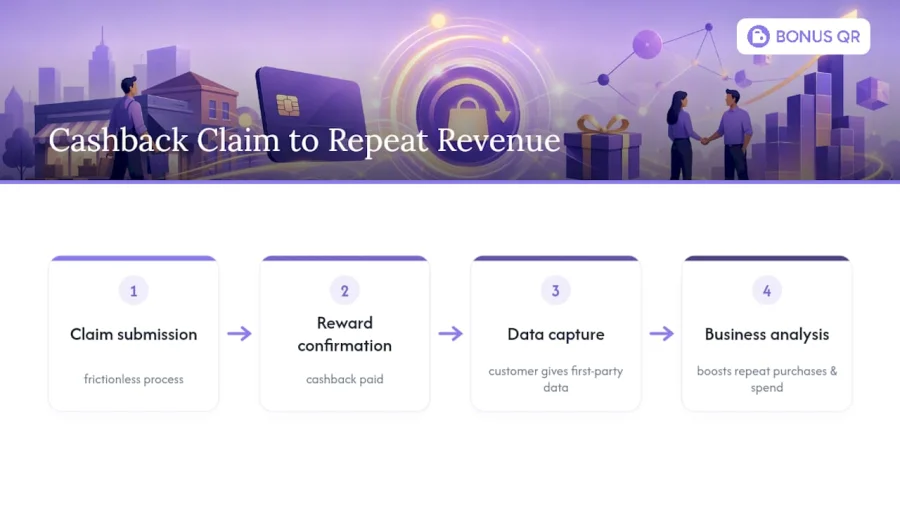
None of that uplift happens automatically. Faculty research from Tuck points out that a frictionless claim process is what converts the behavioural effect into actual revenue; a clunky redemption flow can cancel out the goodwill entirely. There is also a quieter strategic win: every cashback claim is a moment where a customer voluntarily hands over first-party data, which Inmar’s analysis of cashback incentives flags as increasingly valuable now that third-party tracking is disappearing.
How should you set rates, caps and thresholds?
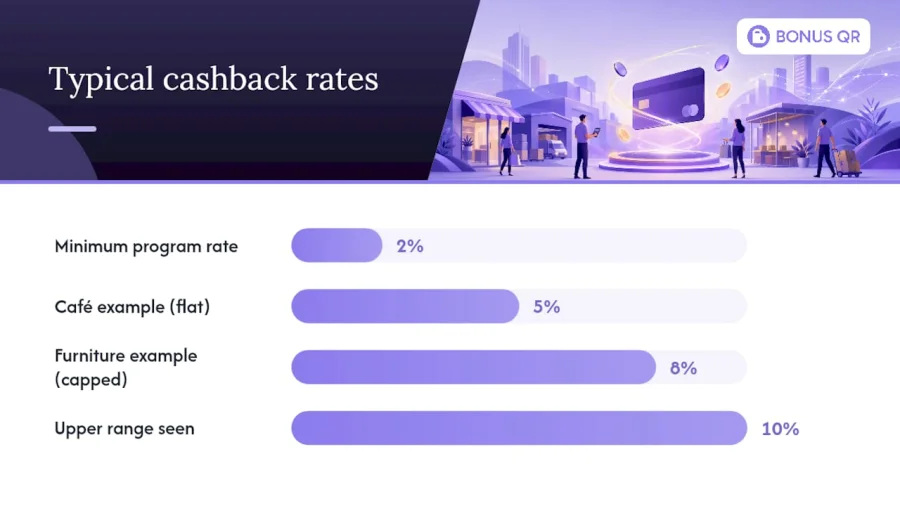
Most merchant-funded programmes sit between 2% and 10% cashback, with higher rates typically capped at a fixed dollar amount to protect margin on larger baskets. A café might offer a flat 5% with no cap; a furniture retailer might offer 8% capped at $40 per transaction, because an uncapped rate on a $2,000 sofa would erode profit fast.
Minimum redemption thresholds are one of the more underused levers. Research on the goal-gradient effect shows that people work harder and buy more as they get closer to a target, so a “redeem at $10 earned” rule can genuinely stretch out purchase cadence rather than just annoying customers who want their money now.
- Small thresholds ($5 or under) suit high-frequency, low-margin businesses like coffee shops, where fast gratification keeps traffic coming back weekly.
- Larger thresholds ($20 to $30) suit lower-frequency purchases, stretching the reward across several visits and protecting margin on any single transaction.
- Expiry windows (60 to 90 days is common) prevent unredeemed balances from sitting as an open liability indefinitely.
The trade-off is real: immediate small credits drive frequency, delayed larger payouts protect margin but risk customers forgetting the reward exists.
Pro Tip: *Write your eligibility rules in plain language before launch, not after your first support ticket.
What do you need to decide before you launch?
A cashback programme fails more often from unclear rules than from a poorly chosen rate. Work through these decisions in order:
- Set objectives and targets — pick the metrics that matter (repeat rate, AOV uplift, acceptable customer acquisition cost) before you touch the rate calculator.
- Choose your tracking method — receipt scan, loyalty account, or POS integration, and map exactly how that data reaches your reporting.
- Draft the rules — earning triggers, caps, expiry dates, basic fraud checks (duplicate receipt detection, for instance), and a short privacy statement covering how you use the data collected.
- Plan the rollout — start with a pilot cohort or a single product category, prepare customer-facing messaging, and set up automated notifications so customers know when they have earned and when a balance is about to expire.
- Brief your team — frontline staff need to explain the programme in one sentence; if they cannot, your rules are too complicated.
A step-by-step implementation guide covering exactly this sequence is worth reading in full before you commit to a launch date.
How do you measure success and estimate ROI?
Track five numbers from day one: repeat purchase rate, redemption rate, average order value, customer lifetime value, and customer acquisition cost. Redemption rate matters most in the early weeks, because a low rate usually signals a claim process that is too slow or too confusing, not a reward that is unattractive.
You can build a rough forecast using published effect sizes rather than guessing. If the $0.32 additional spend per $1.00 of cashback holds even loosely for your customer base, a $10 average cashback payout could plausibly return several dollars in incremental spend before you factor in repeat-visit probability. Run it as an A/B test against a control group that gets no cashback offer, not a before-and-after comparison, since seasonal effects will otherwise distort your numbers.
| Metric | What it tells you | Early action threshold |
|---|---|---|
| Redemption rate | Whether the claim process works | Below 30% signals friction, not a weak offer |
| Repeat purchase rate | Whether cashback is changing behaviour | Compare pilot cohort against a control group |
| Average order value | Whether basket size is growing | Track weekly against pre-launch baseline |
| Customer lifetime value | Long-term programme worth | Review after 90 days minimum |
A detailed retail case study on cashback-driven growth walks through comparable metrics if you want a fuller worked example.
When we recommend cashback, and the mistakes that undo it
Cashback works best for medium-frequency purchases where you have some margin flexibility, cafés, salons, boutique retail, hotels rebooking repeat guests, rather than one-off high-ticket sales where a single visit may never repeat. If your customers realistically buy from you once every few weeks, cashback gives them a concrete reason to come back rather than drift to a competitor.
The three mistakes we see most often: vague earning rules that create disputes, slow fulfilment that kills the mental-accounting effect before it starts, and treating redemption as purely transactional instead of a data capture opportunity. A platform built for rapid setup, receipt-based or app-based flows, and real-time analytics can remove most of that friction by design, which is exactly why the operational choices matter more than the headline percentage you advertise.
— Michal
Set up merchant-funded cashback without the technical overhead
Building the tracking, rules engine and analytics for a cashback programme from scratch is exactly the kind of project that stalls small businesses for months. Bonusqr gives you tiered cashback, receipt-based claim flows, and no requirement for POS integration, so a café or salon can launch a working programme in days rather than negotiating a hardware upgrade first.
A typical setup: a hair salon offers 6% cashback on services over $40, customers upload a receipt photo in the app, credit lands in their account within 24 hours, and the salon reviews redemption and repeat-visit data through the platform’s built-in features. Service businesses can see the exact structure on the loyalty application for services page. If you are ready to see how quickly it comes together, register for Bonusqr and start building your first cashback rule today.
Further reading and primary sources
For the underlying research, see the Tuck School of Business cashback study, the Journal of Marketing Research paper, and Inmar’s analysis of cash back incentives. For implementation, read Bonusqr’s SMB cashback growth guide and this broader look at customer retention strategies.
Sources
- Cashback Is Cash Forward: Delaying a Discount to Entice Future Spending (Journal of Marketing Research)
- Does cashback make consumers come back? | Tuck School of Business
- How brands can use cash back incentives to increase sales and customer loyalty (Inmar)
FAQ
What is a cash back credit card in a loyalty programme context?
It refers to merchant-funded cashback, a percentage refund or store credit the business pays customers after a purchase through a loyalty app, not a feature of a bank-issued credit card.
What is a good cash back percentage to offer?
Most merchant-funded programmes sit between 2% and 10%, with higher rates usually capped at a fixed dollar amount to protect margin on larger purchases.
What credit card offers the most cash back, in loyalty terms?
There is no single “best” rate; the right figure depends on your margin, purchase frequency, and whether you cap the reward, which is why platforms like Bonusqr let you set tiered rates rather than one fixed number.
How fast should cashback redemption be?
As close to immediate as possible. Research on the redemption experience shows that delays or complex claim steps reduce repeat uptake and undermine the loyalty benefit entirely.
Does cashback really increase repeat purchases?
Yes.


