A café owner hears it every week. “This place is brilliant, I'll bring my friend next time.” A salon owner gets the same promise after a great appointment. A gym manager watches members recommend classes in person, then has no clean way to tell whether those conversations turned into paying visits.
That's the gap. Word of mouth is happening, but the business can't measure it, reward it properly, or improve it.
A referral tracking program fixes that. It turns vague goodwill into something a business can follow from recommendation to redemption. For UK cafés, salons, gyms, and local retailers, that matters even more because many referrals start in person, not through a polished online funnel. A customer shows a QR code at the till, tells a friend over coffee, or forwards a link in WhatsApp after leaving the shop. If the tracking method only works online, the business misses half the story.
From Word of Mouth to Measurable Growth
Passive word of mouth is nice. Structured referrals are better.
The difference is simple. Passive word of mouth relies on memory, luck, and staff asking awkward questions at checkout. A proper referral tracking program gives each advocate a shareable path, records who invited whom, and ties the reward to a real action such as a first visit, a first purchase, or a completed sign-up.
That shift matters because untracked referrals create two problems. First, the business can't prove what's working. Second, good customers stop bothering to refer when the process is clumsy or inconsistent.
Why this matters now
UK small businesses are already moving towards digital loyalty systems. The UK loyalty programs market is projected to grow at a 12.2% CAGR during 2025 to 2029 and reach $4.06 billion by 2029, according to UK loyalty market projections. That doesn't mean every local business needs a complicated stack. It means competitors are becoming more organised about retention and referrals.
For a local café or salon, the practical takeaway is straightforward. If customers are already recommending the business, the business should stop treating those recommendations like a bonus and start treating them like a channel.
Practical rule: If a business is willing to spend money on paid ads, it should also be willing to track the customers who bring in trusted new business.
What a referral tracking program actually does
A useful referral setup should answer a few basic questions:
- Who referred the new customer? Without that, rewards become guesswork.
- What action triggered the reward? A scan, a first purchase, or a redeemed offer.
- Did the referred customer come back? That's the difference between a cheap discount and a profitable acquisition.
- Which staff member can verify it quickly? Busy teams need a fast workflow.
Many small businesses encounter difficulties at this point. Most referral advice still assumes a clean online journey. Someone clicks a link, lands on a page, buys immediately, and the software credits the referrer. Real life in hospitality doesn't work like that. People scan in-store, switch devices later, or redeem face to face.
Why tracking beats guessing
A tracked programme gives the owner control over three things that passive word of mouth never can:
| Business question | Without tracking | With tracking |
|---|---|---|
| Which customers send referrals? | Staff memory | Named customer record |
| Which offer works? | Opinion | Real redemption behaviour |
| Is the reward worth it? | Hard to prove | Tied to referral outcomes |
A structured programme also helps the business build repeatable habits. Staff know what to say. Customers know what to share. The owner knows where the numbers are coming from.
A lot of local businesses don't need more marketing ideas. They need fewer leaks. A tracked referral programme closes one of the biggest leaks in local growth: recommendations that happen every day but vanish without a record.
For owners who want a broader guide to boosting customer loyalty, referrals should sit next to stamps, points, cashback, and bounce-back offers. They aren't a separate strategy. They're part of the same retention system.
Designing a Referral Programme That Actually Works
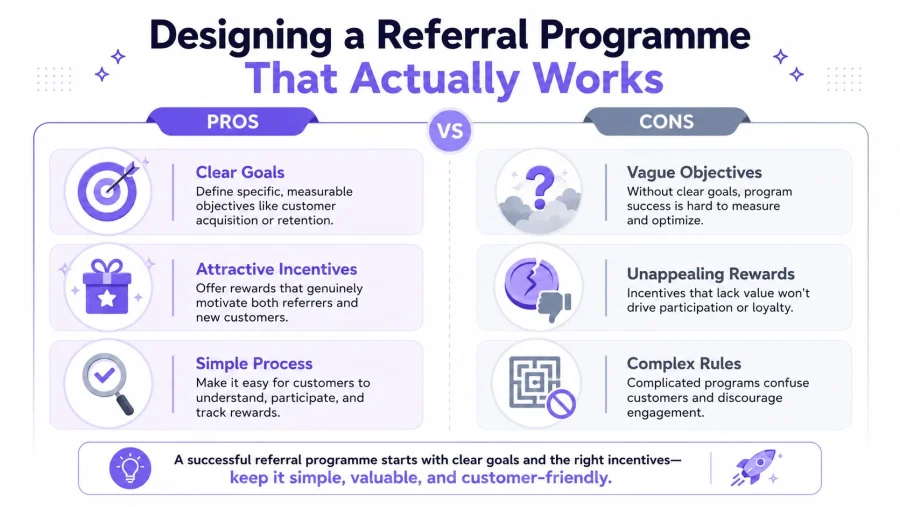
A referral programme usually breaks in the first week for very ordinary reasons. The barista forgets how to explain it. The stylist is too busy between clients to log anything manually. The customer wants to share it, but only if it takes ten seconds and does not involve downloading three apps or remembering a code.
That is why the design work matters more than the launch graphic.
Set goals around one real business problem
“More customers” is too broad to guide staff or measure results. Pick the pressure point you need to fix.
For a UK café, that might be more first-time weekday visits between 2pm and 5pm. For a salon, it might be getting referred clients to book colour, brows, or another higher-margin service instead of only a basic cut. For a gym, it might be getting guest passes to convert into paying members.
Three questions keep the goal practical:
- Are regulars sharing it?
- Are new customers redeeming it?
- Are those referred customers worth the reward?
If the answer to the third question is no, the programme is busy but not useful.
Pick a reward your margin can survive
Owners often choose rewards by gut feel. That is how you end up giving away too much, or offering something so small that nobody bothers.
Start with your average order value and your gross margin. Then set a reward that feels clear at the counter and still leaves room for profit after the referred customer's first visit. In a café, that might be a free drink add-on or money off a second purchase, not a full meal giveaway. In a salon, a modest credit against the next service usually works better than a large blanket discount on day one.
The best reward is not the most generous one. It is the one customers understand instantly and staff can apply without a debate.
If a team member needs a script card to explain the offer, the mechanics are too complicated.
Start with a two-sided offer in most local businesses
A two-sided reward gives the new customer a reason to try you and gives the referrer a reason to share. That balance matters in face-to-face businesses, where recommendations happen in conversation, not only through links.
A simple structure works well:
| Reward structure | Best fit | Main drawback |
|---|---|---|
| One-sided | Very tight margins or a highly loyal regular base | The friend has little reason to act now |
| Two-sided | Cafés, salons, gyms, barbers, clinics, retailers | You need clear tracking and anti-abuse rules |
In practice, most independent cafés and salons get better uptake from “Give £5, get £5” logic than from “Refer a friend and maybe get something later” vagueness. The friend needs a reason to scan the QR code or mention the referral at the till.
Build it around real customer behaviour
This is the gap many referral articles miss. Customers in local businesses do not always move through a clean online journey. They chat at work, send a screenshot in WhatsApp, scan a poster in the shop window, or mention a friend's name while paying in person.
So design for that reality.
A good referral journey for a café or salon usually looks like this:
- The regular customer gets a personal QR code or simple share link.
- They show it in person or send it in a message.
- The friend scans it and sees one clear offer.
- Staff can recognise and redeem it at the counter without searching through a back office system.
- The reward triggers only after the qualifying visit or completed appointment.
That structure is simple enough for a Saturday rush and accurate enough to measure later.
Keep the rules short and visible
Every extra condition cuts participation. Hidden restrictions also create the fastest route to customer complaints.
Use rules people can absorb in a few seconds:
- Who can refer
- What the friend gets
- When the referrer gets rewarded
- Any minimum spend or qualifying service
- Whether it is limited to first-time customers
That is enough. You do not need legal-style wording on your menu board or reception desk. You do need consistency. If one staff member applies the reward differently from another, trust drops fast.
Pressure-test the programme before launch
Before rolling it out, test it like an owner, not like a marketer.
Ask:
- Can a new staff member explain it after one read?
- Can a customer share it while standing in the queue?
- Can the friend redeem it without downloading extra tools on the spot?
- Can you verify the referral without checking handwritten notes?
- Can the reward be abused by the same household or repeated self-referrals?
If one of those answers is shaky, fix the design first.
A referral programme that works in a real café or salon is rarely clever. It is clear, quick to share, easy to redeem, and built for the messy way local recommendations happen.
Choosing Your Referral Tracking Method
It is 8:30 on a Saturday morning. The café queue is building, or the salon has back-to-back appointments, and a new customer says, “My friend told me to come in.” If your staff still need to ask three follow-up questions, check a notebook, or remember a name from last week, your referral tracking method is already failing.
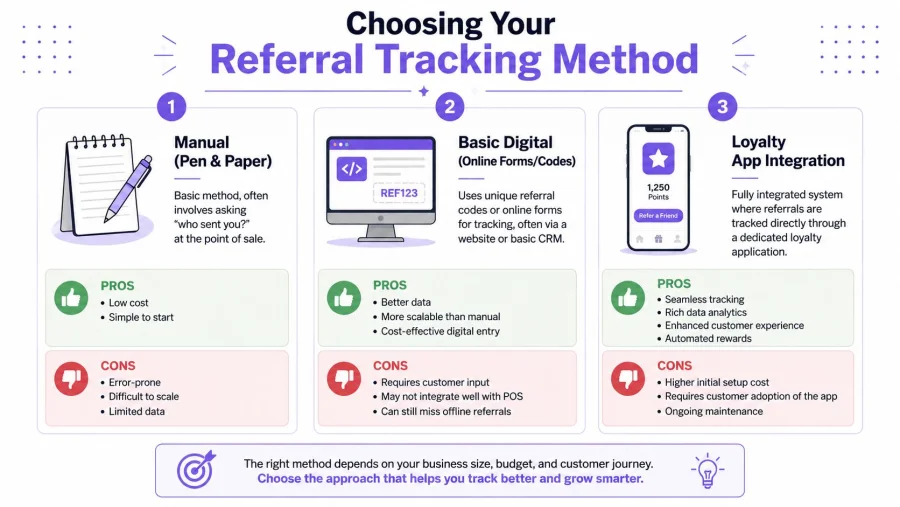
Small businesses usually end up choosing between three approaches. Manual tracking, basic digital tracking, or a loyalty app with QR-based referral redemption. The right choice depends less on features and more on what your team can run without slowing service, creating disputes, or adding admin to their workload.
Manual tracking
Manual tracking usually starts with staff asking, “Who referred you?” and writing down the answer.
It looks cheap because there is no software cost. The hidden cost is staff time, missed credits, and the cleanup job that lands on the owner later. In a busy café or salon, names get misspelled, customers forget who sent them, and staff skip the question when the queue gets long.
Manual tracking still has a place. It works for a short test, a single site, or a business with very low referral volume and an owner who is prepared to accept some inaccuracy.
Where it helps
- Early proof-of-concept testing
- Limited-time campaigns
- Very small single-location businesses
Where it breaks down
- Staff inconsistency
- Weak attribution
- No usable record of repeat visits after the referral
- Frequent customer queries about whether a reward was applied
Basic digital tracking
Basic digital tracking usually means referral codes, sign-up forms, booking notes, or shareable links.
That is an improvement over pen and paper, but only if the customer journey is already digital. A pilates studio with online bookings can often make this work. A neighbourhood café or hair salon usually cannot rely on it alone because many referrals start in person. One customer mentions the business over coffee, sends a screenshot later, and the friend walks in days after that. If the system expects a tidy online path from click to purchase, it misses how local referrals happen.
That offline gap matters more than many owners expect.
Loyalty app integration with QR-based redemption
QR-based referral tracking is often the most practical option for physical businesses because it matches how customers really share recommendations. Someone at the counter, in the waiting area, or leaving an appointment can pull up a code or referral link from their loyalty profile and pass it on in seconds. The friend then redeems it in-store or before booking, and staff can verify it quickly.
For a UK café or salon, that is the difference between a referral system that looks good in theory and one that holds up during live service. You do not need a full POS integration or a technical project. You need a clear customer identifier, a scannable referral path, and a way for staff to confirm redemption without stopping the line.
Used well, this method closes the gap between offline recommendation and digital record.
Side-by-side decision view
| Method | Cost to start | Accuracy | Staff effort | Best fit |
|---|---|---|---|---|
| Manual | Low | Low | High over time | Short tests only |
| Basic digital | Moderate | Medium | Moderate | Online-first businesses |
| QR loyalty app | Moderate | High when set up well | Low at point of service | In-person businesses |
The strongest method is the one your team can apply correctly during a rush.
What to choose in a café or salon
In cafés, speed usually decides the issue. Staff need to spot the referral, validate it, and move on. A QR-based approach is easier to run than asking cashiers to collect names and remember conditions between orders.
In salons, delay is the bigger problem. A customer may hear about you after an appointment, wait a week, then book. Good tracking needs to preserve that referral link across that gap without forcing reception to piece the story together manually.
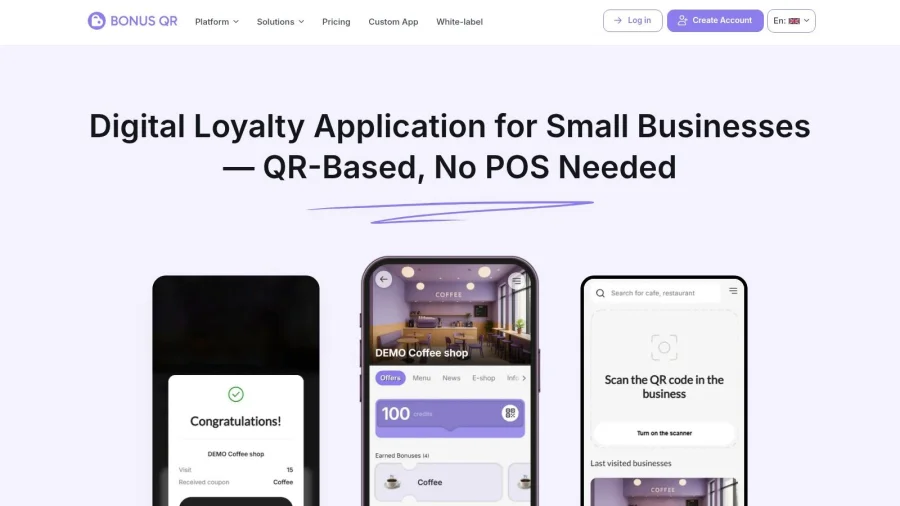
For many local operators, the practical middle ground is a loyalty system that handles referrals inside the same customer profile used to boost customer loyalty. One example is BonusQR, which supports a QR-based loyalty profile and referral flow without requiring POS integration. That suits businesses that want a simple in-store process rather than another tool staff have to work around.
Implementing Your Programme with a Loyalty App
A Friday lunch rush in a UK café is not the time for staff to explain referral rules, search through screens, or argue over who referred whom. The same applies at a busy salon desk when one client is paying, another is arriving, and the phone is ringing. If the process slows service, staff stop using it.
A loyalty app works when it keeps the referral process short, visible, and easy to verify. For small businesses, that usually means a QR-led setup that runs alongside normal service, not through a costly POS project.
Keep the referral journey simple enough to use during service
Owners often make implementation harder than it needs to be. They add too many entry points, too many rewards, and too many exceptions before the first customer even shares the offer.
Start with one working journey:
- Existing customer opens their loyalty profile
- Customer shares their referral QR or link
- Friend scans, signs up, or books
- Staff confirm the visit or purchase
- Reward is applied after the trigger is met
That structure suits physical venues because it gives staff one thing to check at the counter or reception desk. It also gives customers a clear next step instead of a vague promise to “mention a friend”.
If referrals are going to support repeat visits as well, keep them inside the same account you use to boost customer loyalty. One profile is easier to manage than separate tools for stamps, rewards, and referrals.
Set the rules before you print a single QR card
Good implementation starts with decisions, not artwork.
The owners who get into trouble are usually the ones who launch first and sort out edge cases later. That is how you end up giving rewards for no-shows, duplicate accounts, or first visits that were never paid for.
Set these rules in the app before promotion starts:
| Setup item | Decision to make |
|---|---|
| Advocate reward | What the referring customer gets |
| Friend reward | What the new customer gets |
| Trigger event | First paid purchase, completed booking, or verified visit |
| Eligibility | New customers only, or limited groups |
| Validation step | What staff need to confirm before reward approval |
The trigger matters more than owners expect. In a café, a reward after a first paid order usually protects margin better than rewarding a sign-up. In a salon, it often makes more sense to trigger after a completed appointment, because bookings alone do not guarantee revenue.
Roll it out in stages your team can actually handle
A staged rollout works better than a big launch because it gives you time to catch operational problems early. That matters in physical businesses, where the true test is whether staff remember the process during a busy shift.
Use the first month to prove the mechanics.
First month
Keep the programme tight. One in-store QR prompt. One share message in the app. One staff script.
For a café, the script might be: “If you want to refer a friend, scan your loyalty profile and send them your QR. They get the welcome offer after their first visit.”
For a salon, the wording may work better after a good appointment or at checkout: “If you know someone who'd like this service, send them your referral QR from the app. We'll add your reward after they complete their first booking.”
Watch for practical issues:
- Are staff remembering to mention it at the right moment?
- Do customers understand how to share it without help?
- Are referred visitors completing the action needed for the reward?
- Are any rewards being claimed without a valid visit or purchase?
Second month
Once the process works in person, add it to normal customer touchpoints.
Examples:
- A salon adds the referral prompt to post-appointment messages
- A café prints a small QR reminder on takeaway inserts
- A fitness studio mentions referrals after a class package renewal
The goal is not to plaster the offer everywhere. The goal is to place it where satisfied customers are already paying attention.
Third month
Trim the parts that create friction.
By this stage, patterns usually show up clearly. Staff may ignore a long script. Customers may respond better to a friend reward than an advocate reward. One printed prompt may drive more verified referrals than three other placements combined.
Keep what produces clean, trackable redemptions. Remove the rest.
Train staff on one page
Small teams do not need a training pack nobody will read. They need a one-page guide that answers four questions fast:
- What do I say?
- When do I say it?
- What screen or QR do I check?
- When do I refuse the reward?
That last point matters. Staff should know not to apply rewards for duplicate accounts, unclear customer identity, or visits that do not meet the trigger rule. Clear boundaries prevent awkward arguments at the till or desk.
Use printed prompts to support the app
Digital tracking does not remove the need for physical prompts. In cafés and salons, many referrals start face to face. The app records them, but the prompt that starts the action is often a card, sticker, mirror sign, or takeaway insert.
Useful formats include:
- Counter card: one short offer and one QR action
- Takeaway insert: effective for cafés with regular footfall
- Mirror or station sign: useful in salons where customers have dwell time
- Reception card: good for checkout desks and waiting areas
Keep the message tight. One offer. One action. One place to scan.
That is usually enough to get a referral programme running in practice, without custom integrations, extra admin, or a tech team standing by.
Measuring Success and Optimising for Growth
It is Monday morning. The café had a busy weekend, a few referral rewards were claimed, and the owner wants to know whether the programme is working or just giving away free coffee. That is the true test for a referral tracking programme in a physical venue.
For a salon or café, success is not measured by how many people scanned a QR code. It is measured by whether those scans turned into verified first visits, repeat spend, and margin that still makes sense after the reward.
Measure the actions that affect profit
Owners usually get the clearest view by checking a short set of numbers every month. Keep it simple, but tie each metric to a business decision.
| Metric | What it shows | What to question if it looks weak |
|---|---|---|
| Referral participation rate | Are regular customers actually sharing? | Staff are not mentioning it, the QR prompt is poorly placed, or the offer is not strong enough |
| Verified referral redemptions | Are referred people becoming real first-time customers? | Too much friction at claim, weak offer clarity, or loose tracking rules |
| Average spend from referred customers | Are referred visits profitable after the reward? | Discount is too heavy or attracting low-value visits |
| Repeat visit rate of referred customers | Are referred customers coming back? | You are buying one-off bargain visits instead of genuine local loyalty |
| Invalid or disputed rewards | Is misuse eating into margin? | Rules are unclear or staff are approving rewards too loosely |
This is enough for a small business to manage without a POS integration or a separate reporting stack.
Use a dashboard that matches how referrals happen in person
Digital referral advice often assumes online checkouts, coupon fields, and ecommerce attribution. A UK high street business deals with a different reality. A customer scans a counter QR, sends the offer to a friend on WhatsApp, and that friend walks in three days later and shows the code at the till.
That means the dashboard needs to answer practical questions:
- Which QR placement starts the most verified referrals?
- Which staff shift or service window produces the best redemption rate?
- Are referred customers spending enough to justify the reward?
- Are too many rewards being approved without a valid first visit?
Reporting inside BonusQR analytics features can help owners review referral activity alongside visits and rewards, which is far more useful than a vanity total of scans.
Keep the attribution window tight
Long attribution windows create bad data in bricks-and-mortar businesses. If a referred customer comes in six weeks later, there is a good chance they were going to visit anyway, especially in neighbourhood cafés and salons where local traffic is already high.
A shorter window usually gives cleaner tracking. For many small venues, 7 to 14 days is a sensible starting point. It is long enough for a friend to act on a recommendation, but short enough to reduce the number of ordinary walk-ins being wrongly counted as referrals.
Review it against your buying cycle. A café may need a shorter window than a salon, where clients often book a few days ahead.
Check for misuse before it becomes a margin problem
Referral abuse in small businesses is rarely complex. It is usually ordinary rule-breaking that goes unchecked because the team is busy.
Look for patterns such as:
- the same mobile number tied to multiple “new” customers
- one advocate generating a cluster of low-value redemptions in a short period
- rewards claimed without a matching qualifying visit
- family or housemate referrals that break your new-customer rule
- manual approvals that staff cannot explain later
A monthly review is usually enough for an SMB. Weekly is better if the offer is generous or the programme gets a lot of use.
Improve the weak point, not the whole programme
If results are poor, the fix is usually narrower than owners expect.
Low participation means the prompt is weak, badly placed, or not being mentioned at the right moment. Low redemption means the referred friend is hitting friction, often because the QR journey is unclear or staff are asking for too much at the counter. Low repeat spend means the reward got the first visit but not the right customer.
Treat optimisation as a series of small operating changes. Move one QR sign. Shorten one claim step. Tighten one rule. Change one reward threshold.
That is how referral tracking starts producing measurable growth in the tangible world, not just activity on a screen.
Keeping Your Programme Compliant and Effective
A lot of small business owners assume GDPR is the part that makes a referral programme too hard to run. That's usually not true. The actual problem is vague process.
Compliance gets simpler when the workflow is specific. Who shares the referral. What data is captured. When consent is requested. Where the event is logged. Who can view it. How rewards are validated. That's manageable, even without a CRM or a POS integration.
GDPR isn't the obstacle. Loose handling is.
For small UK merchants using app-based QR scanning, the key issue is staying aligned with UK GDPR consent and legitimate interest laws in a practical workflow that fits non-integrated systems, as outlined in guidance for referral networks and data handling. Generic CRM advice doesn't help the owner of a café with a tablet at the till or a salon using an app-based loyalty profile.
The fix is operational discipline.
A workable compliance routine for local businesses
A compliant referral setup should follow a few plain rules:
- Collect only what the programme needs. Don't ask for extra data just because the form allows it.
- Make the referral action clear. Customers should understand what happens when they share.
- Log consent where required. Especially when marketing messages or ongoing contact are involved.
- Separate reward validation from broad data access. Staff need enough to verify a referral, not full customer histories.
- Keep an audit trail. If a reward is challenged, the business should be able to see the event path.
That's what most owners need. Not legal jargon. A routine.
Compliance is easier when the business uses one referral workflow consistently instead of mixing paper notes, verbal claims, and disconnected apps.
What legitimate interest means in practice
For a local business, legitimate interest usually means the business has a valid operational reason to process limited referral data, provided it handles that data fairly and transparently.
In practical terms:
- the business can track a referral event tied to a reward,
- it should explain that tracking in its privacy notice or programme terms,
- and it shouldn't stretch that data into unrelated marketing without the right basis.
Non-integrated app systems can help. A tighter workflow can reduce ad hoc sharing between staff, inboxes, and spreadsheets.
Keep the programme fresh without making it messy
Once the programme is compliant and stable, the owner can keep it effective with controlled changes rather than constant tinkering.
Good refresh options include:
- Limited-time referral campaigns: short bursts around seasonal peaks
- Top-advocate recognition: extra reward access for proven referrers
- Category-specific referral pushes: for example, promoting a quieter service line
- On-site prompt updates: refreshing signage and in-app wording
Weak refresh tactics include adding complex conditions, stacking too many reward types, or changing rules so often that staff stop trusting the system.
A simple long-term checklist
Every quarter, the owner should review:
| Review area | What to check |
|---|---|
| Data handling | Is the current process still consistent and documented? |
| Staff access | Can staff see only what they need to do their job? |
| Reward clarity | Do customers still understand the offer quickly? |
| Programme fatigue | Has the message become too familiar or ignored? |
The strongest referral programmes stay boring in the right places. Clear rules. Clean records. Consistent staff behaviour. Then the owner can layer in occasional campaigns without breaking the core workflow.
A referral tracking programme works when it fits the way local businesses operate. In a UK café, salon, gym, or neighbourhood shop, that means fast staff actions, QR-friendly customer journeys, no heavy integration project, and reporting that shows which referrals become real business.
That's why simple systems usually outperform clever ones. The business doesn't need more theory. It needs a process that captures in-person recommendations, credits the right customer, protects margin, and stays manageable week after week.
For teams that want to run referrals inside the same QR-based loyalty flow they already use for rewards, BonusQR offers a practical route to launch without extra hardware or POS integration.


