
 Deutsch
 Español
 Français
 Italiano
 Magyar
 Polski
 Slovenčina
 Čeština
The single most effective move is a short, segmented reactivation sequence that pairs a time-limited incentive with content personalised to why that customer bought in the first place. Prioritise customers who were recently active and spent above average before they lapsed.
TL;DR:
- Set the lapse trigger by business model: use cancellation or failed renewal for subscriptions, and the usual repurchase window or engagement drop for retail.
- Prioritize recently lapsed customers with high spending and engagement, and contact them within days; exclude chargebacks and terms violations, while older accounts get email only.
- Escalate an offer only once, midway through the sequence; use discounts or free shipping for price sensitive retail customers, and points or credit to protect margins.
- Compare reactivation, recovered revenue, and lifetime value against a no campaign holdout, measuring at 30, 60, 90, and 180 days to capture delayed returns.
What a win-back campaign is and when to run one
A win-back campaign is outreach aimed at customers who converted before but have since stopped buying or engaging with us. It is different from acquisition marketing because the relationship already exists, so the message can reference real history: past purchases, loyalty points earned, or features used.
Deciding when someone counts as “lapsed” depends on your business model rather than a single fixed number. A subscription service might flag a customer the day they cancel. A retailer might wait until a customer passes their average repurchase window without a return visit. HBR’s research on reclaiming lost customers points out that effective win-back work starts with understanding why someone left, not just noticing that they are gone.
Set your threshold using whichever signal fires first:
- A fixed inactivity window based on your typical purchase cycle (for example, 60 days for a monthly consumable).
- A hard trigger such as cancellation, a failed renewal, or a missed appointment.
- A drop in engagement signals: no app opens, no email clicks, no loyalty point redemptions.
Measure three things once a campaign runs: revenue recovered, the feedback gathered on why customers left, and the lift in retention for anyone who re-engages. Simple automated flows handle the bulk of volume well, triggered by inactivity or cancellation events. Reserve manual outreach for your highest-value accounts, where a personal note or call can justify the time it takes.
Who to target: segmentation rules that focus effort where it pays
Not every lapsed customer deserves the same amount of attention. HBR’s guidance on reclaiming lost customers stresses prioritising by recoverable value rather than running one undifferentiated blast to everyone who has gone quiet, and that principle should shape your segmentation before you write a single subject line.
Build your segments around four axes, scored from low to high:
- Recency: how long since their last purchase or login, scored against your typical repurchase window.
- Monetary value: lifetime spend or average order value compared with your customer base.
- Engagement depth: email opens, app usage, loyalty point activity, and support interactions before they went quiet.
- Churn reason proxy: a billing failure behaves very differently from a dissatisfaction signal such as a complaint or a one-star review, so route them into separate flows.
A simple scoring matrix multiplies recency against spend and engagement, then sorts customers into three tiers: high-value and recently lapsed (contact within days), moderate value with longer inactivity (contact within a few weeks), and low value or very old accounts (include in a light-touch, low-cost email only).
Exclude customers who triggered chargebacks or broke your terms of service. Spending budget trying to win back someone who disputed a payment rarely pays off and can create more support friction than revenue.
Segment examples by model: a subscription business separates voluntary cancellations from failed-payment churn, since the second group often just needs a card update. A retail brand splits repeat buyers by purchase frequency, treating a weekly shopper who skipped a month very differently from a once-a-year holiday buyer. A service business, such as a salon or gym, segments by missed rebooking versus an expired membership.
Pro Tip: Build your highest-value segment first and launch it alone. A tightly targeted list of 200 valuable lapsed customers will teach you more than a vague blast to 20,000.
Winback campaign ideas: 12 email types with subject lines and short templates
Twelve ideas cover most lapsed-customer scenarios. Pick two or three that match your segments rather than running all twelve at once.
- We miss you: a simple emotional nudge for recently lapsed, engaged customers. Subject: “We miss you, come back for 15% off.” Template prompt: reference their last purchase and offer a modest incentive to return within a set window.
- Feedback request: for customers who left after a complaint or a drop in satisfaction. Subject: “What went wrong? We’d like to fix it.” Template prompt: ask one specific question and offer a small thank-you credit for a response.
- Limited discount: best for price-sensitive retail buyers nearing the end of a reactivation window. Subject: “48 hours left: 20% back on your next order.” Suits retail more than subscriptions, where discounting can erode perceived value.
- Loyalty points reward: for members of an existing points programme who have gone quiet. Subject: “You’ve got 150 points waiting.” Works for both retail and subscription loyalty tiers.
- Back-in-stock alert: for shoppers who abandoned a browse or wishlist item. Subject: “It’s back: the item you wanted is in stock.” Needs no discount, since the trigger itself is the incentive.
- Personalised recommendation: for customers with a purchase history deep enough to model preferences. Subject: “Picked for you, based on your last order.” Template prompt: pull their top category and show two or three related items.
- Usage reminder: for subscription or app-based products where a customer stopped logging in. Subject: “You haven’t used [feature] in a while, here’s a quick way back in.” Template prompt: highlight one feature with a one-line benefit.
- Anniversary or celebration: for long-tenure customers nearing a renewal or sign-up anniversary. Subject: “It’s been a year, here’s a thank-you from us.” Template prompt: pair a genuine thank-you with a loyalty credit rather than a hard discount.
- Win-back survey: a short, structured version of the feedback request, best for cancelled subscriptions. Subject: “60 seconds to tell us why you left?” Template prompt: three multiple-choice questions and one open text field.
- Re-onboarding series: for customers who signed up but never fully adopted the product. Subject: “Let’s try this again, three steps to get set up.” Template prompt: break the original onboarding into shorter, separate emails.
- Feature update: for lapsed customers whose main objection was a missing capability. Subject: “The thing you asked for is here.” Template prompt: name the feature plainly and link straight to it.
- Cart recovery for repeat buyers: for customers with a history of completed purchases who abandoned a more recent cart. Subject: “Still thinking it over? Here’s a little nudge.” Template prompt: show the exact items left behind alongside a modest, time-boxed incentive.
Trust-forward copy tends to outperform desperate-sounding discounting in win-back sends, a pattern that shows up repeatedly across template-led marketing guides covering reactivation email examples.
Match the idea to the model: subscriptions respond best to usage reminders, re-onboarding, and feature updates, while retail and service businesses see stronger results from discounts, back-in-stock alerts, and loyalty point reminders.
Timing and triggers: when to start the flow and how to pace it
Timing decides whether a win-back message reads as helpful or as noise. The trigger should be specific and immediate rather than a vague “it’s been a while” guess.
- Pick your trigger event: inactivity past your threshold, a cancellation, a missed reorder date, or a failed payment.
- Set the first-contact delay by model: subscriptions typically see the best results starting outreach seven to thirty days after cancellation, while retail repeat-buy flows wait thirty to ninety days depending on how often that customer normally purchases.
- Build a cadence of three to five messages across two to six weeks, starting with a soft, relevant message and only escalating to a stronger offer by message two or three.
- Escalate the offer only once, usually in the middle of the sequence, rather than opening with your biggest discount and training customers to wait for one.
- Apply stop and suppression rules: pull anyone who converts, unsubscribes, or marks a message as spam out of the sequence immediately, and suppress anyone who has already churned twice without responding to avoid wasted sends and list fatigue.
A HubSpot community thread on B2B win-back strategy echoes this logic, noting that timing re-engagement to a meaningful event such as a product update or industry milestone tends to lift response rates far more than a generic calendar-based send.
Offers and incentives: choose offers that convert without training discounts
The right incentive depends on who you are talking to, not just what is easiest to automate.
- Discounts work well for price-sensitive retail segments but should be time-limited to avoid becoming an expectation.
- Free trials or trial extensions suit subscription customers who cancelled over a feature gap rather than price.
- Loyalty points or credit feel less like a discount and more like a reward, which protects your margin and your brand’s pricing integrity.
- Free shipping often converts as well as a percentage discount for retail buyers, at a lower cost to you.
- Exclusive early access suits high-value customers who respond better to status than to money off.
Tier your offer by value and recency: your highest-value, most recently lapsed customers can receive a stronger incentive, while older or lower-value segments get a lighter-touch offer or none at all.
Framing matters as much as the offer itself. Calling a reward a “credit” rather than a “discount” shifts the perception from markdown to gift. Adding a deadline creates genuine urgency without feeling manipulative, and framing access as exclusive, rather than available to everyone, increases perceived value.
Pro Tip: Grant loyalty points instead of a cash discount wherever your programme supports it. Points feel earned rather than given away, and they pull the customer back into your ecosystem rather than just one transaction.
How to measure success: KPIs, evaluation windows and testing approach
Four numbers tell you whether a win-back campaign is working: reactivation rate (the share of the targeted segment who return), recovered revenue, return on investment per campaign, and the change in lifetime value for the reactivated cohort compared with customers who never lapsed.
- Measure results across multiple windows: a 30-day window captures immediate response, 60 and 90 days capture slower converters, and 180 days shows whether reactivated customers actually stick around.
- Compare the reactivated cohort against a holdout group that received no campaign, so recovered revenue is not just a count of who would have returned anyway.
- Run A/B tests on one variable at a time: subject line, offer size, or cadence length, so you know what actually moved the number.
- Attribute recovered revenue to the specific campaign and trigger that preceded the purchase, not just to the last email a customer happened to open.
Marketing guides covering reactivation generally recommend this kind of multi-window evaluation, since crediting only the first thirty days can understate campaigns that work on a longer timeline.
Deliverability and copy best practice for re-engagement sends
A win-back email that lands in spam never gets a chance to work, so hygiene matters before copy.
- Clean your list before sending: remove hard bounces and long-dormant addresses that could flag the whole send as spam.
- Suppress anyone who already unsubscribed or complained, even if they technically match your lapsed segment.
- Write subject lines that signal a specific benefit rather than urgency alone, since “we miss you, 20% back” reads as value while “last chance!!!” reads as spam.
- Use personalisation tokens, such as the customer’s name, last product viewed, or points balance, to make the message feel earned rather than mass-sent.
- Layer channels where it adds value rather than noise: a push notification or SMS can reinforce an email for high-value segments, but stacking all three on a low-value lapsed customer usually just increases unsubscribes.
Pro Tip: Send your first reactivation message from a real sender name, not a generic “no-reply” address. It is a small change that noticeably improves open rates on cold lists.
How BonusQR operationalises win-back flows using loyalty rewards
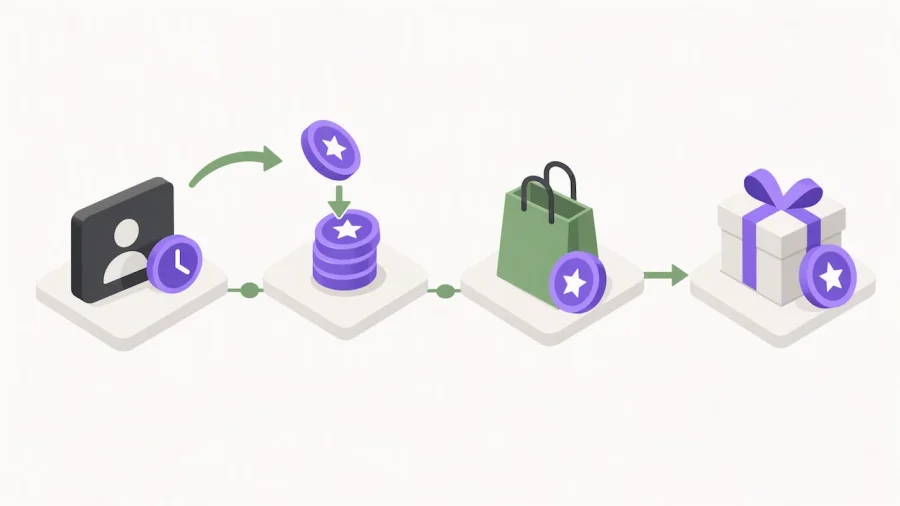
We built our platform so a win-back sequence can run on loyalty mechanics rather than discounting alone. A typical wiring looks like this:
- Identify the lapsed segment using inactivity rules inside our analytics dashboard.
- Trigger an automated flow the moment that segment condition is met.
- Deliver a loyalty credit, stamp, or points top-up as the first touch, rather than opening with a blanket discount.
- Follow up with a personalised offer a few days later if the first touch does not convert.
- Record every redemption automatically, feeding straight back into analytics so you can see which trigger and offer combination actually worked.
A simple starter configuration pairs an onboarding reward with an inactivity trigger and one tiered incentive, which covers most of the twelve ideas above without custom development. Because our setup requires no POS integration, this kind of flow can go live in days rather than months, and automated push and email notifications mean the sequence runs without manual sending once it is configured.
Author’s short take: what to test first and why
If resources are tight, test a segmented discount against a loyalty points grant in month one, same segment, same timing. Discounts recover revenue faster; points tend to build longer retention. Run both, measure at 90 days, and let the data decide where you invest next quarter.
— Michal
BonusQR: a practical tool to implement loyalty-based win-back flows
Everything above works better when the loyalty mechanics and the automation live in one place instead of being stitched together across separate tools. Our platform combines customisable loyalty modules (points, stamp cards, cashback, and fixed discounts), automated push and email notifications, real-time analytics, and branding customisation, so a win-back sequence can go from idea to live flow without a POS integration project.
A sensible starter pack is our Free tier paired with a simple inactivity-to-points flow: set the trigger, grant a small credit, and watch redemption data come in before deciding whether to upgrade. When you are ready for more modules and automation, our Premium plan runs £69 per month, with Basic available at £19 per month for simpler needs, both on our pricing page. Businesses wanting a fully branded app can add White-label Setup at £690 one-off, detailed on our white-label page.
Check pricing and pick a tier that matches your current segment size, then build your first flow this week.
FAQ
What is a winback campaign in marketing?
A winback campaign is targeted outreach, usually a short email or multi-channel sequence, aimed at customers who previously bought or engaged but have since gone quiet. It typically pairs a relevant message with an incentive to prompt a return purchase, and works best when segmented by how recently and how much that customer previously spent.
How long should a win-back sequence run?
Most effective sequences run three to five messages across two to six weeks, with the offer escalating only once partway through rather than opening at full strength. Subscriptions tend to start outreach seven to thirty days after cancellation, while retail flows often wait thirty to ninety days depending on normal repurchase frequency.
What is the best incentive for a lapsed customer?
The best incentive depends on the segment: price-sensitive retail buyers respond well to time-limited discounts or free shipping, while loyalty points or credit protect margin better and build longer retention for subscription or repeat-purchase customers. Framing a reward as a credit rather than a discount tends to feel more valuable to the customer.
How do you measure if a winback campaign worked?
Track reactivation rate, recovered revenue, return on investment per campaign, and the change in lifetime value for the reactivated group compared with a holdout that received no campaign. Evaluate across multiple windows, typically 30, 60, 90, and 180 days, since some reactivated customers convert slowly.
Should I use the same offer for every lapsed customer?
No, tier the offer by customer value and recency: your most valuable, most recently lapsed customers can justify a stronger incentive, while older or lower-value segments usually only need a light-touch message or none at all. Running one blanket offer to everyone wastes budget on customers unlikely to respond and under-serves your highest-value accounts.