
 Deutsch
 Español
 Français
 Italiano
 Magyar
 Polski
 Slovenčina
 Čeština
Offering exclusive discounts to loyal shoppers increases customer retention and lifetime value because it creates a membership mindset, reduces churn, and raises average order value. This is not simply a promotional tactic. It is a structural decision that changes how customers relate to your business.
Three reasons this works immediately:
- Membership and status: Customers who receive offers others cannot access feel recognised. A SheerID survey found that 71% of consumers are more loyal to brands that give them exclusive deals.
- Improved spend per visit: Repeat customers tend to spend more over time. Research shows repeat customers can spend 67% more during months 31–36 of a relationship compared with a new customer’s first six months.
- Easier re-engagement: Loyal shoppers are already in your app, on your email list, or holding your loyalty card. Reaching them costs far less than acquiring someone new.
Quick test you can run this month: Pick your top 20% of customers by purchase frequency. Send them one app-only or email-only discount code valid for two weeks. Measure redemption rate and average order value against your baseline. That single test will tell you more than any report.
What are exclusive member discounts and how do they differ from public promotions?
An exclusive discount is an offer available only to a defined, verified group: your loyalty programme members, app users, or a specific community segment such as students or long-term subscribers. The customer must qualify to receive it, and that qualification is the point.
Common formats include:
- Member-only percentage discounts (e.g. 10% off every purchase for registered members)
- Tiered discounts that increase with spend level or tenure (e.g. Silver, Gold, Platinum tiers)
- App-only coupon codes delivered via push notification or in-app wallet
- Anniversary or tenure rewards triggered on a customer’s membership anniversary
- Early-access sales where members shop 24–48 hours before the public
A public promotion, by contrast, is available to anyone: a sitewide sale, a first-time buyer code published on a voucher site, or a seasonal discount advertised on social media. These drive volume but attract price-sensitive shoppers who often leave once the deal ends. Exclusive offers, framed as a reward for tenure or behaviour, reduce that problem by filtering for customers who have already demonstrated commitment.
Gating matters for perceived fairness. When customers see that an offer requires membership or a verified status, they understand why they earned it. Framing is equally important: messaging that says “As a valued member, here is your exclusive reward” signals appreciation rather than scarcity, which reduces resentment among customers who do not yet qualify.
Why exclusive discounts work: the behavioural and economic case
The psychology behind member-only offers
Several well-documented behavioural mechanisms explain why exclusive discounts are more effective than public sales at building lasting loyalty.
- Reciprocity: When you give customers something of genuine value, they feel an obligation to return. A personalised discount triggers this more reliably than a generic sale.
- Social identity and status: Belonging to a tier or member group satisfies the human need for recognition. Customers who hold Gold status behave differently from those who do not, even when the monetary difference is small.
- Mental accounting: Structured accumulation frameworks make brand-specific points and credits feel more valuable than their equivalent cash value, because customers mentally ring-fence them for future use.
- Scarcity and access: Early-access offers and limited-edition member drops create anticipation. That anticipation drives repeat visits even before a purchase is made.
The economic logic
The business case is straightforward. Retaining an existing customer costs less than acquiring a new one, and retained customers spend more over time. An exclusive 10% loyalty discount, sent via push notification to members who have not purchased in 30 days, can recover a lapsing customer at a fraction of the cost of a paid acquisition campaign.

Consider a realistic example. A café in Prague with an average transaction value of €4.50 offers a 10% member discount to customers who have visited at least five times. The discount costs €0.45 per redemption. If that offer brings a lapsing customer back for six additional visits over the next three months, the incremental revenue is €27, against a discount cost of €2.70. The net gain is clear, and the customer’s lifetime value has grown.
Emotional attachment is the critical mediator here. Discounts that feel earned and personal build that attachment; blanket public sales do not. This is why the most effective programmes blend monetary discounts with experiential rewards rather than relying on price cuts alone.
What business metrics do exclusive discounts actually move?
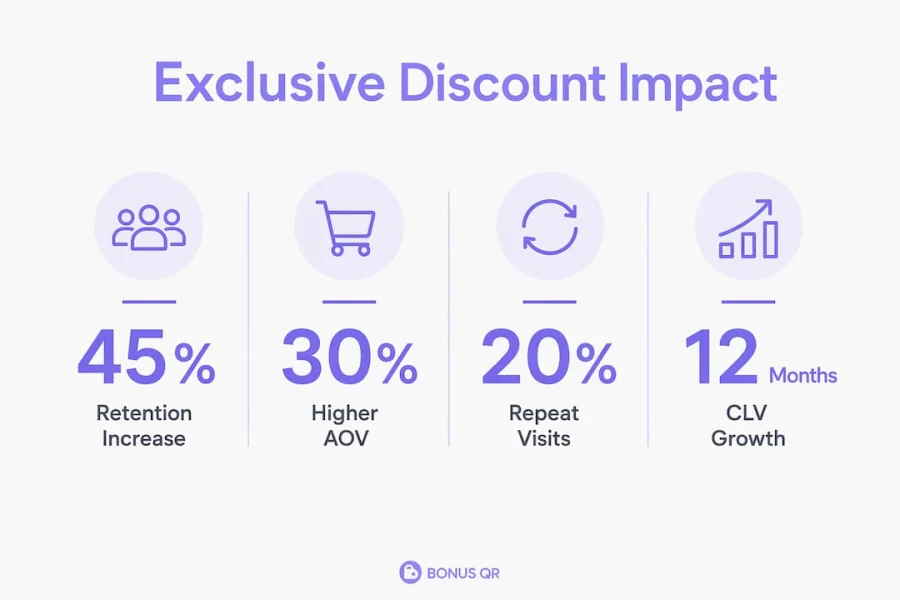
Exclusive offers for returning customers affect several KPIs simultaneously. Understanding which ones to track, and when to expect movement, helps you build a credible business case.
| KPI | How to measure | Reporting cadence | Typical timeline |
|---|---|---|---|
| Retention rate | % of customers who return within 90 days | Monthly | 2–3 months |
| Repeat purchase rate | Purchases per customer per quarter | Monthly | 1–2 months |
| Customer lifetime value (CLV) | Average order value × purchase frequency × tenure | Quarterly | 3–12 months |
| Average order value (AOV) | Total revenue ÷ number of transactions | Weekly | 4–8 weeks |
| Redemption rate | Coupons redeemed ÷ coupons issued | Per campaign | Immediate |
| Referral rate | New customers attributed to referral | Monthly | 3–12 months |
| Margin impact | Revenue from offer cohort minus discount cost | Per campaign | Immediate |
A few practical notes. Redemption rate and AOV move quickly and are the easiest early signals. Retention rate and CLV take longer but carry more strategic weight. Always measure incremental lift, not absolute numbers: compare the offer cohort against a matched control group who did not receive the discount. That comparison tells you whether the discount caused the behaviour change or simply coincided with it.
The Deloitte consumer loyalty research is clear that ongoing programme benefits outperform single sign-up incentives in driving long-term loyalty. Build your KPI reporting around the ongoing relationship, not just the first redemption event.
Types of exclusive discounts and practical examples you can copy
Tiered percentage discounts
Reward customers based on cumulative spend or visit frequency. A gym in Warsaw might offer 5% off merchandise to members who have attended 10 sessions, 10% after 25 sessions, and 15% after 50. The tier structure gives customers a visible goal and a reason to keep coming back.
Anniversary and tenure rewards
Trigger a discount automatically on a customer’s membership anniversary or after a set tenure milestone. A grocery retailer in Budapest could send a “Happy 1-year membership” coupon worth 8% off the next shop. These feel personal and cost very little to automate.
App-only coupons
Deliver a time-limited code exclusively through your loyalty app or mobile wallet. Because the offer is invisible to non-members, it reinforces the value of membership without publicly advertising a discount. Exclusivity marketing research shows this approach raises engagement and lifetime value without the margin erosion of blanket sales.
Early-access sales
Open a sale to members 24–48 hours before the public. No price cut required. The access itself is the reward, and it protects your full-price margin on the first wave of purchases.

Personalised value-based credits
Issue credits based on individual purchase history. A customer who regularly buys coffee and pastries receives a credit specifically for that combination. This conditional discount approach preserves the customer’s internal reference price for the product at full cost, because the discount feels earned rather than standard.
Community and gated offers
Segment by identity: students, healthcare workers, or long-term subscribers. These gated offers generate higher emotional connection—73% of consumers feel more emotionally connected when given gated offers—than generic coupons, and convert well for identity-based groups.
When to prefer non-monetary exclusives: For high-margin products or customers already satisfied with price, early access and limited editions often outperform straight discounts. They shift the conversation from price to access, which raises willingness to pay rather than lowering it.
Pro Tip: When launching a new exclusive offer, send a brief message to non-members explaining what members receive and how to join. This turns the offer into a recruitment tool without alienating anyone who sees it.
How to build an exclusive-discount programme step by step
Step 1: Set objectives and guardrails
Define what success looks like before you design anything. Typical objectives include a target retention rate lift, a minimum repeat purchase rate, and an acceptable margin reduction per redeemed offer. Set a ceiling on discount depth (e.g. no single offer exceeds 15% off) and identify which customer segments you want to protect from over-discounting.
Step 2: Segment and gate your audience
Use tenure, recency, frequency, and spend data to define tiers. A simple starting framework:
- New members (0–3 months): Onboarding offer to encourage a second purchase.
- Active members (3–12 months, 2+ purchases): Regular member discount, app-only codes.
- Loyal members (12+ months or top 20% by spend): Tiered upgrade, early access, anniversary reward.
Gating requires verification. App login, loyalty card scan, or email confirmation are the most common mechanisms in Central Europe. Each creates a data touchpoint that feeds your CRM.
Step 3: Design discount rules and frequency
Keep rules simple. Customers who find redemption confusing disengage quickly. Decide:
- How steep (10–15% is a common starting range for member discounts)
- How often (monthly or per-visit, not both simultaneously)
- Stacking policy (can a member combine a tier discount with a campaign code?)
- Expiry (14–30 days is enough urgency without feeling punitive)
Step 4: Choose channels and timing
| Channel | Best use | Timing |
|---|---|---|
| App push notification | Time-sensitive codes, early access | 48 hours before expiry |
| Anniversary rewards, tier upgrades | Day of trigger event | |
| SMS | High-urgency flash offers | Same day |
| In-store receipt | Post-purchase next-visit incentive | At point of sale |
Step 5: Launch, test, and iterate
Run an A/B test on your first campaign. Split your eligible members into two groups of equal size. One group receives the exclusive offer; the other does not. Compare redemption rate, AOV, and 90-day retention between the two groups. This is your control definition. A meaningful result typically requires at least 200 customers per group and a four-week observation window.
GDPR and Central Europe compliance note: Under the EU General Data Protection Regulation, which applies across Central Europe, you must have a lawful basis for processing customer data used to personalise offers. Consent or legitimate interest are the most common bases. Ensure your loyalty programme sign-up captures explicit consent for marketing communications, and honour opt-outs promptly. The customer retention workflow in Bonusqr’s platform includes consent management features that simplify this.
How to measure ROI and avoid the common pitfalls
Measuring true incremental value
Three simple calculations anchor your ROI analysis:
Incremental revenue per campaign: (Average order value of offer cohort × redemptions) minus (Average order value of control cohort × equivalent period purchases) minus total discount cost.
Incremental CLV: Compare the 12-month CLV of customers who received and redeemed an exclusive offer against a matched cohort who did not. The difference is the attributable lift.
Payback period vs acquisition cost: If your average customer acquisition cost is €25 and your exclusive discount programme costs €3 per retained customer per quarter, the retention route pays back in under one quarter for any customer who makes two or more purchases.
Always run a holdout cohort. Without a control group, you cannot separate the effect of the discount from seasonal trends or natural repeat behaviour.
Common pitfalls and how to avoid them
- Over-discounting: Offering discounts too frequently trains customers to wait for deals rather than paying full price. Cap offer frequency and vary the reward type. Public limited-time deals attract price-sensitive shoppers; exclusive member offers should not replicate that pattern.
- Attracting price-shoppers: If your gating is too loose (e.g. anyone who signs up today gets the discount), you recruit deal-seekers rather than loyal customers. Require a minimum tenure or purchase history before the offer unlocks.
- Cannibalisation of full-price sales: Monitor whether offer redemptions replace purchases that would have happened anyway. If redemption rate is high but incremental revenue is flat, the discount is subsidising existing behaviour, not changing it.
- Confusing tier structures: Customers who cannot easily understand what they need to do to reach the next tier disengage. Keep tier names and thresholds visible in the app and on receipts.
- Perceived unfairness: Customers who discover an exclusive offer they did not receive can feel excluded. Frame all communications around earned status (“You’ve reached Gold tier”) rather than arbitrary selection. Grandfather existing customers into new tiers rather than resetting them.
What recent research says about exclusive discounts
Three findings from 2024–2025 research are particularly relevant for Central European businesses designing loyalty programmes.
First, a study of 520 consumers published in the ACR journal found that loyalty points and experiential rewards outperformed BOGO (buy-one-get-one) offers in building long-term loyalty, with emotional brand attachment serving as the key mediator. The practical implication: discounts should trigger emotional attachment, not substitute for it. Pair a member discount with a personal message or a status upgrade to maximise the effect.
Second, research on conditional discounts published in the European Journal of Marketing shows that conditional discounts preserve customers’ internal reference prices better than unconditional ones. When customers understand that a discount is earned through patronage, they do not revise their perception of the product’s full price downward. This is a meaningful advantage over public sales, which can erode price credibility over time.
Third, practitioners consistently recommend replacing blanket public sales with layered, behaviour-based discounts that reward tenure. This preserves margin while delivering a genuine perceived advantage to loyal customers.
Practical best practices drawn from the evidence:
- Blend monetary discounts with at least one non-monetary exclusive (early access, status recognition) to build emotional attachment alongside transactional value.
- Frame every offer around earned status rather than scarcity alone. “You’ve earned this” outperforms “Limited time only” for long-term retention.
- Track both behavioural metrics (repeat rate, AOV) and attitudinal ones (Net Promoter Score, reported appreciation) to detect fairness issues before they become complaints.
A Central Europe example with Bonusqr: A grocery chain in Bratislava uses Bonusqr’s tiered discount module to offer 5% off to members who shop twice a month and 10% to those who shop four or more times. App-only coupons are issued via push notification on Thursdays, driving weekend footfall. The analytics dashboard tracks redemption rate and AOV by tier weekly, allowing the marketing team to adjust offer depth without manual reporting. The benefits of customer loyalty programmes in this kind of structured setup compound over time as tier membership grows.
Key takeaways
Exclusive discounts increase retention and lifetime value when they are gated, earned, and paired with status recognition rather than used as a substitute for genuine customer relationships.
| Point | Details |
|---|---|
| Gate your offers properly | Require tenure or purchase history before a discount unlocks to avoid recruiting price-shoppers. |
| Blend discount types | Pair monetary discounts with early access or status rewards to build emotional attachment, not just transactional habit. |
| Measure incrementally | Always compare an offer cohort against a control group; redemption rate alone does not prove the discount changed behaviour. |
| Keep rules simple | Customers who find redemption confusing disengage; cap tiers at three levels and publish thresholds clearly. |
| Use Bonusqr to automate | Bonusqr’s tiered discount, app-only coupon, and analytics features let you run and measure exclusive-discount programmes without manual reporting. |
When are exclusive discounts the right tool?
Exclusive discounts are most effective in markets with meaningful price sensitivity, where customers are actively comparing options and a verified member benefit creates a real reason to stay. They also work well when your customer acquisition costs are rising. If you are spending more to bring in new customers than it costs to retain existing ones, shifting budget towards exclusive member offers is a straightforward reallocation.
Where I would urge caution is with low-margin products and with customers who are already highly satisfied and returning regularly without any incentive. Offering a discount to someone who would have purchased anyway is a margin cost with no behavioural return. For those customers, experiential perks, early access, or status recognition deliver perceived value without touching your margin.
The sequencing question matters too. Start with a monetary exclusive to establish the habit of returning, then layer in non-monetary perks as the relationship matures. A customer who joins for the 10% discount and stays for the early-access events is far more valuable, and far harder to poach, than one who stays only because the discount exists. Brand differentiation ultimately comes from the full experience you create around membership, not from the discount percentage alone.
Bonusqr makes it straightforward to run exclusive-discount programmes
If you are ready to move from theory to practice, Bonusqr gives you the tools to build, gate, and measure exclusive-discount programmes without needing a developer or a complex POS integration. The platform supports fixed discount programmes and tiered structures out of the box, with app-only coupon delivery, push notifications, and real-time analytics built in.
Three features that map directly to the implementation steps above:
- Segmentation and gating: Define member tiers by spend, visit frequency, or tenure. Offers unlock automatically when a customer meets the criteria.
- App-only coupon delivery: Issue time-limited codes via the mobile app or Apple/Google Wallet, keeping offers invisible to non-members and reinforcing the value of membership.
- Analytics dashboard: Track redemption rate, AOV, and retention by tier in real time, so you can adjust offer depth based on actual data rather than guesswork.
Set up your first exclusive-discount programme with Bonusqr’s loyalty card platform and run your first A/B test within weeks.
Useful sources and further reading
The following sources underpin the claims and recommendations in this article. All are publicly accessible and relevant to businesses operating in Central Europe.
- From discounts to brand love: examining the long-term impact of promotional strategies on customer loyalty — ACR Journal, peer-reviewed study of 520 consumers on emotional attachment and promotional strategy.
- Consumer loyalty survey: 71% of consumers are more loyal to brands that give them exclusive offers — SheerID survey of 3,200+ consumers on exclusivity and emotional connection.
- Reshaping customer loyalty programmes — Deloitte consumer loyalty research on ongoing benefits, redemption ease, and programme design.
- The impact of conditional discounts on consumers’ internal reference prices — European Journal of Marketing, peer-reviewed research on conditional vs unconditional discounts.
- Exclusive offers vs limited-time deals: which strategy boosts customer loyalty? — Industry analysis on deal-seeker attraction and membership mindset.
- Exclusivity marketing — Practitioner analysis on early access, limited drops, and LTV without heavy discounting.
- Loyal customers vs new customers — Data on repeat customer spend in later relationship months.
- Mental accounting and loyalty rewards — Research on structured accumulation and perceived point value.
- Using loyalty programmes to attract consumers to value-added businesses — Penn State Extension practical guide on loyalty programme design.
GDPR note for Central Europe: Any loyalty programme that collects personal data to personalise exclusive offers must comply with the EU General Data Protection Regulation (GDPR), which applies in all Central European EU member states including Poland, the Czech Republic, Slovakia, Hungary, and Austria. Obtain explicit consent for marketing communications at sign-up, document your lawful basis for data processing, and provide a clear opt-out mechanism. The national data protection authority in each country (e.g. UOOU in the Czech Republic, NAIH in Hungary) publishes guidance on loyalty programme compliance. For consumer protection, the EU Unfair Commercial Practices Directive also applies: exclusive offers must not mislead customers about the conditions of eligibility or the value of the benefit.