A café owner checks the counter drawer and finds a stack of paper stamp cards. Some have gone missing in customers' coats; others are half-finished. The owner recognises regular faces but can't tell who visits most often, or whether a reward brings anyone back sooner.
A white label rewards platform is a loyalty system built and maintained by a provider, but presented to customers under a business's own brand. It gives a local business a way to run digital rewards without developing the underlying software itself.
What a White Label Rewards Platform Is and Why It Matters
It is like renting a fitted shop unit and putting the business's own sign above the door. The provider supplies the fittings and handles upkeep; the merchant chooses the look and decides what customers can earn.
The first working part is the reward engine. It applies the rules for stamps, points, cashback, visit thresholds or other offers. A café might offer a drink after a set number of visits. A salon might reward a customer after a series of appointments.
The second part is the customer profile. A member can see their progress and available rewards, often through a personal QR code. An optional digital wallet pass can keep the loyalty card handy on a phone.
The third part is the merchant side. Staff scan the customer's code to record a visit or redeem a reward. The owner can review visit history and see how customers use the scheme, depending on the platform's tools.
Branded scheme or shared app?
A shared marketplace app can be quick to try, but it presents multiple businesses together. A customer who joined a café's scheme may also see other local offers in the same app. That can help a small business get discovered, but it means the loyalty experience isn't exclusive to its brand.
A white label app presents the programme under the merchant's own name, icon and colours. The trade-off is that the business needs to promote its own scheme, rather than relying on a shared app to introduce customers to it.
The term describes a branded front end backed by a provider's software. The three working parts are the reward engine, the customer profile and the merchant tools. The key distinction is whether the customer joins a business's own branded scheme or a shared one.
Core Features and Benefits for Small Businesses
A useful platform should make the reward easy to understand at the counter and straightforward for staff to run. These features cover common needs for cafés, restaurants, salons, gyms and local retailers.
- Stamp cards reward a simple action, such as buying a coffee. They suit businesses where customers visit often and want visible progress.
- Points systems can scale with spend, which helps when bills vary in size.
- Cashback returns value as credit to use on a later visit.
- Visit and spend thresholds connect a clear target to a reward, such as a free drink after the tenth visit.
- Fixed discounts give customers a quick, easy-to-explain benefit.
- Welcome offers give new members a reason to try the scheme straight away.
- Birthday and seasonal coupons can be scheduled for relevant moments rather than sent by hand.
- Referral rewards recognise a member who brings a friend.
- QR check-in lets customers show one code instead of finding a paper card.
- Apple and Google Wallet passes keep a digital card available on a phone.
- Staff redemption tools should show what the reward is and what action staff need to take.
- Analytics can help an owner review top customers, coupon use and visit trends.
What those features change day to day
A digital card can reduce printing and the number of rewards lost because a customer forgot a paper card. The customer list also gives the owner a way to distinguish active members from people who haven't returned, then choose an appropriate offer instead of sending the same discount to everyone.
A reward only helps if customers can understand and claim it. In a 2024 Deloitte survey that included UK consumers, 86% rated financial rewards, simplicity and ease of use as important or very important loyalty-programme attributes (Deloitte's consumer loyalty survey). A complicated redemption flow can undo the appeal of a generous offer.
Launch rule: Choose one main reward and one occasional secondary reward. Customers should be able to explain the scheme in a sentence.
Implementation Options Compared Side by Side
A business can run loyalty with paper, a shared app, a white label platform, a custom app or a loyalty module built into its point-of-sale system. The right choice depends on how much brand control and system integration the business needs.
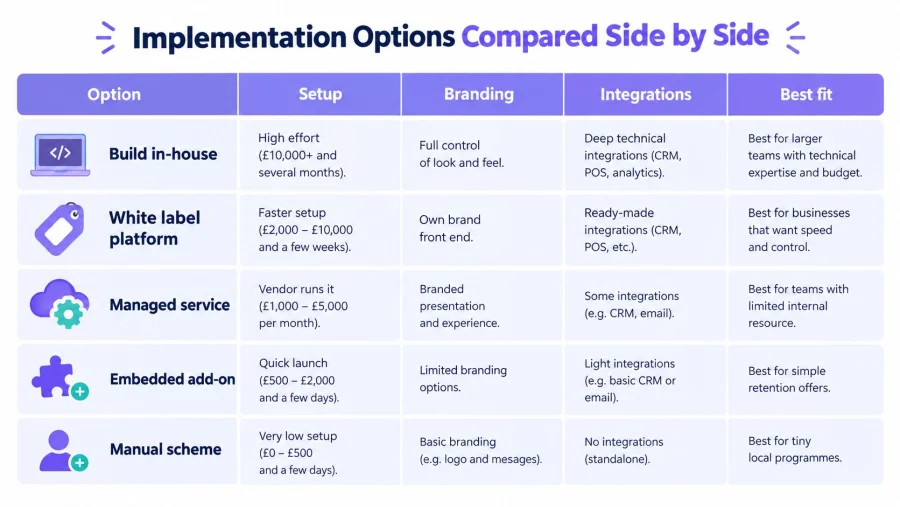
| Option | Setup Time | Branding | Integrations | Best Fit |
|---|---|---|---|---|
| Paper punch cards | Same day | Your printed logo | None | Very small shops testing an idea |
| Shared marketplace app | Minutes | Platform brand, other shops visible | None | Testing demand at low cost |
| White label app | Days to weeks | Your icon, logo and colours | None, with no POS or CRM link | Brands wanting their own app |
| Custom-built app | Months or longer | Fully bespoke | POS and CRM possible | Chains with specific rules |
| POS-built loyalty module | Setup with the POS system | Limited to the POS theme | Built into one POS | Shops already on that POS |
Paper punch cards cost little and need no technology, but don't give an owner a customer list or visit history. They're useful for testing a simple offer before choosing software.
A shared marketplace app can be fast to launch, but customers see other businesses in the same space. That may help discovery, though it also gives customers reasons to browse elsewhere.
A white label app puts the business's icon, logo and colours in the customer-facing experience. It's a fit for merchants who want a branded scheme but don't need POS or CRM data to flow into it.
A custom-built app allows specific rules and system connections, but needs more development work and a longer delivery plan. A POS-built module may be quicker for a merchant already using that till, but can make a later move to another system harder.
For a broader view of the systems a retailer may need to compare, the retail point-of-sale software checklist can help identify requirements before choosing a loyalty setup.
If the priority is a branded experience without a POS link, a white label app is the straightforward option. If customer and transaction data must flow both ways between loyalty and POS or CRM, investigate custom development. Ask each vendor for dated setup timelines and a complete price list, and get unclear items confirmed in writing before comparing offers.
Which Businesses Gain Most From Branded Rewards
Loyalty schemes are already familiar to many UK customers. In a YouGov survey of 1,019 adults in Great Britain, conducted online from 15–22 May 2024, 82% said they were signed up to a supermarket loyalty programme, 34% belonged to a food-service programme and 30% belonged to a beauty-retailer programme (YouGov's 2024 survey of loyalty preferences).
Those figures show that customers may recognise the format. They don't mean every business should copy a supermarket scheme. The reward should fit the normal gap between visits and the value of a typical purchase.
| Business | Typical Visit Pattern | Best Reward Type | Main Watch-Out |
|---|---|---|---|
| Coffee shop or café | Short, frequent visits, often daily | Stamp card or visit threshold | Rewards must arrive quickly or they feel slow |
| Restaurant or quick-service eatery | Weekly or occasional, larger bills | Points or spend-based reward | Discounts can eat margin on busy nights |
| Beauty salon or wellness centre | Booked every four to eight weeks | Visit threshold or birthday offer | Track rebooking, not just visits |
| Gym or fitness studio | Recurring weekly attendance | Attendance milestones and streaks | Reward showing up, not just paying fees |
| Retail or grocery store | Mixed and often unplanned | Spend-based points or cashback | Cash and card sales need a clear logging method |
Match the reward to the return cycle
A café visit may last only a few minutes, and regulars may come daily. A reward that takes too long to reach can feel remote. A restaurant has larger, less predictable bills, so a spend-based reward may be fairer than counting every table as an identical visit.
A salon has a different rhythm. Say a salon offers a free treatment after a customer's fifth visit. If appointments normally fall several weeks apart, the salon can make the milestone visible at each booking and encourage customers to arrange the next appointment before leaving. The useful measure isn't just how many stamps were earned; it's whether customers rebooked and returned within the expected appointment cycle.
Gyms should recognise attendance rather than reward membership fees. For retail and grocery shops, the owner needs a clear way to log qualifying purchases when some customers pay cash and others use cards.
Start with the row closest to the business. Test its suggested reward, then check whether customers return more reliably, rather than assuming that sign-ups alone mean the offer works.
Avoiding Loyalty Fatigue and Serving Customers Who Skip Apps
One more scheme can be welcome, even for someone already enrolled elsewhere. But an app that demands too much or makes rewards feel distant can quickly become another chore. UK loyalty reporting from BDO notes that consumers already involved in multiple schemes may be more willing to join additional programmes, so loyalty fatigue isn't universal (BDO's restaurant and bars report).
Watch for these signs that the programme is asking too much:
- The first reward takes months to reach. Members may stop noticing their progress.
- An app install is required before the first stamp counts. That adds a barrier at the moment of sign-up.
- The same discount repeats every week. Customers may learn to wait for it instead of responding to a fresh reason to visit.
- Notifications arrive too often. Frequent messages can make a useful scheme feel intrusive.
Set the first reward within a few visits so customers can see progress early. Keep the main offer consistent and use a surprise reward occasionally, rather than filling every week with another promotion.
For customers who won't install an app, a QR code can open a mobile web page, staff can look up a member at the till, and a paper card can remain available for anyone who needs a simpler option. A collection of QR campaign ideas from RedirHub can help a business think through where to display a code and what the scan should open. A web app for repeat visits is another route to participation without requiring an app download.
Before changing the journey, ask a practical question: could a customer who skipped the app still earn and redeem a reward?
How to Evaluate a Rewards Vendor Before You Sign
Vendor homepages often promise similar outcomes. A fair comparison starts with the same questions for every provider, answered in writing, so a polished demo doesn't hide gaps in the everyday service.
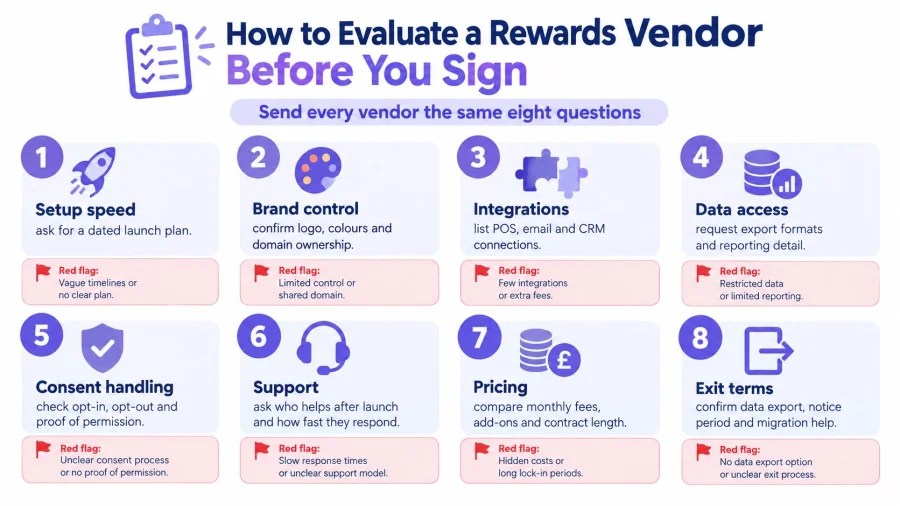
| Question | Why It Matters | Red Flag |
|---|---|---|
| Setup speed: Can the vendor provide a dated launch plan, and who handles setup? | The plan shows what the business must prepare and when staff can start using the scheme. | No timeline |
| Branding: Will the customer see the business's icon, logo and colours without the platform brand? | The customer experience should match what the business is promising. | Platform branding visible to customers |
| Integrations: Are POS or CRM links included, and what do they cost? | A connection that costs extra changes the real scope and price. | Integration promised without a price |
| Customer access: Is there a QR code, wallet pass and a route for people who won't install an app? | More than one access route helps keep the scheme usable at the counter. | App-only, with no fallback |
| Reward rules: Which reward types are available, and can the business change rules itself? | An owner needs to update an offer without waiting for support. | Rules can't be changed without help |
| Analytics: Can the owner see top customers, coupon results and visit trends? | Scan totals alone don't show how customers behave. | Reporting shows only total scans |
| Data ownership: Who controls the customer list, and how can data be deleted or exported? | Clear answers matter when changing provider or handling customer requests. | Vague ownership terms |
| Pricing: What are the one-off and recurring fees, and what does each plan exclude? | The headline price isn't the full cost if basic features are add-ons. | Hidden fees for basic functions |
A red flag isn't necessarily a high price. It's a vague answer about what the business will receive, what staff need to do or what happens when the contract ends. For additional perspective on assessing a service provider, Sup Growth's service evaluation tips offer a useful way to think about comparing vendors beyond their sales pitch.
A two-week test with five real customers can reveal issues a presentation won't. Check whether each person can join, earn a reward and redeem it without staff having to explain every screen. The BonusQR rewards for small businesses can also help owners consider the practical features a small-business programme may need.
Consent and Customer Trust Rules You Must Follow
A rewards scheme can collect customer details and send marketing, so the business needs to make clear what customers are agreeing to. ICO guidance says consent for electronic marketing must be active, specific and freely given. It must identify the organisation, clearly cover electronic marketing and involve an affirmative action; pre-ticked boxes aren't valid consent (ICO guidance on marketing and data protection).

A practical sign-up flow separates the reward account from optional promotional permission. Customers should be able to join and earn without being forced to agree to marketing.
- Separate the choices. Make reward-account registration distinct from promotional messages.
- Ask by channel. Give customers clear controls for email, SMS and push notifications rather than treating one tick as permission for every channel.
- Name the business. Customers should know which organisation is asking to contact them.
- Make opting out easy. Withdrawal must be as straightforward as opting in, and each campaign should provide a clear way to stop messages.
- Keep marketing optional. Don't make promotional consent a condition of earning points or receiving the core reward.
A business may be able to use the soft opt-in to send similar offers to a customer whose details it collected while selling or negotiating to sell a product or service. That requires an opt-out when the details are collected and another in each later message. A loyalty sign-up should not add every customer to unrelated promotions without clear consent.
Partner offers need extra care. Someone who joined one café's scheme hasn't automatically agreed to receive promotions from another independent business. Keep a consent record with the date, the privacy notice version and the permitted channel. A central opt-out process should stop promotional messages across the relevant campaigns, while reward-account notices such as points or voucher updates should only continue where legally justified.
Before sending any campaign, ask whether a customer would be surprised to receive it.
How to Prove Rewards Drive Extra Visits
Engagement means customers scanned or opened a message. Incremental profit means the programme led to additional visits or spend that wouldn't otherwise have happened. Those are different results, and a business needs a comparison to tell them apart.
- Record a baseline. Track visits and average spend for a consistent period before launch. This provides a reference point for later comparisons.
- Hold back a control group. Randomly leave some members out of the new offer for a limited test period. Their behaviour helps show what might have happened without the offer.
- Compare behaviour. Look at visit frequency and average transaction value for customers who received the offer and those who didn't.
- Calculate reward cost against extra spend. Don't divide the cost by all member spending; focus on the additional activity linked to the campaign.
- Set an attribution window. Decide how long after an offer a return visit counts, then apply the same rule throughout the test.
Without a POS link, a café can ask staff to tally scanned visits each day and compare those with total transactions. This is an estimate, not a full transaction record, so mixed cash and card payments need a consistent logging method. For a business preparing to test an offer, plan a local loyalty campaign around one clear action and one measurable outcome.
Illustration, not a sector average: A café has 300 members and holds 40 out of the offer group as a control. Suppose the stamp offer adds 0.3 extra visits per member per month. That 0.3 is a planning assumption to test, not an expected result, and 40 control members is a small group. The first comparison can point to a direction, but it can't establish proof on its own.
Small samples produce noisy results. Judge the pattern over a full quarter, and keep the same measurement method long enough to separate a genuine change from ordinary week-to-week variation.
Choose Your Setup and Start a Test This Month
A small, measurable test is more useful than launching several offers at once. Pick one reward that fits the business's visit pattern, then keep the setup simple enough for staff and customers to use.
- Choose one primary reward that suits the business, such as a stamp card for a café or an attendance milestone for a gym.
- Set a reachable threshold so regular customers can make visible progress within a few weeks.
- Put the QR code where the action happens, such as by the counter and till.
- Review visits and redemptions after 90 days against the business's baseline.
BonusQR suits businesses that want a QR-based loyalty programme without extra hardware or POS work. Customers scan at the store to see available rewards, create an account with one click and receive a personal QR code. Staff scan that code to award or redeem rewards, with the redemption details visible during the process.
The white label version carries the business's icon, logo and colours and is ready to use in 14 days. BonusQR doesn't provide third-party POS or CRM integrations with its standard or white label app; those connections are possible with a custom app, which should be priced separately.
Start with BonusQR and test one clear reward this month. Give regulars an easy way to earn it, then review whether they came back more often before adding another offer.


