
 Deutsch
 Español
 Français
 Italiano
 Magyar
 Polski
 Slovenčina
 Čeština
A café owner notices the same pattern every week. Customers return, but paper loyalty cards disappear, staff forget to stamp them, and regulars don't have an easy way to see what they've earned. The owner wants a branded app, yet a fully custom build feels expensive, slow and difficult to maintain.
That is where white label app development can fit. A prebuilt loyalty product is adapted with the business's icon, colours, name and reward rules, while the underlying functions remain ready to use. The important question isn't whether the app can launch quickly. It's whether the product can support customer data, campaigns, hosting, maintenance and changing loyalty rules after launch.
What White Label App Development Means for Loyalty
A white label loyalty app is one platform presented as a specific business's digital product. A café can use visit stamps, a salon can reward spending, a gym can offer membership incentives, and a retailer can create points or cashback rules without commissioning an entirely separate system each time.
The customer sees the business's branding. Staff use the same practical workflow behind the scenes. A customer signs up through mobile or web, receives a personal QR code, collects rewards and checks their history. Staff scan the code and redeem the reward without requiring a new till system or specialist hardware.
The difference from a custom build
A custom app starts with the business's requirements and creates the product around them. That offers deeper control, but the business also takes on more discovery, testing, technical decisions and long-term ownership.
A white label app starts with a working core. Branding and configuration sit on top of that core, so the business can focus on the loyalty proposition rather than rebuilding account creation, QR rewards, redemption and campaign infrastructure.
It isn't the same as a basic no-code wrapper around a website. A credible white label product should provide a defined customer journey, operational tools, data controls and a support model. The business still needs to decide:
- Reward logic: Whether customers earn stamps, points, cashback, visit rewards or spend bonuses.
- Customer journey: How customers join, identify themselves, earn rewards and redeem them.
- Brand presentation: Which logo, colours, messages and store information appear in the app.
- Operating responsibilities: Who manages campaigns, support, hosting, updates and compliance.
The UK market provides a substantial ecosystem for this model. The UK app development industry was valued at £32.3bn in 2026, with 15,282 businesses operating in the sector, according to UK app development industry data. The number of businesses grew at a 5.5% CAGR between 2021 and 2026, while market size expanded at a 10.9% CAGR over the same period.
At the same time, adoption among small businesses remains uneven. O2 Business reported that only 7% of small businesses had moved at least part of their business onto a smartphone app since March 2020, leaving 93% with no part of the business on an app, as reported in this UK small-business app adoption analysis.
For a brick-and-mortar operator, the practical choice is therefore not “app or no app”. It's whether an app can solve a specific repeat-visit problem without creating an unwanted software operation. A brick-and-mortar white-label program should make that decision easier by keeping the customer experience branded while reducing unnecessary build work.
Build vs Buy vs White Label and How to Choose
The right decision depends on ownership, not just the first quotation. A custom build may provide maximum flexibility, but it also leaves the business responsible for product decisions, technical maintenance and integration risk. Buying an off-the-shelf platform can be simpler, although the brand and loyalty rules may be constrained.
White label sits between the two. It gives the business a branded customer-facing product while reusing a proven loyalty foundation. That can be a practical fit for cafés, salons, gyms and retailers whose differentiation comes from their offer, service and customer relationships rather than from inventing new app infrastructure.
| Criteria | Custom Build | White Label | Off-the-Shelf Platform |
|---|---|---|---|
| Build cost | Highest ownership burden, with discovery, design, development and testing priced separately | Lower starting scope when existing loyalty functions cover the requirement | Usually the simplest route to start, subject to plan and feature limits |
| Time to market | Longer because core functions must be designed and built | Faster when branding and rules can be configured | Fast if the standard workflow matches the business |
| Branding control | Deep control over app experience and visual system | Branded app identity with configuration boundaries | Often limited to platform templates and account branding |
| Integrations | Suitable for unusual POS, CRM or membership requirements | Works best with supported integrations and clear data boundaries | Depends on the vendor's available connectors |
| Support | The business needs a named technical owner or development partner | The white label partner normally manages the shared platform and agreed support | Vendor support may be standardised rather than tailored |
| Data governance | The business and its technical partners must define the full operating model | Responsibilities must be stated clearly in the agreement | The vendor's standard terms determine much of the model |
| Maintenance | Every change, bug fix and platform update must be planned | Shared platform maintenance can reduce duplicated work | Updates follow the vendor roadmap, not always the business roadmap |
Where the hidden cost appears
Scope creep is the most common source of friction. A simple loyalty app becomes harder when the brief adds a custom membership engine, several POS connections, advanced reporting and unusual reward exceptions.
UK project budgets commonly fall between £10,000 and £49,999, while the average project budget is around £90,780, according to this UK app development budget analysis. Those figures aren't a quote for every loyalty app, but they show why a tightly defined white label scope can be commercially sensible.
A custom build makes more sense when the app itself is a strategic product, when advanced integrations are essential, or when the business needs behaviour that a configurable platform cannot support. White label is usually the simpler choice when the core need is repeat visits, reward redemption, branded communication and manageable customer data.
Decision rule: Choose custom development for unique operational software. Choose white label when the loyalty experience is valuable but the underlying infrastructure doesn't need to be reinvented.
Essential Loyalty Features and Branding That Converts
A loyalty app shouldn't begin with a long feature list. It should begin with the behaviour the business wants to encourage. A café may need more regular visits, a salon may want customers to return between appointments, and a gym may want members to engage with additional services.
Start with the reward mechanic
Use one primary mechanic first, then add supporting rules only when staff and customers understand the journey.
- Stamps: A clear visit-based reward works well when the purchase pattern is frequent and easy to recognise.
- Points: Points suit businesses with different product prices or several categories of spend.
- Cashback: Cashback can make the benefit feel direct, but the business needs clear redemption rules and margin discipline.
- Visit thresholds: A reward after a defined number of visits gives customers a reason to return without requiring complex calculations.
- Spend thresholds: Spend-based bonuses suit salons, gyms and retailers where transaction values vary.
- Welcome bonuses: A joining reward gives a new member an immediate reason to try the programme.
- Birthday and seasonal coupons: Timely offers can support relevant communication instead of constant discounting.
The strongest setup usually combines a simple earning rule with a specific reward. Customers should know what action earns value, how much value they receive and when they can redeem it.
Add only the brand and service layers that matter
The app icon, name and colour palette should match the physical business. A customer shouldn't feel that a local salon has redirected them to a generic software portal.
Useful supporting functions can include:
- Menus and price lists for cafés and restaurants.
- News and campaign updates for retailers and gyms.
- Reviews and customer feedback prompts.
- Reservations where appointment or class booking supports the loyalty journey.
- Google Wallet and Apple Wallet passes for convenient access to offers.
- A personal QR code that customers can show at the counter or reception desk.
No POS integration is required for a QR-based workflow. Staff scan and redeem within the app, which keeps the initial operation easier to train and deploy.
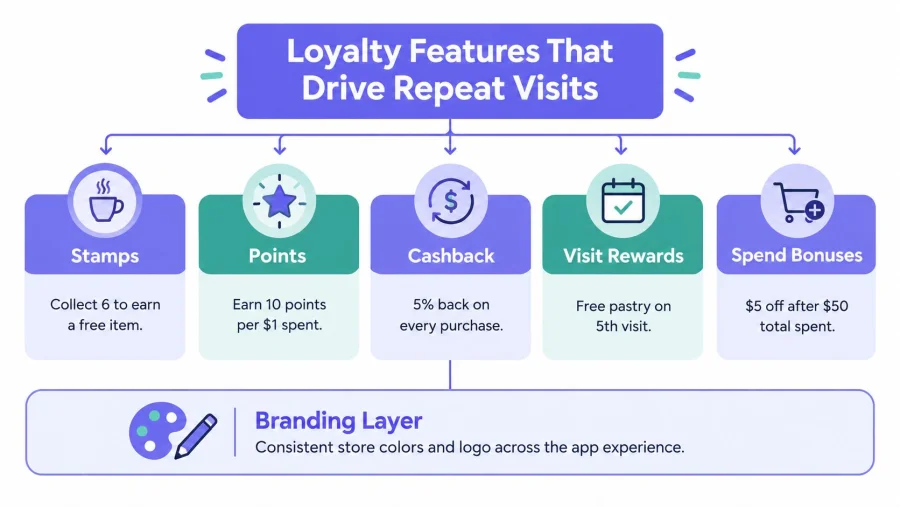
A practical specification should separate must-have, useful later and custom-only features. Stamps, points, QR identification, reward redemption and basic campaign messaging usually belong in the first group. A complex CRM connection or bespoke pricing engine can wait until the business has proved that customers and staff use the core journey.
Timeline Integrations and Data Responsibilities Explained
A white label app still needs disciplined delivery. The platform may already exist, but the business must define its reward rules, supply brand assets, test the customer journey and agree who handles support.
A practical delivery sequence looks like this:
- Scoping and branding: Define the loyalty mechanics, customer journey, visual assets and launch requirements.
- App build and configuration: Apply the brand, configure stamps or points, and connect supported services.
- Quality assurance: Test sign-up, earning, redemption, notifications, account access and staff workflows.
- Store submission: Prepare app metadata, screenshots and publisher information for Apple and Google.
- Launch and monitoring: Train staff, promote the app, monitor usage and correct operational issues.
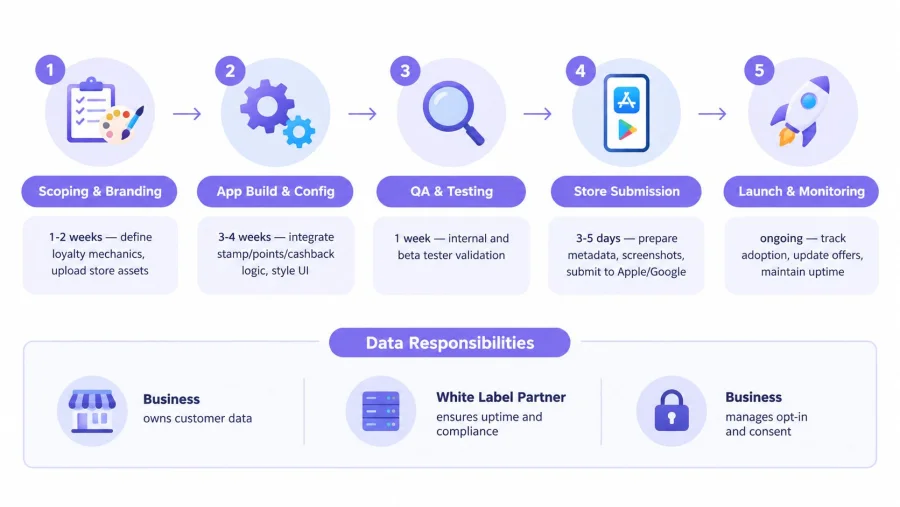
The business should ask for a delivery plan with named owners, acceptance criteria and a change-control process. “Fast delivery” means little if the app reaches launch with unclear reward rules, missing store assets or untested redemption paths.
Integrations need a clear boundary
A small operator may not need a POS connection at all. A QR scan can be enough for a café, salon or independent retailer to identify the customer and apply the reward.
More complex requirements should be separated from the initial release:
- POS integration: Useful when transactions must be captured automatically.
- CRM integration: Relevant when customer profiles already live in another system.
- Membership integration: Important for gyms with access tiers or recurring plans.
- Booking integration: Valuable for salons and businesses where appointments drive visits.
- Analytics connections: Helpful when management needs reporting across locations or channels.
Hidden integration work can create cost and delay. A partner should document available connectors, data fields, error handling, testing access and ownership before development begins.
GDPR is part of the product
Collecting a customer's name, email address or phone number means the business is processing personal data. Customers must receive a privacy notice under Article 13, and the business needs a written Data Processing Agreement with the platform under Article 28, according to this UK GDPR loyalty compliance guidance.
The business should minimise collected data, use a UK or EU hosted platform where possible, record consent clearly and define deletion and access procedures. The partner should explain hosting, security, uptime, subprocessors and incident responsibilities in plain language.
Validation must happen before extensive configuration. One 2026 analysis attributed 42% of failed launches to “no one wants this” and 29% to poor product-market fit, meaning 71% of failures in that analysis were determined before development began, according to this UK app launch failure analysis.
Practical control: Pilot the minimum loyalty journey with a small merchant group or customer segment before adding custom features.
For businesses exploring restaurant loyalty via Apple Wallet, the same questions still apply. Convenience doesn't remove the need for consent, clear notices or responsible data handling.
Your Launch Checklist and Post Launch Growth Playbook
Launch preparation should cover the physical shop as well as the app store. A customer may discover the programme through a counter sign, receipt, staff recommendation or social post, so every route needs to lead to the same simple joining experience.
Pre-launch checks
- Test every loyalty flow: Create accounts, earn rewards, reach thresholds, redeem offers and handle an unsuccessful scan.
- Prepare store assets: Check the icon, screenshots, description, app name and brand language before submission.
- Create location-specific QR materials: Use visible signage at tills, reception desks, tables, mirrors or changing areas.
- Train staff with short instructions: Explain how customers join, how staff scan, how redemption works and what to do when a scan fails.
- Test real conditions: Check lighting, network quality, older devices, staff permissions and the speed of the redemption flow.
- Write the customer explanation: Give staff a natural sentence that explains the benefit without forcing a hard sell.
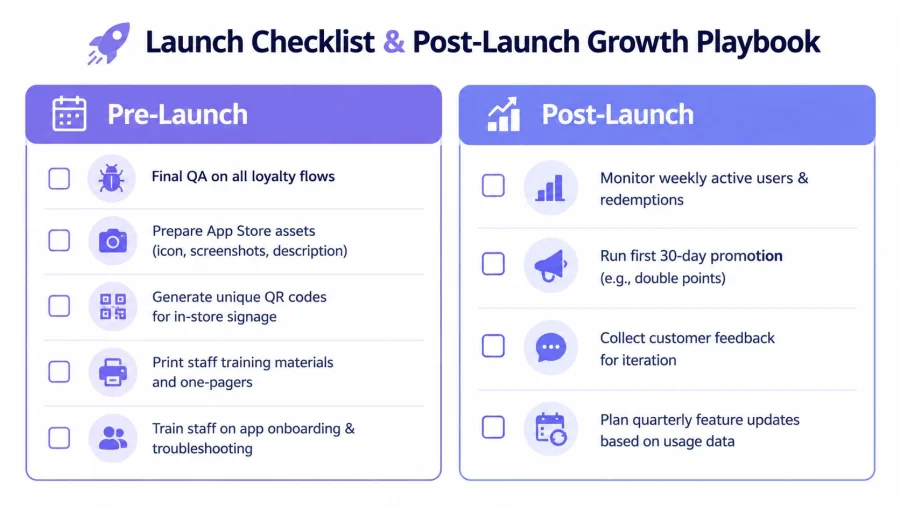
A launch fails operationally when staff don't know what to do. The best training material is short, visual and specific to the shop's real workflow. Employees should practise both a successful redemption and a customer who has forgotten how to access the reward.
Post-launch activity
The first campaigns should reinforce the behaviour the programme was designed to create. A café might promote a return visit, a salon might remind customers about a seasonal service, and a gym might highlight an underused class or membership benefit.
Track:
- Active customers: Identify whether sign-ups become repeat usage.
- Redemptions: Compare claimed rewards with redeemed rewards to find friction.
- Offer performance: Retire coupons that attract little response and refine those customers use.
- Customer feedback: Ask where joining, earning or redeeming feels unclear.
- Staff feedback: Record recurring questions and operational failures.
- Repeat behaviour: Look for changes in visit patterns and spend quality without assuming every increase comes from the app.
Automated push and email campaigns can deliver welcome messages, timely offers and feedback requests. They should support the loyalty rules rather than overwhelm customers with unrelated promotions.
Launch principle: The app is the delivery channel. The loyalty offer, staff behaviour and follow-up campaigns determine whether customers keep using it.
Cost Maintenance and Your Next Move With BonusQR
The initial build price is only one part of the decision. A loyalty app also needs hosting, security updates, store maintenance, customer support, campaign management and someone responsible for changing reward rules when the business changes its offer.
UK development agencies quote £600 to £1,100 per day per developer, while a typical customer-facing app for a regional business is valued at £25,000 to £55,000 in the UK, according to this UK white label app cost guide. The same guide places offshore white label delivery for a standard business app at £6,000 to £18,000, described as 40% to 60% below equivalent UK-based development costs.
Another UK delivery guide places standard cross-platform white label business apps at £6,000 to £18,000, with complex apps involving custom integrations and backend infrastructure at £18,000 to £45,000. Equivalent UK-based builds are estimated at £15,000 to £35,000 and £40,000 to £100,000 or more, respectively, in this white label agency cost comparison.
The lower initial cost only works when requirements remain controlled. Businesses should confirm:
- What the fee includes: Branding, configuration, testing, store submission and launch support.
- What continues afterwards: Hosting, updates, support, campaign operations and data administration.
- Who owns the account: App-store access, customer data, creative assets and export rights.
- How changes are priced: Standard configuration, custom development and urgent support should be separate.
- How success is measured: Repeat visits, reward redemption, customer retention and campaign response.
For an SMB that needs a branded loyalty product rather than a large software project, BonusQR provides QR-based stamps, points, cashback, visit and spend thresholds, fixed discounts, welcome bonuses, birthday and seasonal coupons, customer profiles, Wallet passes, analytics and automated push or email campaigns. Businesses can start free, launch a white label app under their own icon in about 14 days, or commission a fully custom app with advanced integrations. Further options are outlined on the BonusQR pricing page.
The next move is practical. List the single repeat-visit problem, choose the first reward mechanic, confirm the data responsibilities and request a scoped demonstration using the business's branding. Then pilot the customer journey with staff and real customers before paying for features that haven't earned their place.