Referral marketing is defined as a structured approach where businesses incentivise existing customers to recommend their products or services to new prospects, using unique codes or links to track and attribute each conversion. Unlike casual word-of-mouth, referral marketing turns organic advocacy into a measurable acquisition channel with defined rules, rewards, and reporting. Platforms like Shopify and Salesforce have built dedicated guidance around referral programmes precisely because referred customers convert at higher rates and tend to spend more over their lifetime. For small and medium-sized business owners, this makes referral marketing one of the most cost-effective growth strategies available. You do not need a large budget to run one. You need a clear structure and the right incentives.
How does referral marketing work to drive customer acquisition?
Referral marketing works by converting satisfied customers into active advocates through a defined programme with tracking, incentives, and conversion rules. Referral marketing uses unique codes or links to attribute each new customer back to the person who referred them. That attribution is what separates referral marketing from general word-of-mouth. Without it, you cannot measure ROI or reward the right people.

The referral funnel has three stages. First, you identify and activate advocates, typically your most satisfied existing customers. Second, those advocates share a personalised referral link or code with their network. Third, when a new customer completes a qualifying action, such as a purchase or sign-up, the system records the conversion and triggers the reward. Each stage requires a deliberate decision from you: who qualifies as an advocate, what counts as a conversion, and how rewards are attributed.
Referral programmes define eligibility, conversion events, and attribution rules to produce repeatable, measurable results. This structure is what makes referral marketing a genuine acquisition channel rather than a lucky streak of recommendations. For SMEs, it also means you can calculate a cost per acquisition and compare it directly against paid advertising or other channels.
The table below shows common referral programme structures and their typical conversion points.
| Programme type | Advocate reward | Referee reward | Conversion trigger |
|---|---|---|---|
| One-sided (referrer only) | Discount or credit | None | First purchase |
| One-sided (referee only) | None | Welcome discount | Account creation |
| Two-sided | Store credit | Discount on first order | Completed purchase |
| Product-linked | Free product or upgrade | Free trial extension | Subscription sign-up |
| Cash-based | Fixed cash payment | None | Verified purchase |
Pro Tip: Track conversion rates at each stage of your referral funnel separately. If advocates share but referees do not convert, the problem is your referee incentive. If advocates do not share at all, the problem is your ask or your advocate incentive.
What are referral incentives and how do one-sided and two-sided rewards compare?
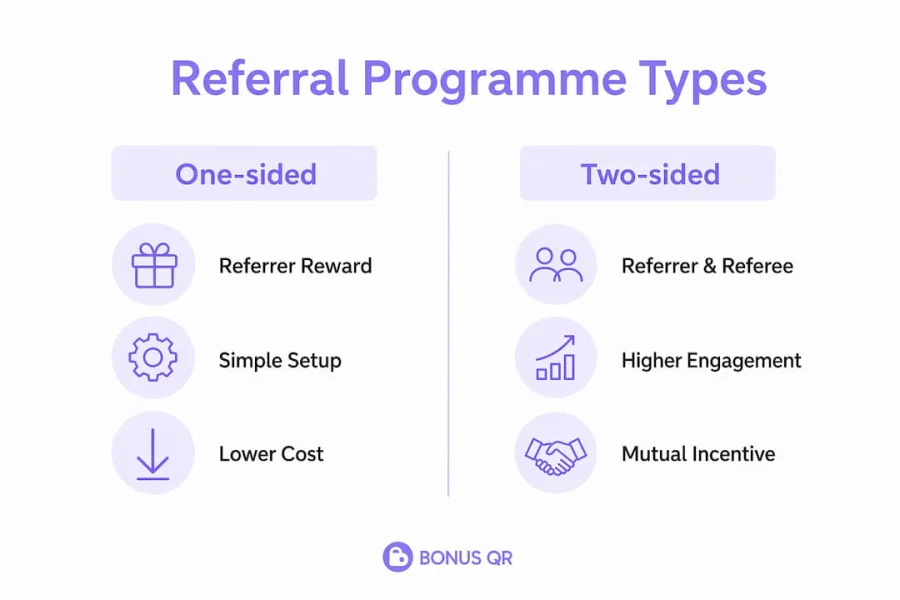
Referral incentives are the rewards offered to motivate customers to refer others, and they fall into two broad categories: one-sided and two-sided. Two-sided rewards are generally more effective because they give both the referrer and the new customer a reason to act. One-sided programmes only reward one party, which limits participation from the other.
One-sided incentives
One-sided incentives reward either the referrer or the referee, but not both. Rewarding only the referrer can feel transactional to the new customer, who receives nothing for trusting a recommendation. Rewarding only the referee can attract low-quality sign-ups from people who have no genuine interest in your product.
Two-sided incentives
Two-sided incentives reward both parties and create a shared motivation for the referral to succeed. A referrer who earns store credit and a referee who receives a first-order discount both have a concrete reason to complete the transaction. Effective referral marketing separates the motivation for advocacy from the motivation for conversion, using tailored incentives for each party rather than a single blanket reward.
Internal vs external rewards
Beyond one-sided and two-sided structures, incentives also divide into internal and external types. Internal rewards are tied directly to your product or service, such as a free month of subscription, bonus loyalty points, or an upgrade. External rewards are unrelated perks, such as cash, gift cards, or third-party vouchers. Rewards aligned with product usage generate a compounding effect on customer retention and lifetime value. Cash rewards attract a wider audience but do not reinforce product engagement.
| Incentive type | Strengths | Weaknesses |
|---|---|---|
| One-sided (referrer) | Simple to manage | New customer has no motivation |
| One-sided (referee) | Attracts new sign-ups | Referrer gains nothing; lower sharing rates |
| Two-sided | Motivates both parties; higher conversion | Slightly higher cost per referral |
| Internal reward | Builds product loyalty; compounding retention value | Less appealing to non-customers |
| External reward (cash/gift card) | Broad appeal | No product engagement; attracts deal-seekers |
Common referral incentive formats used by SMEs include:
- Percentage discounts on the next purchase
- Fixed cash or account credit
- Free products or service upgrades
- Loyalty points added to an existing programme
- Exclusive access to new products or early sales
Pro Tip: Avoid rewarding referral activity such as clicks or shares alone. Tie rewards to completed conversions such as a verified purchase or confirmed sign-up. Paying for shares inflates your costs without delivering real customers.
What are the best practices for implementing referral marketing programmes?
A referral programme succeeds when it has clear rules, the right timing, and the right channels. The most common mistake SMEs make is launching a programme without defining what counts as a successful referral. Before you go live, set three things in writing: who is eligible to refer, what action triggers the reward, and how attribution works when multiple referrers send the same new customer.
Define your programme rules before launch
Eligibility criteria determine which customers can participate. Most SMEs restrict referrals to verified purchasers or active loyalty members, which filters out low-quality advocates. The conversion event is the specific action that triggers the reward, typically a completed purchase above a minimum value. Attribution rules decide what happens when a new customer clicks two different referral links. First-click or last-click attribution are the most common choices, and each produces different incentive costs.
Time your referral ask correctly
Timing is critical in referral campaigns. Asking a customer to refer a friend immediately after a successful purchase or a positive service experience produces far higher sharing rates than asking at a neutral moment. For e-commerce businesses, the post-purchase confirmation page is one of the highest-converting places to present a referral prompt. For service businesses, a follow-up message sent within 24 hours of a completed appointment works well.
Choose the right sharing channels
Customers share referrals through the channels they already use. Offering multiple sharing options increases participation without adding complexity. The most effective channels for SME referral programmes include:
- Email with a personalised referral link
- SMS with a short referral code
- WhatsApp and direct messaging apps
- Social media sharing buttons on post-purchase pages
- Printed referral cards for in-store businesses
Practical steps to increase referral participation in your programme:
- Make the referral ask visible and easy to find, not buried in a menu
- Use plain language: “Share this code and you both save £10” outperforms vague promises
- Send a reminder to advocates who have not yet referred after 14 days
- Celebrate successful referrals with a personalised thank-you message
- Test two different incentive amounts and measure which drives more conversions
For more ideas on structuring your programme, the referral programme ideas for small businesses guide from Bonusqr covers practical formats across retail, hospitality, and service sectors.
Pro Tip: Do not launch your referral programme to your entire customer base at once. Start with your top 10–20% of customers by purchase frequency. These advocates are most likely to refer, and their early results will tell you whether your incentive structure works before you scale.
How does referral marketing differ from other promotional strategies?
Referral marketing is distinct from affiliate marketing, paid advertising, and general word-of-mouth in both structure and outcome. Understanding those differences helps you decide where referral marketing fits in your overall customer acquisition plan.
Referral marketing vs affiliate marketing
Affiliate marketing involves third-party publishers, bloggers, or influencers who promote your products to their audiences in exchange for a commission. The affiliate has no prior relationship with your brand as a customer. Referral marketing, by contrast, activates your existing customers as advocates. The trust that drives a referral comes from a genuine personal relationship between the referrer and the new customer. That personal trust is the core advantage referral marketing holds over affiliate channels, where the audience knows the recommendation is commercially motivated.
Referral marketing vs general word-of-mouth
Word-of-mouth happens organically when a satisfied customer tells someone about your business. Referral marketing turns organic word-of-mouth into a scalable acquisition channel by adding structure, tracking, and incentives. The difference is control. Word-of-mouth is unpredictable. A referral programme gives you a repeatable mechanism you can measure, adjust, and grow. You can read more about the mechanics in this guide to how referrals work for small businesses.
The role of trust and customer satisfaction
Referral marketing does not create advocacy from nothing. In B2B SaaS, customer satisfaction and trust drive advocacy more than the referral programme itself. The programme moderates and amplifies existing goodwill. It does not replace the need for a genuinely good product or service. This is a critical point for SME owners: if your customer satisfaction is low, a referral programme will not fix it. It will simply make the problem visible faster. Referral marketing accelerates organic advocacy rather than substituting for excellent customer experiences.
The practical benefit for SMEs is lower customer acquisition cost. Referred customers arrive with a pre-existing level of trust in your brand, which shortens the sales cycle and increases the likelihood of a second purchase. Combining referral marketing with a loyalty programme compounds this effect, as returning customers have more reasons to refer and more to gain from doing so. The benefits of customer retention for retail are directly amplified when referral and loyalty strategies work together.
Key takeaways
Referral marketing delivers measurable customer acquisition by combining personal trust with structured incentives, defined conversion rules, and consistent timing.
| Point | Details |
|---|---|
| Clear programme rules | Define eligibility, conversion events, and attribution before launch to track ROI accurately. |
| Two-sided incentives outperform | Rewarding both referrer and referee produces higher participation and conversion rates. |
| Timing the ask matters | Place referral prompts at peak enthusiasm, such as immediately after a successful purchase. |
| Reward outcomes, not activity | Tie rewards to completed conversions, not clicks or shares, to control acquisition costs. |
| Trust drives advocacy | A referral programme amplifies existing customer satisfaction; it does not replace it. |
Why I think most SMEs underestimate referral marketing
Most small business owners I speak with treat referral marketing as a nice extra, something to add once the “real” marketing is sorted. That view gets it backwards. Paid advertising requires constant spend to maintain results. Referral marketing, when built correctly, produces a compounding effect: each new referred customer becomes a potential future referrer.
The mistake I see most often is launching a programme with the wrong conversion trigger. Business owners reward shares or clicks because those numbers look impressive in a report. The actual cost of that approach becomes clear only when the accounts are reviewed and the new customers are not there. Tying rewards to completed purchases feels stricter, but it produces a programme you can actually afford to run for years.
The second mistake is treating the incentive as the whole programme. Incentives matter, but the timing of your referral ask matters just as much. A customer who has just received a product they love is in the best possible state of mind to recommend it. That window is short. If you wait a week to send your referral prompt, the enthusiasm has faded and the moment is gone.
My honest view is that referral marketing is the most underused growth channel for SMEs. It does not require a large team or a complex technology stack. It requires a clear offer, a well-timed ask, and a product worth recommending. Get those three things right, and referral marketing will outperform most paid channels on a cost-per-acquisition basis.
— Michal
How Bonusqr supports your referral and loyalty strategy
Bonusqr is a loyalty platform built for small and medium-sized businesses that want to run structured customer engagement programmes without complex setup. Its customer loyalty cards feature lets you create digital stamp cards, points programmes, and cashback rewards that complement referral campaigns by giving referred customers an immediate reason to return. The mobile and web app puts your loyalty programme in your customers’ pockets, making it easy to share referral codes and track rewards in real time. Bonusqr also includes coupon management tools that let you create and distribute referral incentives without manual administration. For SMEs looking to combine referral marketing with a retention strategy, Bonusqr provides the infrastructure to run both from a single platform.
FAQ
What is the referral marketing definition in simple terms?
Referral marketing is a structured programme where businesses reward existing customers for recommending their products or services to new buyers. It uses unique codes or links to track each referral and attribute rewards accurately.
What are referral incentives and which type works best?
Referral incentives are rewards given to the referrer, the new customer, or both. Two-sided incentives, which reward both parties, generally produce higher participation and conversion rates than one-sided structures.
How does referral marketing differ from affiliate marketing?
Referral marketing uses existing customers as advocates, relying on personal trust between the referrer and the new customer. Affiliate marketing uses third-party publishers who promote your brand commercially, without a prior customer relationship.
When is the best time to ask a customer for a referral?
The best time is immediately after a positive experience, such as a completed purchase or a successful service interaction. Asking at peak enthusiasm significantly increases sharing rates compared to asking at a neutral moment.
Can referral marketing work for very small businesses?
Referral marketing works for businesses of any size. Small businesses benefit particularly because the cost per acquisition is low and the trust between local customers is high. A simple two-sided discount programme is enough to start.


