
 Deutsch
 Español
 Français
 Italiano
 Magyar
 Polski
 Slovenčina
 Čeština
Customer churn is defined as the percentage of customers who stop doing business with you within a set period. It is one of the most direct indicators of business health, sitting alongside revenue as a metric no owner can afford to ignore. Improving retention by just 5% can raise profits by 25%, yet acquiring a new customer costs 5 to 25 times more than keeping an existing one. That gap makes churn reduction the highest return growth lever available to most businesses. This article covers how to measure churn accurately, what causes it, and which customer retention strategies deliver real results.
What is customer churn and why does it matter?
Customer churn, also called attrition rate, is the percentage of customers lost over a defined time period. The standard customer churn definition is straightforward: divide the number of customers lost during a period by the number you had at the start, then multiply by 100. A business that starts the month with 500 customers and ends with 475 has a churn rate of 5%.
That 5% sounds manageable. 95% retention sounds good, but 5% churn exposes immediate issues that compound fast. A 5% monthly churn does not equal 60% annual loss. Because of compounding, a 5% monthly churn rate translates to approximately 46% of your customer base lost over a year. That is nearly half your revenue base eroded before you have replaced a single customer.

The impact of churn on business extends beyond lost revenue. High churn signals deeper problems: a product that does not deliver on its promise, an onboarding process that confuses new customers, or pricing that does not match perceived value. Rising churn often signals systemic business problems beyond customer service alone, including product-market fit failures. Treating churn as a pure customer service metric misses the point entirely.
How is customer churn calculated?
The core formula for measuring customer churn is simple. Divide customers lost in a period by customers at the start of that period, then multiply by 100. The result is your churn rate as a percentage.
| Formula type | Calculation | Best used for |
|---|---|---|
| Customer count churn | (Customers lost ÷ Starting customers) × 100 | Tracking overall account loss |
| Revenue churn (gross) | (MRR lost ÷ Starting MRR) × 100 | Measuring financial impact of churn |
| Net revenue churn | (MRR lost minus expansion MRR) ÷ Starting MRR × 100 | Balancing loss against upsell growth |
| Retention rate | 100 minus churn rate | Framing health positively for reporting |
Tracking both revenue churn and logo churn is critical because losing a few large accounts can overshadow losing many small ones. A business with 200 customers might lose 10 small accounts and show a 5% logo churn, while losing one large account representing 30% of revenue. The two metrics tell completely different stories.
Differentiating customer count churn from revenue churn is the foundation of prioritising retention efforts correctly. If your revenue churn is far higher than your logo churn, your largest customers are leaving. That requires a different response than losing many small accounts.
Most businesses measure churn monthly for operational visibility and quarterly for strategic review. Annual churn figures are useful for board reporting but too slow for day-to-day decisions. You can find a detailed walkthrough of these calculations in this churn rate guide for small businesses.
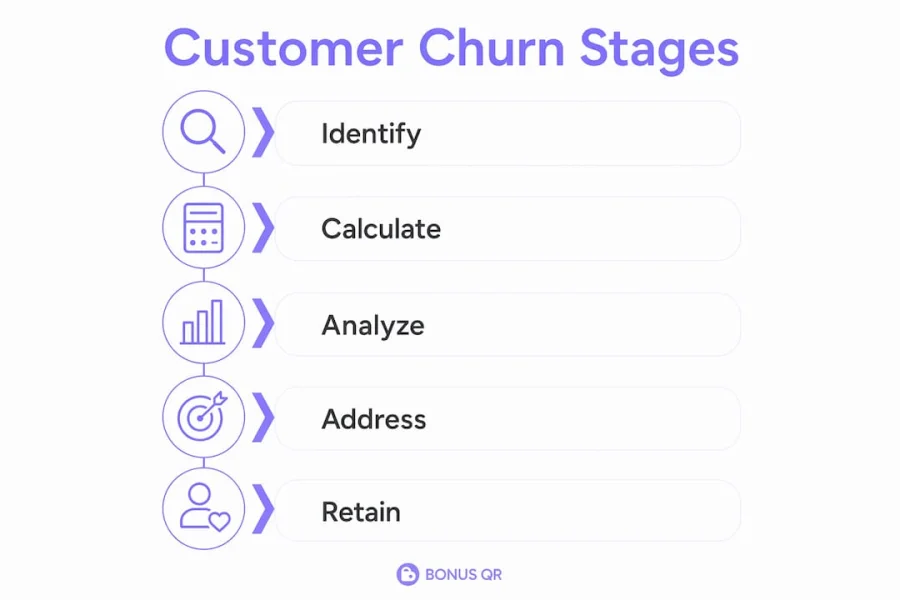
Pro Tip: Track churn separately during the onboarding period, typically the first 30 to 90 days. Early lifecycle churn behaves differently from mature customer churn and requires a different set of interventions.
What are the common causes of customer churn?
Poor onboarding is the single largest driver of early churn. Up to 60% of customer churn happens within the first 30 days of the customer lifecycle. Customers who do not reach their first moment of value quickly conclude the product is not worth their time.
Beyond onboarding, the causes of customer churn fall into several clear categories. Unmet expectations occur when marketing promises do not match the actual product experience. Price-to-value misalignment happens when customers feel they are paying more than the benefit they receive. Disengagement builds gradually when customers stop finding reasons to return. Poor customer service accelerates departure when problems go unresolved.
The most useful insight for business owners is that churn rarely happens without warning. 73% of customers who eventually churn show disengagement signals 30 to 90 days before cancelling. That window is your opportunity to intervene.
The five warning signs to monitor are:
- Declining login frequency or visit rate
- Reduced spend per transaction over consecutive periods
- Increased support complaints or unresolved tickets
- Failure to engage with new features or offers
- Silence after a negative experience, with no follow-up contact
Over-investing in product usage telemetry without qualitative diagnostics limits churn prediction accuracy. Usage data tells you what customers are doing. It does not tell you why. Qualitative feedback, whether through surveys, interviews, or direct conversations, fills that gap.
Pro Tip: Combine behavioural data with short customer interviews after a period of low engagement. Customers who feel heard are significantly less likely to leave, and the conversation itself often reveals fixable problems.
Which customer retention strategies effectively reduce churn?
Retention is not a single tactic. It is a system of touchpoints that keeps customers engaged, valued, and returning. The strategies below are ordered by where they have the greatest impact in the customer lifecycle.
-
Fix onboarding first. A personalised onboarding experience is statistically the most impactful churn reduction tactic in early lifecycle stages. Guide new customers to their first success quickly. Use welcome sequences, tutorials, and check-in messages within the first week.
-
Segment your customers and personalise communication. Not all customers have the same needs. Segment by purchase behaviour, visit frequency, or spend level. Send relevant offers and messages rather than blanket promotions. Personalisation increases engagement and reduces the feeling of being just another transaction.
-
Build a loyalty programme. Loyalty programmes give customers a structured reason to return. Points collection, stamp cards, cashback rewards, and visit-based incentives all create habitual behaviour. Customers enrolled in a loyalty programme have a tangible reason to choose you over a competitor.
-
Create feedback loops. Ask customers for their opinions regularly and act on what you hear. A simple post-visit survey or a follow-up message after a complaint shows customers that their experience matters. Closing the feedback loop, by telling customers what you changed based on their input, builds trust.
-
Resolve issues fast. Slow or dismissive responses to complaints accelerate churn. A customer whose problem is resolved quickly is often more loyal than one who never had a problem at all. Train your team to treat complaints as retention opportunities.
-
Reward loyalty milestones. Recognise customers at key moments: their first anniversary, their tenth purchase, or their highest spend month. These moments reinforce the relationship and remind customers that you notice them.
The table below compares retention strategy types by their primary effect and best application.
| Strategy | Primary effect | Best application |
|---|---|---|
| Onboarding improvement | Reduces early lifecycle churn | New customer acquisition phases |
| Loyalty programme | Increases repeat visit frequency | Retail, hospitality, service businesses |
| Personalised communication | Raises engagement and spend | Segmented customer bases |
| Feedback and resolution | Recovers at-risk customers | Post-complaint or low-engagement periods |
| Milestone rewards | Deepens long-term loyalty | Established customer relationships |
For a deeper look at proven approaches, the 7 customer retention strategies guide covers practical implementation across retail and service sectors. You can also explore top retention strategies for growth for a broader view of how retention connects to revenue.
How can churn insights improve your business operations?
Churn data is most valuable when it informs decisions beyond the customer service team. Used well, it becomes a diagnostic tool for the entire business.
- Identify product or service gaps. If customers consistently churn after using a specific feature or service, that is a signal the experience is falling short. Churn data pinpoints where the product fails to deliver.
- Align sales and customer success. Sales teams that overpromise create churn downstream. When churn data is shared with sales, it creates accountability for the quality of customers acquired, not just the quantity.
- Add churn to your core KPIs. Churn rate should be a primary KPI reported alongside revenue to expose business health realistically. A business growing revenue while churn rises is building on an unstable foundation.
- Use predictive tools where possible. AI-powered customer interview tools can detect relational churn risks up to 90 days before behaviour changes appear in usage data. Early detection at that scale changes the economics of retention entirely.
- Balance data types. Combining behavioural telemetry with qualitative feedback greatly improves churn prediction accuracy. Neither source alone gives a complete picture.
The businesses that reduce churn most effectively treat it as an operational problem, not a reporting exercise. They review churn data weekly, assign ownership to specific team members, and connect findings directly to product, pricing, and service decisions. For a full comparison of how retention and churn metrics work together, the retention rate vs churn rate guide is a practical starting point.
Key takeaways
Customer churn is a compounding threat: even a modest monthly rate erodes nearly half your customer base within a year, making early detection and structured retention the most cost-effective growth strategy available.
| Point | Details |
|---|---|
| Churn definition | The percentage of customers lost in a period, calculated as lost customers divided by starting customers times 100. |
| Compounding impact | A 5% monthly churn rate removes approximately 46% of your customer base annually, not 60%. |
| Early warning window | 73% of churning customers show disengagement signals 30 to 90 days before leaving. |
| Retention ROI | A 5% improvement in retention can raise profits by 25%, far outperforming new customer acquisition. |
| Most effective tactic | Personalised onboarding in the first 30 days is the single highest-impact churn reduction action. |
Churn is an operational problem, not just a metric
I have worked with business owners who track churn religiously but treat it as a reporting number rather than an alarm. That is the most common and costly mistake I see. When churn rises, the instinct is to look at customer service. The real answer is usually further upstream: in the onboarding flow, the product promise, or the pricing structure.
The other pitfall I see repeatedly is over-reliance on usage data. Dashboards showing login frequency and purchase counts are useful, but they tell you what happened, not why. The businesses that get ahead of churn are the ones that pick up the phone, send a personal message, or run a short survey. That qualitative layer reveals the real reasons customers leave, and those reasons are almost always fixable.
Unchecked churn compounds quietly. A business losing 5% of customers monthly does not feel the pain immediately. Six months later, the revenue gap is undeniable and the cost of recovery is far higher than prevention would have been. The businesses I respect most treat churn as an urgent operational signal, reviewed weekly, owned by a named person, and connected directly to decisions about product, pricing, and service.
Start with onboarding. Fix the first 30 days. Then build the feedback loops and loyalty structures that keep customers engaged long term. The maths of retention are unambiguous: keeping customers is cheaper, faster, and more profitable than replacing them.
— Michal
How Bonusqr supports your retention efforts
Reducing churn requires more than awareness. It requires systems that keep customers engaged between purchases and give them a reason to return. Bonusqr’s loyalty platform gives you the tools to build exactly that: points programmes, stamp cards, cashback rewards, and visit-based incentives that create habitual customer behaviour. The platform requires no POS integration, sets up quickly, and includes push notifications and real-time analytics so you can see what is working. For businesses looking to add loyalty gamification to their retention mix, Bonusqr offers a flexible module that makes earning rewards feel engaging rather than transactional. If you are ready to put a retention system in place, Bonusqr is built to make that straightforward.
FAQ
What is the customer churn definition in simple terms?
Customer churn is the percentage of customers who stop buying from or using a business within a set period. It is calculated by dividing customers lost by customers at the start of the period, then multiplying by 100.
What leads to customer churn most often?
Poor onboarding is the leading cause, with up to 60% of churn occurring in the first 30 days. Unmet expectations, price-to-value misalignment, and slow issue resolution are the next most common drivers.
How do I start measuring customer churn?
Divide the number of customers lost in a month by the number you had at the start of that month, then multiply by 100. Track this figure monthly and separately for your largest accounts using revenue churn.
What is the difference between customer churn and revenue churn?
Customer churn counts the number of accounts lost. Revenue churn measures the monthly recurring revenue lost. A business can have low customer churn but high revenue churn if its largest accounts are the ones leaving.
How can a loyalty programme reduce churn?
Loyalty programmes give customers a structured incentive to return, such as points, stamps, or cashback rewards. Customers enrolled in a programme have a tangible reason to choose your business over an alternative, which directly reduces attrition.