The best Voucherify alternative depends on who will run the program. If you have developers and want an API-first promotion engine, look at Talon.One or Open Loyalty. If you run a Shopify store, a ready-made plugin like Smile.io fits better. If you own a cafe, gym, salon, hotel or shop and want rewards running this week without a POS integration or an engineer, a QR-based platform like BonusQR is the simplest path.
Voucherify is a capable product, but it is built for teams that integrate promotions into their own systems through APIs. Many small businesses searching for it discover they need something lighter. This guide compares the realistic options, explains the trade-offs honestly, and shows where each one fits.
Key takeaways
- Voucherify is API-first and priced for developer-led teams. Its paid tiers are listed at $650 and $1,300 per month, with no free plan.
- The market splits into three groups: API-first engines, ecommerce plugins, and no-code loyalty apps for physical and service businesses.
- Small businesses with a counter, a front desk or a till usually need stamps, points and cashback without a POS or custom code.
- BonusQR starts free, with paid plans at 19 EUR and 69 EUR per month, and offers a branded white-label app if you outgrow a shared one.
- Judge any platform on setup time, who maintains it, what it costs at your volume, and whether your customers will actually scan, tap or install.
Why businesses look beyond Voucherify
Voucherify describes itself as an API-first engine for coupons, referrals, gift cards and loyalty. That is a strength when your engineering team wants to control every rule in checkout. It is a cost when the person setting up the loyalty program is the owner, who also covers the schedule, the inventory and the customer who just walked in.
Three reasons come up most often when owners start comparing.
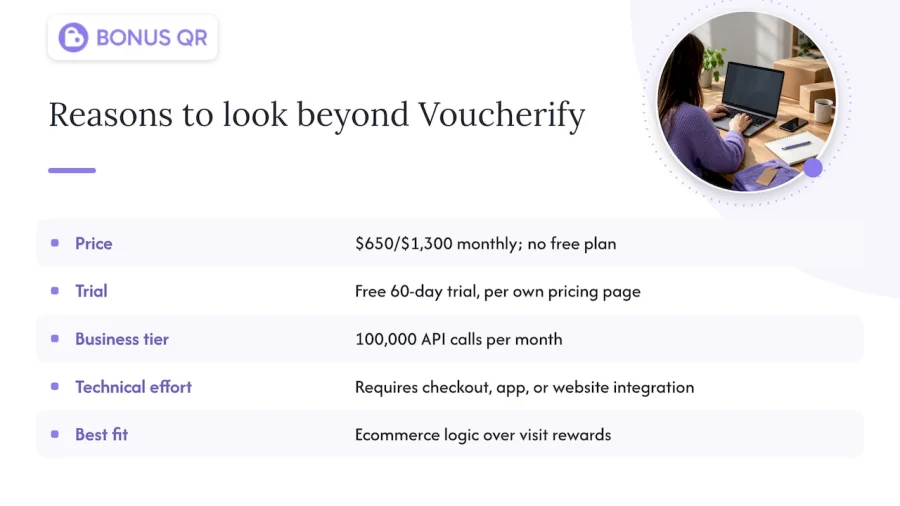
Price. According to LetsMetrix’s summary of the Shopify listing, Voucherify has no free plan, with a Business tier at $650 per month and an Organization tier at $1,300 per month. The Business tier includes 100,000 API calls per month. Voucherify’s own pricing page says plans match API usage and mention a free 60-day trial. Check the current figures before you decide, because enterprise pricing changes.
Technical effort. An API-first product assumes someone will wire it into your checkout, app or website. A restaurant with a tablet and a card reader does not have that someone.
Fit. Coupon and promotion engines excel at ecommerce checkout logic. A gym that wants to reward its fifth visit, or a cafe that wants a ten-stamp card, is solving a different problem: getting people back through the door.
The three kinds of alternatives
Review sites list dozens of rivals, and they are not interchangeable. TrustRadius’s competitor list for Voucherify mixes Talon.One, Growave, Antavo, TrueLoyal, Referral Factory, Yotpo, Giftbit and GrowSurf. Those tools solve quite different problems. It helps to sort them first.
- API-first promotion and loyalty engines. Built for developers and larger brands, with deep rules and high customization.
- Ecommerce loyalty plugins. Installed on Shopify, BigCommerce or Wix stores, with points and referrals tied to online orders.
- No-code loyalty apps for physical and service businesses. Stamps, points and cashback collected in person, often through a QR code, with no integration project.
A quick benchmark of scores shows how the categories fall out. In WorldMetrics’ 2026 loyalty club ranking, Open Loyalty scores 9.1 out of 10 and Talon.One 8.5, both tagged API-first, while Smile is tagged SMB ecommerce and scores 8.8. These are editorial scores from one publisher, not a measure of how well a tool fits your shop, but the tags confirm the split.
Voucherify alternatives compared
| Option | Category | Best for | Setup effort | Price signal |
|---|---|---|---|---|
| BonusQR | No-code, QR-based loyalty | Cafes, restaurants, retail, gyms, wellness, hotels, grocery, gas stations | Low, no POS needed | Free plan, 19 EUR/month, 69 EUR/month |
| Talon.One | API-first engine | Larger brands with engineering teams | High | Quote-based, check with vendor |
| Open Loyalty | API-first engine | Teams that need control over deployment and data | High | Check with vendor |
| Smile.io | Ecommerce plugin | Shopify-style online stores | Low to medium | Check with vendor |
| Antavo | Enterprise loyalty cloud | Mid-market to enterprise programs with gamification | High | Check with vendor |
| Growave | All-in-one ecommerce suite | Online stores that want loyalty, reviews and wishlists in one app | Medium | Check with vendor |
We only quote prices that we can verify on a vendor’s own listing. For the rest, ask for a current quote and compare it against your expected monthly customer count, not the headline plan name.
Option 1: BonusQR, for businesses that serve customers in person
BonusQR is a QR-based digital loyalty platform built for small businesses. Customers scan a code at the counter or table, join, and collect rewards. Nothing has to connect to your POS, which removes the biggest barrier for most independent shops and restaurants.
What you get:
- Digital stamp cards, points systems, tiered cashback and fixed discounts
- Onboarding promotions and special-occasion rewards
- Coupon and reward management
- Automated marketing, with push and email notifications
- Referral and review modules
- Analytics on customer behavior
- Brand and app customization, plus Apple Wallet and Google Wallet support
Pricing (as published on our site):
| Plan | Price |
|---|---|
| Free | No published price |
| Basic | 19 EUR per month |
| Premium | 69 EUR per month |
| White-label | 690 EUR one-off setup, plus 69 EUR per month subscription |
| Custom app | From 1500 EUR one-off, plus maintenance from 69 EUR per month |
See the details on the BonusQR pricing page.
Where it fits best: Owners and managers who want a working loyalty program quickly and do not want to hire a developer. It suits restaurants, cafes, retailers, service providers, gyms and wellness centers, hotels, grocery stores and gas stations.
Limits to weigh: It is not a developer-first promotion engine. If you need to build thousands of rule combinations into a custom checkout, an API-first product is the better match. That is a different job from the one we designed for.
Option 2: Talon.One
Talon.One is one of the names that appears most often next to Voucherify. WorldMetrics classifies it as API-first, and it is typically considered by larger companies with in-house engineering. The strength is rule flexibility across many channels. The cost is time: modeling campaigns, integrating them, and maintaining the integration.
Choose it if: you run a multi-channel retail or ecommerce operation with a dedicated technical team.
Skip it if: you want to launch a stamp card by Friday.
Option 3: Open Loyalty
Open Loyalty tops the WorldMetrics list mentioned above with a 9.1 score and an API-first tag. It is built for teams that want to build a loyalty experience on top of a flexible backend. As with Talon.One, the right buyer has engineers and a long-term product roadmap.
Choose it if: loyalty is a core part of your digital product and you want deep control over how it works.
Skip it if: you need a customer-facing app, wallet cards and reward tracking without any build phase.
Option 4: Smile.io and other ecommerce plugins
Smile.io is the standard example of the plugin category. WorldMetrics lists it among the top customer loyalty rewards tools in its 2026 edition, tagged as SMB. If your sales happen mostly in an online store, a plugin that installs on your store platform and awards points per order is a sensible, low-effort choice.
The gap shows up when the business is physical. A plugin tied to online orders does not track the customer who buys a coffee, a haircut or a tank of fuel in person. Businesses that sell both online and offline sometimes run a plugin for the web store and a QR-based program for the counter.
Option 5: Antavo, Growave and the wider field
Antavo is aimed at larger programs, and a Loyalty Methods comparison groups it as mid-market to enterprise with a focus on gamification. Growave bundles loyalty with reviews and other store features for online merchants. Both are credible, but neither is built around a small business with a counter.
The long tail on CB Insights adds names such as Hello Clever and Kard, which sit in other niches again. Treat any long list as a starting point and filter by category before you compare features.
How to choose: five criteria that matter
Feature checklists mislead because every vendor ticks the same boxes. These five questions separate the options in practice.
1. Who will run it day to day?
If the answer is the owner or a shift manager, you need no-code setup and automation. If the answer is a development team, API flexibility becomes an advantage instead of a burden.
2. Where do customers buy?
Online-only stores should look at plugins. In-person businesses need a way to identify the customer at the point of sale without new hardware. A QR scan is the cheapest answer to that problem.
3. What is the real monthly cost?
Compare cost at your volume. A $650 monthly tier is reasonable for a company running large promotional campaigns and unreasonable for a six-seat cafe. A free plan plus a paid tier at 19 EUR or 69 EUR per month changes the math for a small operator.
4. How fast do you see results?
A loyalty program only works after customers join. The sooner the first stamp card is on the counter, the sooner you learn what drives repeat visits. Long integration projects delay that learning.
5. Can it grow with you?
Check whether you can move from a shared app to a branded one without starting over. This is where white-label and custom app options matter.
A worked example
Take a hypothetical neighborhood cafe with 400 regular customers. The owner wants a stamp card, a birthday reward and a monthly push notification for slow weekdays.
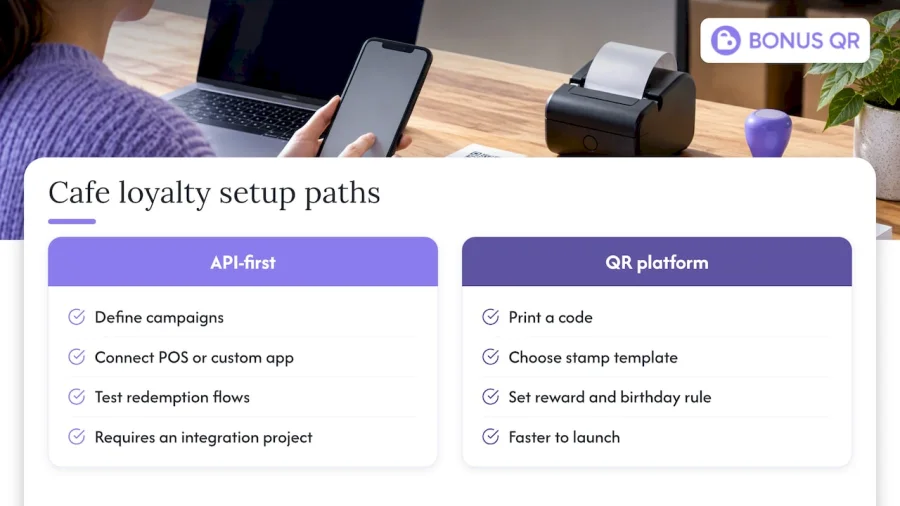
With an API-first engine, someone must define campaigns, connect the point of sale or a custom app, and test redemption flows. That is a project. With a QR-based platform, the owner prints a code, picks a stamp card template, sets the reward and adds a birthday rule. The cafe tracks which customers return and sends a weekday offer to the ones who have not visited recently.
The second path is not more powerful in the engineering sense. It is faster, and speed is what a small business needs. For more on running campaigns automatically, see our guide on how to automate loyalty campaigns for better retention.
Our perspective on choosing a loyalty platform
We build for owners who do not have a technical team, so our view is shaped by that audience. Most small businesses do not fail at loyalty because their rules are too simple. They fail because the program is hard to launch, hard to explain to customers, or never gets maintained after the first month.
That is why we focus on automation: rewards are distributed by the system, notifications go out on a schedule, and analytics show which customers return. Repeat visits are the lifeblood of a small business, and anything that adds friction for staff or customers works against them.
We also think a platform should not trap you. Start on the free plan, move to Basic or Premium as your customer base grows, and, if you want your own brand in the app stores, move to a white-label or custom app. If your needs are truly API-first, a developer-oriented engine such as Voucherify or Talon.One may serve you better, and we would rather you choose the right tool than the wrong one.
If you are comparing options in more depth, our guide to choosing the best loyalty platforms for growth walks through the criteria in detail.
— Michal Palus
Beyond software: loyalty is a relationship strategy
No platform replaces the basics. Customers return because they feel recognized and rewarded, and software only makes that consistent. Broader relationship marketing strategies for customer loyalty can help you decide which rewards, messages and touchpoints deserve a place in your program before you pick a tool.
If you want practical reward ideas, our list of customer incentive ideas is a good place to start. Restaurant owners can also read our comparison of restaurant rewards systems.
Try BonusQR before you commit
If you run a business with in-person customers, you can launch digital stamps, points or cashback without a POS integration. Start with the free plan, review the Free, Basic and Premium plans, and upgrade when your customer base calls for it.
Want your own branded app? Our white-label option costs 690 EUR one-off for setup plus a 69 EUR monthly subscription. For something fully bespoke, custom app development starts from 1500 EUR one-off, with maintenance from 69 EUR per month.
FAQ
Who are Voucherify’s main competitors?
The names that appear most often include Talon.One, Open Loyalty, Antavo, Growave, Yotpo and Smile.io, according to review sites such as TrustRadius and WorldMetrics. For small businesses with physical locations, BonusQR is a lighter alternative that needs no developer.
Is there a free alternative to Voucherify?
Yes. Voucherify has no free plan according to LetsMetrix, though its own pricing page mentions a free trial. BonusQR has a Free plan, with paid plans at 19 EUR per month (Basic) and 69 EUR per month (Premium). Check each vendor’s page for current limits.
Do I need a POS integration to run a loyalty program?
Not with a QR-based approach. Customers scan a code at your counter or table and collect rewards without any connection to your till. That makes it practical for independent shops, cafes and gyms. If you want deeper links to sales data later, you can add integrations as your needs grow.
When is an API-first tool the better choice?
Choose it when you have developers, run complex promotions across several channels, and need custom logic in your checkout or app. If your goal is stamps, points or cashback for repeat visits, a no-code platform will get you live much sooner. Our guide to a cloud based loyalty platform covers the trade-offs.


