
 Deutsch
 Español
 Français
 Italiano
 Magyar
 Polski
 Slovenčina
 Čeština
Most advice about loyalty solutions starts in the wrong place. It talks about points, punch cards, or discounts, when the real job is to tell an owner who comes back, how often they return, and which offer actually moved them. If a café, salon, gym, or shop cannot answer those questions, it is not running loyalty. It is giving away margin and hoping for the best.
That matters more in the UK than most owners realise. The UK government found that 97% of shoppers belong to at least one supermarket loyalty scheme, with an average of 3 memberships and 21% holding 5 or more. It also found that loyalty-priced grocery sales passed £5 billion from November 2023 to January 2024, equal to about 22% of total grocery revenues for the supermarkets offering those promotions, with average savings ranging from 17% to 25% across the five supermarkets examined, so customers are already trained to join schemes and expect immediate value in return for attention. Why UK shoppers now expect visible loyalty value
The owners who win are the ones who treat loyalty as a measurement system. The weakest setup is still the one that looks clever on paper but never gets used at the till. A simple QR-first stack that captures visits, redemptions, and repeat behaviour will beat a fancy platform that staff ignore and customers forget. For a sharp breakdown of how repeat behaviour compounds value, the improving customer lifetime value guide is worth a read, and the psychology behind coffee rewards shows why small, visible rewards keep regulars engaged.
Why Loyalty Is Not Really About Discounts
Discounts are the easiest part of loyalty to copy, and the least interesting. A real loyalty solution tells a business who the best customers are, how often they return, what they redeem, and which campaign brings them back again. That is the part most local merchants miss, because they get stuck on the offer and ignore the measurement.
UK shoppers already expect loyalty to feel useful, not decorative. YouGov found that 77% of Britons were members of a loyalty programme, 72% said loyalty programmes are a good way to reward customers, and 59% said all brands should offer them, while supermarkets had the biggest footprint at 65% of the population and restaurants and coffee shops already had a 25% subscription rate. UK loyalty programme statistics and consumer behaviour That tells owners something blunt. People will join, but they will not keep caring unless the system feels easy and worth the effort.
The problem is loyalty fatigue
Shoppers are not short of schemes. They are short of reasons to use one more app, one more card, or one more membership that asks for effort and gives back confusion. UK research found that 66% of Britons are put off by sign-up or subscription fees, 65% by irrelevant rewards, and 64% by rewards that are hard to obtain, with 41% saying paid loyalty schemes are a waste of money. What Britons want from loyalty programmes
That is why simplicity now beats complexity. If a customer can scan a QR code, see their progress, and claim something obvious, the business has a chance. If the offer feels like a trick, or the redemption path feels awkward, the whole system becomes background noise. The smartest move is to keep the mechanic small, the rule clear, and the reward immediate.
Practical rule: if the owner cannot explain the loyalty offer in one sentence to a new customer, the programme is too complicated.
The UK grocery market shows the same pattern in a harsher form. The government review found that 43% of shoppers still think member-only pricing is unfair and 55% suspect non-member prices are inflated, so owners need to prove fairness, not just push sign-ups. UK government review of loyalty pricing in groceries
What Loyalty Solutions Actually Are
A loyalty solution is a customer memory system. It remembers who came in, what they earned, what they redeemed, and what should happen next. A paper punch card does that badly. A digital system does it properly, and a good one does it without making staff slow down at the counter.
That is the clean way to separate this category from generic marketing tools. A CRM stores contacts. A POS records transactions. A loyalty platform connects repeat behaviour to rewards, then turns that behaviour into usable data. For operators who want a helpful example of how service businesses think about retention, MAJC guest satisfaction strategies is a useful reference point because it frames loyalty around the guest experience, not just the offer.
The ladder of sophistication
At the lowest level sits the old stamp card. It is simple, familiar, and weak on data. Next comes digital stamps or points, which at least show progress and can be tracked across visits. After that come tiers, paid memberships, cashback, and access-based rewards, where the system starts matching behaviour rather than just handing out free items.
The category boundary matters. A loyalty tool should not feel like a newsletter, a discount engine, or a generic app wrapper. It should tell the business, in plain language, which customer is active, which one is drifting, and which offer is worth sending next.
Working definition: if a platform can't track visits, trigger rewards, and show repeat behaviour clearly, it's not a real loyalty solution.
The Main Types and Features You Will See
The mechanics that actually matter
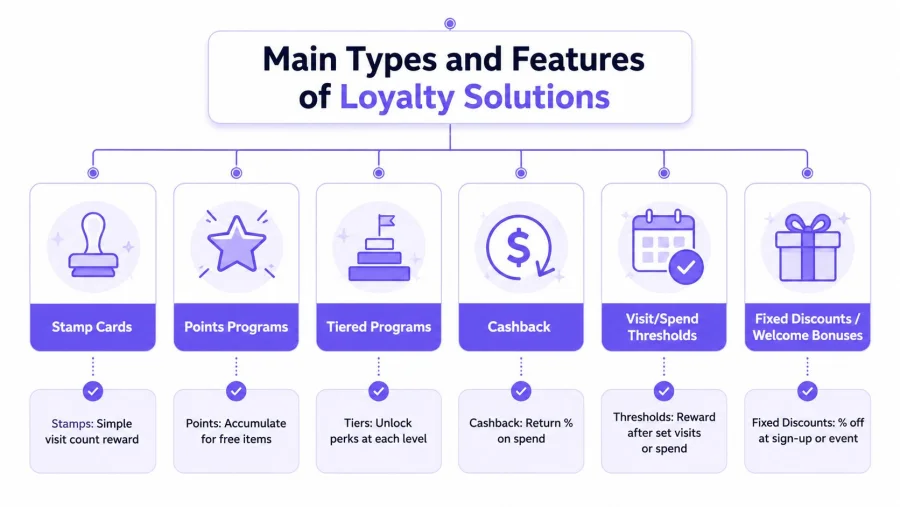
Stamps are the simplest model. One visit earns one stamp, and the reward lands after a set number of visits. A café can use that for a free drink after the card fills. It works best where frequency is high and the purchase is quick.
Points are better when baskets vary. A customer earns value every time they buy, and that value can be redeemed later. A retail shop can tie points to spend, then use them to nudge larger baskets without discounting every transaction. The customer points rewards anchor is a useful starting point for merchants who want a practical points setup.
Tiers offer better treatment as the customer moves up. A salon can reserve early booking windows or priority slots for higher tiers. That suits businesses where status matters as much as the reward itself.
Cashback gives part of the spend back as credit. It works well where repeat purchase is already strong and the owner wants a reason for customers to return soon. It feels more like store value than a straight discount.
Visit or spend thresholds trigger a reward after a clear rule is met. A gym can offer a guest pass after enough attendance, while a shop can grant a seasonal bonus after a spend threshold. This model keeps the promise obvious.
Fixed discounts and welcome bonuses are the easiest to understand at sign-up. They work when a business wants immediate action, not a long nurture cycle. Birthday coupons and seasonal offers fit here too, because they add a reason to open the message now.
Features behind the scenes
The operational stack matters just as much as the reward type. QR sign-up removes friction. Mobile and web profiles give customers a single place to see progress. Google Wallet and Apple Wallet passes keep the reward visible. Built-in analytics show what people redeem, and push or email automation keeps the business from manually chasing every offer.
Choose the mechanic first, then match the feature set to the customer journey. A brilliant reward with a clumsy redemption flow still fails.
Most independent businesses do best with a narrow mix, not six mechanics at once. Stamps plus a welcome bonus suits a café. Points plus birthdays suit a retailer. Thresholds plus access perks suit a gym. The trick is to pick the smallest system that mirrors how customers already buy.
Where Each Mechanic Fits by Business Type
The right mechanic depends on how often people visit, how much they spend, and whether status matters. A coffee buyer and a gym member do not behave the same way, so the reward should not be copied from one into the other.
| Business type | Primary mechanic | Secondary mechanic | Sample campaign |
|---|---|---|---|
| Coffee shops and cafés | Stamps | Welcome bonus | Free drink after nine purchases, plus a bonus stamp at sign-up |
| Beauty salons and wellness centres | Visit thresholds | Birthday rewards | A treatment perk after a set number of visits, plus a birthday coupon |
| Gyms and fitness studios | Paid membership | Access-based perks | Priority class booking for members on higher tiers |
| Retail and grocery stores | Points | Seasonal coupons | Earn points on spend, then release bonus coupons during peak periods |
Coffee shops should keep it plain. A free drink after nine purchases is easy for staff to explain and easy for customers to remember. A welcome bonus can move first-time visitors into the habit of coming back before the novelty wears off.
Salons and wellness businesses need a stronger reason to return on time, not just when convenience allows. Threshold-based rewards work because they reward repeat bookings rather than random visits. Birthday offers also feel personal without becoming expensive.
Gyms should stop thinking like cafés. Access and priority matter more than small discounts, because the customer is paying for progress, availability, and convenience. Higher tiers should provide something useful, not just a badge.
Retail and grocery stores need mechanics that scale with basket size and frequency. Points and seasonal coupons are a better fit than simple punch cards because they give the shop room to segment without confusing shoppers. The UK grocery review showing loyalty-priced sales over £5 billion and about 22% of supermarket grocery revenue among participating chains makes one thing obvious, loyalty can shape demand at scale when the rule is clear and the offer is visible. UK government executive summary on loyalty pricing
How to Choose the Right Loyalty Solution
Setup speed comes first. If a vendor needs weeks of configuration, special hardware, or a painful IT project, most independents will never finish the rollout. The right platform should let staff launch quickly, test a simple mechanic, and change the rule without waiting for a developer.
Friction comes next, at both sign-up and redemption. Customers should be able to join without friction, and staff should be able to redeem without scrolling through a maze of screens. QR-based sign-up and a clean mobile journey are worth more than a long feature list. BonusQR, for example, is a QR-based loyalty platform that supports web and mobile profiles, wallet passes, and staff-side redemption without extra hardware.
What to ask before signing
Data ownership and GDPR posture should be a fundamental priority. The ICO notes that loyalty-card sign-ups can reveal where customers shop, what they buy, and how much they spend, so the owner needs clear retention rules, access control, and secure handling. ICO guidance on data gathered by loyalty cards
Analytics depth matters more than vanity dashboards. An owner needs to see active members, repeat visits, redemption behaviour, and campaign response in a way that supports action. If the platform cannot show who came back after a campaign, it is not helping the business learn.
Pricing tier should match merchant size, not enterprise ambition. A local business should reject pricing that assumes a data team will extract value later. White-label branding matters when the app itself is part of the brand experience, but it should never come before basic usability.
If the sales call spends more time on visual customisation than on redemption flow and reporting, the platform is probably built for show, not for revenue.
A good provider will answer three blunt questions without dodging. Who owns the data? How fast can the programme go live? Can staff run it without extra training? If those answers are vague, walk away.
Why QR-First Platforms Beat POS Add-Ons for Independents
For most independents, a QR-first loyalty platform is the rational default. It avoids the two things that kill adoption fastest, setup friction and staff resistance. POS add-ons often look convenient in a demo, then drag the launch into a long integration project that no small team wants.
The UK market makes that trade-off even clearer. Loyalty participation is already saturated, and the hard problem is no longer getting people to join, it is keeping them active across multiple schemes while proving the programme still feels fair. The businesses that do well are the ones that make redemption obvious and tracking easy, not the ones that bury the mechanic inside a heavyweight system.
The real objections, answered
The first objection is data control. QR-first does not mean low control if the platform stores customer behaviour cleanly and keeps identity, visit history, and marketing actions properly separated. The second objection is analytics depth. That one only matters if the platform cannot show trends, redemptions, and repeat visits in a usable dashboard.
A loyalty system for smartphones solves more than convenience. It puts the programme where the customer already is, which removes the dead weight of cards, forgotten apps, and staff workarounds. That matters more than a technical integration that looks elegant on paper but slows the front line.
Owners should also care about cost discipline. A platform that starts free or low-cost, then supports a white-label rollout later, gives room to test without betting the business on adoption. That is the sensible path for a café, salon, gym, or shop that wants results before complexity.
A 14-Day Implementation Plan and KPI Checklist
Days 1 to 4, get the structure right
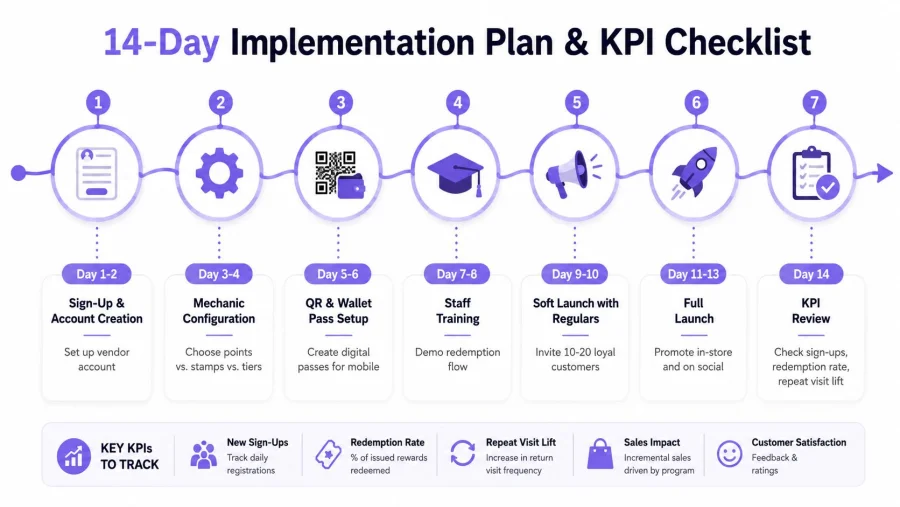
Day 1 and 2 should be about account setup, branding, and one clear reward. The owner should choose the mechanic, write the customer-facing promise, and upload the logo and offer text. Day 3 and 4 should lock the rule, the redemption path, and the staff flow.
No one should overbuild this stage. A clean launch beats a feature pile, because the first version is for learning. If the rule is too broad or the reward too generous, the margin pain shows up before the business gets any useful data.
Days 5 to 10, test with real customers
Day 5 and 6 should cover QR placement and wallet pass setup. Day 7 and 8 should be staff training, with one person showing the exact join, earn, and redeem steps at the counter. Day 9 and 10 should be a soft launch with regulars, not a public announcement.
The soft launch matters because it reveals what staff forget and what customers misunderstand. Fix those mistakes before opening the floodgates. That is how small businesses avoid the embarrassing launch-day scramble that makes everyone distrust the system.
Days 11 to 14, launch and measure
Day 11 to 13 should be the full launch, with in-store promotion and a simple welcome bonus. Day 14 should be a KPI review and a decision on the first adjustment. The owner should not wait a month to find out whether the offer works.
Track these seven KPIs from day one.
- Active members: Count how many people are still using the programme, not just how many signed up.
- Repeat-visit rate: Check whether members are coming back more often after joining.
- Average visits per member: Watch whether the programme is lifting frequency, not just registration.
- Redemption rate: See whether customers claim the reward.
- Top-customer share: Identify how much revenue comes from the best regulars.
- Campaign response rate: Measure whether a message causes action.
- Incremental visit lift: Compare visits before and after the launch to spot real movement.
Printable launch checklist
- Sign-up form: Keep it short and mobile-friendly.
- QR placement: Put it where customers already wait or pay.
- Staff script: Write one sentence every team member can repeat.
- First campaign: Use one welcome bonus, not three offers.
- Analytics review cadence: Check results at the same time each week.
Bringing It All Together and Your Next Step
Loyalty is not a discount trick. It is a measurement system, a repeat-visit system, and a fairness test all at once. The simplest platform that staff use will beat the most complicated one sitting unused behind a sales demo.
The right move is clear. Pick one mechanic, make the reward obvious, and measure whether it brings people back. Do not start with a giant feature list or a long integration project. Start with a system that customers understand in seconds and owners can run without help.
If a café, salon, gym, or shop wants the fastest path to that setup, BonusQR gives a QR-based loyalty stack with stamps, points, cashback, thresholds, wallet passes, and simple launch tools, so the business can start free, test one offer, and tighten the programme from real customer behaviour. The next step is simple, open a free account, configure one mechanic, and launch with a welcome bonus this week.