Marketing automation is defined as the technology-driven process that enables businesses to automate, personalise, and optimise marketing tasks to generate higher ROI and reduce manual effort. For small and medium-sized businesses (SMBs), the importance of marketing automation has never been clearer. Platforms like HubSpot and Zoho have made these tools accessible at every budget level, and the data from 2026 confirms what early adopters already knew: businesses that automate their marketing outperform those that do not, across lead generation, customer retention, and revenue growth.
What are the primary benefits of marketing automation for smbs?
Marketing automation delivers measurable, documented advantages that go well beyond saving time. The numbers are striking, and each one points to a concrete operational shift your business can make.
-
Lead generation at scale. Automated lead generation can produce up to a 450% increase in leads compared to purely manual marketing efforts. That figure reflects what happens when every website visit, form submission, and email open triggers a pre-built follow-up sequence rather than waiting for a team member to act.
-
Productivity gains for your marketing team. Automation produces over 12% productivity gains for marketing teams and cuts sales cycles by 23%. When your team stops manually sending follow-up emails and scheduling social posts, they redirect that time toward strategy and creative work.
-
Higher conversion rates. Automated nurturing workflows report 77% higher conversion rates and 80% more leads compared to manual marketing. The reason is simple: automated workflows respond to customer behaviour in real time, not on a weekly review schedule.
-
Strong, fast ROI. Businesses using marketing automation see an average ROI of $5.44 for every dollar invested, recovering costs within six months. For an SMB watching every pound of budget, that payback period is genuinely compelling.
-
Customer lifetime value growth. Marketing automation combined with strong SEO and content creates 24% growth in customer lifetime value. This matters because acquiring a new customer costs significantly more than retaining an existing one.
These five outcomes are not theoretical. They reflect what happens when you replace ad-hoc marketing activity with structured, data-driven workflows. The advantages of automating marketing compound over time: each workflow you build runs indefinitely, generating returns without additional labour.
Pro Tip: Start by automating your single highest-volume repetitive task, whether that is a welcome email sequence or a post-purchase follow-up. Prove the ROI on one workflow before building the next.

How does marketing automation improve customer engagement?
Customer engagement improves when your communications arrive at the right moment, with the right message, based on what a customer has actually done. Marketing automation makes this possible at a scale no small team could achieve manually.
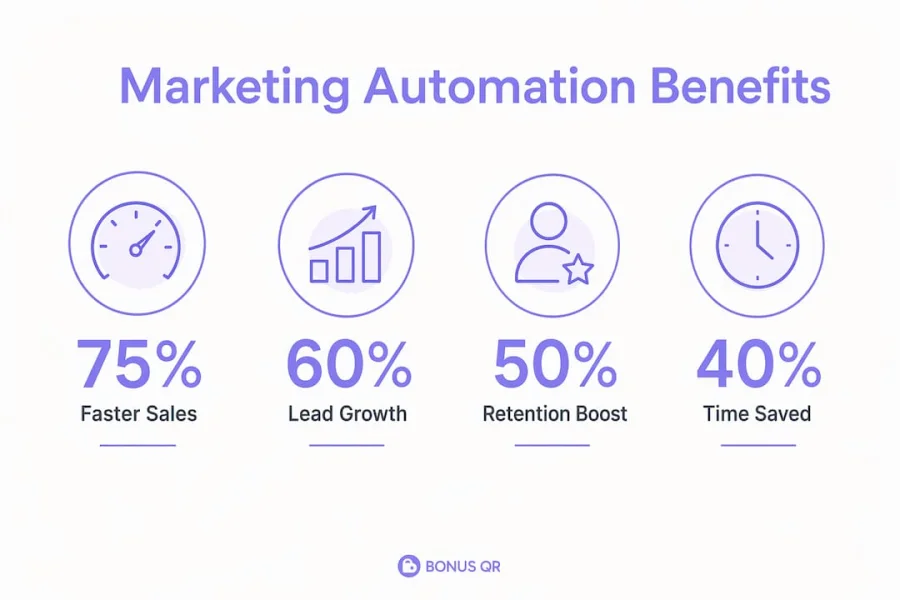
The core mechanism is behavioural triggering. When a customer browses a specific product category, abandons a basket, or reaches a loyalty milestone, an automated system sends a relevant message within minutes. That speed and relevance is what separates automated engagement from batch-and-blast email campaigns.
Here is how automation shapes the customer experience across channels:
- Email sequences. Triggered emails based on purchase history or browsing behaviour consistently outperform generic newsletters. Automated loyalty emails can boost retention by 27%, which compounds directly into revenue.
- SMS and push notifications. Time-sensitive offers sent via SMS or app push notifications reach customers when they are most likely to act. Bonusqr’s platform uses push notifications to deliver these messages automatically, without manual intervention.
- Multi-channel consistency. Automation ensures your brand message stays consistent whether a customer encounters you via email, social media, or your website. Inconsistent messaging is one of the most common reasons customers disengage.
- Loyalty programme triggers. Automated messages tied to points balances, stamp card completions, or cashback thresholds keep customers aware of their rewards and motivated to return. This is particularly effective in retail, where customer engagement in retail directly drives repeat purchase rates.
Retention is where automation’s effects on engagement become most visible. When customers receive timely, relevant communications, they feel recognised rather than marketed at. That distinction drives loyalty.
Pro Tip: Map your customer journey before building any automation workflow. Identify the three moments where a customer is most likely to disengage, then build triggered messages specifically for those points.
What misconceptions do SMB owners have about marketing automation?
The most common misconception is that marketing automation is primarily a time-saving tool. It is not. Automation is a relevance-maker, enabling you to deliver personalised communication at a scale that would be impossible for any team to replicate manually. Time savings are a by-product, not the point.
A second misconception is that automation works regardless of data quality. This is incorrect and costly. Poor data quality before automation leads to ineffective communication and risks damaging your brand reputation. If your contact list contains outdated emails, duplicate records, or missing purchase history, automation scales those errors rather than fixing them. A data audit before implementation is not optional.
A third misunderstanding is that automation replaces content. It does not. Lack of foundational content undermines automation effectiveness because nurturing workflows depend entirely on relevant content to function. If you have no blog posts, no product guides, and no segmented email copy, your automation platform has nothing to send.
Here is a clear summary of the realities SMB owners need to accept before investing:
- Automation requires clean, segmented customer data to function correctly.
- You need a content library tailored to different customer segments and buying stages.
- Automation enforces sales and marketing accountability by replacing subjective arguments with data-driven service-level agreements, such as requiring sales to contact a lead within 30 minutes of a trigger event.
- The platform is infrastructure for growth, not a shortcut to skip strategy.
Viewing automation as infrastructure changes how you invest in it. You build it carefully, maintain it, and expect it to compound returns over months and years, not days.
Pro Tip: Before selecting any automation platform, run a data audit on your existing customer records. Clean data is the single biggest factor in whether your first campaigns succeed or fail.
Which marketing automation tools are best suited for smbs?
Choosing the right platform depends on your team size, budget, existing systems, and the complexity of the workflows you want to build. The table below compares the most relevant options for SMBs in 2026.
| Platform | Best For | Key Strength | Starting Cost |
|---|---|---|---|
| HubSpot | Growing SMBs with CRM needs | All-in-one CRM and automation | Free tier available |
| Zoho Marketing Automation | Budget-conscious teams | Affordable, deep integrations | Low monthly cost |
| Mailchimp | Email-first businesses | Simple email automation | Free tier available |
| Bonusqr | Loyalty-driven SMBs | Automated rewards and push notifications | Free and premium tiers |
| ActiveCampaign | Advanced segmentation needs | Powerful behavioural triggers | Mid-range monthly cost |
When evaluating any platform, apply these four criteria:
Ease of use. If your team needs weeks of training to build a basic workflow, the platform is wrong for your business. HubSpot and Mailchimp both offer drag-and-drop workflow builders that non-technical users can operate within hours.
Integration with your existing systems. Automation platforms that do not connect to your CRM, e-commerce system, or point-of-sale data will create data silos. Zoho’s ecosystem is particularly strong here because it connects natively with Zoho CRM, Zoho Books, and dozens of third-party tools.
Scalability. Your needs in year one will differ from your needs in year three. Choose a platform with pricing tiers that grow with you rather than forcing a full migration when your contact list doubles.
Content and loyalty integration. For SMBs focused on repeat business, platforms that combine automation with loyalty features deliver the most direct ROI. Bonusqr’s platform automates loyalty campaigns, including stamp card completions, cashback triggers, and points milestones, without requiring POS integration. That matters for independent retailers and hospitality businesses that lack enterprise-level infrastructure.
Practical implementation follows a clear sequence. First, define the customer journey you want to automate. Second, build the content assets that each workflow stage requires. Third, segment your contact list by behaviour or purchase history. Fourth, build and test one workflow before scaling. Fifth, review performance data monthly and adjust triggers and messaging based on what the numbers show.
Lead nurturing strategies that combine segmentation with behavioural triggers consistently outperform single-channel approaches. The most effective marketing automation strategies treat each workflow as a living system, not a set-and-forget task.
Pro Tip: Integrate your automation platform with a loyalty programme from day one. Customers who earn rewards are significantly more likely to open automated messages, which improves your deliverability scores and overall campaign performance.
Key takeaways
Marketing automation delivers measurable ROI, higher lead generation, and stronger customer retention when built on clean data, quality content, and clearly defined customer journeys.
| Point | Details |
|---|---|
| ROI is fast and significant | Businesses recover automation costs within six months and average $5.44 return per dollar spent. |
| Lead generation multiplies | Automated workflows can increase lead generation by up to 450% compared to manual marketing. |
| Data quality is non-negotiable | Audit your customer data before automating to avoid scaling errors that damage engagement. |
| Content fuels every workflow | Automation without a segmented content library produces irrelevant messages that customers ignore. |
| Loyalty automation compounds retention | Combining automation with loyalty triggers, such as points and stamp cards, drives repeat purchases directly. |
Why most smbs get marketing automation wrong before they even start
I have worked with dozens of small business owners who invested in platforms like HubSpot or Zoho, set up a welcome email, and then declared that automation “did not work.” Every single time, the problem was not the platform. It was the order of operations.
The businesses that get real results from automation do one thing differently: they treat it as infrastructure, not a campaign. They build their contact data carefully, segment it honestly, and create content that actually addresses what their customers need at each stage of a purchase decision. Only then do they turn on the workflows.
The uncomfortable truth is that most SMBs are not ready to automate when they think they are. Their data is messy, their content is thin, and their customer journey has never been mapped. Automation in that state does not fix those problems. It amplifies them.
What I have found genuinely works is starting with one automated sequence tied to a specific, measurable outcome. For a retail business, that might be an automated message sent 48 hours after a first purchase, offering a loyalty reward for a second visit. That single workflow, done well, teaches you more about your customers than six months of manual email campaigns.
Analytics-driven marketing is what separates the businesses that scale automation successfully from those that abandon it after three months. You need to read the data, adjust the triggers, and treat every workflow as a hypothesis you are testing, not a solution you have found.
Start small. Build on what works. Scale deliberately. That is the only approach that holds up over time.
— Michal
How Bonusqr helps smbs put automation into practice
Bonusqr is built specifically for SMBs that want to automate customer engagement without complex technical setup. The platform’s electronic reward loyalty platform automates points collection, cashback triggers, and personalised reward notifications, all without requiring POS integration. You can also deploy a digital stamp card programme that automatically rewards customers after a set number of visits or purchases, driving repeat business with zero manual effort. Bonusqr’s push notification tools and real-time analytics give you the data you need to refine your campaigns over time. For SMBs looking to put marketing automation strategies into practice quickly, Bonusqr offers free and premium tiers to match your current stage of growth.
FAQ
What is marketing automation in simple terms?
Marketing automation is software that handles repetitive marketing tasks automatically, such as sending emails, delivering loyalty rewards, and following up with leads, based on customer behaviour or set schedules.
Why use marketing automation as a small business?
Small businesses benefit because automation allows a small team to deliver personalised, timely communications at scale, with documented results including up to 450% more leads and a payback period of under six months.
What are the most common effects of marketing automation on sales?
The most consistent effects are shorter sales cycles (by around 23%), higher conversion rates (up to 77% higher with automated nurturing), and improved lead quality through behavioural segmentation.
Do i need a large budget to start with marketing automation tools?
No. Platforms like HubSpot, Mailchimp, and Bonusqr all offer free starting tiers. The priority is clean data and a defined customer journey, not budget size.
How does marketing automation improve customer retention?
Automation keeps customers engaged through timely, relevant messages tied to their behaviour, such as loyalty milestones, post-purchase follow-ups, and re-engagement triggers, which reduce the gap between purchases and increase lifetime value.


