Scalable loyalty solutions are defined as cloud-native, modular platforms engineered to grow with your business, handling increasing transaction volumes, multi-channel engagement, and real-time personalisation without performance loss. Unlike traditional loyalty programmes bolted onto a single system, these platforms use architectural models such as MACH (Microservices, API-first, Cloud-native, Headless) to let you add, swap, or upgrade individual components independently. One enterprise-grade system unified over 70 brands, millions of members, and multi-country support within a single loyalty ecosystem. That scale is now accessible to businesses of all sizes, and understanding how these systems work is the first step to choosing one that genuinely drives customer retention and sales growth.
What are scalable loyalty solutions and how do they work?
Scalable loyalty solutions are modular, API-driven platforms that separate the loyalty engine from the customer-facing experience, allowing each layer to scale independently. The industry standard architecture for achieving this is MACH: Microservices, API-first, Cloud-native, and Headless. Each element plays a specific role in making the system both flexible and resilient.
Microservices break the loyalty programme into discrete functions. Points calculation, reward redemption, fraud detection, and campaign management each run as separate services. If you need to update your rewards catalogue, you do so without touching the points engine. This isolation means faster releases and fewer system-wide failures.

API-first design means every function is accessible via a standard interface. Your mobile app, website, point-of-sale terminal, and third-party marketing tools all connect to the same loyalty data in real time. This is what enables true multi-channel loyalty, where a customer earns points in-store and redeems them online without any manual reconciliation.
Cloud-native deployment means the platform runs on infrastructure like Microsoft Azure or Amazon Web Services, scaling compute resources automatically during peak periods such as Black Friday or a promotional campaign launch. You pay for capacity when you need it, not year-round.
Headless architecture separates the back-end loyalty logic from the front-end customer experience. Your brand controls exactly how the programme looks and feels across every touchpoint, without being constrained by a vendor’s template.
Composable vs. monolithic vs. headless platforms
| Platform type | Best suited for | Key trade-off |
|---|---|---|
| Composable (MACH) | Multi-channel, mid-to-large businesses | Higher setup complexity, faster post-launch velocity |
| Monolithic | Simple, single-channel programmes | Easier to launch, harder to customise or scale |
| Headless | Brands needing front-end flexibility | Requires technical resource for UI development |
Composability suits mid-market brands with multiple channels and complex loyalty needs, while simpler businesses may benefit from a monolithic or headless platform initially. Initial setup for a composable system can take between 3 and 12 months depending on complexity, but it delivers significantly higher feature release velocity once live. The right choice depends on your current channel footprint and your growth trajectory over the next three to five years.
Pro Tip: Before committing to a platform type, map every customer touchpoint where loyalty interactions occur today and where you plan to add them within 24 months. This exercise alone will clarify whether you need composable flexibility or whether a simpler headless system will serve you well.
Why is measuring incremental ROI critical for loyalty programme success?
Incremental ROI measurement is the practice of isolating the revenue your loyalty programme actually caused, rather than crediting it with all revenue generated by members. The distinction matters enormously when you are making the financial case to a board or CFO.
The core problem is straightforward. Your best customers are almost certainly already enrolled in your loyalty programme. If you compare member revenue to non-member revenue and call the difference your programme’s contribution, you are measuring correlation, not causation. Financial modelling shows that true incremental revenue typically represents only 25 to 45 per cent of total member revenue. That gap between perceived and actual programme value is what causes CFOs to question loyalty budgets.
The solution is holdout testing, also called incrementality testing. You divide a segment of customers into two matched groups: one receives loyalty programme communications and rewards, and the other does not. By measuring revenue per visitor (RPV) across both groups simultaneously, you can attribute lift with statistical significance. Holdout tests are the only reliable method to prove AI-powered loyalty lift and satisfy CFO scrutiny.
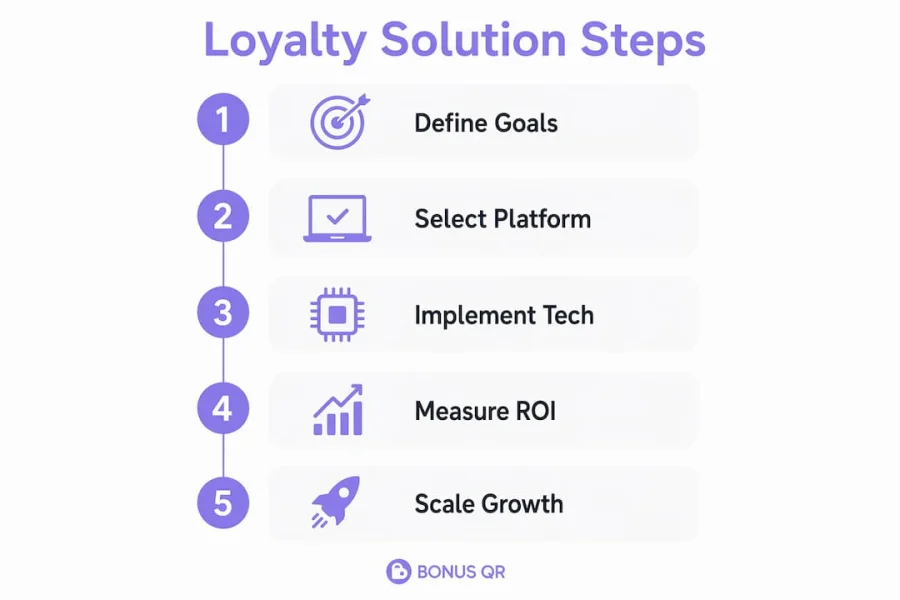
Here is a practical framework for building an incremental ROI case:
- Define your baseline. Measure average purchase frequency, average order value, and customer lifetime value for your target segment before the programme launches or before a new feature goes live.
- Create matched control groups. Select a statistically equivalent group of customers who will not receive the loyalty treatment during the test period. Match on recency, frequency, and monetary value.
- Run the pilot for 90 days. A well-structured 90-day pilot focused on a high-value customer segment can accelerate budget approvals by demonstrating financial metrics in a low-risk format.
- Measure RPV, not just total revenue. Revenue per visitor normalises for differences in traffic volume between your test and control groups, giving you a clean comparison.
- Calculate payback period. Divide total programme cost by monthly incremental revenue to determine how many months until the investment breaks even. This is the number your finance team will ask for first.
Pro Tip: Set your success metrics before the pilot begins, not after. Pre-defined thresholds for incremental revenue lift and retention improvement prevent post-hoc rationalisation and make your results credible to sceptical stakeholders.
Failing to isolate incrementality systematically inflates financial projections, risking programme credibility and future funding. Getting the measurement right from the start protects your budget and builds the internal trust you need to expand the programme over time.
What are the practical benefits of scalable loyalty solutions across industries?
Scalable loyalty solutions deliver measurable business impact well beyond simple reward mechanics. The benefits span customer lifetime value, operational agility, and data asset creation, and they apply across retail, hospitality, food service, and professional services alike.
Here are the core benefits you can expect when implementing a well-architected loyalty system:
- Higher customer lifetime value. Loyalty programmes increase purchase frequency and average order value by giving customers a financial reason to return. When combined with personalised offers triggered by behaviour, the effect compounds over time.
- Unified customer profiles. A scalable platform consolidates purchase history, channel preferences, and engagement data into a single customer record. This enables lifecycle marketing, where you send the right message at the right moment rather than broadcasting generic promotions to your entire database.
- First-party data asset. Unified loyalty data drives 15 to 20 per cent improvements in paid media conversion rates and reduces effective customer acquisition cost. As third-party cookies continue to disappear, this first-party data becomes one of your most valuable commercial assets.
- Operational agility. Because modular platforms isolate each function, your marketing team can launch a new campaign, adjust reward thresholds, or add a referral mechanic without raising an IT ticket. Campaign agility translates directly into faster response to competitive threats and seasonal opportunities.
- Lifecycle marketing integration. Loyalty functions as infrastructure for lifecycle marketing, using verified customer identity and permissioned behavioural data to fuel personalisation, upsell, and cross-sell at every stage of the customer relationship. This is a fundamentally different model from running a loyalty programme as a standalone promotional tool.
- Reduced IT dependency. Cloud-native platforms handle infrastructure management, security patching, and capacity scaling automatically. Your internal team focuses on strategy and customer experience rather than server maintenance.
For a practical view of how these benefits manifest across different retail contexts, the best retail loyalty programmes in 2026 demonstrate a consistent pattern: the businesses achieving the strongest retention results are those treating loyalty as a data and engagement infrastructure, not a discount mechanism.
How to evaluate and select a scalable loyalty solution for your business
Choosing the right loyalty platform is a multi-year decision. The system you select today will shape your marketing capabilities, data strategy, and customer experience for the foreseeable future. Evaluating options on price alone is a common and costly mistake.
The following criteria should guide your assessment:
- Scalability under load. Ask vendors to demonstrate performance during simulated peak traffic. A platform that slows during a promotional event undermines the customer experience at the exact moment you need it most.
- Modularity and integration capability. Confirm that the platform supports API-based integration with your existing tools, including your e-commerce platform, CRM, email service provider, and any point-of-sale systems. Platforms built on MACH principles allow independent component upgrades without broad regression testing, which reduces ongoing maintenance cost significantly.
- Total cost of ownership over three to five years. Initial licence fees are rarely the largest cost. Factor in implementation, integration, staff training, ongoing customisation, and the cost of migrating away if the platform does not meet your needs. Composable architectures reduce maintenance costs by isolating changes to individual microservices, which lowers the total cost of ownership over a multi-year horizon.
- Marketing team autonomy. Evaluate how much your marketing team can do without developer support. Can they create a new reward tier, adjust point multipliers, or segment a campaign audience independently? Platforms that require IT involvement for routine changes slow your marketing velocity.
- Vendor upgrade roadmap. Ask for the vendor’s product roadmap and release history. A platform that has not shipped significant features in the past 12 months is unlikely to keep pace with evolving customer expectations around personalisation and AI-driven engagement.
Platform selection decision framework
| Evaluation factor | What to assess | Red flag |
|---|---|---|
| Scalability | Peak load performance, auto-scaling capability | No SLA for uptime during high-traffic periods |
| Modularity | Independent service upgrades, API documentation | Monolithic updates requiring full system downtime |
| Integration | Pre-built connectors, open API access | Proprietary data formats with limited export options |
| Marketing autonomy | Self-service campaign tools, no-code configuration | Every change requires a developer or vendor ticket |
| Total cost | 3-year TCO including implementation and migration | Pricing based on transactions with no volume cap |
For businesses exploring loyalty programme modules as a starting point, beginning with a focused set of features and expanding over time is a lower-risk path than attempting to implement every capability at launch. Pilot with a defined customer segment, measure incremental results, and use that data to justify the next phase of investment.
Pro Tip: Request a sandbox environment from any vendor you are seriously evaluating. Running a real campaign scenario in a test environment reveals integration gaps, usability issues, and performance limitations that no sales demonstration will show you.
Key takeaways
Scalable loyalty solutions succeed when they combine modular architecture, rigorous incremental measurement, and genuine first-party data strategy rather than treating rewards as a standalone promotional tactic.
| Point | Details |
|---|---|
| MACH architecture enables true scalability | Microservices, API-first, cloud-native, and headless design lets each component scale and upgrade independently. |
| Incremental ROI is the only credible measure | True programme lift is 25 to 45 per cent of total member revenue; holdout testing proves the real figure. |
| First-party data is a strategic asset | Unified loyalty data improves paid media conversion by 15 to 20 per cent and reduces customer acquisition cost. |
| Platform selection is a multi-year decision | Evaluate total cost of ownership, marketing autonomy, and integration capability, not just licence price. |
| Pilot before full deployment | A 90-day pilot with pre-defined success metrics builds the financial case and reduces implementation risk. |
Why loyalty infrastructure thinking changes everything
I have worked with enough businesses to know that the most common loyalty mistake is not choosing the wrong platform. It is treating loyalty as a campaign rather than infrastructure. A campaign has a start date, an end date, and a budget line. Infrastructure is permanent, cross-functional, and gets more valuable the longer it runs.
The businesses I see achieving the strongest retention results are the ones where loyalty data flows into the CRM, informs the paid media strategy, shapes the email calendar, and feeds the product team’s decisions about what to stock or build next. That only happens when the platform is genuinely modular and the data is genuinely unified. It does not happen when loyalty sits in a separate system that the marketing team logs into once a week to check point balances.
The second thing I would caution against is vanity metrics. Member count is not a loyalty metric. It is a registration metric. The number that matters is incremental revenue per active member, measured against a control group. Discipline in experimentation with holdout controls and incremental margin measurement is what separates programmes that get their budgets cut from programmes that get expanded.
My practical advice: start smaller than you think you need to, measure more rigorously than feels necessary, and treat every feature you add as a hypothesis to be tested rather than a certainty to be celebrated. The platforms that support this kind of disciplined iteration are the ones worth investing in.
— Michal
How Bonusqr helps you build a loyalty programme that grows with you
Bonusqr is a cloud-based, modular loyalty platform built for businesses that want to launch quickly and scale without technical complexity. You can start with customer loyalty cards, points collection, stamp cards, or cashback programmes and add features as your customer base grows. The platform requires no POS integration, supports mobile and web applications out of the box, and gives your marketing team full control over campaigns, push notifications, and real-time analytics without raising an IT ticket. Whether you run a single location or a multi-site operation, Bonusqr’s modular structure means your loyalty programme scales with your ambitions. Explore online reward programmes and find the configuration that fits your business today.
FAQ
What is loyalty programme scalability?
Loyalty programme scalability is the ability of a loyalty platform to handle growing transaction volumes, additional customer segments, and new channels without degrading performance or requiring a full system rebuild. Cloud-native, modular architectures achieve this by scaling individual components independently.
What is the difference between composable and monolithic loyalty platforms?
A composable platform uses separate microservices for each loyalty function, allowing independent upgrades and integrations, while a monolithic platform bundles all functions together, making changes slower and riskier. Composable systems suit businesses with multiple channels; monolithic systems are simpler to launch for single-channel operations.
How do you measure the ROI of a loyalty programme accurately?
Accurate ROI measurement requires holdout testing, where a matched control group of customers does not receive loyalty communications during a test period. Comparing revenue per visitor between the treatment and control groups isolates the programme’s true incremental contribution, which typically represents 25 to 45 per cent of total member revenue.
How long does it take to implement a scalable loyalty solution?
Implementation time ranges from a few days for a modular SaaS platform like Bonusqr to 3 to 12 months for a fully composable enterprise system, depending on the number of integrations, channels, and custom features required.
Why is first-party loyalty data valuable beyond the programme itself?
Loyalty data creates a verified behavioural profile of your customers that can improve paid media targeting, personalise email and SMS campaigns, and inform product decisions. High-quality first-party loyalty data has been shown to drive 15 to 20 per cent improvements in paid media conversion rates.


