
Many business owners believe cashback programs underperform points-based systems, but cashback modules often outperform points by 8-12% in customer retention. Selecting the right loyalty program modules is critical for small and medium-sized businesses seeking sustainable growth. This guide defines loyalty program modules, explores different types, explains customization strategies, and shows you how to measure effectiveness. You’ll learn which modules fit your business model and how to optimize them for maximum customer lifetime value.
Key takeaways
| Point | Details |
|---|---|
| Loyalty modules are building blocks | Each module serves a distinct function in your digital loyalty strategy, allowing flexible combinations. |
| Different types suit different businesses | Points, cashback, stamp cards, coupons, and discounts each address specific customer behaviors and business models. |
| Customization drives engagement | Tailoring modules to customer segments and integrating automation maximizes participation and reduces manual effort. |
| Metrics guide optimization | Track repeat purchase rate, redemption rates, and lifetime value to refine programs and boost ROI. |
| Modular design scales with growth | Add or adjust modules as your business evolves, maintaining flexibility and competitive advantage. |
Understanding loyalty program modules
Loyalty program modules are distinct functional components within digital loyalty programs. Each module handles a specific reward mechanism or customer engagement feature. Think of modules as interchangeable building blocks you can combine and customize to create a loyalty strategy that fits your unique business needs.
These modules play a critical role in customer retention and revenue growth. Businesses using loyalty program types for SMBs report higher repeat purchase rates and stronger customer relationships. Modules allow you to target different customer segments with relevant rewards, increasing engagement across your entire customer base.
The modular approach offers significant advantages for small and medium-sized businesses. You can start with one or two modules and expand as your program matures. This scalability prevents overwhelming your team or customers with complexity. Loyalty program modules for retention demonstrate how restaurants use targeted modules to reduce churn and increase visit frequency.
Implementing modular loyalty programs requires minimal prerequisites. You need customer data collection capabilities, a digital platform to manage modules, and clear business objectives. Many modern platforms eliminate the need for complex POS integration, making adoption accessible even for businesses with limited technical resources. Understanding types of secure wifi solutions for SMBs can support data collection infrastructure.
Pro Tip: Start with one module that directly addresses your biggest retention challenge, then add complementary modules as you gather performance data.
Types and benefits of loyalty program modules
The five most common loyalty program modules are points, cashback, stamp cards, coupons, and discounts. Each serves different customer motivations and business objectives. Points modules reward cumulative spending and encourage larger transactions. Cashback modules return a percentage of purchase value, appealing to value-conscious customers. Stamp card modules work well for businesses with frequent, lower-value transactions like cafes or car washes.
Recent research challenges conventional wisdom about module effectiveness. Cashback programs can build stronger loyalty than points-only systems with 8-12% improved retention rates. This data reveals that simplicity and immediate value perception drive customer behavior more effectively than complex point accumulation systems. The stamp card vs cashback loyalty comparison shows context-specific performance differences.
| Module Type | Best For | Primary Benefit | Typical Redemption Rate |
|---|---|---|---|
| Points | High-value purchases | Encourages larger transactions | 15-25% |
| Cashback | Price-sensitive customers | Clear, immediate value | 25-35% |
| Stamp Card | Frequent visits | Simplicity and habit formation | 40-50% |
| Coupons | New customer acquisition | Targeted promotions | 20-30% |
| Discounts | Bulk purchases | Inventory management | 30-40% |
Business-specific use cases reveal optimal module selection strategies:
- Retail stores benefit from points modules that encourage higher cart values and cross-category purchases
- Service businesses like salons thrive with stamp card modules that promote regular appointment scheduling
- Hospitality venues use combined cashback and discount modules to drive off-peak visits
- Restaurants leverage loyalty program modules boosting retention to increase average check size and visit frequency
The redemption experience significantly impacts perceived value. Customers prefer modules with straightforward earning mechanics and clear redemption paths. Complex point calculations or restrictive redemption rules reduce engagement and increase program abandonment. Research from cashback vs points research confirms that transparency drives loyalty program success.
Customization and integration of loyalty program modules
Small and medium-sized businesses gain competitive advantages through module customization without complex technical requirements. POS-free loyalty modules eliminate integration barriers that historically prevented SMB adoption. You can implement digital loyalty programs using mobile apps, QR codes, and web interfaces that customers already understand.
Customization strategies should align rewards with customer segments and purchase patterns. Analyze your transaction data to identify high-value customers, frequent buyers, and at-risk segments. Create module variations that address each group’s distinct motivations. High-value customers might respond to exclusive tiered benefits, while frequency-focused customers engage better with stamp card modules.
Integration with push notifications and marketing automation multiplies module effectiveness. Automated triggers based on customer behavior eliminate manual campaign management. When a customer nears a reward threshold, automated reminders increase redemption likelihood. How to automate loyalty campaigns demonstrates workflow designs that reduce operational burden while improving results.
Automation features tied to loyalty modules reduce manual marketing effort by up to 40%, freeing your team to focus on strategic initiatives. Automated birthday rewards, anniversary bonuses, and win-back campaigns run continuously without daily management. This efficiency makes sophisticated loyalty programs accessible to businesses with small marketing teams.
Flexible platforms enable A/B testing of module parameters. Test different reward thresholds, earning rates, and redemption mechanics to optimize performance. Customizable loyalty program benefits show how hospitality businesses refine modules based on guest feedback and behavioral data.
Pro Tip: Map your customer journey and place module touchpoints at moments when engagement naturally occurs, like after purchase completion or during seasonal shopping periods.
Measuring and optimizing loyalty program module effectiveness
Tracking the right metrics transforms loyalty programs from cost centers into measurable revenue drivers. Four critical metrics provide actionable insights:
- Repeat purchase rate measures the percentage of customers making multiple purchases within a defined period
- Redemption rate tracks how many earned rewards customers actually claim and use
- Customer lifetime value quantifies total revenue generated per customer over their relationship with your business
- Participation rate shows what percentage of eligible customers actively engage with your loyalty program
Real-time analytics enable dynamic program adjustments. Monitor metric trends weekly to identify performance changes quickly. Loyalty program analytics dashboards visualize key performance indicators, making data interpretation accessible for non-technical team members.
| Optimization Action | When to Apply | Expected Impact |
|---|---|---|
| Lower reward threshold | Redemption rate below 20% | Increase redemption 10-15% |
| Add module variety | Participation rate plateaus | Expand engaged customer base 15-20% |
| Increase earning rate | Competitor program launch | Retain at-risk customers 8-12% |
| Introduce tiered benefits | High-value customer churn | Improve retention 12-18% |
Sequential optimization follows a proven framework. First, establish baseline metrics for current performance. Second, identify the biggest performance gap. Third, implement one targeted change. Fourth, measure results over a statistically significant period. Fifth, iterate based on findings.
Customer retention strategies for SMBs emphasize continuous testing. Customer preferences evolve, competitive landscapes shift, and economic conditions change. Your loyalty modules must adapt accordingly. Schedule quarterly reviews of all module parameters and performance metrics.
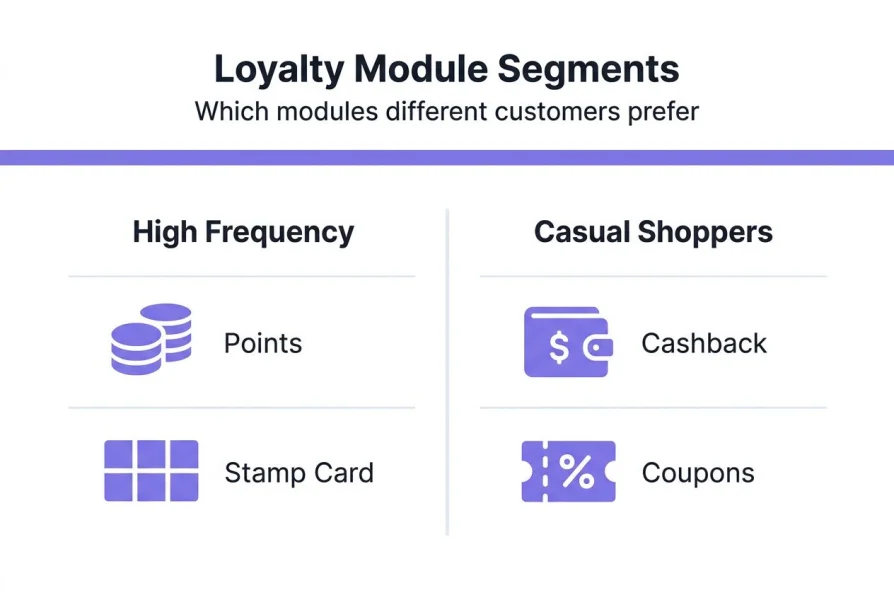
Segment analysis reveals which modules resonate with different customer groups. High-frequency customers might engage strongly with stamp cards while occasional shoppers respond better to targeted coupons. This granular understanding enables personalized module recommendations that increase overall program effectiveness.
Pro Tip: Set module-specific goals aligned with broader business objectives, then track progress monthly to maintain accountability and momentum.
Common misconceptions about loyalty program modules
Myth: Cashback programs are less effective than points-based systems. Contrary to popular belief, cashback modules often outperform points systems by 8-12% in customer retention. The perceived complexity of points calculations reduces engagement for many customer segments. Cashback delivers immediate, tangible value that customers easily understand and appreciate.
Myth: One loyalty module suits all businesses. Business model diversity demands module customization. A boutique retail shop needs different engagement mechanics than a quick-service restaurant. Customer purchase frequency, average transaction value, and competitive positioning all influence optimal module selection. Generic, one-size-fits-all approaches consistently underperform tailored strategies.
Poorly aligned programs generate concerning dropout rates. Industry data shows mismatched loyalty modules cause 35-45% of enrolled customers to become inactive within 90 days. This waste represents lost revenue and missed relationship-building opportunities. Stamp card vs cashback impact illustrates performance differences when modules match or mismatch customer expectations.
Aligning module choice to customer preferences requires research and testing. Survey your existing customers about reward preferences. Analyze competitor programs to understand market expectations. Run pilot programs with small customer segments before full rollout. This evidence-based approach prevents costly misalignment.
“Successful loyalty programs balance business objectives with genuine customer value. Modules must reward behaviors that benefit both parties, creating sustainable engagement loops.”
Module effectiveness varies by demographic factors. Younger customers often prefer digital rewards and instant gratification through cashback. Older demographics sometimes engage more with familiar stamp card mechanics. Geographic and cultural contexts influence reward preferences. Research from cashback loyalty effectiveness research provides demographic segmentation insights.
Avoid copying competitor programs without understanding your unique customer base. What works for a national chain might fail for a local business with different customer relationships and operational constraints. Your loyalty modules should reflect your brand personality and customer expectations.
Benefits of modular loyalty program design
Modular design delivers scalability that grows with your business. Start with basic modules and expand functionality as your customer base and operational capacity increase. This phased approach prevents overwhelming your team or confusing customers with excessive complexity at launch. You can add advanced modules like tiered benefits or partner rewards after establishing strong engagement with core offerings.

Flexibility to adjust modules as conditions change provides competitive resilience. When customer behaviors shift, you can modify earning rates, reward types, or redemption mechanics without rebuilding your entire program. Seasonal adjustments, promotional campaigns, and competitive responses become manageable operational tasks rather than major technical projects. Modular loyalty program benefits demonstrate this adaptability in hospitality contexts.
Increased customer lifetime value results from strategic module combinations. Pairing acquisition-focused modules like new customer discounts with retention-focused modules like stamp cards creates engagement throughout the customer lifecycle. Cross-module strategies encourage diverse behaviors: initial purchase, repeat visits, referrals, and high-value transactions. Each module addresses different motivations, expanding your program’s appeal.
Operational efficiency improves through module specialization. Each module handles specific functions, simplifying staff training and customer education. Clear module purposes reduce confusion and support questions. Maintenance and updates target individual modules without disrupting the entire program. This compartmentalization makes ongoing management more efficient.
Key advantages of modular loyalty programs:
- Lower initial investment through staged implementation
- Easier testing and optimization of individual components
- Better alignment with diverse customer segments
- Reduced technical complexity and faster time to market
- Enhanced ability to respond to competitive threats
- Clearer performance attribution for ROI analysis
Modular design encourages ongoing innovation. When you identify new customer needs or market opportunities, you can add relevant modules without disrupting existing successful components. This evolutionary approach keeps your loyalty program fresh and competitive. Continuous improvement becomes part of your operational rhythm rather than periodic major overhauls.
Pro Tip: Document the strategic purpose of each module in your program, ensuring every component contributes to measurable business objectives rather than adding complexity without clear benefit.
Explore BonusQR’s customizable loyalty program modules
BonusQR provides the flexible, modular loyalty platform described throughout this guide. Our electronic reward loyalty platform eliminates POS integration requirements while delivering robust functionality. You can launch programs quickly and scale as your business grows.
Choose from multiple module types including stamp card loyalty program and points system loyalty program options. Each module integrates seamlessly with marketing automation and analytics tools. Customize reward mechanics, branding, and customer communications to match your unique business needs. Our platform supports the data-driven optimization strategies discussed in this guide, helping you maximize customer lifetime value and retention.
Frequently asked questions
What are loyalty program modules?
Loyalty program modules are distinct features or reward mechanisms within a digital loyalty program designed to engage customers through specific incentives. Common modules include points accumulation, cashback rewards, stamp cards, coupons, and discounts. Modules can be combined and customized based on your business goals, customer preferences, and operational capabilities.
How do I choose loyalty modules for my small business?
Analyze your customer purchase behaviors, transaction frequency, and average order value to identify patterns. Select modules that align with these behaviors and your technical capabilities. Test different module combinations with small customer segments before full deployment. Use performance metrics to refine your selection over time.
Can I integrate loyalty modules without complex POS systems?
Yes, modern platforms offer POS-free customizable loyalty modules that work through mobile apps, QR codes, and web interfaces. Integration with marketing automation and customer engagement tools is standard. This approach reduces technical barriers and accelerates implementation for small and medium-sized businesses.
What metrics should I track to measure loyalty program success?
Focus on repeat purchase rate, reward redemption rate, customer lifetime value, and program participation rate as your core metrics. Track these indicators monthly to identify trends and optimization opportunities. Use analytics dashboards to visualize performance and guide program adjustments based on data rather than assumptions.


