A lot of independent restaurant owners are stuck in the same place. They know regulars matter. They know paper cards are messy. They know a proper restaurant rewards app could help. But they also worry it'll become one more monthly tool, one more staff task, and one more project that never pays back.
That hesitation is understandable. Most loyalty advice is written for chains with app teams, POS developers, and marketing departments. An independent café, takeaway, bistro, or neighbourhood restaurant needs something simpler. It has to be easy for staff, easy for guests, and financially sensible from week one.
The good news is that loyalty doesn't need to be complicated to work. It needs to match how UK diners behave, and it needs to produce trackable repeat visits without adding operational drag.
Moving Beyond the Data Blind Spot of Paper Cards
Paper loyalty cards feel cheap. That's why many owners keep using them, or keep postponing a digital alternative.
The actual cost isn't the paper. The actual cost is the data blind spot.
A paper card can't tell staff which guest hasn't visited in a month. It can't show whether lunch regulars are drifting away. It can't separate a strong reward from a weak one. It can't build a contact list for birthday offers, quiet-day offers, or win-back campaigns. It gives away discounts without showing what came back in return.
Why good enough usually isn't good enough
A “good enough” loyalty setup often means one of two things. Either the restaurant uses paper cards and learns almost nothing, or it has no programme at all and relies on memory, instinct, and occasional social posts.
That sounds safe, but it often costs more than owners realise.
Data from Pointify's UK loyalty app analysis shows that a programme only needs to drive about 10 extra covers per week at a £28 average bill and 30% margin to cover a £100 monthly subscription cost. The same analysis notes that reward cost should generally sit around 3 to 6% of spend, and that 43% of UK restaurants still offer no loyalty programme at all.
That's the break-even math many owners never see. They assume a restaurant rewards app has to transform the whole business to justify itself. It doesn't. It often just needs to bring back a handful of guests who would otherwise skip a visit.
Practical rule: If a loyalty tool can't clearly show what extra visits it's generating, the restaurant is guessing. If it can, the owner can manage it like any other profit lever.
What paper cards fail to measure
A digital programme changes loyalty from a vague idea into something operational.
Here's what paper cards usually miss:
- Customer identity: The restaurant doesn't know who its repeat guests are unless staff recognise faces.
- Visit patterns: There's no easy way to see whether guests come weekly, monthly, or only when prompted.
- Reward performance: The owner can't tell which offer drives return visits and which one just gives margin away.
- Lapsed regulars: Guests can disappear without any trigger for follow-up.
- Marketing permission: Paper cards don't create a usable customer list for targeted outreach.
What a simple digital setup does better
For most independents, the most practical upgrade isn't a heavy branded app. It's a lightweight digital system such as QR stamp card loyalty programs, where guests join quickly, collect rewards without friction, and give the business a usable record of activity.
That matters because loyalty isn't just about rewarding frequency. It's about spotting behaviour early enough to act on it.
A restaurant owner doesn't need a giant dashboard. The owner needs answers to very practical questions:
| Question | Why it matters |
|---|---|
| Who visited three times and then stopped? | Those guests are often easiest to win back |
| Which reward gets redeemed quickly? | Fast redemption usually signals relevance |
| Are lunch guests joining more than dinner guests? | The restaurant can tailor the offer by service period |
| Is the programme generating enough extra visits to cover its cost? | That decides whether the tool stays |
The strongest reason to move beyond paper isn't technology. It's control. A restaurant rewards app gives owners visibility into repeat business, and visibility is what turns loyalty from a hopeful idea into a manageable financial decision.
Designing a Reward Structure Customers Actually Want
Most loyalty programmes fail before launch. Not because the software is bad, but because the reward design doesn't fit the venue.
A coffee shop copies a points system built for a chain. A full-service restaurant copies a stamp card built for a takeaway. A fine dining venue offers discounts when recognition would work better. Then the owner concludes that “customers didn't care”.
The problem usually isn't loyalty itself. The problem is the match between the reward structure and the guest's buying habit.
What UK diners usually respond to
Industry guidance highlighted by Perkstar's UK comparison of restaurant loyalty models makes a useful distinction. UK diners often respond better to frequent, smaller rewards such as a free coffee after five visits than to large, infrequent discounts. The same comparison also notes that high-frequency, low-spend venues such as cafés and takeaways need stamp-style mechanics, while low-frequency, high-spend venues such as fine dining need VIP-style perks.
That one distinction fixes a lot of weak programmes.
Comparing the main reward models
| Model | Works best for | Strength | Risk |
|---|---|---|---|
| Digital stamp card | Cafés, bakeries, takeaways, QSR | Simple and visible progress | Can feel too basic for premium venues |
| Points per pound | Multi-category menus, restaurants with upsell focus | Flexible and easy to layer offers onto | Often too abstract for guests |
| Tiered VIP | Premium dining, bars, high-value regulars | Builds status and exclusivity | Too slow for infrequent guests if thresholds are unclear |
| Surprise rewards | Most formats as an add-on | Feels personal and memorable | Doesn't work well as the whole programme |
When stamps beat points
A guest buying coffee, lunch, or a quick takeaway wants fast progress. They don't want to calculate value. They want to know that a few more visits earn something tangible.
That's why visit-based schemes often outperform complicated points logic in everyday food and drink settings. A visible path to a reward creates momentum. Guests understand it immediately, staff explain it in one sentence, and the programme becomes part of the visit rather than an extra task.
For operators who want spend-linked logic as well, tools like BonusQR loyalty points can support points-based rewards. That can work well when the venue has varied ticket sizes or wants to steer guests toward specific menu choices. But points only work when the guest can see the payoff quickly and the explanation stays simple.
A reward structure should match the pace of the customer relationship. Fast-visit businesses need fast-feeling rewards.
A practical way to choose
The easiest way to choose the right structure is to start with visit frequency, not software features.
Use this lens:
- If guests come often and spend modestly, use stamps or visit rewards. Cafés, dessert shops, sandwich bars, and takeaways usually fit here.
- If guests spend unevenly across visits, points can help connect reward value to spend, especially where upsells matter.
- If guests visit less often but spend more, use recognition perks. Priority booking, exclusive menu access, or member-only events fit better than chasing lots of visits.
- If the venue has a mixed audience, combine a simple core mechanic with occasional surprise rewards.
Common mistakes in reward design
Some programmes look attractive on paper and fall flat in service. A few patterns come up repeatedly:
- Too much complexity: If staff need a script to explain it, sign-ups will drop.
- Rewards too far away: Guests lose interest when progress feels distant.
- One model for every venue: What works for a neighbourhood coffee shop won't automatically work for a destination restaurant.
- Discount-only thinking: Constant discounting can train guests to wait for offers instead of building habit.
A reward should feel achievable, relevant, and easy to remember. If those three conditions aren't there, the restaurant rewards app won't rescue the programme.
Your Essential Restaurant Rewards App Features
Technology choices shape adoption more than most owners expect. A lot of restaurants spend too much time comparing reward ideas and too little time comparing the sign-up experience.
That's backwards. If guests don't join easily, the reward structure barely matters.
Choose access over app-store ambition
In the UK restaurant sector, LoyaltyPass reports that QR-based wallet-pass loyalty schemes achieve 65 to 75% customer adoption, while standalone branded apps typically reach only 10 to 20% adoption. That gap is enormous for independents because adoption drives everything else. No sign-up volume means no data, no re-engagement, and no useful programme economics.
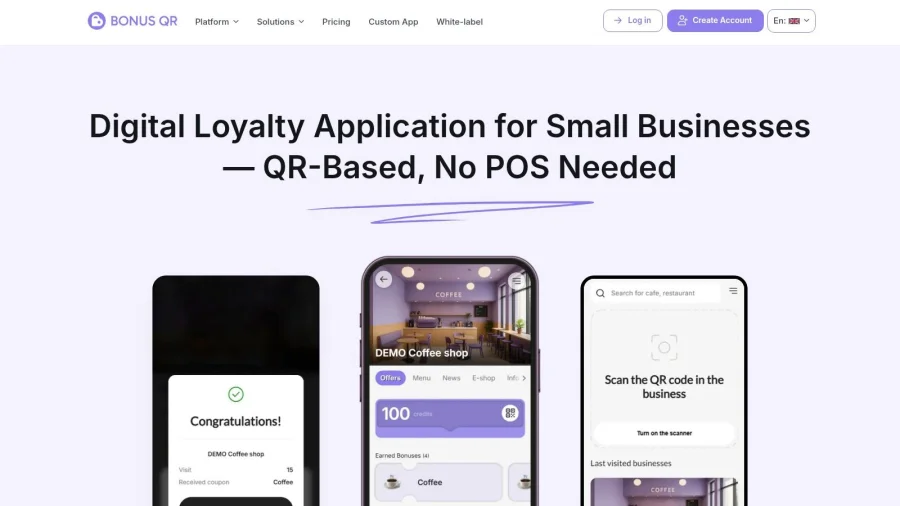
A branded app sounds impressive. In practice, most guests won't download another restaurant app unless they already visit constantly. A QR-led setup linked to Apple Wallet or Google Wallet removes that friction.
That's why a restaurant rewards app for independents should be judged first on join speed, not visual polish.
The non-negotiable feature checklist
A useful system needs to cover these basics well:
- Fast QR sign-up: Guests should be able to join at table, till, or counter without a long form.
- Wallet compatibility: Loyalty passes need to stay visible on the customer's phone without another app login.
- No extra hardware: Staff should be able to scan and redeem using standard iOS or Android devices.
- Simple reward management: The owner should be able to update offers without waiting for developers.
- Built-in analytics: The platform must show repeat visits, reward use, and customer trends in a clear way.
- Automated messaging: Basic win-back, birthday, and campaign messaging should be easy to run.
- GDPR-safe handling: Customer data needs to be stored and managed appropriately for UK use.
What staff need is different from what marketers want
Many loyalty platforms are sold to owners with screenshots of dashboards and campaign builders. Staff need something else. They need a flow that works in a live service environment.
If a barista, server, or cashier can't sign a guest up in a few seconds, they'll stop offering it. If redemption causes confusion at the till, staff will resist it. If a manager has to explain exceptions every shift, the programme becomes a nuisance.
That's why the best systems are usually the boring ones operationally. They scan fast, show the reward clearly, and don't interrupt service.
A sensible evaluation question
When comparing platforms, one question reveals a lot: could a new team member learn the loyalty workflow during a normal shift without slowing the queue?
If the answer is no, keep looking.
One example in this category is loyalty solutions for brick-and-mortar, where QR enrolment, wallet support, staff scanning, and light operational setup are built around in-store use rather than app-store downloads. That approach tends to fit independents better than custom-built consumer apps that require heavier maintenance.
Operator check: The right feature set reduces friction for guests and staff at the same time. If it only solves one side, adoption usually stalls.
A Step-by-Step Plan to Launch Your Programme
A loyalty launch doesn't need a large campaign. It does need discipline.
Most poor launches fail in predictable ways. The reward is unclear. Staff forget to mention it. The QR code is hidden. The owner checks sign-ups after a month, finds little momentum, and assumes the concept didn't work.
The first month decides whether the programme becomes part of daily trade or a forgotten add-on.
Start with a tight setup
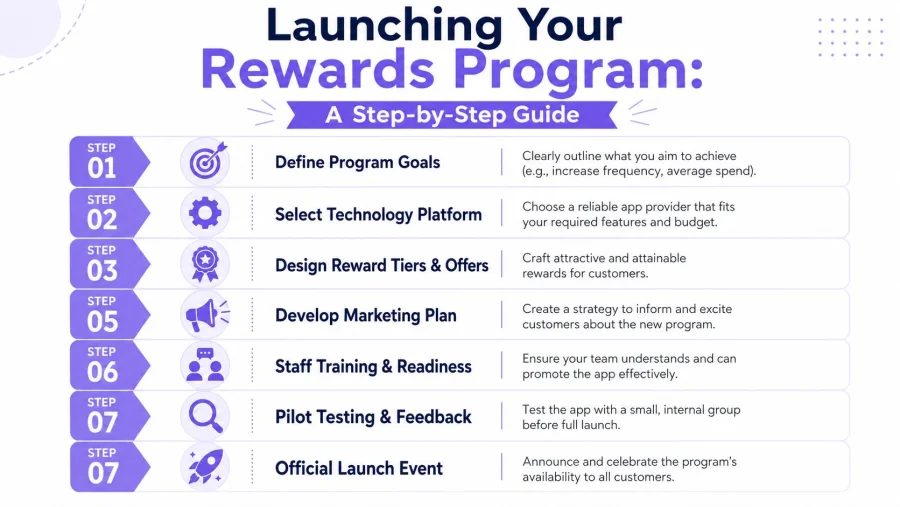
Before a single guest joins, the restaurant should lock down five decisions:
The main business goal
Pick one primary objective. Increase repeat visits is different from increasing average spend, and both are different from filling quiet midweek periods.The first reward
Keep it easy to understand. Staff should explain it in one sentence.Where guests will see the programme
Counter, menu, receipt, table talker, window, and social profile all matter more than many owners expect.Who owns the programme internally
One person must check performance, answer staff questions, and adjust weak offers.How redemption works
If the guest journey isn't clear, launch gets messy fast.
Build the staff script before the posters
Staff behaviour drives early enrolment. If the team treats the programme like an optional extra, guests will too.
A simple script works better than a sales pitch. The best version sounds like part of service, not marketing. For example, staff can ask whether the guest wants to collect rewards on today's order, then point to the QR code and explain the first benefit plainly.
What matters is consistency. Every shift. Every till. Every table where it fits.
What high-performing launches do in the first month
According to Slerp's loyalty guidance, high-performing UK programmes aim for 25% customer enrolment within the first 30 days. The same guidance links that result to aggressive on-site promotion, including table talkers with QR codes at every seat, staff incentives of £1 per enrolment, double stamps for the first week, and social media countdown campaigns.
That combination works because it covers the three places a launch usually breaks: visibility, staff motivation, and customer urgency.
A practical 30-day rollout
Days 1 to 7
Focus on visibility and momentum.
- Place QR prompts everywhere: Every table, till point, takeaway bag insert, and menu sleeve should make joining obvious.
- Give staff a reason to remember: A small incentive per enrolment keeps the programme front of mind during the launch push.
- Use a limited-time boost: Double stamps in week one give early joiners an immediate reason to act.
- Post daily reminders: Social content should show the reward, the joining method, and the deadline for the launch bonus.
If guests have to ask how loyalty works, the promotion isn't visible enough.
Days 8 to 14
Use the second week to spot friction.
Maybe guests are scanning but not finishing sign-up. Maybe staff only mention the programme at lunch. Maybe the reward sounds attractive online but lands weakly at the counter.
Run quick checks:
- Ask staff which explanation gets the best response.
- Check whether one shift or one location is outperforming another.
- Watch one real customer journey from invite to redemption.
Days 15 to 30
The final stretch of the opening month is about habit.
This is when the programme needs to stop feeling new and start feeling normal. Keep the prompts in place. Keep managers checking that staff mention it. Keep social proof visible by showing rewards being earned and redeemed.
A launch calendar doesn't need flashy creativity. It needs repetition.
Avoid these launch errors
A lot of restaurants damage good loyalty concepts with preventable mistakes:
- Launching without strong promotion: If the team is shy about promoting it, sign-ups stay low.
- Choosing a distant reward: Guests won't commit if the payoff feels remote.
- Hiding the QR code: Counter clutter kills enrolment.
- Training once and forgetting: New staff and busy shifts quickly break consistency.
- Treating launch as a one-day event: Most momentum is built through repeated promotion across several weeks.
The strongest launches are operational, not dramatic. They give guests a reason to join today and make it easy for staff to ask every time.
How to Measure and Optimise for Long-Term Growth
A loyalty programme shouldn't be judged by sign-ups alone. A large member list with weak usage doesn't help much.
The useful question is simpler. Are members behaving differently in ways that improve revenue and retention?
The numbers that matter after launch
A restaurant rewards app becomes valuable when it helps the owner answer a short list of commercial questions.
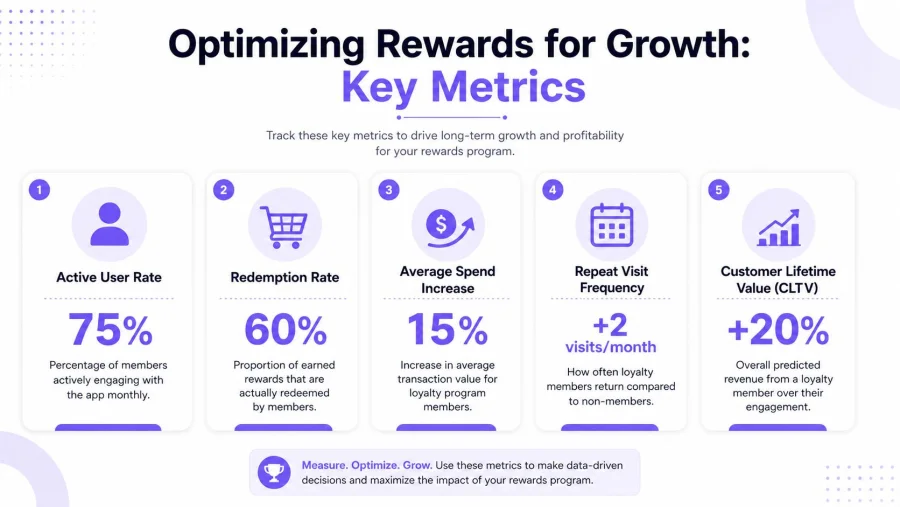
Track these indicators consistently:
- Repeat visit behaviour: Are members returning more often than non-members?
- Average transaction value: Are members spending more when they visit?
- Reward redemption pattern: Are rewards attractive enough to be used, but not so costly that they damage margin?
- Lapsed member groups: Which once-active members have stopped coming?
- Offer response by segment: Do lunch guests, takeaway guests, and dine-in guests react differently?
The point isn't to build a giant reporting system. It's to identify what needs changing while there's still time to change it.
What good member behaviour looks like
Restaurant loyalty members often show stronger commercial behaviour than non-members. Deliverect's restaurant loyalty statistics report that about 64% of loyalty members spend more on each transaction to maximise point earnings, and that loyalty members generate 12 to 18% more incremental annual revenue than non-members.
That matters because it changes how the owner should read the dashboard. A reward programme isn't only about filling a card. It can also increase order value, especially when the reward logic encourages one more item, one more add-on, or one more visit within a useful time window.
How to act on the data
Different metrics point to different fixes.
| What the dashboard shows | Likely issue | Practical response |
|---|---|---|
| Lots of sign-ups, weak repeat use | The reward isn't compelling enough | Simplify the offer or make the first reward feel closer |
| Strong use, weak profitability | Reward value is too generous | Tighten the reward cost or shift to a higher-margin item |
| Good engagement from one segment only | The programme fits one audience better than another | Build segment-specific offers instead of one generic reward |
| Members disappear after early use | There's no follow-up after first redemption | Add a post-reward message or next-visit prompt |
Review little and often
Monthly reporting is often too slow for loyalty. Small problems become habits.
A better rhythm is to check engagement regularly, look at lapsed cohorts, and adjust ignored rewards quickly. Owners don't need to obsess over every data point. They do need to catch obvious weak spots before they burn through margin or staff attention.
Management principle: A loyalty programme improves when the owner treats it like a living menu item. Keep what sells. Fix what doesn't. Remove what creates friction.
Long-term growth comes from small improvements made consistently. Better reward timing. Cleaner messaging. Faster redemption. Smarter reactivation. That's where a restaurant rewards app earns its place, not as a gimmick, but as a tool for repeatable commercial decisions.
Independent restaurants don't need a complicated loyalty stack. They need a programme that diners will join, staff will use, and owners can justify financially.
The strongest setup is usually simple. A clear reward. A fast QR join flow. Wallet access instead of a heavy app download. Visible in-store promotion. Regular review of real customer behaviour.
For operators who want to move beyond paper cards and vague loyalty ideas, BonusQR is one practical route. It supports QR-based enrolment, wallet passes, flexible reward rules, built-in analytics, and staff-friendly redemption without extra hardware. Restaurants can explore BonusQR to see whether that structure fits their service model, team, and budget.
If the current system doesn't show who the regulars are, which offers work, or whether loyalty is paying back, it's already costing more than it seems.


