A busy café can lose a loyal customer before the next order even starts. The customer reaches the till, realises the paper card is missing, and accepts another untracked visit. Staff then guess whether a stamp was due, while the business learns nothing about the customer's return pattern.
QR code stamps replace that fragile paper moment with a repeatable habit loop. The customer scans, receives a digital stamp, sees progress towards a reward, and has a reason to return. The operator gets a clearer record of visits and redemption behaviour without adding a separate card to the customer's wallet.
The strongest programmes aren't built around technology for its own sake. They use one obvious scan flow, a reward customers understand immediately, and a fallback when scanning fails. This guide shows how to build that experience, with practical choices for cafés, salons, restaurants, and other local businesses. It also explains where a platform such as BonusQR can keep setup and day-to-day management straightforward.
Why QR Code Stamps Beat Paper Cards for Busy Shops
The familiar paper-card failure happens at the busiest point of service. A regular customer orders a coffee, asks for a stamp, and then discovers the card is in another coat. Another customer has a card with unclear marks, while a new employee isn't sure whether a partially completed row is valid. The visit may still create revenue, but it disappears from the loyalty record.
A digital stamp card keeps the customer's progress on the phone. The customer joins through a mobile or web journey, receives a personal QR code, and presents it at the counter. Staff scan it, the account updates, and the customer can see what remains before the reward is released.
The real upgrade is the habit loop
Paper cards record isolated transactions. QR code stamps connect the prompt, action, progress, and reward:
- Prompt: A counter sign or staff member invites the customer to scan.
- Action: The customer presents a personal code during the visit.
- Progress: The digital card shows the new stamp straight away.
- Reward: The customer knows what they'll receive after completing the card.
That visibility matters because repeat visits depend on a reason to come back, not merely on the existence of a discount. A customer who can see progress has a stronger reminder than someone who has to remember where a paper card is stored.
Digital loyalty also gives the operator useful signals. A business can identify active participants, see which rewards are being redeemed, and communicate with enrolled customers through permitted channels. Paper cards can't provide that same view without manual administration.
Make the customer experience feel familiar
The scan shouldn't compete with ordering, payment, or collection. It belongs in the same physical places where customers already pause, such as the till screen, collection shelf, table tent, salon reception desk, or receipt area.
Businesses already connecting physical service points to mobile journeys can also launch a QR menu with TopFoodApp, then keep the loyalty action close to the ordering experience. The principle is simple: customers shouldn't have to search for the programme after they've decided to buy.
A practical stamp card loyalty system should let staff explain the programme in one sentence: “Scan this code today and your digital card will add a stamp.” If the explanation takes longer, the rules probably need simplifying.
How QR Code Stamps Work in Real Life
A QR stamp programme has two connected experiences, one for the customer and one for staff. The customer needs a fast way to join and track progress. Staff need a reliable way to award and redeem stamps without extra hardware or a complicated till procedure.
The customer journey
The flow should look like this:
- Sign up: The customer joins from a mobile or web page.
- Receive a personal code: The system creates a QR code linked to the customer's loyalty profile.
- Scan at the till: Staff scan the customer's code after the qualifying purchase.
- Track and redeem: The customer checks stamps and rewards in the same profile, then presents the reward when ready to use it.
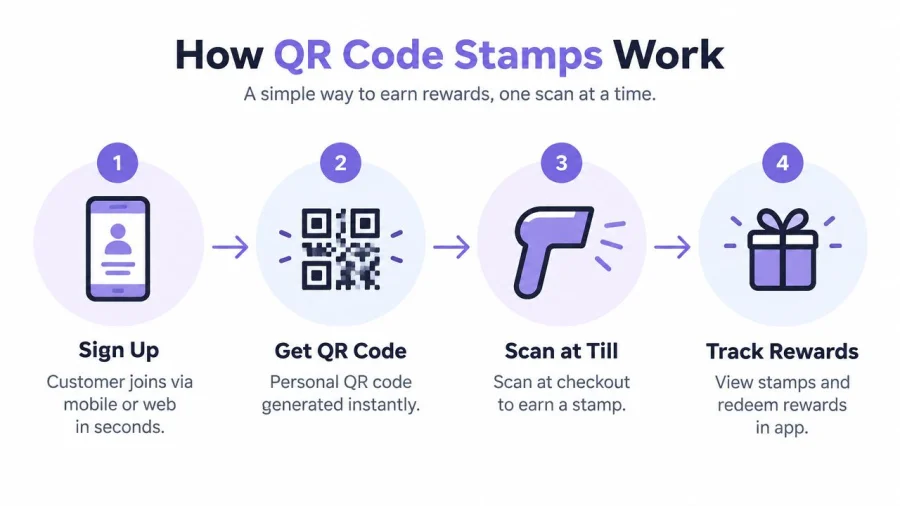
The best customer journeys avoid unnecessary typing, app-store searching, and multiple screens. A customer should understand what the scan does before opening the camera, and the landing page should lead directly to joining, showing the card, or claiming the reward.
The staff journey
Staff usually scan the customer's personal code through the loyalty system. The platform validates the profile, adds the appropriate stamp, and can handle reward redemption when the card is complete. That means the business doesn't need to issue physical cards or install dedicated scanning equipment.
The operator still needs a clear staff rule. For example: one qualifying visit earns one stamp, staff scan once after payment, and rewards are redeemed only through the digital profile. This prevents accidental double stamps and avoids arguments about whether individual items qualify.
The distinction between physical and digital cards is practical:
| Paper stamps | QR code stamps |
|---|---|
| The customer must carry the card | The customer keeps progress on a phone |
| Staff mark the card manually | Staff scan and update the profile |
| Progress can be lost or damaged | Progress remains connected to the account |
| Promotion depends mainly on printed material | The business can use digital messages and offers |
The same thinking used for traceable digital product journeys appears in Monopack ltd compliance guide. For loyalty, the important lesson is not compliance complexity. It's that a physical interaction becomes more useful when the digital record remains clear, accessible, and connected to the person using it.
Practical rule: Staff should be able to describe earning, checking progress, and redeeming in one short explanation. If they need to memorise exceptions, customers will receive inconsistent answers.
Set Up Your QR Stamp Programme and Configure Rules That Convert
A loyalty card fails before launch when the reward sounds vague or the earning rule changes from one employee to another. Configuration should begin with the behaviour the business wants to encourage, then work backwards to a reward that feels reachable without damaging margin.
Choose a visible reward threshold
A café might reward a completed series of qualifying drinks with a free drink or a clear fixed discount. A salon could award a treatment upgrade or a defined amount off a future appointment. A quick-service restaurant might offer a specific menu item rather than an open-ended discount.
The threshold should be easy to display and easy to repeat verbally. Customers don't need a complex explanation of the economics behind the reward. They need to know what counts, what they're working towards, and what happens when the card is complete.
The reward also needs a clear redemption condition. State whether it applies to a particular item, service, visit, or booking type. Avoid wording such as “enjoy a special reward” if the customer will still need to ask staff what that means.
Define one primary earning rule
The most reliable starting point is one core action for one stamp. For many cafés, that means one qualifying visit. For a salon, it could mean one completed appointment. For a food business, it might mean one eligible order, provided the definition is simple enough for every team member to apply consistently.
PizzaExpress provides a useful example of channel-specific earning. In its UK omnichannel loyalty deployment, customers earned 1/12 of a slice by scanning packaging, 6/12 through Deliveroo box QR codes, and 12/12 by dining in-store, with the in-restaurant route designed as the fastest path because it was the most profitable channel. The rollout recorded 2 million sign-ups in the first 12 months, 2.2 million stamp-card transactions per year, and 25% of revenue linked to the loyalty scheme, as detailed by BonusQR's account of the PizzaExpress digital loyalty deployment.
Those rules make sense in a large, carefully attributed omnichannel model. A smaller operator should be cautious before copying the fractional structure. Every additional route creates more questions for customers and staff, particularly when a customer buys through different channels in the same week.
Keep exceptions out of the main flow
A strong café configuration might say:
- Qualifying visit: One purchase at the café earns one stamp.
- Exclusions: Gift cards, refunds, and loyalty rewards don't earn another stamp.
- Reward: The customer receives the named reward when the card is complete.
- Redemption: Staff validate the digital reward before providing it.
A salon can use the same structure while defining the qualifying service. The programme might exclude cancellations, deposits, or already-discounted appointments if those exclusions protect profitability. The wording should appear wherever customers join and wherever staff need to answer questions.
Add timing without creating pressure
Expiry dates can encourage customers to return while the programme is still salient, but they should be visible at sign-up and on the digital card. A business should avoid surprising customers with an expired reward at the till. If the programme uses a time limit, staff need a simple response for customers who ask for an extension.
Welcome perks can help a new member experience value quickly. Birthday or seasonal offers can create additional reasons to return, but they shouldn't distract from the main stamp mechanic. The core card has to work even if the customer ignores every secondary promotion.
Use the configuration screen to test the customer view before launch. The card should answer four questions at a glance:
- What action earns a stamp?
- How many stamps are needed for the reward?
- What exactly is the reward?
- How does the customer redeem it?
A business can browse loyalty card software while comparing features, but the platform matters less than the rule design. A simple system with a well-understood offer will outperform a feature-rich system that forces staff to explain multiple earning paths.
Print still has a role in the launch. Counter cards, window signs, and appointment-desk prompts can carry the same message, and businesses that need physical promotional materials can consider sheet sticker printing UK for durable labels placed near natural pause points.
Operator's test: If a new employee can explain the earning rule after reading the counter sign once, the configuration is probably ready. If the employee needs a manager to interpret it, simplify the programme before customers encounter it.
Promote Your Stamps In Store So Customers Actually Scan
A QR code hidden on a receipt is technically available but commercially weak. Customers scan when the code appears at a point where they're already waiting, choosing, collecting, or finishing a transaction.
Place the main code at the till, not in a separate loyalty corner. Add a second prompt at the collection point or table if customers spend time there. Salons can use reception, the consultation area, or the payment desk. The wording should tell the customer what happens next:
- “Scan to collect today's stamp.”
- “Join the rewards card before you leave.”
- “Scan now, track your reward on your phone.”
Avoid a paragraph of instructions. A customer who needs to read a manual at the counter is likely to abandon the action, especially during a queue.
Give staff a line that doesn't slow service
Staff prompts should sound like part of the transaction, not a sales presentation. A barista can say, “Would you like to collect a stamp for this visit?” A stylist can ask, “Would you like today's appointment added to your rewards card?” The customer then receives a clear instruction rather than a vague invitation to join a scheme.
Training should cover three moments:
- Invitation: Ask at the point of purchase or completion.
- Scan: Confirm that the code has been captured before moving on.
- Reward: Explain what the customer will see when the card is complete.
The operator should also define what happens when a customer's camera doesn't recognise the code, the page loads slowly, or the customer doesn't have a suitable device. QR-only loyalty creates avoidable exclusion if staff have no alternative.
Build a fallback into the process
A fallback might allow staff to locate the customer profile by a permitted identifier, provide a short join link, or record the visit through an approved manual process. The fallback must protect against duplicate claims, so it should be available only when the scan fails and should remain as simple as the primary flow.
UK government research makes the risk clear. The Tell ABAB 2025-26 report found that 79% of users said QR codes were easy to use, while 13.5% gave up and used an alternative method and 7.5% found them difficult. The report also found that 68% found QR access to guidance helpful, which indicates that usefulness depends on context and clarity, not merely on the presence of a code. These findings appear in the Tell ABAB 2025-26 report.
The fallback should be visible to staff but not positioned as the primary route. Customers need confidence that a failed scan won't erase their visit.
Make the code easy to find later
Digital wallet passes can keep the loyalty card close to the customer's everyday phone tools. Apple Wallet and Google Wallet support can reduce the need to search through messages or revisit the original sign-up page, especially for regular customers who don't want another app icon.
Before opening, check the in-store journey:
- Can a customer see the sign within the normal queue?
- Is the code large enough and sharply printed?
- Does the sign explain the immediate benefit?
- Does the landing page show the card without unnecessary navigation?
- Does every employee know the fallback?
- Does the reward appear clearly after completion?
QR adoption is also becoming more familiar within UK retail infrastructure. GS1 UK reported that 11% of its members had implemented next-generation QR technology, while 33% planned to do so within 12 months, with the source describing a projection that nearly half of its 60,000-member base could be using it by 2026. The GS1 UK report on next-generation barcodes supports the broader direction, but each small business still needs to make its own scan experience obvious and dependable.
Measure Performance and Keep Customers Coming Back
A stamp programme doesn't need a wall of dashboards. Operators need a small set of signals that explain whether customers are joining, returning, and reaching the reward.
Start with repeat visit rate. If many customers join but few return, the issue may sit in the reward threshold, the prompt, the service experience, or the visibility of the digital card. If customers return but don't redeem, the reward may be unclear, difficult to claim, or poorly timed.
The time between visits is equally useful. A café can watch whether enrolled customers come back within the normal buying rhythm. A salon may see a longer natural interval between appointments. The correct response isn't always to send more messages. It's to compare the customer's usual pattern with the timing of the next reminder.
Read the programme weekly
A weekly review can focus on:
- New members: Are staff inviting customers consistently?
- Scan completion: Are customers completing the action after seeing the code?
- Stamps issued: Do the numbers reflect real qualifying visits?
- Reward redemptions: Are customers reaching and using the reward?
- Inactive regulars: Which previously active customers have gone quiet?
- Top customers: Who returns often enough to deserve a more relevant offer?
UK shoppers already understand loyalty mechanics. A 2024 UK government review found that 97% of shoppers belonged to at least one supermarket loyalty scheme, with an average of 3 memberships, while 21% held 5 or more. The UK loyalty market review suggests that familiarity reduces the need to educate customers about collecting rewards. The business still has to make its own rules distinctive and easy to use.
Another UK survey reported that loyalty cards were used on average 3 times per week, 28% of shoppers used them 4 times a week or more, and 95% of users said they were satisfied or very satisfied with the schemes they used. The Ecrebo loyalty report reinforces the value of habitual, low-effort redemption.
Turn signals into actions
If scan completion is weak, move the sign or shorten the call to action before changing the reward. If customers collect stamps but stop near the threshold, check whether the reward is attractive and whether redemption instructions are clear. If redemptions are strong but margin suffers, adjust the reward or qualifying purchase rather than adding more complexity.
Automated push or email messages can support these moments. A welcome message can explain the first scan. A reminder can reach a customer whose activity has slowed. A seasonal offer can appear when the business has a reason to increase visits. Messages should reflect the customer's status, not send the same promotion to everyone.
Operators can view loyalty program stats to inspect customer activity, coupon performance, and visit trends. The useful question is always operational: what will staff change this week because of the signal?
Launch Checklist and Next Steps With BonusQR
A dependable QR stamp programme needs fewer moving parts than most operators expect. Before going live, confirm the following:
- One primary scan flow: Customers know exactly where and when to scan.
- One clear earning rule: Staff can explain what qualifies without exceptions.
- Visible reward threshold: The card shows what customers are working towards.
- Reliable redemption: The reward validates digitally and staff know what to do.
- Failed-scan fallback: No customer loses a visit because the camera or connection fails.
- Consistent promotion: Counter signs, wallet passes, and staff prompts use the same wording.
- Weekly review: The operator checks participation, repeat visits, redemption, and inactive regulars.
The UK market supports both familiarity and caution. Traditional stamp rewards remain relevant, but a UK loyalty survey found 43% of consumers preferred digital loyalty cards over physical ones, as reported by SumUp's UK loyalty programme survey. Customers may welcome digital convenience, but they still need clear instructions and a dependable alternative when technology interrupts the transaction.
BonusQR lets a business create a digital stamp card, issue personal QR codes, manage rewards, use wallet passes, and review loyalty activity without requiring POS integration or extra hardware. Businesses can start for free, use ready-to-print promotional materials, and handle customer data with GDPR-safe processes.
The next practical move is to choose one qualifying visit, one reward, and one counter location. Set up the card, test it with staff, print the sign, and invite the next customer to scan. Launch the simplest version with BonusQR, watch where customers hesitate, and improve the flow before adding any advanced rule.


