
 Deutsch
 Español
 Français
 Italiano
 Magyar
 Polski
 Slovenčina
 Čeština
A QR-code loyalty programme lets customers enrol and earn rewards by scanning a code at checkout instead of filling in forms or carrying a card. The main payoff is speed: sign-up takes seconds, and every scan logs a stamp, point or reward automatically, so you spend less time tracking loyalty by hand. Platforms such as BonusQR let you launch this kind of programme without point-of-sale integration.
TL;DR:
- Choose dynamic QR codes so you can change promotions without reprinting signs; static codes keep pointing to one fixed destination.
- Use a pass delivered by text or email to reduce sign up friction; choose a dedicated app when customers expect richer features.
- Cafés with frequent, low cost purchases suit stamp cards, while salons benefit from tiered points and businesses with variable spending can use cashback.
- A controlled study found scanning averaged 24%, but rates improved when code content offered immediate value, so test clear incentives and track local results.
- If point of sale integration is unavailable, staff can validate redemptions and reconcile exported logs weekly; pilot with regular customers before expanding.
How QR-code loyalty programmes work: enrolment, scanning and redemption
A QR-code loyalty programme follows a simple loop. A customer scans a code, enrols with minimal details, earns a stamp or points on each visit, and redeems a reward once they hit a threshold you set.
The process usually breaks down like this:
- The customer scans a code at the counter, on a receipt or on a table tent.
- They enter a phone number or email to enrol, often with no app download required.
- The system logs the visit or purchase and updates their stamp count, points balance or cashback total.
- Once they reach your reward threshold, they redeem it in-store, and the system resets or carries over their progress.
Some programmes work entirely app-free: the customer gets a digital pass by SMS or email that they save to their phone and present on future visits. Others use a dedicated app, which suits businesses that want push notifications or a richer customer experience. Neither is universally better. App-free passes reduce friction for first-time sign-ups, while native apps work well when customers already expect to download something, such as at a gym or a hotel.
A more technical distinction matters just as much: dynamic versus static QR codes. A static code points to one fixed destination forever, so changing a promotion means reprinting every poster or table tent. A dynamic code routes through a link you control, which means you can swap the landing page, update a promotion or redirect to a new campaign without touching the printed material. For a loyalty programme that will run promotions, seasonal offers or test different incentives, dynamic codes are the practical choice.
On the technical side, most modern phones scan QR codes with the native camera app, so no QR-scanning app is needed. Reward tracking typically happens in the cloud: each scan writes an event to a customer record, which syncs across tills, staff devices and your dashboard in real time. Full point-of-sale integration is not strictly necessary. Many platforms can run without it, syncing through a phone or tablet instead.
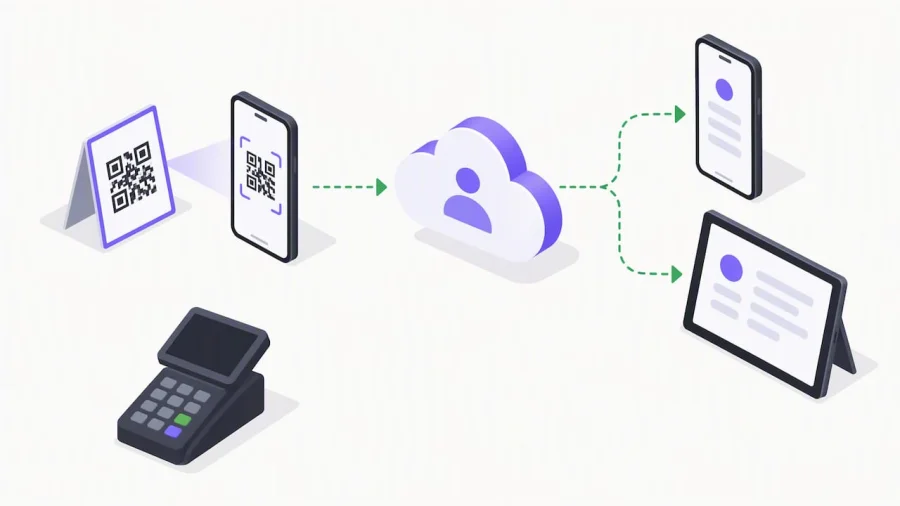
Common loyalty programme types you can run with QR codes
QR codes work as the entry point for several different reward structures, and the right one depends on how your customers buy from you.
- Stamp or punch cards: the digital replacement for the paper card, rewarding a free item after a set number of visits, which suits cafés and quick-service restaurants.
- Points and tiers: customers earn points per purchase and unlock higher tiers with better perks, which fits retailers and salons with a wider basket of services or products.
- Cashback and spend-linked rewards: customers earn a percentage of what they spend back as credit, which works well where purchase values vary a lot, such as grocery stores or service businesses.
- Onboarding promos: a first-visit coupon delivered right after QR sign-up, which turns a one-off visitor into someone with a reason to come back.
- Special-occasion rewards: time-limited campaigns tied to birthdays, anniversaries or seasonal events, which give you a natural reason to re-engage dormant customers.
A café with high footfall and low average spend tends to do best with a simple stamp card: buy nine coffees, get the tenth free. The mechanic is instantly understood and does not need explaining at the till.
A salon or wellness business, where visit frequency is lower but spend per visit is higher, often benefits more from points and tiers. A customer who books a cut and colour spends differently from one who books a trim, and a tiered structure lets you reward that difference without complicating the stamp-card logic.
Retailers and service businesses with variable basket sizes, such as grocery stores or garages, tend to favour cashback or spend-linked rewards, because the reward scales naturally with what the customer actually spends rather than treating every visit as equal.
Onboarding promos and special-occasion rewards work alongside any of the above. A first-visit discount delivered the moment someone scans your QR code and signs up gives them an immediate reason to return, while a birthday reward or a holiday campaign reactivates customers who have gone quiet. Running these as short, dynamic campaigns, rather than permanent fixtures, keeps the programme feeling fresh without you needing to redesign the whole structure.
Practical setup checklist: what you need to launch a QR-code loyalty programme
Launching a QR-code loyalty programme does not require a long project plan. Working through a short checklist in order gets most small businesses live within a week.
- Define your goals and reward logic: decide whether you are rewarding frequency (visits) or value (spend), since this shapes everything that follows.
- Choose a platform that supports dynamic QR codes and the specific modules you need, whether that is stamp cards, points, cashback or a combination.
- Design the enrolment flow to ask for as little as possible, typically just a phone number or email, since every extra field reduces completion.
- Decide where your QR codes will live: counter stands, table tents, receipts or product packaging all work, and placement affects visibility more than design does.
- Brief your staff on how to prompt customers to scan and how to process a redemption so nobody is improvising at the till.
- Connect your loyalty system to existing tools where possible, such as your CRM, email platform or SMS provider, or set a simple manual reconciliation routine if full integration is not available.
- Run a short pilot with a handful of regular customers before a full rollout, and adjust based on what confuses them or what they ask for.
If point-of-sale integration is not realistic for your business, a short manual reconciliation window, where staff validate redemptions and you export logs weekly, keeps the numbers accurate without extra engineering work.
Pro Tip: Pilot the programme with your most regular customers first. They will tell you honestly whether the sign-up flow is too slow before you roll it out to everyone else.
Ways to promote scans and increase enrolment and participation
Getting customers to scan in the first place is often the hardest part of the whole programme, harder than the technical setup. A behavioural study on QR-code scanning found that average scanning occurred only 24% of the time in an experimental setting, with a large proportion of participants never scanned any code at all. That is a useful reality check: a QR code alone does not generate engagement, the incentive and the prompt around it do.
A few tactics reliably lift scan rates:
- Make the incentive immediate and obvious, such as “10% off this visit when you scan and join,” rather than a vague future benefit.
- Use clear staff prompts and signage, including table tents, counter stickers and shelf talkers, placed exactly where the customer is already looking.
- Deliver the QR code through digital receipts, email or SMS as well, so customers who do not scan in-store can still join later.
- Run short, time-limited promotions, such as double-points days, to drive a spike in scans and repeat visits.
- Track which placements and messages get the most scans, then shift budget and signage toward what is actually working.
The same research found that scan rates rose when the information behind the code felt directly useful to the customer in the moment, which is the same principle that makes “scan for a free coffee” outperform “scan to join our loyalty programme”.
Measurement: the KPIs and analytics to track for a QR-code loyalty programme
A QR-code loyalty programme only earns its place in your business if you are measuring it. A handful of metrics tell you most of what you need to know.
- Enrolment rate: the share of customers who scan and complete sign-up, which tells you whether your prompt and incentive are working.
- Scans per visit: how consistently enrolled customers actually use the programme once they have joined.
- Active membership: the proportion of enrolled customers who have scanned or redeemed in the last month, which separates genuine engagement from a one-off sign-up.
- Redemption rate: how often rewards are actually claimed, which signals whether your thresholds feel achievable.
- Repeat purchase uplift and average order value change: the commercial payoff you are ultimately trying to prove.
Scan rates vary considerably by context, so treat early numbers as a baseline rather than a verdict. Scanning averaged 24% in a controlled behavioural experiment, rising when the content behind the code felt immediately useful. Use your own first few weeks of data to set a realistic benchmark for your specific customers, then measure improvement against that baseline rather than an industry average that may not apply to your footfall or sector.
Privacy and security: what to tell customers and simple steps to reduce QR risks
Customers are right to be cautious about scanning unknown codes. The US Federal Trade Commission has warned that scammers hide harmful links inside QR codes to steal personal information, so a few basic practices protect both your customers and your reputation.
- Use branded, secure landing pages with a visible, trustworthy domain, rather than a generic shortened link that hides where it goes.
- Collect only the data you actually need for enrolment, typically a phone number or email, and say clearly what it will be used for.
- Give customers an easy way to opt out of marketing messages at any time, which keeps you aligned with data protection guidance on necessity and proportionality in direct marketing.
Why BonusQR is a practical choice for QR-code loyalty
We built BonusQR around the exact checklist above, so each step maps to a feature rather than a workaround.
- Rapid setup with no point-of-sale integration required.
- Stamp card, points, and cashback modules available for customization.
- Onboarding promos and special-occasion rewards are supported and can trigger automatically.
- Real-time analytics to track enrolment, scans, and redemptions from a dashboard.
- Push notification and email automation tools to promote campaigns.
- An option for a white-label app for businesses seeking a branded experience.
In practice, this looks different depending on the business. A café uses the stamp card module to replace a paper punch card, with every scan logged automatically. A salon sets up tiered points so a client who books colour and cut earns faster than one who books a quick trim. A retailer uses an onboarding promo to turn a first-time shopper into a repeat customer with a coupon triggered the moment they sign up.
When QR-code loyalty is the right next step for a small business
In our view, QR-code loyalty earns its place fastest where footfall is high, transactions are quick, and customers already return regularly, think cafés, salons, gyms and local retailers rather than once-a-year purchases.
Start with a narrow pilot: one reward type, one till, a few weeks of staff practice before a full rollout. Train your team on the prompt line they will say to every customer, since that single sentence drives more enrolment than any poster.
If you want to see how the setup looks in practice, our resources at BonusQR walk through the modules in more detail.
— Michal
How BonusQR helps you get started: plans and next steps
Getting started costs nothing to try. Our Free plan covers the basics, while Basic at €19 per month and Premium at €69 per month unlock more modules, automation and analytics depth as your programme grows.
- Start on the Free plan to test enrolment flow and one reward module with real customers.
- Move to Basic or Premium once you need more modules, automated campaigns or deeper analytics.
- Choose white-label setup for a branded app of your own, a one-off €690 fee, or talk to us about custom app development from €1,500 if you run multiple locations or need bespoke features.
If you are ready to see how your own programme would look, sign up and explore the plans directly, or get in touch about a white-label build if you already know you want a branded app.
FAQ
What is a QR code loyalty program?
A QR code loyalty programme is a rewards system where customers scan a code to enrol, log visits or purchases, and redeem rewards, replacing paper punch cards or app-only sign-ups. It typically runs through a cloud platform that tracks stamps, points or cashback automatically each time a code is scanned.
Does customer loyalty still exist?
Yes, customer loyalty still exists, though it looks different from the card-in-your-wallet version of a decade ago. Customers respond to clear, immediate incentives and low-friction sign-up, which is exactly what QR-code programmes are designed to deliver.
Can someone get your information from a QR code?
A QR code itself only encodes a link or text, but a malicious one can direct you to a harmful website that then collects your information. The US Federal Trade Commission advises caution with unknown codes, which is why businesses should use clearly branded, secure landing pages.
What is the best free loyalty app?
The right free loyalty option depends on which reward modules and integrations your business needs. Our Free plan at BonusQR gives you a working stamp card or points system with no cost to start, which suits a small business testing the idea before upgrading.