
 Deutsch
 Español
 Français
 Italiano
 Magyar
 Polski
 Slovenčina
 Čeština
Yes, properly designed customer loyalty programmes reliably increase customer lifetime value and reduce churn. One well-documented case saw a non-tiered programme lift CLV by close to 30%, mostly by cutting attrition. However, the benefit isn’t automatic — it depends on clear rules, visible rewards, and honest measurement, all of which this guide walks through.
TL;DR:
- A well-designed loyalty program can increase customer lifetime value mainly by reducing attrition, but success depends on clear rules, visible rewards, and accurate measurement.
- Simplifying reward structures, showing cash-equivalent benefits, and streamlining redemption processes are key to improving customer engagement and program effectiveness.
- Relevant KPIs include enrolment and active participation rates, redemption rates, churn reduction, and CLV improvements, which should be tracked regularly through control group comparisons.
- The fastest wins come from removing friction, such as using simple stamp cards or easily understandable points systems, especially for small businesses with high purchase frequency.
- Low-cost platforms like Bonusqr enable rapid testing of loyalty mechanics, with quick implementation and real-time analytics ensuring faster impact within weeks.
How does a customer loyalty programme work?
At its core, a loyalty programme trades a reward for repeat behaviour. You give customers a reason to come back, and in return, you get more frequent purchases, richer data, and a buffer against competitors. The mechanism is part psychology, part economics: habit formation keeps your brand top of mind, status tiers appeal to identity and recognition, and financial lock-in (unredeemed points, saved cashback) makes switching feel like a loss.
Most programmes fall into a handful of categories:
- Points-based programmes — customers earn points per purchase, redeemable for rewards; flexible but can feel abstract.
- Tiered programmes — status levels (silver, gold, platinum) that reward your highest-value customers with escalating perks.
- Non-tiered/stamp-card models — simple, visit-based rewards that suit high-frequency, low-consideration purchases like cafés and salons.
- Subscription/membership programmes — customers pay upfront for ongoing perks, shifting the relationship from transactional to recurring.
- Coalition programmes — multiple brands share one rewards currency, extending reach but adding complexity.
A busy coffee shop rarely needs tiers. A gym chasing long-term retention usually benefits from one.
The economics of retention: CLV, payback and typical effects
Acquiring a new customer costs more than keeping an existing one, and the gap widens the longer a relationship lasts. Retained customers buy more often, spend more per visit, and cost less to serve because you’re not paying for repeated acquisition campaigns. That’s the entire financial case for loyalty programmes in one sentence: they shift marketing spend from chasing new customers to squeezing more value from the ones you already have.
The evidence backs this up, though it comes with a caveat. A Wharton study published in Marketing Science found a non-tiered programme produced a significant increase in customer lifetime value, with reduced attrition driving most of that gain. That’s a strong signal, but it comes from one matched-cohort study in one sector (a salon chain), so treat it as a benchmark rather than a universal promise. Self-selection is a real risk here too: customers who join loyalty programmes were often going to be loyal anyway.
Before rolling out a programme, run through a short checklist:
- Can you calculate baseline CLV and churn rate today?
- Do you have a control group or historical cohort to compare against?
- Is the reward cost lower than your current cost of acquiring a comparable customer?
- Can you track redemption and repeat-visit data without manual effort?
Statistic callout: Marketers surveyed globally report positive ROI from loyalty programmes as a general trend, though the size of that return depends heavily on design and measurement discipline.
Core benefits grouped by commercial impact
The advantages of loyalty programmes tend to cluster around four commercial levers: more revenue per customer, lower cost to serve, better data, and a stronger competitive position.
- Higher purchase frequency and bigger baskets. Members visit more often and spend more per visit once a reward is within reach, which lifts average order value alongside frequency.
- Stronger retention and lower churn. This is where the biggest financial upside sits, since retained customers require far less remarketing spend than replacements.
- Actionable customer data. Every scan or redemption generates a data point you can use to personalise offers, time promotions, and predict who’s about to churn.
- Advocacy and referral-driven growth. Engaged members recommend you to friends and family, often through built-in referral incentives, turning existing customers into an acquisition channel.
- Price insulation and differentiation. A strong programme makes price comparisons feel less urgent, because switching costs the customer their accumulated rewards.
- Operational efficiency. Targeted offers, win-back campaigns, and cross-sell prompts become sharper and cheaper once you can segment by actual behaviour rather than guesswork.
A meta-analysis covering three decades of loyalty research confirms strong evidence for behavioural loyalty gains, though it notes that shifting genuine emotional attachment to a brand is harder than shifting purchase habits, and results vary by design and sector.
Pro Tip: Track redemption rate alongside enrolment. A programme with thousands of sign-ups but low redemption is producing data, not loyalty — and that gap usually points to a visibility or complexity problem, not a lack of interest.
Why loyalty programmes underperform and how to fix it
Most programmes that disappoint fail for one of four reasons: customers can’t see their balance easily, the payoff takes too long to feel real, the earning rules are too complicated to follow, or the rewards don’t match what customers actually want. EY’s loyalty market research finds programmes still perform well on enrolment and ROI, but consumers are engaging with fewer programmes and checking their rewards less often, largely because the value isn’t visible enough day to day.
Fixes are mostly about friction, not budget:
- Simplify earn rules to one clear sentence a customer could repeat back to you.
- Show cash-equivalent value (“£4.50 saved”) rather than abstract points.
- Use automatic prompts and reminders at the point of purchase, not buried in an app.
- Make redemption a one-tap action, never a multi-step process.
Pro Tip: If a customer has to think for more than a few seconds to understand what they’re earning, the reward structure is too complicated — simplify before you promote.
Measuring success: KPIs, attribution and reporting cadence
You need behavioural metrics, not vanity ones. Enrolment numbers feel good in a report but tell you little about whether the programme is changing behaviour.
Track these core KPIs:
- Enrolment rate and active participation rate (members who actually engage monthly)
- Redemption rate as a share of points or stamps issued
- Change in churn rate among members versus non-members
- CLV delta between cohorts
- Change in average order value
- ROI and payback period on programme cost
For attribution, run matched-cohort comparisons or a pilot-versus-control structure rather than trusting before-and-after numbers alone, since seasonality and general market shifts can masquerade as programme impact. Review results monthly for the first quarter, then quarterly once the trend stabilises, watching closely for early drops in redemption rate, which usually signal a visibility problem before churn numbers move. Calculating customer lifetime value correctly is the foundation this entire framework rests on.
Quick-start checklist: launching or improving a programme
- Set one primary objective (retention, frequency, or referral) and pick the customer segment it targets.
- Choose the simplest reward structure that fits your purchase frequency, stamp card for frequent low-cost visits, points or tiers for higher-value relationships.
- Draft earn and redemption rules in plain language, then test them on a colleague who’s never seen the programme.
- Run a six to twelve-week pilot with a matched control group, tracking repeat-visit frequency and churn before wider rollout.
- Sort out data capture and integration priorities early, decide what you’ll track from day one, not after launch.
- Plan communications and redemption logistics, including how staff will handle it at the point of sale.
What I’ve learned building loyalty programmes for small businesses
The fastest wins rarely come from clever reward mechanics. They come from removing friction: a stamp card that scans in two seconds beats a points system nobody understands. Most small business owners overestimate how much complexity their customers want and underestimate how much a visible, simple reward matters.
Configurable SaaS platforms suit most retail, hospitality, and service businesses because you can launch in days and adjust rules as you learn. Custom or white-label builds only make sense once you have proven demand and specific integration needs. The biggest trap I’ve seen is businesses copying coalition-style, multi-partner structures before they’ve validated a single simple offer, and the second is redemption cycles so long that customers forget they’re even enrolled.
— Michal
Turning these benefits into a working programme
Everything above depends on getting the mechanics right without burning weeks on setup, which is exactly where a platform like Bonusqr is built to help. It lets you launch a stamp card, points system, or tiered cashback programme without needing POS integration, so you’re not stuck waiting on a technical project to test whether loyalty actually moves your numbers. Mobile and web app integration, push notifications, and real-time analytics come built in, which means you can track the exact KPIs covered above from day one.
Retail shops, cafés, gyms, and service businesses tend to see the fastest results because their purchase frequency is high enough to generate a signal within weeks rather than months. Businesses wanting a fully branded experience can move to a white-label or custom app build once the core programme proves itself.
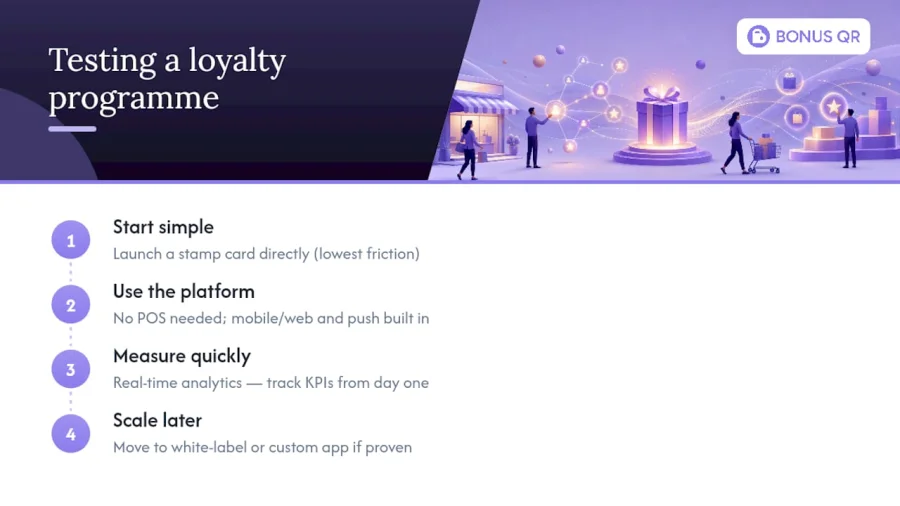
If you want to test the fixes discussed here, a stamp card is the lowest-friction place to start, and you can set one up directly to see how quickly redemption behaviour shifts.