
 Deutsch
 Español
 Français
 Italiano
 Magyar
 Polski
 Slovenčina
 Čeština
Most local businesses do not need a custom loyalty app. They need a system that customers will use at the till, on the street, and on the way out the door.
That distinction matters because the UK is already phone-first in everyday buying. The Office for National Statistics reported that 77% of UK adults used a smartphone to buy something online in the previous 3 months in 2024, up from 69% in 2023 ONS milestone on smartphone buying. Mobile commerce is already normal behaviour, which means the key question is not whether people can use their phones. It is whether a loyalty mechanic is simple enough to earn a second visit.
A custom build gives control. A QR-first or wallet-pass setup gives speed. For an independent café, salon, gym, or neighbourhood retailer, speed usually wins because the programme lives or dies on whether staff can promote it in seconds and customers can join without thinking twice.
The mistake is treating loyalty like a software project. It's a behaviour system. If the mechanic is clumsy, no amount of branding saves it. If the mechanic is friction-free, the phone in the customer's hand does the heavy lifting. For owners comparing a bespoke build with a lighter option, the practical middle ground is a custom loyalty app only when the business needs deep integrations and advanced control. For everyone else, the simplest path is the one that gets used.
Practical rule: if the staff can't explain the offer in one sentence at the till, the programme is already too complicated.
For operators who are still looking for a simple workflow inside a messaging-led marketing stack, Instagram automation 2026 is a useful reference point for how low-friction customer touchpoints are being built elsewhere. Loyalty should be just as easy.
Why Most Local Businesses Do Not Need a Custom Loyalty App
A custom app sounds impressive. It also creates a long list of problems that small operators rarely need, including maintenance, training, customer adoption, and the temptation to overbuild features nobody asked for. The strongest loyalty programmes are usually the least dramatic ones, because they fit into the moment customers already have at the counter.
The real trade-off is friction versus control
Local businesses usually want repeat visits, higher spend, and a way to recognise regulars. They do not need a product roadmap. They need a mechanic that works during a lunch rush, a salon checkout, or a gym visit when staff are busy and the queue is visible.
That is why QR-led, wallet-pass, and microsite flows make more sense than a fully custom mobile app for most independents. Public coverage also points to interest in app-free or low-friction loyalty through QR codes, microsites, and wallet passes rather than full installs mobile-first loyalty mechanics. A customer can scan, save, and return without downloading yet another app they may ignore tomorrow.
The mobile loyalty decision should be boring in the best way. If the customer already pays on the phone, then earning and redeeming rewards should happen in the same motion. That is exactly where the phone-based loyalty habit becomes useful, because it keeps the reward loop inside an everyday action instead of turning it into a separate project.
Why BonusQR fits the middle ground
Some operators do need more than a paper stamp card, but they still do not need a custom build. A platform like BonusQR sits in the practical middle, between paper and enterprise software. It is useful when a business wants a fast launch, a branded experience, and enough flexibility to run stamps, points, visit rewards, or spend thresholds without dragging in a development team.
That is the cleanest way to think about mobile app loyalty programs for local businesses. The winning move is not bigger software. It is lower friction, clearer rewards, and a customer path that staff can repeat all day without explaining it twice.
What Mobile App Loyalty Programs Actually Are
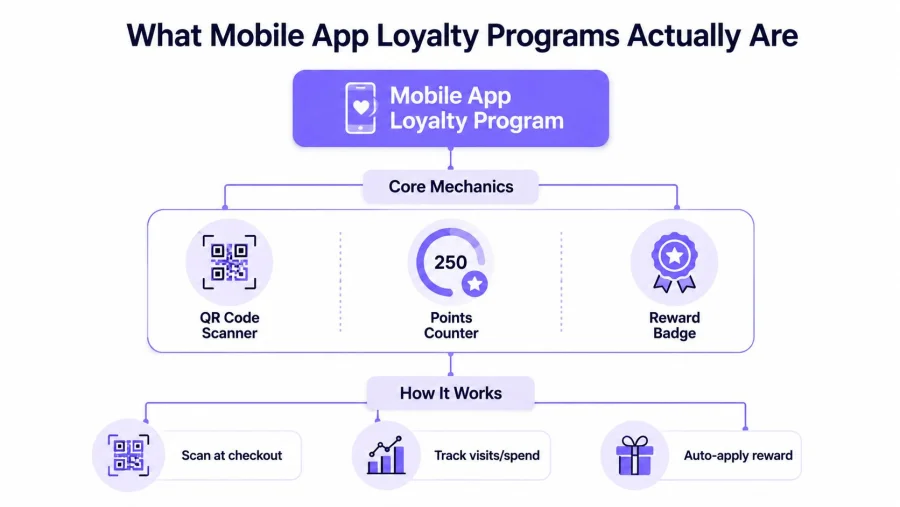
A mobile app loyalty programme is just a digital way to reward repeat behaviour. The customer joins on a phone, gets tracked by a profile, and earns something useful when they come back, spend again, or hit a milestone. Strip away the jargon and it becomes a modern version of the old stamp card, except it is harder to lose and easier to manage.
The mechanics that actually matter
A QR check-in is the digital equivalent of showing a membership card at the counter. The customer scans a code, the visit is recorded, and the staff keeps moving.
Digital stamps work like the old paper punch card. Buy nine coffees, get the tenth free. Everyone understands it instantly, which is exactly why it works.
Points balances behave like a running tab. Every visit or pound spent adds points, and the customer can cash them in once there's enough value to care.
Cashback or store credit feels like a small rebate. It gives the customer a reason to return because the reward looks like money coming back to them.
Tiered rewards are the loyalty version of gaining access to better perks. The more someone visits, the better the perks become. For a gym, that might mean access to a free PT session. For a salon, it might mean priority booking or a service upgrade.
Wallet passes keep the offer close without another install. Apple Wallet and Google Wallet can hold the pass so it shows up where the customer already looks.
The internal logic is simple. The customer profile collects visits, redemptions, and history in one place. The business decides which reward rules should trigger, and the system applies them automatically. A good mobile loyalty web application keeps that flow light enough for casual users while still giving the owner a real programme, not a pile of disconnected offers.
Useful lens: if a mechanic can be explained with a stamp card analogy, it's probably worth testing. If it needs a training manual, it's probably too heavy for a local business.
The best programmes mix only a few of these blocks at first. That keeps the experience clear, makes staff training easier, and prevents the customer from feeling like they joined a points maze.
Which Mechanics Fit Which Type of Local Business
Different businesses should not copy the same loyalty setup and expect the same result. A café runs on frequency. A salon runs on appointments. A gym runs on consistency. Retail and grocery care more about basket size and return visits than tiny transaction loops. The mechanic has to match the buying pattern.
| Business type | Best mechanic | Why it works | Typical cycle |
|---|---|---|---|
| Coffee shop | Digital stamps plus wallet pass | Quick, familiar, easy to explain at the till | Frequent, low-ticket visits |
| Restaurant or quick-service eatery | Visit thresholds and birthday coupons | Rewards repeat dining without overcomplicating the flow | Regular meals and family occasions |
| Salon or wellness centre | Points per visit or spend, plus rebook reminder | Makes future booking feel worthwhile and keeps the relationship warm | Appointment-driven, less frequent |
| Gym or fitness studio | Visit streak rewards and tiered unlocks | Reinforces habit and keeps members coming back | Weekly or near-daily routines |
| Retail or grocery store | Cashback, spend thresholds, seasonal coupons | Works better when basket value and promotions matter | Mixed frequency, varying spend |
Coffee shops and cafés
Coffee shops should keep it simple. Stamps, a wallet pass, and an occasional morning-rush bonus are enough for most independents. Customers already understand the reward rhythm, so the shop's job is to make the join-and-scan flow effortless.
Restaurants and quick-service eateries
For restaurants, restaurant points rewards make sense when the goal is to encourage another lunch, another takeaway, or another family visit. Visit thresholds and birthday offers work well because they reward people for coming back without forcing the staff to explain a complex formula.
Salons and wellness centres
Salons and wellness operators should lean into points per visit or spend, then tie in rebook reminders. The emotional value here is continuity. A customer who likes their stylist or therapist should feel that staying loyal also feels organised and worthwhile.
Gyms and fitness studios
Gyms are habit businesses. Visit streak rewards and tiered perks work because they reward consistency, not just spending. A person who shows up often should feel progress in the loyalty system as well as in the mirror.
Retail and grocery stores
Retail and grocery should focus on cashback, spend thresholds, and seasonal coupons. These businesses need a mechanic that fits larger baskets and more varied purchasing patterns. The reward should feel noticeable, not symbolic.
The right question is never “what mechanics does the platform have?” The right question is “what behaviour does this business need more of?” Once that's clear, the setup gets much simpler.
A Practical Launch Checklist for Your First 30 Days
A good loyalty launch is not a grand reveal. It is a sequence of small, disciplined moves that get the programme live, visible, and easy to use before the team gets bored with it. The first month matters because that is when staff habits form and customers decide whether the rewards are worth remembering.
Week 1 set the rules
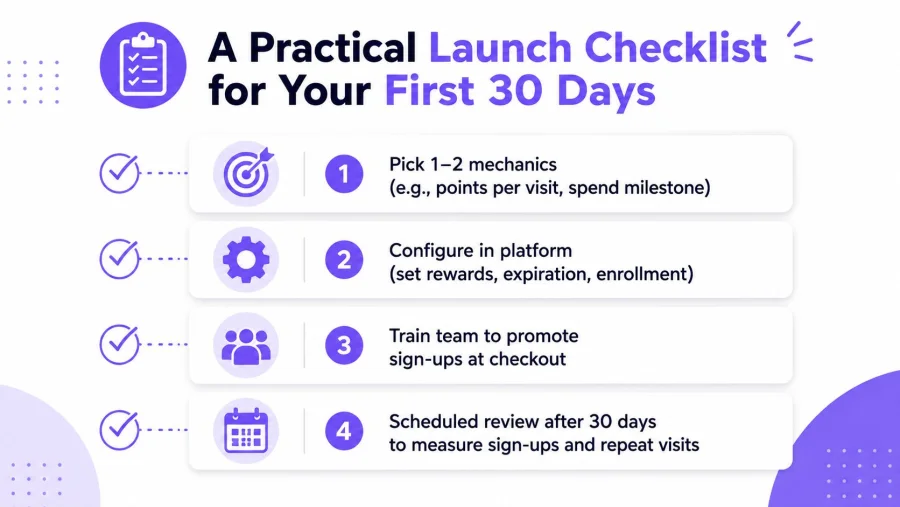
Pick one or two mechanics only. A café might start with stamps and a welcome bonus. A salon might start with points per visit and a birthday reward. The point is to create one clean path, not a menu of options.
Then configure the programme in the platform, set the reward values, and decide when points expire. Keep the rules visible to staff before anyone asks a customer to join. If the team cannot answer a simple question at the till, the launch is not ready.
Week 2 make the programme visible
Print counter cards, table tents, or small stickers near the card machine. Sign-up should feel like part of the checkout, not a side quest. The customer should know the programme exists before leaving the venue, not after scrolling a feed later.
A staff script helps more than most owners expect. Something as simple as, “Join here, scan this code, and your points start today,” removes hesitation. That takes seconds, and it keeps the offer from sounding like a sales pitch.
Week 3 seed the first redemptions
Sign up the first customers personally. Offer a welcome bonus so the first reward feels close enough to matter. A programme with no early redemption looks dead, even if the backend is working perfectly.
This is also the moment to handle the edge cases. A customer forgets their phone, a queue builds, or a payment is split. Staff need a default answer, not improvisation. The cleanest answer is usually to scan the customer's personal code, let the system record the visit, and move on.
Operational rule: the checkout flow should not take longer than the time it takes to say the reward aloud and scan once.
Week 4 review and tighten
Send a short push or email asking for feedback. Check whether customers joined, whether staff prompted consistently, and whether the first reward got used. If nobody redeems, the reward is probably too distant or too confusing.
The point of the first 30 days is not perfection. It is momentum. Once the loop works once, it can be improved. Before that, it is just a concept with a logo.
KPIs and Analytics That Actually Tell You If It Is Working
Most loyalty dashboards drown owners in noise. That is a waste of time. A busy operator only needs a handful of signals that show whether the programme is changing behaviour, paying for itself, and staying usable on the shop floor.
The five numbers worth checking
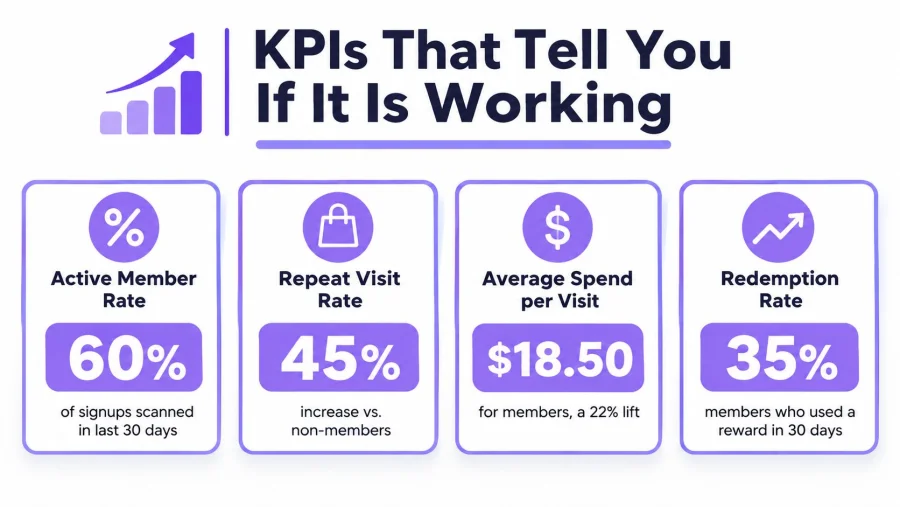
Active member rate tells the owner how many sign-ups scanned in the last 30 days. If it is low, the programme may be easy to join but hard to remember.
Redemption rate shows whether the reward is attractive enough to use. If customers earn rewards but never cash them in, the offer is probably too weak or too slow.
Repeat visit gap measures how long customers go between visits. If the gap is shrinking for members, the programme is doing useful work.
Incremental spend compares member spend with non-member spend. If members are not spending more, the reward may be attracting people without changing basket size.
ROI is the blunt check. If reward cost eats too much of the revenue it creates, the programme needs a reset.
Good sign: customers are redeeming without staff chasing them. That means the reward feels real, not theoretical.
What bad data looks like
A dead programme often has the same symptoms. New sign-ups stall. Rewards pile up unused. Staff forget to mention it. The owner keeps running the same offer because nobody is looking at the numbers closely enough to notice it stopped working.
That is why programme design matters as much as reporting. An append-only points ledger with idempotent transactions protects against double redemptions and messy balance disputes, which is exactly what a small business needs when staff are busy and customer trust matters. In practical terms, the system should record every earn, redemption, expiry, and adjustment as a clear event rather than overwriting balances in place.
For owners who want a separate view of customer activity and campaign performance, a local search analytics platform can sit alongside the loyalty data and help spot which offers bring people back. The value is not in collecting more graphs. It is in making one better decision each week.
Common Pitfalls and How to Fix Them Before They Cost You Sales
Most loyalty programmes fail for ordinary reasons. They are not elegant failures. They are messy, avoidable ones.
The usual mistakes
Over-engineered rules confuse customers. If the offer can't be explained in one sentence, it needs trimming. The fix is to keep one mechanic until repeat visits are stable.
Points that feel too far away kill momentum. A customer should feel the reward getting closer, not disappearing into the distance. Front-load a welcome bonus and make the earning rate obvious.
Staff who never prompt are usually dealing with a bad flow, not bad intentions. The fix is a five-second scan script and a printed cheat sheet by the till.
No follow-up after sign-up wastes the first bit of interest. Send automated push and email messages, then schedule birthday and seasonal coupons so the programme keeps showing up.
Ignoring the data turns the offer stale. Dead coupons, inactive members, and flat visit trends should trigger a monthly reset, not another month of silence.
The common thread is simple. Customers need clarity. Staff need a habit. Owners need a review rhythm. Without those three things, even a decent loyalty idea drifts into background noise.
A programme does not have to be perfect to work. It has to be visible, explainable, and easy enough that nobody resents using it. That is the standard.
Choosing the Right Path and Putting It Into Action
There are three sane routes. A free or low-cost QR-led tool works when the business wants a lean setup on the customer's phone and the team's existing device. An affordable white-label app works when the owner wants the business under its own icon without building from scratch. A fully custom app only makes sense for chains that need advanced integrations and deep control.
For most independent cafés, restaurants, salons, gyms, and retail stores, the practical answer is the middle lane. BonusQR covers stamps, points, cashback, visit and spend thresholds, fixed discounts, welcome bonuses, birthday and seasonal coupons, plus QR and wallet-based access. It also avoids the usual friction points, because there's no need for extra hardware or a POS-heavy rollout, and the system can be run with customer profiles, analytics, and automated campaigns from one place.
Operators who care about simple execution usually care about the same traits described in Simply Hospitality's operator success traits. That's the right mindset here too. Keep the offer clear, keep the team aligned, and keep the customer path short.
The next move is straightforward. Launch a programme that gives the business a live customer list, a working loyalty loop, and a clean view of repeat visit behaviour in the first 30 days. Then keep it simple enough that regulars use it without being chased.