The most popular advice on the high street is simple. Launch a stamp card, hand out a discount, and call the extra visits loyalty. That advice mixes up three different things, and the mix-up is expensive. A customer can come back because the coffee is good, because the shop is on the way to the station, or because the tenth drink is free. Only one of those is loyalty to customer. The other two are habit and a bought visit. A reward can raise both. It cannot tell you which one you bought.
Sorting them apart is the whole job. Service earns the choice. A discount only rents it. The pages below show how a café, salon, gym or shop can see the difference in a few numbers, price a reward before giving it away, and run a small holdout test so a scheme pays for itself.
What Loyalty to Customer Means for a Local Business
A regular orders the same flat white every Tuesday. She knows the barista, sits by the window, and rarely looks at the board. Is that loyalty?
Not yet. Three things are easy to confuse.
A repeat purchase is only what happened. She paid. She left. The till recorded a sale, not a reason.
A habit is often why it happened. The café is between the bus stop and the office. The cup is ready before she reaches the counter. Convenience and proximity do the work. Move the bus stop and the habit can move with it.
Loyalty is the harder claim. She keeps choosing this café when a rival is cheaper, closer or newer. The relationship survives a small inconvenience.
A salon makes the same split obvious. A client who books the same stylist for years, even after a price rise, is loyal. A client who returns only because a cancellation left a free chair is merely repeating. Both look identical on a booking screen until you ask what would happen if the chair were not free.
Why the split matters on the high street
The Square local economy report found that 44% of consumers buy locally at least weekly and 74% do so a few times a month or more. 61% typically spend about the same amount per visit, while 27% tend to spend more when the experience is right.
That is two levers, not one. Visit frequency is how often people come back. Basket value is how much they spend each time. A local shop lives on a small group, so losing ten regulars hurts more than losing a dozen one-off buyers. One lever shortens the gap between visits. The other lifts what they spend when they do come, without cutting the price of every cup.
A sort you can run this week
Pull last month's names, or a week's receipts if names are missing, and put each person in one group.
- Regulars: They come on a pattern and would be missed if they stopped.
- Habitual buyers: They come because you are easy, not because they would cross town.
- Drifters: They appear once, or only when something is free.
Count each group. That count is the starting picture of loyalty to customer, before any reward changes it.
Metrics That Show Whether Loyalty Is Growing
Feelings lag the numbers. A short set of metrics, each with a formula, shows whether people are staying, coming more often, or only turning up to cash a coupon. Check the simple ones every week. Save the slow ones for a quarterly review.
| Metric | What It Tells You | How to Calculate |
|---|---|---|
| Retention rate | Share of customers still visiting | Customers still visiting ÷ customers at the start |
| Churn rate | Share of customers lost | Customers lost ÷ customers at the start |
| Repeat visit rate | Share with two or more visits in 90 days | Customers with 2+ visits in 90 days ÷ customers seen in those 90 days |
| Visit frequency | How often active customers come in | Visits ÷ active customers in the period |
| Average spend per visit | Size of each basket | Total takings ÷ number of visits |
| Customer lifetime value | Gross profit from one customer over the relationship | Spend per visit × visits a year × years × gross margin |
| Redemption rate | Share of earned rewards actually claimed | Rewards claimed ÷ rewards earned |
One café, row by row
Say a café had 120 regulars in March and 90 of them still visited in April.
Retention is 90 ÷ 120, which is 75%. Churn is the other 30 people, which is 25%. Those two always add to 100%, so a rise in one is a fall in the other. They answer a blunt question. Did last month's people come back?
Repeat visit rate looks forward over 90 days. If 70 of 100 people seen in that window came at least twice, the rate is 70%. It catches people who returned once and then vanished, which monthly retention can miss.
Visit frequency is visits divided by active customers. If those 90 people made 270 visits in April, frequency is 3. That is the lever a stamp or a visit reward is meant to move.
Average spend per visit is takings divided by visits. If April takings were £1,620 across 270 visits, spend is £6. A points rule aimed at basket size should move this figure, not the visit count.
Customer lifetime value turns that into profit. At £6 a visit, 36 visits a year, a two-year relationship and a 60% gross margin, gross profit is £6 × 36 × 2 × 0.60, about £259 per customer. Use gross profit, not turnover. A busy customer who only buys discounted items can look valuable and still lose you money.
Redemption rate is rewards claimed divided by rewards earned. A high rate with flat visit frequency means people are collecting a perk they would have visited for anyway.
What to check, and when
Repeat visit rate and visit frequency can be counted from a book or a QR visit log every week. Retention and customer lifetime value need a clean start date, so review them each quarter. Loyalty plans across the BonusQR merchant base show 40% higher 90-day retention. That is a relative figure from one platform, so measure your own starting point before comparing yourself with anyone else. A practical retention measurement guide for café owners walks through the same weekly habit in more detail.
Practical rule: Pick three metrics only, and write the starting values down before any scheme launches. Later results need something to be compared against.
What Builds Loyalty Beyond the Reward
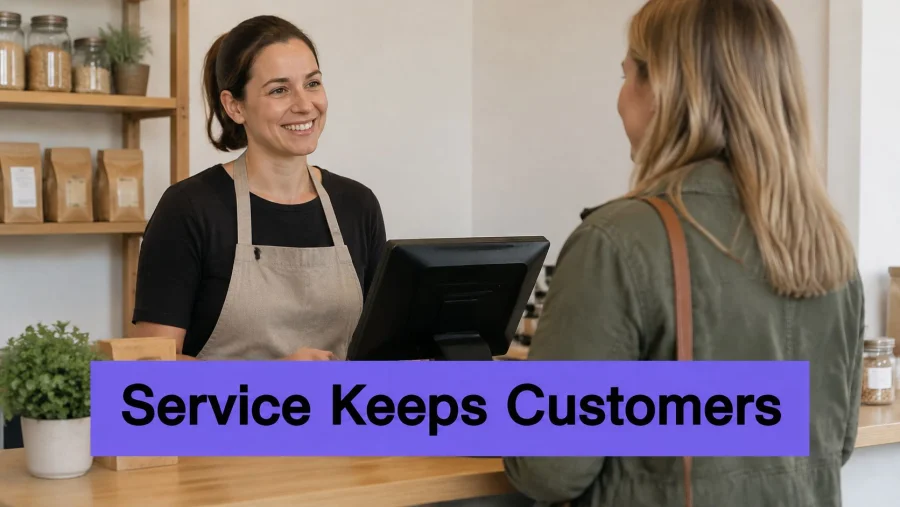
A stamp cannot rescue a slow queue or a cold cup. In a December 2022 survey of 1,266 UK consumers, Yotpo's UK loyalty research found that more than 64% would lose loyalty after bad customer service, more than the 61.8% who would switch after a decline in product quality. Repeat buying is the practical sign of loyalty in that research. It still collapses when the visit itself is poor.
Four drivers, and one action each
Reliable service and consistent quality. People return to a result they can predict. The flat white tastes the same on a wet Tuesday as it did last month. The colour at the salon matches the photo. The gym class starts on time. This week, hold a ten-minute huddle on the top three complaints from the last fortnight, and fix the one that shows up most often before you print a single card.
Fairness. The UK government's 2024 grocery review found that 43% of shoppers thought it unfair that scheme members paid less than non-members. Member-only pricing can look like a penalty for everyone else. Keep the benefit visible, say what it is in one sentence, and do not hide a higher shelf price behind the card. This week, rewrite the offer so a new customer can explain it without staff help.
Relevance. A British Retail Consortium associate insight reports a UK YouGov survey in which 66% of adults were discouraged by sign-up or subscription fees and 65% by irrelevant rewards. A gym voucher is useless to someone who came in for a haircut. This week, drop any joining fee and swap the reward for something that customer already buys.
Recognition. Staff who remember a name, or the usual order, do work a discount cannot. A plain thank-you on the tenth visit costs nothing and marks the relationship. This week, ask the team to greet five regulars by name before they reach the till. Broader actionable customer retention playbooks from Silver Spoon Agency are a useful next read when service, not the perk, is the weak point. Small, specific gestures also delight customers with thoughtful perks once the basics are already solid.
A reward should reinforce a good experience, never replace one.
Reward Mechanics That Fit Your Business
Britons say they want the benefit in cash, not in a clever points story. In a YouGov survey of 3,099 people from 2 to 15 July 2024, YouGov found that 85% said discounts were appealing, 82% preferred monetary rewards such as vouchers, and 67% each chose freebies, points accumulation, and rewards linked to an immediate purchase. Simple rules win because a customer can repeat them.
| Mechanic | Best For | How It Works | Watch Out For |
|---|---|---|---|
| Stamp card | Cafés, bakeries, sandwich shops | Buy nine drinks, get the tenth free | Easy to forget, and paper cards get lost |
| Visit reward | Gyms, salons, barbers | Every tenth visit earns a free treatment or class | Threshold must be reachable within about six weeks |
| Points per spend | Retail, grocery | Points per £1 spent, redeemable at a set total | Points can go unused or expire; 26.2% go unspent in UK research |
| Fixed discount | Salons, independent retail | 10% off every visit, or on quiet days only | Cuts margin on every sale and soon feels expected |
| Tiered cashback | Retail, higher-ticket services | Cashback rate rises after a set spend | More rules to explain, so tier names must be plain |
| Special occasion | All sectors | A free treat on the customer's birthday | Small cost and high goodwill, but it needs a birthday |
| Referral reward | Salons, gyms, cafés | Referrer and new member both get a reward | Credit must land on the right person |
| Welcome offer | All sectors | A one-time coupon after the first visit | Can pull in discount-only sign-ups, so pair it with a visit reward |
Why the threshold has to be reachable
A Decision Marketing report found that 26.2% of loyalty points go unused and 11.9% expire unspent, while 46.3% of respondents valued free products or services and nearly half said rewards take too long to earn. Unused points look like a saving. They feel like a broken promise.
Set the threshold so a typical regular can reach it in four to six weeks. A café regular who comes twice a week can hit a tenth drink inside five weeks. A salon client on a six-week cycle cannot hit "every tenth visit" inside a season, so that rule will frustrate them. Show progress toward the next reward in the customer's profile, and avoid points that expire in a few weeks. A free item often beats a small percentage off, because the customer can picture the drink, the class or the treatment.
Pick the simplest mechanic a customer can explain in one sentence. Add a second only after the first has run for 60 days and the visit or spend number has clearly moved.
What Loyalty Costs and How to Budget Rewards
Price the reward before you launch it. Reward cost equals the value of one reward multiplied by the number of rewards people claim. A threshold reward costs nothing until someone earns it. A standing discount costs money on every sale, including sales you would have made anyway.
The budget rule
Cap total reward cost at the incremental margin the scheme is expected to create. Incremental means visits or spend you would not have had without the offer, after the cost of the reward. If the test cannot show that extra margin, the scheme is a subsidy.
Cost a free item at ingredient or cost of goods, not menu price. A flat white listed at £3.50 might cost 40p in coffee, milk and a cup. Budget 40p, not £3.50. A free class costs the empty space on a timetable, not the drop-in price, unless you turned a paying client away.
What each shape of reward costs
- Fixed 10% off: Hits every transaction. On a £30 colour treatment that is £3 gone, whether the client was coming anyway or not.
- Visit reward: Costs only when the tenth visit lands. Nine paid visits fund one free one.
- Paper cards: Carry print cost, and a lost card means a dispute at the till.
- A QR scan: Records the visit with nothing to reprint or replace.
Breakage, the rewards people never claim, lowers the bill. Do not design for it. If customers feel the goalposts moved, the saving costs trust. The BonusQR on customer retention costs page is a clear walk-through of putting a figure on a kept customer before you set the perk.
Using the café sum from earlier, 120 regulars at about £259 of gross profit each over two years is a large base. A reward that costs a few pence a visit is worth testing only if it adds visits you can see. A scheme is affordable when reward cost sits inside the extra margin the test measures, not inside a hope that takings will rise.
Industry Examples for Cafés, Retail, Gyms and Salons
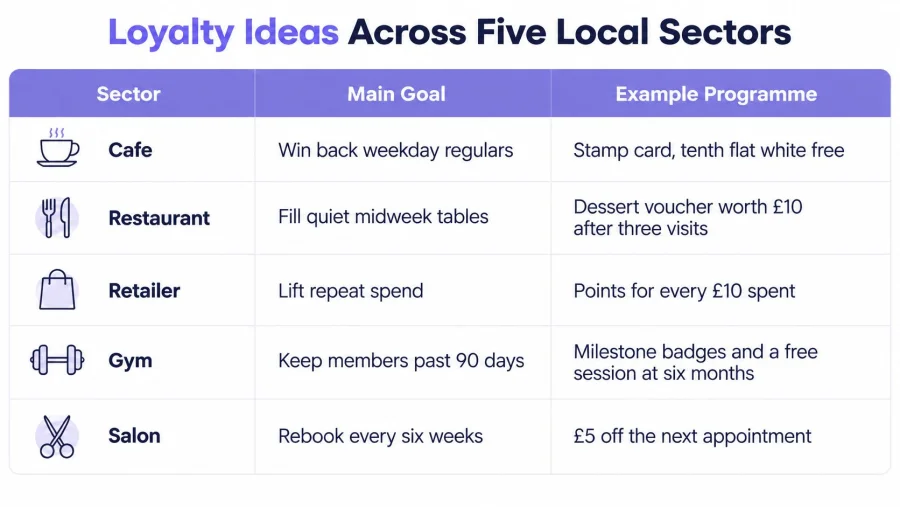
The same idea changes shape by sector. Match the goal first, then the perk, then one number.
| Sector | Main Goal | Example Programme | Metric to Watch |
|---|---|---|---|
| Coffee shop or café | Fill quiet mornings | Stamp card with double stamps before 11am | Visits per active customer |
| Restaurant | Build weekday lunch trade | Free dessert after five weekday lunches | Weekday covers from regulars |
| Retail or grocery | Raise basket size | Points per £1, reward just above the typical basket | Average spend per visit |
| Gym or fitness studio | Cut cancellations | Free personal training session after 10 classes | 90-day retention |
| Hair salon or beauty | Rebook more often | Tiered VIP plan after six visits | Return-visit rate within 90 days |
A neighbourhood café runs a stamp card and gives double stamps before 11am. The tenth flat white is still the prize. The double stamp pulls Tuesday and Wednesday trade into a quiet hour, which is cheaper than discounting the lunch rush. Staff watch visits per active customer, not how many cards went out.
A restaurant chasing weekday lunch uses a free dessert after five weekday lunches, and counts covers from named regulars. Weekend trade is already full. Rewarding it would give margin away.
A retailer sets the points reward a little above the usual basket, so the customer adds one more item rather than waiting months. Average spend per visit is the only number that matters until it is stable.
A gym uses ten classes for a free session because cancellations cluster after the first weeks. Sign-ups flatter the picture. 90-day retention shows who stayed. Practical retention guidance for fitness business owners from Zee Palm is worth reading alongside that metric, because class habits and billing friction lose members before any reward can help.
A 3-chair hair salon in Bratislava doubled its return-visit rate within 90 days after launching a tiered VIP plan on BonusQR. That is one merchant's result, not a promise. The useful part is the metric. Return-visit rate inside 90 days, against the rate before the tiers existed.
Find the row closest to your business, copy its metric, and track only that until you can count it without guessing.
UK Rules for Loyalty Messages and Customer Data
Get specific consent before you send marketing emails or texts to individual customers. Under UK PECR rules, the ICO's direct marketing guidance says consent must be freely given, specific and informed, and based on a clear affirmative action. A pre-ticked box, silence or inactivity does not count. Consent for email does not cover text messages, because permission has to match the channel. Ask for each one on its own.
The soft opt-in, and where it stops
The ICO's guide to electronic marketing allows a message to an existing customer without a fresh opt-in, but only inside set limits. You collected the details yourself during a sale or an enquiry. The message is about similar products or services. You offered a clear opt-out when you collected the details, and you repeat that opt-out in every later message. A café can mention similar drinks. A salon can mention related treatments. Neither can use the list for unrelated products, and neither can pass the data on.
A short checklist
- Say what they will get: At sign-up, name the messages, such as a reward reminder or a birthday note.
- Separate the consent: Keep marketing permission out of the general terms.
- Record it: Note when and how the person agreed, and for which channel.
- Unsubscribe every time: Put a working opt-out in each email and each text.
- Stay on related offers: A café promotes drinks it already sells, not a partner's products.
Teams that want the wider craft of a clean list can generate qualified leads through email with Baikou, then apply the same consent habits to loyalty notes. This is general guidance. A business with complex data, sharing, or several brands should read the ICO pages in full before sending.
Measure Real Loyalty and Launch Your First Step
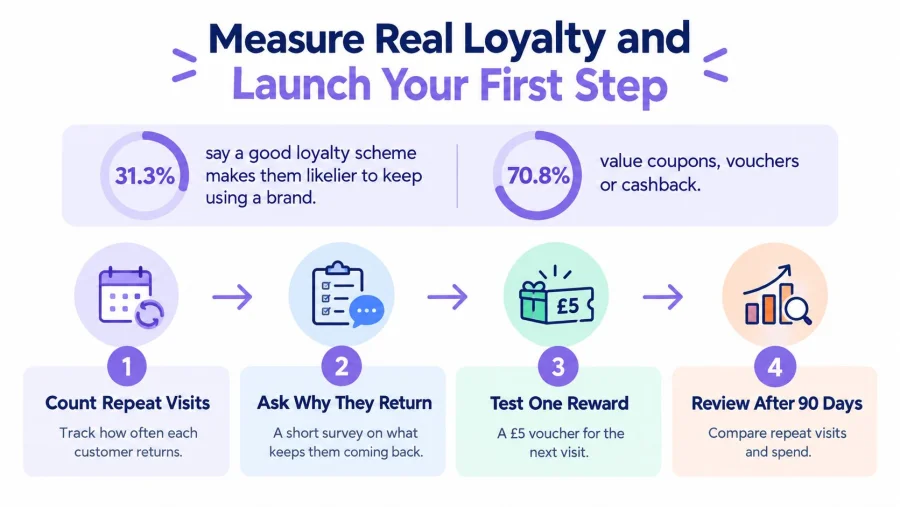
A rise in visits can be rented. A 2026 survey reported by Retail Gazette found that 31.3% of UK and Ireland consumers were more likely to stay with a brand offering a good loyalty scheme, while 70.8% valued coupons, vouchers or cashback, only 41.6% wanted personalised rewards, 49.1% said rewards take too long to earn, 41.1% were frustrated by expiring points, and 38.9% found rewards unattractive. Immediate money motivates more people than a clever scheme. A simple, quickly reached reward can beat an elaborate points ladder, but only if a test shows the visits would not have happened anyway.
Run a holdout before you scale
Members of BonusQR loyalty plans visit 2.4 times as often as non-members. That gap is not proof the scheme caused the visits. People who join were often the keen ones already. Comparing members with non-members flatters the card. Compare the same kind of customer with and without the offer.
- Record the baseline. Log visits and spend for the 90 days before launch.
- Split at random. Divide active regulars into group A and group B. Do not pick your favourites for A.
- Offer one group only. Send or apply the reward to group A. Group B keeps the normal experience.
- Hold the line. Run it for four to six weeks. Do not add a second perk halfway through.
- Compare like with like. Visits per customer and spend per customer, A against B.
- Do the sum. Extra visits times margin, minus reward cost. Keep the offer only if that number is positive.
Each QR scan at the counter is a visit record, so the test does not need a till integration. With each visit, the customer shows a QR code and moves closer to the next reward. The number to report is incremental visits × margin − reward cost. Registrations are not that number.
Launch one reward this week
A loyalty programme can be set up in a few minutes. Choose one mechanic, set a threshold a regular can reach in four to six weeks, and judge it on one metric.
- Choose the reward and the threshold. One sentence a customer can repeat.
- Write the sign-up line and the consent wording using the channel rules above, and keep marketing permission separate from the terms.
- Print a QR code for the till and the tables so joining is a scan, not a form.
- Run the holdout for 30 days, then review visits per customer before you add anything else.
If group A and group B look the same after reward cost, the visits were not bought, and they were not earned either. Change the offer or drop it.
Start on BonusQR's free plan, with unlimited members, and put the first reward live this week. Customers join from one scan, follow progress in a profile, and can keep the card in Google Wallet or Apple Wallet. Check current plan terms on the BonusQR site before you quote them to anyone, then review visits per customer after 30 days and keep the reward only if the holdout sum is positive.


