
 Deutsch
 Español
 Français
 Italiano
 Magyar
 Polski
 Slovenčina
 Čeština
More tiers don't automatically create more loyalty. For most independent UK businesses, they create more questions at the till, more rules for staff to remember, and another reward balance customers never check. The practical answer is usually two loyalty program tiers, built around one behaviour the business can measure and one benefit customers understand immediately.
That matters in a crowded market. YouGov reported that 82% of Britons were signed up for at least one loyalty programme in 2024, while UK consumers belonged to an average of 4.7 programmes, compared with a global average of 3.7, according to UK loyalty programme statistics from LoyaltyPass. A loyalty scheme isn't competing only with nearby cafés, salons, gyms, or shops. It's competing with every other reward notification on a customer's phone.
The right question isn't, “How many tiers can this business build?” It's, “What repeat behaviour deserves a better experience, and can a customer explain the upgrade in one breath?”
Why Most Tier Designs Fail Before They Launch
The popular advice says that more status levels create more aspiration. That advice suits airlines, hotel groups, and large retailers with complex purchasing patterns. It often fails at an independent shop where the owner has a small team, a limited average basket, and customers who want to know what they get before the queue moves.
UK participation data points to a different problem. Mintel reports that 55% of UK consumers belong to at least four schemes, yet 58% have actively used three or fewer in the past six months in its UK customer loyalty in retailing report. Customers already join plenty of programmes. The scarce resource is active attention.
A five-tier structure can look elegant in a planning document and still collapse at the counter. Staff forget the thresholds, customers can't see a meaningful difference between levels, and the owner ends up rewarding complexity rather than repeat visits.
Three design mistakes that cause friction
- Too many tiers: Five or more levels turn progression into administration. Customers may remember that a scheme exists, but not which threshold corresponds to which reward.
- Airline-style thresholds: A long annual status ladder ignores the economics of a coffee, haircut, class booking, or small basket. The threshold must fit the shop's natural buying rhythm.
- Polished names with no meaning: “Connoisseur” and “Aficionado” sound like campaign copy. “Regular” and “Regulars Plus” tell staff and customers what the levels mean.
The UK market also shows how easily enrolment can become vanity reporting. Industry reporting says only 33% of consumers are more likely to join a loyalty programme than the previous year, while members belong to an average of 4.7 programmes, as outlined in UK loyalty statistics from Antavo. A large member database isn't proof of a healthy programme if members don't return or redeem.
Practical rule: Start with one entry tier and one top tier. Add a third only when the data shows a genuine behavioural gap that two levels cannot address.
Before writing names, rewards, or launch copy, the owner should answer five questions:
- Which action matters most, visits, spend, bookings, attendance, or referrals?
- How quickly can a typical customer reach the first useful reward?
- What exact behaviour should move someone into the higher tier?
- Can a new staff member explain both levels without checking a screen?
- Does the upgrade provide a visible benefit rather than a badge?
If those answers aren't clear in ten minutes, the programme isn't ready for five tiers. A simple two-tier structure will usually produce a cleaner launch, clearer staff behaviour, and better evidence for later optimisation.
Choosing the Right Threshold Model for Your Shop
The threshold should follow the way customers already buy. A café with similar-sized transactions doesn't need points maths. A salon with sharply different service prices shouldn't treat a trim and a colour appointment as equal visits. A gym needs to recognise attendance, not just membership fees.
Match the mechanic to the buying rhythm
Visit-based tiers suit cafés and quick-service businesses. If a Bristol café sees customers buying broadly similar drinks, a move to Tier 2 after nine visits in 90 days creates a visible frequency goal. The customer doesn't need to calculate spend, and staff only need to record the visit.
Spend-based tiers work better for salons and restaurants, where transaction values vary. A Manchester hair salon could move a customer to the higher level at £250 cumulative spend. That approach recognises a client who books higher-value services without forcing the salon to award the same status for every appointment.
Attendance-based tiers fit gyms and fitness studios. A Leeds boutique gym could set Tier 2 at 12 attendances per quarter, giving members a reason to use the membership consistently without tying status to a discount or annual fee.
Points-based programmes earn their complexity in independent retail, where products have mixed prices and margins. The shop can assign different values to categories, then let customers exchange balances for a clearly stated reward. Businesses considering this route can review reward points for cafes, but a café should still avoid points if a visit stamp would communicate the same value faster.
| Vertical | Best Threshold Model | Recommended Tier 2 Trigger | Data Captured at QR Scan |
|---|---|---|---|
| Café | Visits | Nine visits in 90 days | Visit count |
| Quick-service restaurant | Spend or visits | A defined cumulative spend or repeat-visit target | Transaction value or visit |
| Hair and beauty salon | Spend | £250 cumulative spend | Transaction value |
| Independent gym | Attendance | 12 attendances per quarter | Attendance count |
| Indie retailer | Points | A points balance linked to product spend | Item value or points |
Hybrid models are usually unnecessary at the start. Combining visits, points, spend, and seasonal multipliers gives the owner more settings, but it gives customers more rules to decode. A QR scan should capture the one data point that determines progression, whether that's a visit, value, or attendance.
The exception is a business with two distinct customer journeys. A restaurant might track spend for dining customers and visits for coffee customers, but it should present those as separate programme paths rather than one tangled ladder.
Three Real Shop Scenarios That Change Everything
A three-site café group in Sheffield had built a four-tier card that looked generous in the design file. At the counter, staff spent hours each week explaining the levels, checking progress, and answering questions about which reward applied. The owner collapsed the scheme to two tiers and changed the explanation to: “Join as a Regular. Visit often and achieve Regulars Plus.”
The decision was simple: use one visit count, one visible upgrade, and two names customers could repeat. The owner stopped selling the mechanics and started selling the next visit.
The salon that stopped arguing about transaction values
A Birmingham independent salon tracked spend inconsistently. One stylist logged the full appointment value, another recorded only the service subtotal, and a third sometimes forgot to log anything until the end of the day. Customers saw different balances for similar bookings, which damaged confidence in the scheme.
The owner replaced spend tracking with fixed points per visit, linked to service bands. The customer-facing wording became: “Every appointment earns progress. Higher service bands earn more points.” That decision reduced staff judgement at checkout and made the reward rule easier to audit.
The salon still recognised higher-value services, but it did so through predefined bands rather than improvised calculations. The important change wasn't a more advanced tier structure. It was a rule that behaved consistently regardless of who served the client.
The gym that rewarded attendance instead of promises
A Croydon gym noticed members disappearing after the early enthusiasm of joining had faded. The owner had considered a high annual fee for a premium tier, but that would have rewarded ability to pay rather than the behaviour the gym needed.
The redesign linked Tier 2 to 12 attendances per quarter. The replacement wording was: “Attend regularly and earn Plus. Your next class counts towards the upgrade.” Members could see a practical path, while the gym gained a reason to discuss attendance at the point of use.
“The best tier is the one staff can explain while scanning, not the one that looks most impressive in a presentation.”
These scenarios share one lesson. A tier should solve a specific operational or commercial problem. If the café needs frequency, track visits. If the salon needs consistent value recognition, define service bands. If the gym needs attendance, reward attendance.
Sample Tier Structures You Can Copy This Week
The following templates keep the entry level useful and make the top level visibly different. They avoid luxury labels, complicated multipliers, and rewards that cost more than the behaviour is worth.
| Vertical | Entry tier | Top tier | Threshold | Key perk change at upgrade |
|---|---|---|---|---|
| Café | Regulars | Regulars Plus | Tier 2 at nine visits in 90 days | A free size upgrade or member drink replaces a standard welcome reward |
| Quick-service restaurant | Meal Regulars | Meal Regulars Plus | Tier 2 after a defined repeat-visit target | Top tier adds a side or priority offer rather than a blanket discount |
| Hair and beauty salon | Salon Regulars | Salon Regulars Plus | Tier 2 at £250 cumulative spend | Top tier adds a treatment upgrade, birthday perk, or priority booking window |
| Independent gym | Gym Members | Gym Members Plus | Tier 2 at 12 attendances per quarter | Top tier adds a guest pass, class booking benefit, or member event |
| Indie retailer | Shop Regulars | Shop Regulars Plus | Tier 2 after a clearly stated points balance | Top tier adds early access, a product-related reward, or a birthday voucher |
Cafés and quick-service restaurants
The entry tier should reward the first repeat visit, not force a customer to become a heavy regular before seeing value. The higher tier can offer a better version of the same product, such as a size upgrade, an extra topping, or a free side. Those rewards feel immediate at the till and avoid training customers to wait for a large discount.
Birthday rewards and referral perks belong in the entry tier only if the business can fulfil them reliably. A reward that staff can't find or honour creates more friction than value.
Salons, gyms, and retailers
Salons should protect margin by using service upgrades and priority access instead of automatic percentage discounts. Gyms can make the higher tier feel social by adding a guest benefit or a special class opportunity. Retailers have more reason to use points because mixed baskets make a single visit less informative, but the redemption value must stay plain.
The rule should appear beside the QR code: “Reach Regulars Plus by [threshold]. Achieve [specific benefit].” Customers shouldn't need to open a terms page to understand what changes.
Onboarding and Promotion Copy That Brings Members In
A loyalty programme lives or dies in the first conversation. The staff member doesn't need a sales pitch. The staff member needs a short answer to two questions: what does the customer get, and how soon can they get it?
The handover for a new staff member
Place the QR code in four locations. Use a counter card, window cling, receipt slip, and table tent where relevant. Each placement should show the first reward and the Tier 2 trigger.
Use this staff ask. “Scan to join, then earn your next reward with your next visit.” It stays within twelve words and describes a near-term benefit.
Send this four-line onboarding message after the first scan.
Welcome to [Shop Name] Regulars.
Your first reward is [reward].
Reach Regulars Plus after [threshold].
Scan at every visit to keep your progress moving.Run the launch sequence. On the first day, publish an Instagram story with the QR code. On the next customer email, lead with the welcome reward. During the second week, place the QR beside the till and ask returning customers directly.
The business can adapt the same structure for salons with an onboarding bonus for salons, provided the reward is clear and staff know how to apply it.
Phrases that lose customers
Three lines regularly underperform because they describe the programme from the owner's perspective:
- “Would you like to hear about our loyalty initiative?”
- “We have a new engagement platform.”
- “Sign up now for exclusive benefits.”
They don't answer the customer's immediate question. Replace them with wording that names the reward, the action, or the time to value. “Scan here for a reward on the next visit” is stronger because the customer can understand it before the payment is complete.
The same principle applies to social posts and printed material. A QR code should never appear alone. Pair it with the reward, the threshold, and a short instruction.
KPIs to Track and Optimisation Experiments to Run
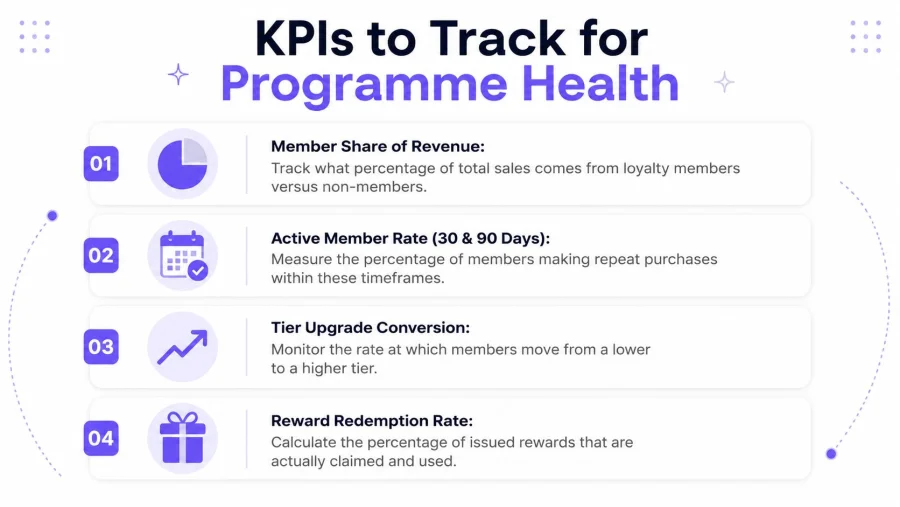
A loyalty dashboard can contain dozens of measures and still fail to answer the owner's main question: are members changing their behaviour? Four measures give a small business a workable health check.
The four measures that matter
Member share of revenue shows how much sales value comes from identified members. A rising share can indicate that customers are linking purchases to the programme, but it shouldn't be treated as proof of incremental revenue on its own. Compare member sales with repeat behaviour and reward cost.
Active member rate at 30 and 90 days separates sign-ups from use. Track the proportion of members who make another purchase within each period. A weak 30-day rate points to poor first-reward timing. A weak 90-day rate suggests the programme hasn't created a durable reason to return.
Tier upgrade conversion shows whether the entry level creates a reachable next step. If many members sit just below the threshold, the target may be motivating. If almost nobody progresses, the threshold or reward needs review.
Reward redemption cost as a percentage of sales protects the margin. Include the actual cost of free products, upgrades, discounts, and staff time, then compare that cost with member sales and repeat activity. UK programme owners report only 57% satisfaction with their loyalty programmes, below the global average of 70%, according to Antavo's UK loyalty programme trends. Clear measurement helps identify whether the problem is the reward, the rules, or execution.
Two tests for the first 90 days
Test the entry threshold. Split eligible new members into two versions of the entry journey, one with the current trigger and one with a nearer trigger. Run each version until both groups have enough members to produce a stable comparison, rather than choosing a fixed invented sample size. Keep the version that produces stronger repeat visits without pushing redemption cost beyond the approved margin.
Test the top-tier perk. Compare a product reward with an experience-led perk, such as priority booking, early access, or a guest benefit. Hold the threshold steady and change only the perk. Choose the winner based on upgrade conversion, redemption behaviour, and repeat activity, not sign-ups alone.
For a fuller measurement framework, the loyalty guide for coffee shops and salons gives owners a useful place to organise retention metrics. The operating rule remains straightforward: change one variable, record the result, and keep the simpler version when performance is comparable.
The Simplest Way to Launch This in a Single Afternoon
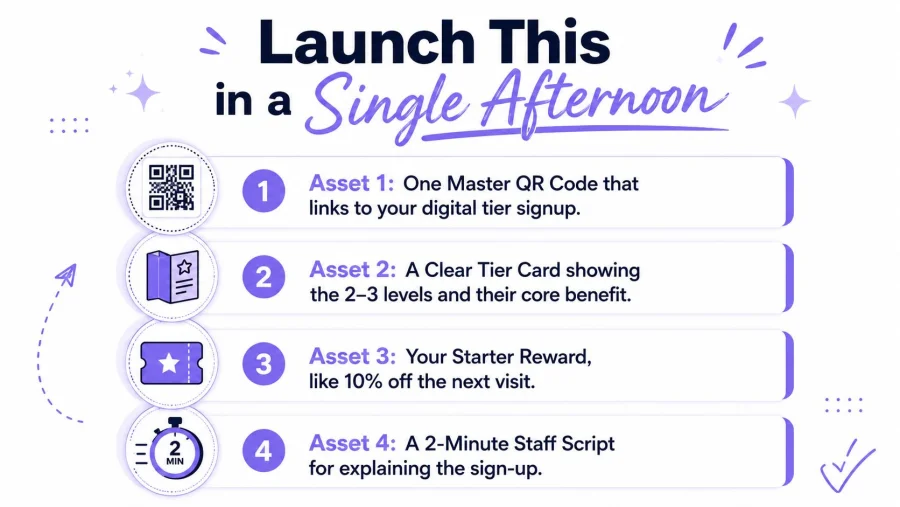
A tiered programme should be simple enough for staff to explain and customers to understand at the till. Prepare four assets, choose two tiers, and put one QR code at the centre of the journey.
Prepare the four assets first
- One master QR code: Send customers to the digital sign-up and tier view.
- One product or service sheet: List relevant products, prices, service bands, or attendance rules.
- One tier table: Add the chosen thresholds, benefits, and customer-facing wording.
- One staff line: Print the till script and place it beside the scanner.
For most independent UK shops and eateries, start with a visit or spend threshold that customers can grasp immediately. If the offer depends on collecting points, build the points-based loyalty system into the same two-tier structure rather than adding extra levels.
A single QR platform can handle the same-day setup. Create the account, enter the tier names and benefits, set the visit or spend rules, add the welcome reward, and print the QR material. Keep the first version narrow. Two tiers are enough to test whether customers return, upgrade, and redeem without forcing staff to explain a maze of conditions.
BonusQR supports mobile or web sign-up, personal customer QR codes, reward tracking, and staff scanning without extra hardware or a POS integration. Use it for the two-tier journey, then adjust the thresholds only after member activity shows a clear need.
The final ten-minute launch check
- Scan the QR code with a personal phone and complete the customer journey.
- Confirm that the welcome reward appears correctly.
- Brief the morning shift on the one-line pitch.
- Tape the QR code to the till at eye level.
- Publish one Instagram story with the reward and scan instruction.
Launch the clear version today. A five-tier scheme that confuses customers at checkout is weaker than a two-tier programme staff can explain in one sentence.
Choose one vertical template, replace its threshold and reward with the shop's own figures, and launch the two-tier journey through BonusQR this afternoon. Print the QR code, brief staff with the one-line ask, and review member activity at 30 and 90 days before adding any new tier.