A Saturday morning queue can look healthy and still hide a leak. The regulars order without thinking, a few new faces glance at the menu, and a paper stamp card sits on the counter like it belongs to a different business. That's the core problem for a loyalty program for small business, especially in cafés, salons, gyms, and local retailers, the work is not getting people in once, it's giving them a reason to come back before they drift elsewhere.
The commercial case is plain. Across loyalty benchmarks, repeat customers are reported to spend up to 67% more later in the relationship than in their first six months, and loyal members buy more frequently than non-members, which makes retention unusually valuable for small operators with thin margins and high repeat trade needs (customer loyalty program statistics 2026). Industry-wide, loyalty programs can return about 4.8× their cost, which is why the format has moved from a nice-to-have to a standard retention tool in small-business marketing (customer loyalty program statistics 2026).
A QR-only setup fits that reality. It avoids the hardware trap, skips a POS replacement, and keeps the workflow simple enough for a busy counter team to use without a training project.
For practical ideas on reducing churn, practical examples for lowering churn is worth reading alongside this guide. For a deeper look at programme design, the BonusQR small business tips page fits well with the same retention logic.
Why Small Businesses Need a Loyalty Program Now
A café owner sees it first. The same three people come in before work, two more arrive after the school run, and one lunch regular buys the same sandwich every Tuesday. The problem isn't demand, it's that the business keeps re-earning those visits from scratch, while a forgettable visit can easily become the last one.
The historical shift matters too. Loyalty used to mean stamp cards, stamps, and hope. UK consumers now buy through phones, scan codes, and expect faster sign-up, faster redemption, and less friction, which is why loyalty has moved from paper-based routines to digital and mobile-first systems.
A strong programme also fits the way customers already behave. 83% of consumers say loyalty programmes affect their decision to buy again, and 81% of members buy more frequently in loyalty programmes than non-members (loyalty program statistics every small business owner should know in 2026). That is not abstract brand talk, it is a direct reminder that repeat trade is shaped by structure as much as by service.
Practical rule: if regulars already exist, the business is not starting from zero, it is under-monetising known customers.
For cafés, salons, and local retail, the smartest answer is usually a lightweight QR programme. It keeps the customer journey short, lets staff move quickly, and avoids the cost and disruption that come with enterprise systems that nobody asked for. The best retention tactic is often the one that the team can run on a Friday rush without slowing service.
Loyalty also makes more sense when acquisition feels expensive and unpredictable. For owners looking at practical marketing services for professional industries, the right lesson is not to chase more channels first, it is to make each existing visit more valuable. That's where simple, repeatable loyalty mechanics win.
Setting Clear Objectives and Picking the Right Mechanic
Most loyalty plans fail before the first customer scans anything. The owner picks a reward because it feels generous, then discovers it does the wrong job, or it does the right job at the wrong margin. A better starting point is to decide which business outcome matters most, then choose the mechanic that supports it.
Decide what the programme is meant to move
Three objectives cover most small-business cases. More repeat visits matters when the customer base is already decent but inconsistent. Higher average spend matters when baskets are small and upsells are hard to attach. Steadier weekday trade matters when the weekend is fine but Monday to Thursday feels thin.
A café often needs visit frequency. A salon often needs rebooking consistency. A retailer often needs a reason for a second purchase, not just a first one. Those differences change the shape of the offer, because a one-size-fits-all reward usually leaks margin where it matters most.
Match the mechanic to the objective
A points system works when the business wants flexibility and can handle a little complexity. Stamps work when the goal is habit formation and the team needs the rule to be obvious in a single glance. Thresholds work well when average spend is the behaviour that needs nudging, because customers understand “spend more, earn more” faster than they understand abstract points.
Cashback feels powerful, but it usually suits businesses that can tolerate looser margin control. Fixed discounts are familiar, yet they can train customers to wait for the deal rather than building habit. A birthday coupon, a welcome bonus, or a quiet-day bonus can sit on top of the main mechanic without turning the whole programme into a mess.
A useful check is whether staff can explain the offer in one sentence. If they can't, the customer won't remember it either. That is why a simple rule with one secondary nudge often beats a clever structure nobody can repeat under pressure.
Practical rule: pick one primary behaviour, then add one small nudge, not three competing incentives.
Owners in service businesses often ask for a stronger brand story, and that's where mobile app for stamp programs can support a cleaner, friction-light experience without turning the offer into a technology project. The software matters less than whether the reward matches the business goal.
Stamps, Points, Cashback and Thresholds Compared
The fastest way to compare loyalty mechanics is to think in trade-offs, not features. Each option creates a different balance between simplicity, perceived value, and margin control. For a small business, the right choice depends on how much explanation staff can spare and how tightly the reward needs to be controlled.
| Sector | Best-fit mechanic | Why it works | Margin risk |
|---|---|---|---|
| Coffee shops | Digital stamps | Easy for regulars to understand, easy for staff to run, and built for frequent visits | Medium, if the reward arrives too soon |
| Quick-service restaurants | Points or stamps | Encourages return visits without forcing a complicated menu of rewards | Medium, especially if redemptions cluster |
| Salons | Visit thresholds | Rewarding a set number of visits fits appointment-led behaviour | Lower, if the reward is tied to a planned return |
| Gyms | Spend thresholds or visit thresholds | Members already think in routines, so milestones feel natural | Lower to medium, depending on the reward size |
| Small retailers | Points | Flexible enough for different basket sizes and product mixes | Higher, because points are easier to misprice |
Digital stamps win when predictability matters. The cost is easy to understand, staff can explain it in seconds, and the customer knows exactly where they stand. The downside is that stamps can feel too blunt for higher-value baskets or longer buying cycles.
Points are more flexible. That flexibility helps when a retailer sells different products or when a salon wants to reward both visits and spend, but points can drift into confusion if the conversion rate is hard to remember. Cashback has the strongest perceived value in some sectors, yet it is also the easiest way to blur the margin picture if the business does not watch redemption carefully.
Thresholds are underrated. They are often the cleanest fit for salons, gyms, and premium retail, because customers can see the milestone and understand why it exists. Fixed discounts remain familiar, but they can become a training burden if staff use them inconsistently or apply them when they shouldn't.
The wider lesson is simple. Do not choose the mechanic that sounds clever. Choose the one that a busy team can explain, the customer can remember, and the margin can survive.
Onboarding Customers with QR, Web and Mobile Sign-Up
The worst loyalty experience is the one the customer never finishes joining. A queue builds, the staff member fumbles with a paper card, and the guest decides the reward is not worth the hassle. That is why the onboarding path matters more than the branding.
A practical flow starts with a QR code at the till, on a table tent, or at the counter. The customer scans it with a phone, lands on a mobile or web sign-up page, and gets a personal QR code back instantly. That QR then lives in Apple Wallet or Google Wallet, so the membership sits one tap away instead of hiding in an email thread.
What the staff workflow should look like
The front-of-house process has to be quick enough for peak time. A team member scans the customer's QR, awards the stamp or visits, confirms the action on screen, and sends the person off. No extra tablet. No hardware install. No long training week. The fewer moving parts, the more likely the programme survives the first busy month.
The biggest mistake is asking people to “sign up later”. Later means never. Customers who are already standing at the counter are much easier to enrol than customers who need to remember a form, an app download, or a password after they leave.
A QR-only setup is also cleaner for businesses that cannot justify a POS integration. That matters because many independent operators want the loyalty layer to sit beside the till, not inside a larger tech stack they'll resent maintaining. For a straightforward mobile app for stamp programs, the user journey should feel like a fast check-in, not an IT migration.
If the customer can't join, understand, and redeem in under two minutes, the programme is too heavy for a small business floor.
The operational test is not whether the software looks advanced. It is whether the barista, receptionist, or shop assistant can keep the line moving while still explaining the reward clearly enough for the customer to come back.
Pricing Rewards Against Margin and VAT
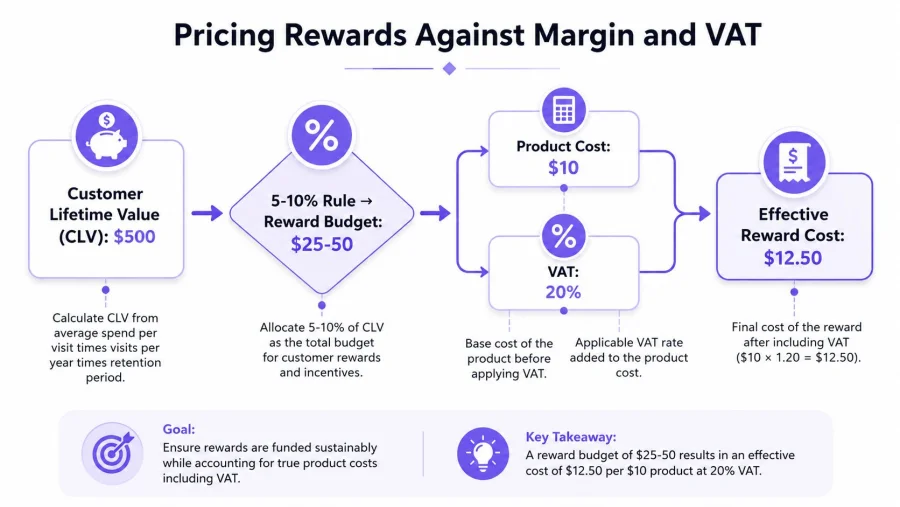
Generic loyalty advice stops at “choose a nice reward”. That's exactly where small businesses get into trouble. A reward that feels generous can still be a weak deal if it eats too much gross margin, gets redeemed at awkward times, or causes staff to apply it loosely.
The independent guidance often points to keeping reward cost around 5-10% of customer lifetime value and making the first reward reachable quickly (Xero loyalty programmes guide). In practice, that rule needs to be translated into the UK prices on the till, the VAT treatment of the reward, and the way the reward changes behaviour.
A simple way to think about reward value
A £3.20 flat white can support a small, frequent reward more easily than a larger one-off discount. A £32 haircut can carry a stronger milestone reward because the customer visits less often and expects a more considered offer. A £49 monthly gym pass works differently again, because the reward should reinforce consistency rather than encourage a single large transaction.
A free item is often the cleanest option in food and drink, because the business can control exactly what is given away. A percentage discount is easier for customers to understand on bigger tickets, but it can create inconsistent reward cost as basket size changes. A fixed bonus sits in the middle and is often easier to budget against than a loose percentage.
The VAT layer matters because the reward does not live in a vacuum. A “simple discount” can look cheap on paper and still bite harder after tax treatment and fees. That is why reward design should be reviewed as a unit-economics exercise, not as a branding exercise.
Practical rule: use free products for high-repeat, low-complexity purchases, percentage discounts for bigger baskets only if staff can apply them consistently, and fixed bonuses when the business needs tighter cost control.
The key question is not whether the reward sounds attractive. It is whether the reward still looks attractive after the customer has used it ten times and the owner has paid for every redemption.
Promotion Tactics and the KPIs Worth Tracking
A loyalty programme that nobody notices is just a hidden discount. The launch has to be visible at the door, at the counter, and in the follow-up messages, or customers will forget it exists before they earn anything. Small businesses do not need a huge campaign, they need repeated reminders in the places where decisions happen.
Low-cost promotion that actually gets used
Window stickers work because they catch the person before they enter. Table tents work because they sit beside the decision. Till-talk prompts work because staff can mention the reward at the moment the customer is already paying. A launch-day offer can create a first burst of sign-ups, while a birthday coupon or a seasonal push can reactivate people during slower periods.
Automation should carry the follow-up. Push and email messages can remind members about unused rewards, a welcome bonus, or a quiet-period offer without the owner manually chasing every person. A moderate cadence matters more than volume, because nobody wants a flood of irrelevant messages from a local business.
For owners looking for practical examples of retention messaging, powerful ways to keep customers is a useful complement to the in-store tactics here. The point is not more noise, it is better timing.
The four numbers worth watching
Track active member rate to see whether people are still participating. Watch redemption rate to check whether the reward is understandable and desirable. Follow repeat visit frequency to see if the programme is changing behaviour at all. Keep an eye on average spend per member to learn whether the reward is attracting better baskets or just cheaper ones.
A small business does not need a giant dashboard. It needs a clean summary that answers one question, is the programme making regulars more valuable? For a helpful starting point, the analytics stats overview can be used as a model for the sort of reporting that stays readable for owners, managers, and shift leads.
If the numbers are flat, the offer may be too hard to understand. If redemption is high but spend drops, the reward may be too generous. If sign-ups rise but active use stays low, the onboarding probably needs to be simpler at the point of sale.
GDPR, Opt-In Best Practice and Your 30-Day Launch Plan
The wrong assumption is that loyalty needs more data. It doesn't. It needs the right data, collected with consent, for a clear purpose, and stored only as long as the business needs it. That keeps the programme useful without turning it into a compliance headache.
The safe default is straightforward. Ask for opt-in at sign-up, explain why the details are being collected, make unsubscribe easy, and never resell the data. A platform with built-in consent handling removes most of the anxiety because the process is designed around permission, not around guessing what's acceptable after the fact.
A simple 30-day rollout
Days 1 to 5. Choose the primary mechanic, define the reward, and decide exactly what staff need to say at sign-up. Keep the wording short enough that it can be repeated without reading a script.
Days 6 to 10. Write the web or mobile sign-up copy, test the QR flow, and make sure the customer can join without confusion. If the form feels long, cut it.
Days 11 to 15. Train staff on how to scan, redeem, and explain the programme in one sentence. The team should be able to do it during a rush, not just in a calm demo.
Days 16 to 20. Soft-launch to a small group of regulars. Watch where they hesitate, where they ask questions, and where the process slows down.
Days 21 to 25. Put the offer in the window, on the counter, and in a short launch message. The programme needs visibility before it needs perfection.
Days 26 to 30. Check the first KPIs, adjust the wording, and simplify any step that customers keep missing. Small corrections early are cheaper than rescue work later.
A platform like BonusQR can fit this kind of rollout because it supports QR-based sign-up, reward tracking, and staff redemption without requiring a POS swap or extra hardware, which keeps the launch practical for independent cafés, salons, and shops.
The next quiet month is usually the right time to start. Pick one reward, one enrolment flow, and one staff script, then launch it properly instead of waiting for the perfect system.
If the business is ready to turn regulars into a steadier revenue stream, the simplest next step is to choose one mechanic, build the QR sign-up, and launch it in the next 30 days. A loyalty programme that staff can explain and customers can redeem quickly is far more valuable than a clever one that sits unused on the counter.


