The most common loyalty marketing advice is also the least useful for many local businesses: launch a points card, offer a small discount, and wait for repeat visits. That approach confuses membership with engagement. A customer can join a programme in seconds, then ignore it for months because the reward feels distant, the rules are unclear, or the business sends nothing relevant.
UK consumers already understand loyalty schemes. The harder task is giving them a reason to use one today. For cafés, restaurants, salons, gyms, and local shops, effective loyalty marketing means delivering visible value with very little effort, while giving the owner enough data to make better decisions about retention, offers, and customer communication.
The Current State of Loyalty Marketing in 2026
A loyalty programme is not automatically a loyalty strategy. The UK market is crowded with schemes, and customers now judge local programmes against every other card, app, and offer competing for their attention.
Mintel reported that 55% of UK consumers belonged to at least four loyalty schemes, but 58% had actively used only three or fewer during the previous six months (Mintel UK customer loyalty research). Membership is widespread, while active usage is selective. A business can celebrate sign-ups even as customers stop opening messages, checking balances, or redeeming rewards.
Antavo's UK data reports an average membership of 4.7 loyalty programmes per consumer, while only 33% say they're more likely to join a programme than the previous year (Antavo UK loyalty statistics). That is the practical definition of loyalty fatigue. Customers do not need another scheme that adds administration to their lives. They need a programme that helps them save, earn, or receive something useful without learning a complicated system.
Why sign-ups no longer prove success
Earlier UK research showed that loyalty mechanics had become part of everyday shopping. YouGov found that 77% of British adults were subscribed to at least one loyalty programme, 59% believed all brands should offer one, and 72% considered loyalty programmes a great way to reward customers (YouGov findings via Mintel). Supermarkets had the broadest reach, with 65% of the population subscribed to a grocery loyalty scheme.
These figures establish familiarity, not guaranteed performance. Customers already know what a loyalty card should do, so a generic “join and collect points” message rarely creates distinction. The same research found participation among 85% of women and 70% of men, showing that adoption can vary by audience segment and should be assessed rather than assumed.
Practical rule: Measure the actions that create revenue, not the registrations that create a database.
A useful programme answers three questions immediately:
- What does the customer get? The reward should be concrete, such as a free drink, a member price, or a discount after a defined number of visits.
- How does the customer earn it? A scan, purchase, visit, or spend threshold must be obvious at the point of sale.
- When can the customer use it? A shorter path to value usually feels more relevant than a reward requiring prolonged accumulation.
Immediate value beats passive loyalty
Hospitality research reinforces this point. A 2024 survey found that 49% of consumers found member-only prices appealing, 73% wanted deals and rewards from favourite venues, and 41% were open to joining a loyalty scheme (Zonal and GO Technology hospitality research).
The same survey found that 31% of restaurant users were likely to switch to a competitor, rising to 41% among weekly diners and drinkers. Regular customers are valuable, but frequent visits also give competitors more chances to win them. A relevant offer delivered before the next likely visit can address that risk more effectively than a points balance nobody checks.
The strongest local programmes therefore focus on activation, not accumulation. They make the next visit easier to justify, keep redemption simple, and use customer behaviour to decide who should receive which message. The engagement gap is usually a data and execution problem, not a missing-programme problem.
Choosing the Right Mechanics for Your Business
The correct loyalty mechanic depends on the behaviour a business wants to encourage. A café usually needs frequency. A salon may need rebooking. A restaurant may want customers to return during quieter periods. A gym may need members to build a consistent attendance habit.
Complexity creates friction at both ends. Customers struggle to understand the offer, while staff struggle to explain and administer it. A loyalty proposition should be explainable in one sentence, such as “Scan on each coffee and receive a reward after your target number of visits.”
A detailed overview of programme structures and planning considerations is available in the Splash Access loyalty programme guide. For a local operator, the most useful decision is still practical: choose the smallest mechanic that changes the desired behaviour.
The decision matrix
| Business Type | Best Mechanic | Why It Works |
|---|---|---|
| Coffee shop or café | Digital stamps | Links a familiar reward to repeat frequency and is easy to explain at the counter. |
| Restaurant | Visit thresholds or fixed discounts | Encourages a return visit without forcing customers to calculate complex points values. |
| Beauty salon | Visit thresholds and birthday coupons | Supports rebooking while creating a timely reason to fill suitable appointments. |
| Gym or fitness studio | Visit thresholds | Rewards consistency and makes attendance progress visible. |
| Independent retail | Points or spend thresholds | Helps connect rewards to basket value rather than only visit count. |
| High-ticket local retail | Cashback | Gives customers a clear financial benefit after larger purchases. |
Stamps for routine purchases
Stamps suit products bought frequently and with limited deliberation. Coffee, smoothies, bakery items, and quick lunches fit naturally because the customer can see progress after each visit. The reward shouldn't be buried behind several conditions. A simple visual tracker usually does more work than a tier structure.
Points for varied baskets
Points make sense when customers buy different products or spend different amounts. An independent retailer can reward spend while keeping room for category-specific promotions. The trade-off is explanation. If customers can't quickly understand how points convert into value, the programme becomes a background feature rather than a reason to return.
Cashback for larger purchases
Cashback can suit furniture, specialist retail, beauty packages, and other higher-value transactions. It gives the customer a direct sense of return, but the business must protect margin and set clear conditions. Cashback also requires reliable balance tracking, because confusion over available value damages trust quickly.
Thresholds for behavioural goals
Thresholds are useful when the desired action is a milestone, such as returning several times, reaching a spend level, or attending consistently. They work best when the customer can see the remaining distance to the reward. A threshold that feels impossible becomes another source of fatigue.
The best mechanic is the one a customer understands before staff finish explaining it.
Launching Your Programme Without the Tech Headache
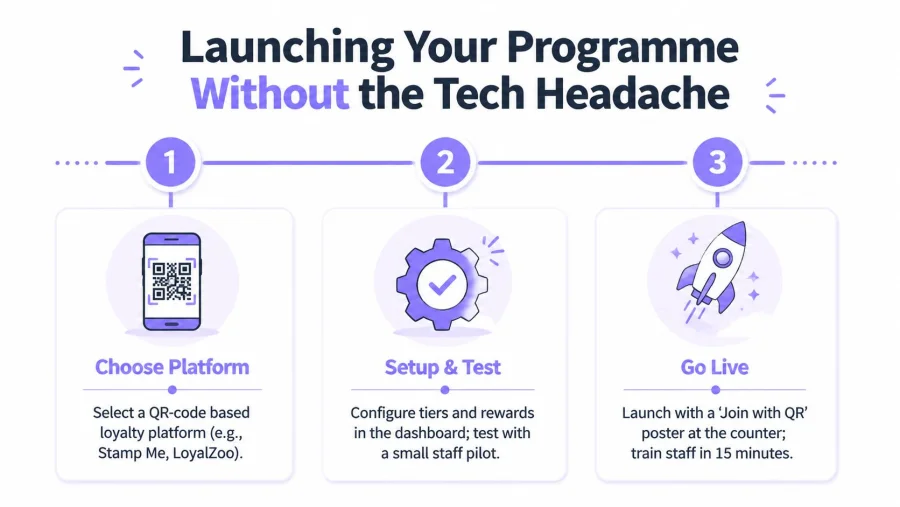
Small businesses often delay loyalty marketing because they assume a programme requires a new till, specialist hardware, or a long POS integration. That assumption pushes owners towards paper cards or no programme at all. A QR-based approach can remove much of that implementation burden, provided the customer journey and staff routine are designed first.
Step one, define the commercial objective
The owner should decide what the programme must change before selecting software. Possible objectives include more frequent café visits, better salon rebooking, stronger weekday restaurant traffic, or improved gym attendance.
The reward should support that objective. A coffee shop might use stamps, while a salon may need a birthday or reactivation offer. A business that wants larger baskets shouldn't automatically use a visit-based card.
Step two, write the offer in plain language
The front-of-house message needs to work without a staff member delivering a long explanation. A poster might say, “Join free, scan after each visit, and get your next reward.” The exact reward and any expiry condition should appear beside the QR code.
A digital platform such as BonusQR can support QR-based stamps, points, cashback, visit and spend thresholds, fixed discounts, welcome bonuses, birthday coupons, and seasonal offers. Customers can sign up on mobile or web, receive a personal QR code, and view rewards and visit history in one profile. The business can also use a branded profile for menus, price lists, news, reviews, and reservations.
Step three, configure and test the customer path
The setup should be tested from the customer's perspective, not only from an administrator dashboard.
- Create the reward rule: Set the earning action, reward, and any expiry or eligibility condition.
- Build the joining point: Place a “Join with QR” poster where customers naturally pause, such as the till, reception desk, or booking area.
- Run a staff pilot: Ask staff to join, scan, redeem, and explain the offer. This exposes unclear instructions before launch.
- Check the redemption flow: A reward that takes too many taps or requires manual intervention will create queues and staff resistance.
- Prepare the message sequence: Write the welcome message first, then the reminder, reward notification, and win-back message.
Businesses serving café customers can compare the practical requirements of a loyalty card for coffee shops before choosing a setup.
Step four, train staff around one routine
Staff don't need to become loyalty specialists. They need one consistent prompt: ask whether the customer is a member, show where to scan, and confirm when the reward has been added or redeemed.
The business should also decide who handles exceptions. A customer may have a dead phone battery, a duplicate account, or a reward that needs checking. Clear escalation rules prevent staff from improvising inconsistent answers.
Step five, keep the first launch narrow
A small pilot is safer than launching every reward type at once. One earning rule and one visible reward create a clean baseline. Once customers use the programme, the business can add birthday coupons, seasonal offers, or segments based on visit behaviour.
The key test isn't whether the technology works. It's whether customers notice the programme, understand it, use it, and return because the benefit matters.
Proven Campaign Strategies by Vertical
A loyalty programme becomes useful when it changes a real customer moment. The following examples show how local businesses can connect rewards to the occasions that matter most, rather than sending the same discount to everyone.
Coffee shops and cafés
A café customer usually makes a fast decision. The loyalty offer must be just as fast.
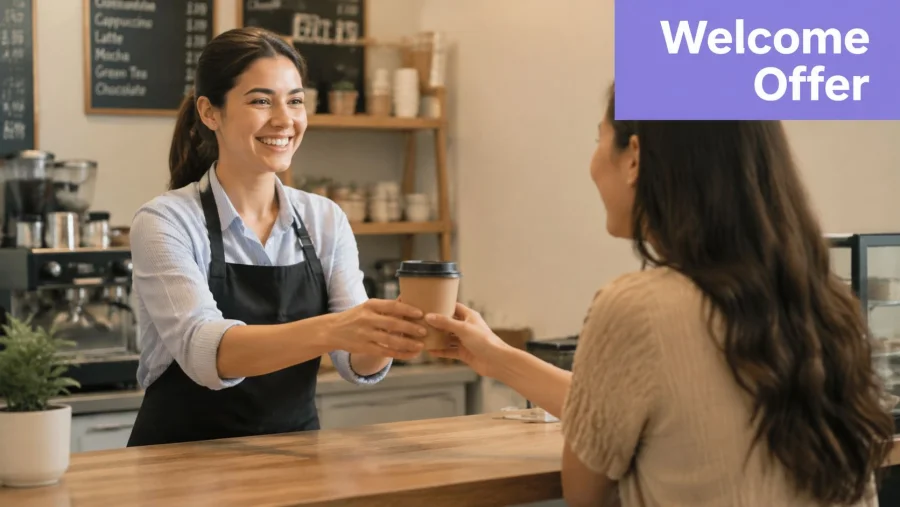
A sensible launch sequence begins with a welcome reward that can be used on a future visit, not necessarily immediately. That protects the first transaction while giving the customer a reason to return. Digital stamps then make repeat behaviour visible, especially when the customer can see progress in a mobile profile or wallet pass.
A café can structure campaigns around three moments:
- Welcome: Give a clear joining benefit, with simple terms and a defined redemption path.
- Routine: Use stamps for the core drink or visit behaviour, while avoiding different rules for every product.
- Reactivation: Send a timely reminder to customers who joined but haven't returned, or who have stopped progressing towards a reward.
The offer should reflect trading patterns. If mornings are busy but afternoons are quiet, a targeted afternoon reward may be more useful than a blanket discount across every visit. A discount that subsidises customers who would have arrived anyway can reduce margin without changing behaviour.
For restaurant operators looking to boost repeat visits at restaurants, visit-based rewards and member-only deals can work together. The restaurant can use a welcome incentive to create the second visit, then a targeted offer to support quieter occasions.
Beauty salons and wellness businesses
Salons have a different retention problem. The customer may not visit frequently enough for a traditional stamp card to feel natural, and the next appointment may depend on treatment cycles, personal routines, or availability.
A salon can use a threshold linked to completed appointments, then add a birthday-month coupon or a service-specific offer. The birthday campaign should be flexible enough to fill quieter slots rather than only discount peak appointments. A message that gives the customer a reason to book during an underused period can produce more useful revenue than a permanent reduction in price.
A rebooking prompt should arrive while the previous service remains relevant. The business can segment messages by service history, where the customer has provided the necessary permissions and the data is appropriate. A regular hair client shouldn't receive the same message as a customer who books occasional skincare treatments.
The salon also needs to protect the experience. Staff should mention the reward naturally during checkout, but the programme must never make the appointment feel transactional. Recognition, easy booking, and consistent service remain part of the loyalty proposition.
Gyms and fitness studios
Fitness loyalty often depends less on discounting and more on reinforcing consistency. A visit threshold can reward attendance milestones, class participation, or a sustained routine. The reward might be a guest pass, an add-on session, or a member benefit that supports continued participation.
The campaign should acknowledge progress without shaming customers who miss sessions. A positive reminder can encourage a return after inactivity, while a milestone notification can reinforce the habit that the business wants to build.
A studio can also create seasonal campaigns around new classes or quieter timetable slots. The loyalty profile provides a practical place to communicate the offer, but the reward should remain easy to understand. Too many tiers, badges, or conditions can turn a motivational programme into another app that members ignore.
Across all three verticals, the same principle applies: the campaign must match the customer's natural reason for returning. Stamps suit routine café purchases, appointment-linked rewards suit salons, and attendance thresholds suit gyms. The mechanics should follow the behaviour, not the other way around.
Turning Data into Repeat Visits
A loyalty programme earns its keep when it replaces guesswork with customer signals that staff can use. The aim is not to collect every possible detail. Start with recent activity, visit frequency, purchase or reward history, and response to previous campaigns.
Build segments that staff can act on
Keep the first segments simple:
- New members: Customers who joined but have not completed a meaningful second action.
- Active regulars: Customers who visit consistently and may respond to recognition or early access.
- Reward-ready members: Customers close to a threshold and likely to act on a progress reminder.
- Lapsed customers: Customers whose previous pattern suggests they need a timely reason to return.
Every segment needs a clear next step. That might mean changing the message, the offer, or the timing. If the segment changes none of these, remove it. A smaller set of useful groups will outperform a complicated profile that staff cannot apply during a busy trading day.
Track behaviour, not membership alone. Relevant measures include reward redemption, repeat visits, average spend, campaign responses, and the cost of each incentive. UK loyalty teams commonly monitor return on investment, which reinforces the need to measure commercial outcomes rather than assume that sign-ups represent success. A local forecast still needs its own baseline and margin calculation.
Use data without weakening trust
Collecting identifiable customer information for a loyalty programme makes the business a data controller under UK GDPR. Customers need a privacy notice covering the controller's identity, the purpose and legal basis of processing, retention, customer rights, and the right to complain to the ICO. If a processor handles the data, the business also needs a written contract under Article 28, as explained in UK GDPR loyalty compliance guidance.
Consent must be specific and understandable. Joining a rewards programme should not automatically enrol someone in every marketing channel. Separate essential programme messages from optional promotions, record permissions, and make unsubscribing straightforward.
A platform can standardise these steps, but the owner remains responsible for choosing appropriate purposes and explaining them clearly. Automated emails and push notifications should relate to a customer's behaviour. A reminder about progress towards a reward has a clearer purpose than repeated offers sent without regard to timing or activity.
For long-term economics, the ELECTE calcolo valore cliente can help estimate customer lifetime value. Compare any increase in repeat behaviour with reward cost, communication cost, and margin given up through discounts. That comparison shows whether engagement is producing profitable visits or merely creating activity.
Measurement rule: A campaign earns its place when it changes behaviour profitably, not simply when customers open the message.
The Future of the Physical Wallet
Paper loyalty cards fail in predictable ways. Customers leave them at home, damage them, lose them, or forget them in a drawer. They also give the business little scope to remind customers about rewards or learn which offers generate repeat visits.
A digital pass in Apple or Google Wallet keeps the programme closer to the purchase. Rewards are easier to find, pass updates can reach customers, and the brand experience is more consistent than with printed cards. Customers still receive a straightforward benefit, while the business gains a practical channel for reminders and reactivation.
The shift does not require a complex app. Local operators need a low-friction joining process, clear earning rules, uncomplicated redemption, and reliable privacy controls. Wallet technology earns its place by removing obstacles, not by adding technical novelty.
Businesses can add rewards to Apple Wallet within a more accessible loyalty journey. The strongest setup pairs the pass with clear counter messaging, staff prompts, and campaigns based on customer activity.
UK consumers already recognise loyalty marketing, but familiarity has increased expectations and fuelled loyalty fatigue. A sign-up total alone will not close the engagement gap. Start with one measurable objective, one easy reward, and a frictionless QR journey. Then review visits, redemptions, and campaign profitability before adding complexity. Use the results to make each offer more relevant than the last.


