Loyalty Data Ownership: Who Controls Your Customer Data
In a loyalty program, the customer owns their personal information and your business controls how it is used. Your platform provider should only process it on your instructions. “Ownership” is mostly a question of control and accountability: who decides how the data is collected, used, kept and deleted, and who answers when something goes wrong. If you run a small business, the practical move is to choose a loyalty platform that lets you run the program and see the results without a POS integration or a technical team, and to put the data terms in writing before you collect a single customer record.
Key Takeaways
- Customers keep rights over their personal data (access, correction, deletion). Your business decides what is collected and why, and stays accountable even when a platform processes the data for you.
- Control follows decisions: the organization that determines how information is collected, used, disclosed, retained and disposed of is generally the one responsible for it.
- Loyalty histories and marketing permissions can stay with the outgoing brand or operator when a relationship ends, so exit terms matter on day one.
- In the US, California sets the most detailed loyalty rules: opt-in consent and clear disclosures about what data is used and what you give in return.
- Collect less, explain more, and give customers real choices. That protects you legally and makes people more willing to share the data that powers personalization.
What “owning” loyalty data actually means
Search for loyalty data ownership and you will find two very different answers. Marketers say “the data is ours, we built the program.” Privacy advocates say “the data is the customer’s, full stop.” Both are partly right, because they describe different layers of the same record.
Think of a loyalty record as three layers:
- The customer’s personal information. Name, phone number, email, birthday, and anything that identifies a person. The individual keeps rights over this, including the right to ask what you hold and to have it corrected or deleted, depending on the law where they live.
- Your business relationship data. How often a customer visits, what they redeem, which rewards bring them back. This is what you build by running the program, and you use it to run and improve your business.
- The platform’s technical records. Logs, system data and anything the software provider needs to keep the service running.
Law rarely speaks of “ownership” in the property sense. It speaks of who determines the purposes and means of processing, and who is accountable. Under Canadian private-sector privacy laws, an organization generally controls personal information when it determines how that information is collected, used, disclosed, retained and disposed of, and it remains accountable for information transferred to a third party for processing on its behalf. That logic, accountability follows decisions, is the best mental model for any country.
For a café, gym or boutique this has a clear consequence. You decide to collect a phone number to send stamp-card reminders. You are the party answerable to that customer for it. Hiring a platform does not hand the responsibility to the platform.
What a loyalty program collects, and who can touch it
A loyalty program typically builds up several kinds of records:
- Identity and contact details: name, email, phone number, sometimes a birthday for special-occasion rewards.
- Transaction and visit history: when a customer scanned, how many stamps or points they earned, what they redeemed.
- Engagement data: which notifications were opened, which offers were claimed, whether a customer left a review or referred a friend.
- Preferences and consent choices: which channels a customer agreed to be contacted on, and what they opted out of.
Who can access, export or delete each category depends on three things: what your agreement with the provider says, what your settings allow, and what the law gives the customer. The business owner or manager normally has the dashboard view. Staff access should be limited to what their job requires. The customer holds rights to request access or deletion, and you must have a way to act on those requests.
The lesson for a small operator: before you choose a platform, know where each of these categories lives, who can see it and how you would get it out. It is far easier to ask these questions before you have 2,000 customers enrolled than after.
Control is not the same as unlimited use
Owning a customer list does not mean you can do anything with it. Two principles show up again and again in privacy guidance.
Purpose limitation. Data collected to run a stamp card is not automatically fair game for every marketing channel. Customers should know what you collect, why, who receives it, how long you keep it and when it is deleted. Law firm Charles Russell Speechlys recommends exactly that kind of privacy notice, backed by preference tools that let people opt out of non-essential uses and exercise access, correction and deletion rights.
Minimization. Collect only what the program or a clearly defined goal needs. The same guidance suggests using aggregated or anonymized data for profiling, research and product development where possible. For a small business this is good news: a stamp-card program needs far less than a full customer profile, and what you do not collect, you never have to protect, explain or delete.
What US rules say about loyalty data
The United States has no single federal privacy law for loyalty programs, so state law fills the gap, and California is the benchmark most businesses watch. Because rules and thresholds change, treat the following as orientation and check with a privacy attorney about your own situation, especially if you operate in several states or collect data at scale.
Koley Jessen’s 2023 comparison explains that California’s CCPA loyalty-program rules call for opt-in consent and disclosures about the program’s benefits, the categories of data collected, how to opt in and out, the relationship between the data use and the benefits, and the estimated value of the data. The same analysis notes that California may allow a business to deny a deletion request where the information is reasonably necessary to provide the loyalty program and the consumer wants to stay enrolled, and that the CCPA sets no specific timing requirement for unenrollment or deletion requests.
The National Law Review’s 2023 analysis of California, Colorado and Florida adds that notices should explain material price or service differences, how customers enroll and withdraw, and whether withdrawing consent affects participation. California also requires a reasonable, good-faith method for valuing the data incentive.
In plain terms, a US loyalty program is on solid ground when it:
- asks customers to opt in rather than enrolling them silently,
- tells them in simple language what is collected and what they get in return,
- lets them leave and request deletion without a hunt for the right form,
- and keeps records of what the customer agreed to.
If you serve customers outside the US, their local law can apply too. Different countries draw the lines differently, and your program should be built to the strictest standard you realistically face.
What goes wrong when consent is vague
The Hong Kong Privacy Commissioner’s 2017 study of loyalty programs is old but still instructive, because the failures it describes are universal. It found broad and vague privacy policies, bundled consent for multiple purposes, and inadequate mechanisms for customers to control or delete their data. The same report notes that Hong Kong’s ordinance does not give individuals a general deletion right, although it requires erasure once the original collection purposes and directly related purposes are fulfilled. It is a good reminder that deletion rights differ by place.
The takeaway is practical. Granular choices and working controls count for more than a long privacy policy nobody reads. A customer who can tick “yes to reward reminders, no to partner offers” trusts you more than one who clicks past a wall of text.
What happens to loyalty data when you switch providers or close the program
This is the part most owners never think about until it hurts. Horwath HTL’s 2026 analysis of hotel data warns that termination or rebranding often leaves loyalty histories and marketing permissions with the outgoing brand or operator, because the contractual and regulatory basis for transferring them is missing. Hotels are a franchise-heavy sector, but the same mechanics apply to any business that builds its customer relationships inside someone else’s system.
The same firm recommends three safeguards you can borrow:
- Define what counts as your data in the agreement, so there is no argument later.
- Require a structured, machine-readable export within a specified period after termination.
- Secure an ongoing usage right that does not depend on the brand or platform relationship continuing.
Consent matters here as well. A customer who agreed to receive offers from your shop has not necessarily agreed to receive them from a different company that inherits the list. Build your sign-up language around your business name and your purposes, so that moving between tools does not break your permission to contact people.
A contract checklist before you sign with any loyalty platform
Canadian guidance on service-provider arrangements boils the contract down to a few essentials: specify what personal information is exchanged, which party obtains consent and safeguards the data, and how the agreement keeps control and protection over the provider’s use of that information. Turn that into a working list:
- Data inventory. Which fields are collected from customers, and which are generated by the platform (visit counts, reward status, engagement)?
- Roles. Who is responsible for collecting consent at sign-up, and whose name appears on the notice the customer sees?
- Permitted use. Can the provider use your customer data for anything other than delivering your program? Look for language on advertising, resale and combining your data with other clients’ data.
- Access and export. Can you export your full customer list and history in a usable format, and how fast?
- Deletion. How are customer deletion requests carried out, and by when? What happens to backups?
- Security and incidents. What safeguards apply, and how soon are you told about a breach?
- Exit. What happens to the data at termination, and how long does the provider keep it?
- Subprocessors. Which other companies touch the data (messaging, hosting, wallet services)?
Most small business owners do not have a lawyer on retainer. You do not need one to ask these eight questions in writing, and a provider who answers them clearly is giving you information you need. For a deeper look at weighing vendors, our guide on how to choose a loyalty software provider walks through the wider decision, and our overview of choosing the best loyalty platforms covers features and fit.
Using loyalty data without losing trust
Control is only half the story. The reason to hold loyalty data at all is to bring customers back more often, and that works best when people are glad to share it.
EY’s 2025 analysis says preference centers, surveys and loyalty programs can create a value exchange in which customers receive more relevant offers while brands gain engagement and stronger relationships, provided consent choices are respected across channels. EY’s earlier work on voluntary preference data adds that this kind of zero-party data can improve accuracy and relevance, and that customers share it more readily when companies are transparent, ethical and clear about how it is used.
For a neighborhood business, that translates into small, concrete habits:
- Ask for less at sign-up. A phone number or email is often enough. Ask for a birthday only if you will actually send a birthday reward.
- Say what the customer gets. “Share your email and get a free coffee after your fifth visit, plus one offer a month” is a clear exchange. “Agree to our terms” is not.
- Separate the choices. Reward reminders, promotional messages and review requests are different purposes. Let customers say yes to one and no to another.
- Honor opt-outs everywhere. If someone unsubscribes from push notifications, they should not get the same offer by email the next day.
- Keep a retention rule. Decide how long you keep inactive members and write it down.
Trust is also a loyalty driver in its own right. Respecting customer preferences and being open about benefits is a theme in guides on how to foster customer loyalty, and it applies directly to how you ask for data.
How a small business can run this in practice
Here is a simple operating model that keeps you in control without a compliance department.
Step 1: Decide what the program needs. Write down the rewards you will offer (stamps, points, cashback, a referral bonus) and list only the data each one needs. A stamp card needs a way to recognize a returning customer, not a detailed profile.
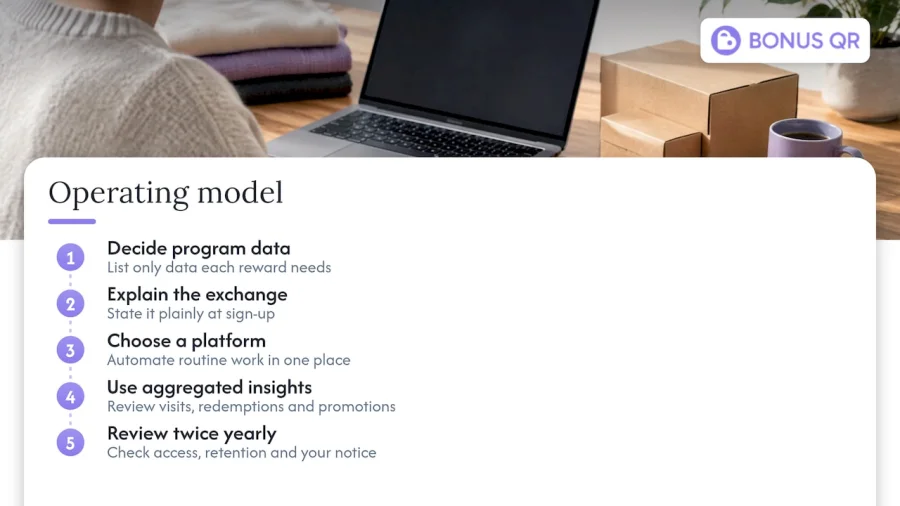
Step 2: Write the exchange in one sentence. Put it at the point of sign-up, in plain language, with your business name.
Step 3: Choose a platform that automates the routine work. Manual spreadsheets and paper cards scatter data across notebooks and phones. A platform that handles reward distribution, notifications and reporting in one place gives you one record to manage, one place to answer a customer’s request and one set of settings to review. Our overview of the cloud-based loyalty platform approach explains how that works day to day.
Step 4: Use insights, not just lists. Look at visit frequency, redemption rates and which promotions bring people back. Aggregated reporting tells you what to change without anyone reading individual histories.
Step 5: Review twice a year. Check who has dashboard access, purge members you no longer need, and confirm your notice still matches what you do. Our guide to the customer retention workflow shows where these checks fit into the wider routine.
Where BonusQR fits
BonusQR is a QR-based digital loyalty platform built for small businesses. Customers earn points, stamps or cashback by scanning, and you do not need an additional POS system to start. The platform automates reward distribution, promotional push and email notifications, review and referral modules, and analytics that track customer behavior, so you can see which rewards bring people back and act on it.
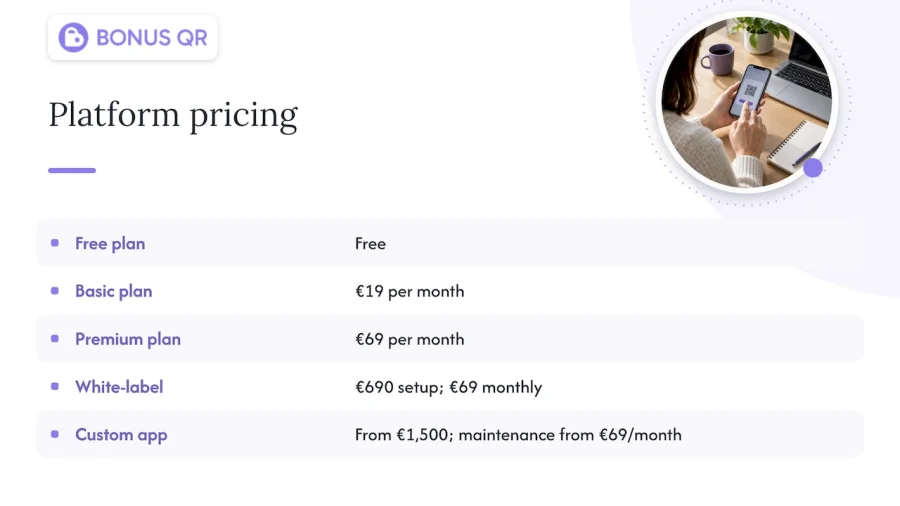
There is a Free plan to get started, a Basic plan at €19 per month and a Premium plan at €69 per month; the details are on the BonusQR pricing page. If you want your own branded app, the white-label option has a one-off setup fee of €690 and a monthly subscription of €69, and custom app development starts from €1,500 one-off with maintenance from €69 per month. Whichever plan you pick, use the checklist above to settle your data terms before you enroll customers.
A single record, run by you
Most small business owners come to us worried about the wrong thing. They ask whether a loyalty program is worth the trouble, when the better question is whether they will have a clear picture of their own customers a year from now.
We built BonusQR so that the loyalty program does the repetitive work: recording visits, handing out rewards, sending the reminder, reporting what worked. When that happens in one place, the owner stops guessing. You can see which stamp card drives a second visit, which promotion brings a lapsed regular back and which customers are about to drift away.
We believe the strongest loyalty data is the data customers hand over willingly because the reward is obvious. That is why our approach centers on simple, customizable rewards, QR scanning with no extra hardware, and analytics that turn behavior into decisions. A program that is easy to join, easy to understand and useful to the customer produces better data than any form with twenty required fields.
Our advice to every owner is the same: decide what you need to know, collect only that, tell customers what they get in return and review it regularly. Do that and the question of who controls the data has a simple answer: you run the program, your customers choose to take part, and the platform works for you.
Michal Palus
Special situations: hotels, franchises and multi-location businesses
The ownership question gets harder when more than one entity touches the customer relationship.
Franchises and brand networks. If a franchisor runs the loyalty system, the franchisee may be able to use the data but not control it. Canadian guidance on franchise systems stresses that responsibilities for independently operating organizations depend on the circumstances, so the franchise agreement should state who decides what and who answers to customers.
Hotels and hospitality. Rebranding or ending a flag can leave guest histories and marketing permissions with the brand. A program run under your own name, with your own sign-up notice, keeps the relationship tied to your property.
Multi-location retailers. Decide whether a customer’s points work across stores and who can see which store’s records. Limit access by role, and make sure a deletion request reaches every location.
For businesses that want their own branded app rather than a shared one, a white-label or custom app puts your name in front of the customer. Our article on digital loyalty schemes shows how that fits into a retention plan.
A worked example: a three-location cafe
Imagine a cafe group with three locations that wants a stamp card: buy nine drinks, get the tenth free. Here is how the principles above apply.
- Data needed: a way to identify a returning customer and the stamp count. An email or phone number is optional if the owner wants to send offers.
- Consent: at sign-up the customer sees a short line: “Get your tenth drink free. Want a monthly offer too? Tick here.” Rewards and marketing are two separate choices.
- Access: the owner and one manager see the dashboard. Baristas can scan and redeem but cannot export lists.
- Retention: members inactive for a set period are reviewed and removed according to a written rule.
- Exit: the owner keeps a record of the fields held and knows how to export them if the setup ever changes.
Nothing here needs a legal team. It needs a few decisions made once and reviewed twice a year. The payoff is a customer base that opted in and understands why you contact them, which is the kind of audience that opens messages and comes back.
Common mistakes to avoid
- Treating the platform’s terms as boilerplate. The data clauses are the part to read.
- Bundling consent. One tick box for rewards, promotions and third-party sharing is the pattern regulators have criticized.
- Collecting “just in case” fields. If you cannot name the use, do not ask.
- Having no deletion routine. When a customer asks, someone must know what to do and by when.
- Ignoring the exit. Decide today how you would take your customer list elsewhere.
- Letting access sprawl. Every former employee with a login is a risk.
For more on building a program that earns repeat visits, see our look at loyalty program trends and our digital loyalty card guide.
FAQ
Who owns loyalty program data, the business or the customer?
The customer keeps rights over their personal information, such as access, correction and, in many places, deletion. The business that runs the program decides how it is collected and used, and is accountable for it. The platform provider processes it for you and should not use it for its own purposes without your agreement.
Can I take my customer list with me if I change loyalty platforms?
Only if your agreement says so. Industry analysis warns that loyalty histories and marketing permissions can stay behind when a relationship ends, so ask for a structured, machine-readable export within a set period after termination. Word your sign-up notice around your own business so permission to contact customers travels with you.
Do I need customer consent to run a loyalty program in the US?
It depends on the state. California’s rules call for opt-in consent and clear disclosures about the data collected and the benefits offered. Colorado and Florida notices are also expected to explain enrollment and withdrawal. Ask a privacy attorney how the rules apply to your business and locations.
How much customer data should a small business collect?
Only what each reward needs. Privacy guidance recommends collecting the minimum required for the program or a clearly defined goal and using aggregated or anonymized data where possible. A stamp card rarely needs more than a way to recognize a returning customer.
What should I do when a customer asks me to delete their data?
Have a simple routine: confirm who is asking, delete or restrict the records, and tell them when it is done. Rules differ by jurisdiction, and California, for example, may allow a business to refuse where the data is needed to provide the program to someone who wants to remain enrolled. Write your process down so any team member can follow it.
Sources
- Who Controls Customer Data in Franchise Systems? Soto LLP
- 2017 Study Report on User Control over Personal Data in Loyalty Programmes, Hong Kong Privacy Commissioner
- How to Conduct Customer Loyalty Programs that Comply with Data Privacy Laws, Koley Jessen
- Loyalty Program Privacy Laws in California, Colorado, and Florida, National Law Review
- Responsible Personal Data Use in Loyalty Programmes, Charles Russell Speechlys
- Organizations can build loyalty through trust, personalization and privacy, EY
- Zero-party data is the next frontier in consumer strategy, EY
- Your hotel’s data: who actually controls and owns it? Horwath HTL


