A café owner may have a loyal customer base, a strong visual identity, and a reliable stream of repeat visitors, yet still rely on a paper stamp card or a generic third-party rewards tool. The salon down the road may face the same problem. Customers want convenient rewards, but the business owner doesn't want to fund a software project, manage app updates, or hand valuable customer relationships to another brand.
A white-label loyalty app solves that gap. It gives a business a branded digital rewards experience without requiring the business to build the underlying technology from scratch. The practical question isn't whether white labelling sounds attractive. It's how to white label a loyalty app without eroding margins, mishandling customer data, or launching an app that nobody uses.
Why Your Business Needs a White-Label Loyalty App
A café owner who wants a branded loyalty app usually starts with a simple ambition: customers should see the café's logo, colours, rewards, and offers every time they open the app. In practice, things are less simple if the business chooses custom development. Product decisions, interface design, account security, testing, app-store publication, maintenance, and future changes quickly become the owner's responsibility.
White labelling takes a different route. The business licences an existing platform, then applies its own identity and reward rules. Customers interact with the café's branded experience, while the technical foundation remains with the software provider.
That model fits businesses where repeat behaviour matters, including cafés, restaurants, salons, gyms, and independent retailers. A digital stamp card can reward visits, while points, spend thresholds, cashback, fixed discounts, birthday offers, and seasonal coupons give the business more control over the customer journey.
The UK grocery market shows why customers are already comfortable with retailer-owned brands. Private-label products accounted for 54 percent of grocery sales in 2022, up from 45 percent in 2005, while the average UK household buys a private-label product 187 times per year, according to Kantar data cited in a USDA Foreign Agricultural Service report. The point for a local business isn't that a loyalty app is the same as a supermarket product. The point is that customers already accept branded alternatives and return to them frequently.
The operational advantage
A branded app gives staff a consistent way to enrol customers, scan rewards, and redeem offers. Customers can see their balance and available rewards without searching through messages or carrying a card. A customer profile can also hold practical business information such as a menu, price list, news, reviews, or booking details.
That convenience only works if the reward system stays understandable. A café may start with a simple visit-based reward. A salon may use spend thresholds. A gym may combine membership benefits with referral rewards. The business should choose one primary behaviour first, then add complexity only when customers and staff understand the basic process.
Practical rule: A white-label app should make the existing customer experience easier, not turn a simple purchase into an administration task.
Businesses comparing loyalty approaches can also review the benefits of loyalty programmes for small businesses, especially where repeat visits and direct customer relationships matter.
White Label vs Custom Development Choosing the Right Path
Custom development offers maximum control, but control comes with responsibility. A bespoke loyalty app requires product planning, user-interface design, development, testing, security work, app-store management, and ongoing maintenance. The business also needs a plan for bugs, operating-system changes, new reward rules, and staff training.
A white-label platform starts with those foundations already in place. The business changes the visible identity and configures the customer experience instead of commissioning every underlying component.
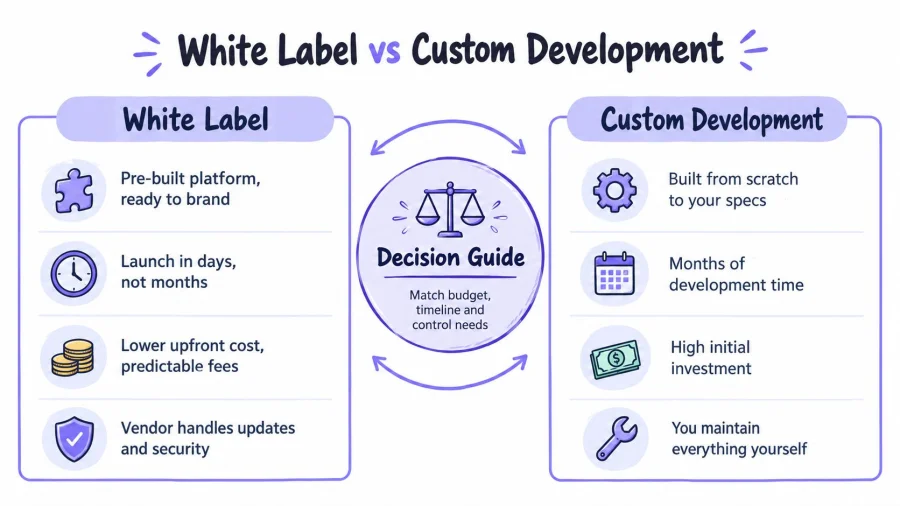
| Decision factor | White-label loyalty app | Custom development |
|---|---|---|
| Launch speed | Uses an existing product and established deployment process | Requires discovery, design, build, testing, and publication |
| Brand control | Supports the business logo, colours, rewards, and customer-facing identity | Can be tailored to almost any specification |
| Maintenance | The platform provider manages core updates and infrastructure | The business owns the maintenance burden or pays a development team |
| Reward flexibility | Works within the platform's available mechanics and integrations | Can be designed around unusual rules or proprietary systems |
| Financial risk | Easier to assess through a defined platform price | Scope changes and technical requirements can increase the total cost |
| Long-term ownership | Depends on the provider relationship and contract | Gives the business more direct control over the software |
When custom development makes sense
Custom software can be reasonable when a business has unusual operational requirements that established platforms can't support. Examples might include a complex membership structure, a proprietary ordering journey, or deep integration with internal systems.
The trade-off is that a custom app isn't finished when it reaches the app store. The owner still needs to fund updates, security reviews, technical support, and improvements. A business that only needs stamps, points, coupons, customer profiles, and basic reporting may be paying for control it won't use.
When white labelling is the practical choice
White labelling generally suits an SMB that wants a professional branded experience without building a technology department. The business can select its reward mechanics, apply its identity, test the customer journey, and start promoting the app while the provider maintains the core product.
Businesses that do decide to build bespoke software can use specialist resources such as hire developers from Mexico to explore development capacity and technical costs. That route may help with custom requirements, but it doesn't remove the need for product ownership and ongoing maintenance.
A business should also compare the level of customisation rather than treating every white-label offer as identical. Some platforms only remove a logo. Others provide branded app-store publication, custom layouts, configurable rewards, customer communications, and analytics. The custom app option is more appropriate when advanced integrations matter more than a rapid, standardised launch.
Step-by-Step Launch of a BonusQR White-Label App
The most reliable way to white label a loyalty app is to make the commercial decisions before the design decisions. The app icon matters, but the reward economics matter more.
Businesses can start for free with BonusQR, launch an affordable white-label app under their icon in about 14 days, or commission a fully custom app with advanced integrations. The launch process still needs disciplined preparation, because a fast deployment can't compensate for unclear rewards or poor staff adoption.

1. Define the customer action
Start with the behaviour the business wants to encourage. A coffee shop may want more repeat visits. A salon may want customers to book their next appointment. A gym may want members to attend consistently or refer friends.
Choose the simplest reward mechanic that supports that behaviour:
- Stamps suit repeat purchases with a clear completion point.
- Points work when the business sells products or services at different values.
- Visit rewards suit gyms, salons, and other businesses where attendance matters.
- Spend thresholds can encourage customers to reach a defined basket value.
- Coupons support birthday, welcome, seasonal, or short-term campaigns.
The reward must feel achievable and commercially safe. A business shouldn't offer a discount that attracts visits but leaves too little margin to cover the transaction.
2. Prepare the brand assets
Gather the logo, app icon, colour palette, type choices, business description, contact details, reward names, and offer wording before setup begins. Consistency matters because customers should recognise the app from the counter, website, social profiles, and printed QR materials.
Keep the first version focused. A clear home screen with the current balance, available reward, and next action is more useful than a crowded collection of menus.
3. Configure the customer journey
Set the welcome bonus, stamp or points rules, redemption conditions, birthday coupon, and seasonal offers. Decide whether staff will scan a customer QR code, scan a business code, or use another supported redemption flow.
Write the customer-facing terms in plain English. Staff should know what counts as a visit, whether rewards expire, how a reward is redeemed, and what happens when a customer requests a correction.
4. Test before promotion
Run the complete journey with staff accounts and test customers. Check sign-up, login, reward accrual, redemption, duplicate scans, failed scans, and the wording of confirmation messages.
Testing should happen during a quiet trading period and at the counter where real interactions take place. A process that works on a laptop may still frustrate a queue of customers if staff need too many taps.
5. Launch with a reason to join
A QR code alone isn't a launch campaign. Staff need a short explanation that connects the sign-up to a clear benefit, such as a welcome reward or easier access to future offers. Printed counter cards, window materials, receipts, menus, and social posts should all use the same wording.
The business should review early sign-ups, reward redemptions, coupon use, and customer feedback. If customers join but don't return to the app, the reward or reminder strategy needs changing.
Legal Compliance and Data Protection in the UK
A loyalty app is a customer-data system, not just a digital stamp card. Sign-ups can reveal what customers buy, where they shop, and how much they spend. The Information Commissioner's Office guidance on loyalty cards says organisations holding this type of personal information must keep it secure.
The business needs to decide who controls the data, which provider processes it, what information is necessary, and how the parties will respond to a security incident. Those decisions belong in the commercial and technical setup, not in a last-minute privacy-policy exercise.
Contracts and brand ownership
A white-label agreement should define who can use the trade marks, where the branded app may appear, who owns customer-facing content, and what happens when the relationship ends. UK legal considerations include the Trade Marks Act 1994, Competition Act 1998, and Data Protection Act 2018.
UK guidance highlights IP licensing, confidentiality, UK GDPR compliance, and cybersecurity as core risks in white-label agreements. It also stresses contractual clarity around trademarks and anti-competitive terms, as outlined in this UK white-label agreement guidance.
The contract should also allocate responsibility for:
- Security controls: who protects the platform and how incidents are reported.
- Data roles: whether the business is a controller, the provider is a processor, or another arrangement applies.
- Subcontractors: which third parties can access or handle customer information.
- Retention and deletion: how records are returned, deleted, or retained after termination.
- Service continuity: what happens if the provider suffers an outage or stops operating.
Privacy notices and consent
A privacy notice should explain what data the app collects, why it needs it, the lawful basis, retention periods, deletion rights, opt-out choices, and any third-party sharing. Automatic enrolment and pre-ticked consent can create compliance problems, particularly where marketing messages are involved.
The business should separate necessary service communications from optional marketing consent. Customers need a genuine choice, and the app should make it straightforward to withdraw consent or request deletion.
A practical guide to customer database software for small businesses can help owners think through access, records, segmentation, and retention before the programme goes live.
The UK Competition and Markets Authority found that most shoppers understand supermarkets collect data through loyalty schemes, but supermarkets commonly describe data sharing in general terms rather than naming every third party, according to its loyalty-pricing review. That makes clear communication a commercial issue as well as a legal one. Customers are more likely to accept data collection when the benefit and the boundaries are easy to understand.
Protecting Margins and Maximizing ROI
A loyalty programme can increase repeat purchasing, but a reward that ignores margin can make busy days less profitable. The right financial question isn't whether customers like discounts. It's whether the programme produces enough additional value to justify the reward, software, staff time, and compliance work.
UK businesses are dealing with talent shortages, higher employment costs, and pressure to deliver faster results. Building an internal app adds another specialist responsibility. The owner may need developers, designers, testers, security support, and someone to manage ongoing changes. White labelling replaces much of that fixed operational burden with a platform relationship.
Build a simple contribution model
Before launch, calculate the contribution from a typical rewarded transaction. The calculation should include:
- The gross sale, before discounts.
- Product or service delivery costs, including materials and direct labour.
- The reward cost, such as a free item, percentage discount, or cashback amount.
- Staff time, including sign-up support and redemption.
- Software and campaign costs, allocated across the active programme.
- The likely repeat value, based on observed customer behaviour rather than hope.
This isn't an argument for removing rewards. It is a reason to make rewards specific. A café might reward a repeat visit with a lower-cost menu item. A salon might offer a service add-on rather than discounting the full appointment. A gym might provide a referral benefit that supports acquisition without reducing every membership payment.
Margin rule: The cheapest reward isn't automatically the best reward. The strongest offer changes a valuable customer behaviour while protecting the sale's contribution.
A platform that needs no extra hardware or POS integration can reduce implementation friction for cafés, salons, gyms, and retail shops. Staff can use the available scanning and redemption process, while customers can keep offers in supported mobile wallet passes. That removes the need to redesign the entire checkout operation before testing the concept.
Judge value by behaviour
A programme should be measured against actions the business can influence:
- Are enrolled customers returning?
- Which rewards are redeemed?
- Do welcome offers lead to a second purchase?
- Which customer groups respond to seasonal campaigns?
- Are staff using the process consistently?
- Does a coupon create profitable activity or only discounted activity?
Customer acceptance is already strong when the value exchange is clear. A UK industry survey reported that 73% of British consumers believe loyalty cards offer good value for money, and 70% say loyalty cards encourage them to return to the same shops, according to SumUp's UK loyalty programme survey. Those figures support the use of loyalty schemes, but they don't guarantee profitability. The business still needs sensible reward rules and regular review.
Promoting and Scaling Your New White-Label App
An app launch fails when the business treats publication as promotion. Customers need to encounter the programme at the moment they buy, hear about it through channels they already use, and understand what they receive for joining.
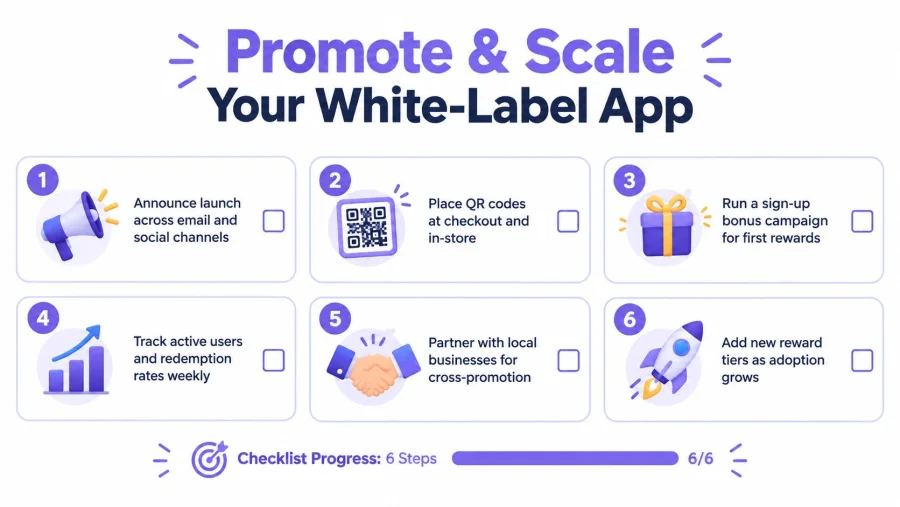
The launch message should be short: the name of the programme, the immediate benefit, the sign-up action, and any important conditions. Staff should use the same explanation at the till, reception desk, treatment room, or gym entrance.
Create several entry points
Place QR codes where customers naturally pause. Counter displays, tables, windows, receipts, menus, appointment confirmations, and staff conversations can all support sign-ups. Printed material should show the reward clearly, rather than asking customers to download an unknown app with no explanation.
Email and social posts should announce the programme in the business's own voice. A salon can connect the app to appointment reminders. A café can promote a morning reward. A retailer can introduce a seasonal offer. The message works better when it reflects an existing buying occasion.
Cross-promotion can extend reach without requiring a large media budget. A café near a gym, salon, or independent retailer may create a joint offer with clear limits and separate customer permissions. Businesses looking at broader partnership-led promotion can also review guidance on how to grow agency revenue with influencer marketing, particularly when a local brand wants help managing creator relationships under its own identity.
Use data without surprising customers
The CMA's review found that most shoppers know supermarkets collect data through loyalty schemes, which reinforces the need for transparent promotion and a clear value exchange. The business should explain why it asks for customer information and avoid presenting unrelated marketing as a hidden condition of receiving a basic reward.
Analytics should answer practical questions, not create decorative dashboards. Review active users, redemption patterns, popular coupons, visit trends, and campaign responses. A reward that attracts sign-ups but sees little redemption may be confusing, poorly timed, or commercially unattractive.
Scale the programme carefully
Add new reward tiers only after the initial process works reliably. A business can test a second offer for a defined customer group, compare redemption behaviour, and remove rules that staff or customers find confusing.
The strongest scaling loop is straightforward:
- Acquire: Give customers a clear reason to join.
- Activate: Make the first reward easy to understand and use.
- Retain: Send relevant reminders and offers.
- Learn: Review visits, redemptions, and customer feedback.
- Improve: Adjust the reward, wording, or timing.
- Protect: Keep consent, security, and access controls organised.
A branded loyalty app should become part of the normal customer experience, not a separate marketing project. Businesses ready to test the model can start with a free setup, define one commercially safe reward, prepare their brand assets, and invite staff to complete the full customer journey before placing the first QR code at the counter.
Start the launch with a clear reward, a compliant privacy notice, and a simple staff script. Set up the branded experience, test every scan and redemption path, then invite customers to join at the moment the benefit is easiest to understand. A focused first campaign will reveal more than months spent planning a complex app that never reaches the shop floor.


