
 Deutsch
 Español
 Français
 Italiano
 Magyar
 Polski
 Slovenčina
 Čeština
A loyalty card program usually gets judged in the wrong place. Owners obsess over the app, the points, the colour of the card, then watch customers hesitate at the till because the offer wasn't obvious, the sign-up was clumsy, or the staff member sounded unsure. The programme wins or loses in that one checkout conversation, not in the dashboard.
For UK independents, the smart starting point is not “What software should be used?” It's “What can a customer understand in one sentence, join in seconds, and redeem without drama?” That's why how to start a loyalty card program is really a checkout design problem, a staffing problem, and a legal data problem wrapped into one.
The Moment a Loyalty Programme Is Won or Lost
A café customer pays, picks up a coffee, and starts to leave. The cashier says, “Would you like to join our loyalty programme?” The customer smiles politely and walks on. That moment happens thousands of times in small businesses, and it fails because the offer is vague, the action is extra work, and the benefit is hidden.
The better version is short and specific. “Scan this QR code, collect stamps, and the next coffee is on us.” That line works because it explains the reward, the action, and the payoff without forcing the customer to learn anything new at the counter. UK customers already live inside digital habits, with 88% of UK adults having internet access at home in 2024 and 98% using some form of contactless payment in 2023, while contactless accounted for 38% of all UK payments Ofcom and UK Finance context. The point is simple, digital sign-up and wallet-friendly rewards fit normal behaviour.
Practical rule: if the enrolment line takes longer than the payment itself, the programme is already too heavy.
That is why cafe customer loyalty strategies matter before any software choice. The psychology of repeat visits only matters if the front counter converts the first visit into the second.
For a UK café, salon, or gym, the launch target is not perfection. It is a clean first transaction where the customer understands the offer, joins quickly, and leaves with the reward in their phone wallet or profile.
Choosing the Right Reward Mechanic for Your Business
The wrong loyalty mechanic makes the maths awkward before the programme even starts. A business with a low average order value and regular visits needs a very different structure from one with larger tickets and rare repeat visits. That is why the simplest answer is usually the best one.
Start with the customer rhythm, not the software feature
If customers come often and spend modest amounts, a stamp card is usually the most defensible choice. It is easy for staff to explain, easy for customers to remember, and easy to redeem without a long gap between effort and reward. The BonusQR stamp card program fits that logic because the mechanic is straightforward, visible, and built for repeat visits.
If spending is higher or visits are less frequent, points can make sense, but only when the customer can see the value without doing mental maths. Cashback-style rewards work better when the business wants immediate value rather than a long climb to a distant prize. Visit thresholds, such as “buy 4, get the 5th free,” are usually the cleanest option when margin is tight and staff need one simple rule.
A useful rule of thumb for operators is this: the less often a customer returns, the simpler the reward should be. Complex tier logic sounds advanced, but a small team can't explain a layered system well at the counter unless the value is obvious in one sentence. For a broader view of referral mechanics and how they sit beside rewards, it can help to explore referral capabilities and compare them with the repeat-visit model.
| Mechanic | Setup Effort | Customer Grasps in One Sentence | Best Fit When |
|---|---|---|---|
| Stamp card | Low | “Collect stamps, get a free item.” | Visits are frequent and the reward should feel fast |
| Points | Medium | “Earn points, redeem them later.” | Spend varies and the business can explain the balance clearly |
| Cashback | Medium | “Spend now, get value back next time.” | Immediate value matters more than status |
| Visit threshold | Low | “After a set number of visits, you get a reward.” | Simplicity and margin control matter most |
Pick the mechanic the team can actually sell
The right question is not whether points are more advanced. It's whether the front line can say the offer confidently during a busy shift. If the team hesitates, the structure is already too complicated. If the customer has to ask twice, it isn't ready.
Configuring Your Loyalty Programme in Under an Hour
A solid setup does not need a long implementation project. For most UK independents, the programme should be built around the business's normal basket size, the reward threshold, and the fastest possible sign-up path. The practical launch flow is simple, choose the earn rule, set the threshold, generate the QR code, and make sure the first customer can redeem without help.
Set the reward logic first
The reward threshold should make sense against the normal order size, not against a wishful marketing target. If the prize feels far away, customers ignore it. If it lands too early, the margin disappears and the scheme becomes a discount leak.
A practical platform flow for a tool such as BonusQR is to define the collecting rule, set the visit or spend threshold, choose any expiry, and then decide whether to include a welcome bonus or birthday reward. Those five settings do most of the behavioural work. Everything else is presentation.
Build the customer flow before launch
The sign-up QR code should go where people already stand, not in a corner nobody notices. UK operational guidance recommends printing it at A5 or larger and placing it at the counter or checkout, then testing the full flow, sign up as a customer, add the card to Apple Wallet or Google Wallet, scan with the merchant app, and confirm the stamp or points update correctly launch checklist guidance.
A common launch mistake is treating the software like the finish line. It isn't. The finish line is a customer who joins, sees the reward live in their wallet, and comes back without needing a reminder from staff.
For small businesses that want a simple start, the main question is whether the programme can run without POS integration or extra hardware. If the answer is yes, the launch burden drops sharply, and the team can spend time on customer behaviour instead of technical work. That matters more than fancy features in the first week.
Decide on the key settings
Before launch, confirm these five settings:
- Earn rule: visits or spend, chosen for the business model.
- Reward threshold: low enough to feel real, high enough to protect margin.
- Expiry: only if the business genuinely needs to manage inactivity.
- Welcome bonus: enough to encourage a first return, not enough to cheapen the offer.
- Birthday reward: only if the business can store that data lawfully and use it properly.
The setup should feel boring. That is a good sign.
Training Staff and Designing the Checkout Moment
A loyalty programme fails fast when staff treat it like an optional extra. The customer doesn't need a speech, and the team doesn't need a sales personality transplant. They need one short line, one recovery line for refusals, and a routine that fits the normal payment flow.
Give the team a script they can say without thinking
The first line should be brief and concrete.
“Scan this and collect a stamp on every visit. When you reach the target, you get the reward automatically.”
That works because it explains the benefit, the action, and the outcome in a single breath. Anything longer sounds rehearsed. Anything vaguer gets ignored.
When a customer says no, the staff response should stay calm and short.
“No problem, it's here if you want it next time.”
That keeps the interaction clean and avoids pressure. Pushy enrolment talk makes the programme feel like a sales trick instead of a customer perk.
Make the checkout area do half the work
The QR code should be visible without being cluttered into the rest of the counter. The printed message should say exactly what happens after scanning, not just that a loyalty programme exists. If the business uses wallet passes, the staff should mention that the card can live on the customer's phone so it's easy to find on the next visit.
Frontline access also needs structure. The staff permissions guide is useful because every team member shouldn't have the same level of control by default. Managers need visibility and editing rights. Front-of-house staff need enough access to scan, enrol, and redeem without creating confusion.
Run the first thirty seconds like a checklist
- Say the benefit first: don't lead with “Would you like to join?”
- Point to the QR code: customers should know where to act immediately.
- Offer help once: if they hesitate, guide them, don't hover.
- Confirm the reward: make the end goal visible.
- Close the sale cleanly: the loyalty pitch must not slow the payment line.
If a customer forgot their phone, staff should have a fallback. A manual note, a later enrolment, or a wallet pass sent after purchase is better than dead-ending the conversation. The point is continuity, not perfection.
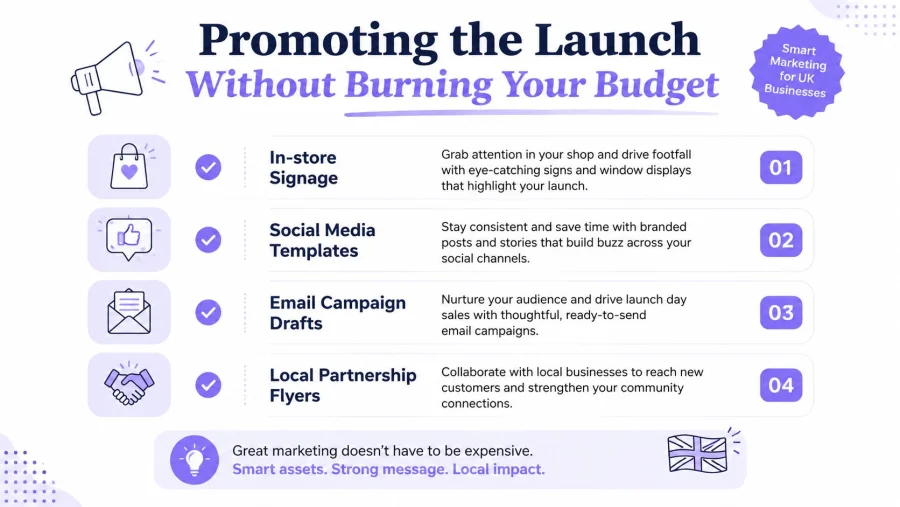
Promoting the Launch Without Burning Your Budget
The first week should feel loud in the right places and invisible everywhere else. A loyalty programme doesn't need a campaign calendar, a designer, or a paid media plan before it starts. It needs a few assets that repeat the same message across the counter, inbox, window, and receipt.
Use the assets customers already see
The launch kit should be small and practical.
- In-store signage: put the QR code where customers queue and pay, with one clear reward line.
- Social media templates: post the same promise customers hear at the counter, without a design-heavy rebuild.
- Email campaign drafts: announce the programme to existing customers with one direct reason to join.
- Local partnership flyers: if the business sits inside a neighbourhood loop, use nearby footfall to spread the message.
Wallet passes also help because they keep the programme present between visits. Once the customer has the card saved, the business doesn't need to rely on memory alone. That's especially useful for seasonal pushes or reminder offers.
Keep the message consistent across channels
The launch message should match the checkout script. If staff say one thing and the email says another, customers notice the drift and the offer loses trust. The same wording should appear on receipts, order confirmations, and any push notification the business sends after enrolment.
The practical sequence is simple. Week one should focus on visibility and first sign-ups. Week four can be used to nudge lapsed customers, but only after the team has seen which message got people to join.
The cheapest promotion is still a clear offer said the same way by every staff member. A confusing offer costs more, even when the spend is zero.
UK Privacy Rules That Shape Your Sign-up Form
A loyalty form in the UK is not just a capture point, it's a data-processing step with legal consequences. The UK General Data Protection Regulation took effect on 1 January 2021, and the ICO has made clear that loyalty programmes usually involve personal data such as names, contact details, purchase history, and preferences, which means operators need a lawful basis, clear privacy information, and tight data minimisation ICO guidance summary. That changes the shape of the sign-up form from the first draft.
Collect less, explain more
The best sign-up form is usually the shortest one. The ICO's guidance says organisations should think about what data is needed and how long it is retained, which means a loyalty programme should not ask for fields that have no operational use. A birthday field, for example, only makes sense if birthday rewards are part of the programme.
A concise privacy notice should say why the data is being collected, how it will be used, and what the customer gets in return. That isn't just compliance copy, it improves conversion because customers can see the trade in plain language. Minimal data collection is a commercial advantage when it's explained properly.
Separate loyalty enrolment from marketing permission
The biggest trap is assuming loyalty sign-up equals marketing consent. UK regulators note that marketing emails and texts generally require consent or a soft-opt-in basis, so the common advice to “capture emails at signup” is incomplete for cafés, salons, and retailers. Loyalty data and marketing permission are related, but they are not the same thing.
A validation layer can help before messages go out. A service like the Email Validation API is useful when the business wants to reduce bad addresses before sending lawful follow-up communications. It doesn't replace consent, and it shouldn't be treated like one.
Compliance rule: if the box says “join the loyalty programme,” the business should not quietly treat that as permission to send promotions later.
The retention rule also matters. Purchase history can help measure repeat behaviour, but it shouldn't be held forever just because the database can store it. A sensible programme keeps only what it needs for rewards, fulfilment, and legally justified reporting.
The Three KPIs That Actually Predict Success
Sign-ups by themselves are a vanity metric. A programme can look busy and still fail if customers never redeem, never return, or don't understand the value. The better scorecard is small, direct, and tied to behaviour at the till.
Measure enrolment, redemption, and frequency together
Enrolment rate shows how many paying customers joined. If staff are asking well and the offer is clear, this number rises quickly. If it stays low, the problem is usually at the counter, not in the software.
Redemption rate shows whether the reward lands. A high enrolment rate with a low redemption rate usually means the reward is too hard to reach, too slow, or too vague. A low enrolment rate with a high redemption rate usually means the reward is generous but the front line isn't selling it well enough.
Frequency lift is the one that really matters. The programme should produce more repeat visits than the pre-launch baseline, because that is the entire economic reason for running it. The 2026 digital commerce analytics guide is a useful companion if the business wants a tighter view of how to read those numbers without drowning in dashboards.
Use a 90-day cadence, not a one-day verdict
Day 14 should answer one question, are staff enrolling people consistently? If not, the script or signage is wrong. Day 30 should answer whether redemption is happening at a natural pace. If not, the reward threshold probably needs a reset.
Day 60 is where the business checks whether lapsed customers are still visible through wallet passes or reminder pushes. If customers joined once and disappeared, the programme has become a forgotten badge instead of a habit. Day 90 is the critical decision point, keep it, tweak it, or rebuild it.
A practical keeper test looks like this:
- Keep: customers join easily, redeem naturally, and return often enough to justify the reward.
- Tweak: people join but don't redeem, or they redeem but don't come back.
- Rebuild: staff can't explain the offer, customers ignore it, or the economics no longer make sense.
The simplest path from there is often a free QR launch first, then a branded white-label app once the programme proves itself and the merchant wants a stronger owned relationship with customers. That's the point where a more customised build starts to make sense, not before.
If a UK café, salon, gym, or independent retailer wants a loyalty card programme that staff can explain, customers can join fast, and the owner can measure without guesswork, start with a QR-based setup, keep the sign-up short, and test the first 90 days against enrolment, redemption, and repeat visits. BonusQR supports that kind of launch, so the next practical move is to map the current reward idea onto a simple stamp, points, cashback, or visit-threshold structure and then put the QR code at the counter this week.