Personalised hotel rewards are defined as loyalty programme benefits tailored to individual guest preferences, behaviours, and stay history rather than applied uniformly across all members. The industry term for this practice is adaptive loyalty, and it sits at the centre of every major programme redesign in 2026. The Marriott Bonvoy Loyalty Trends Report confirms a clear shift away from uniform points towards ecosystems built around guest passions, with food and dining cited as a priority by 63% of APEC travellers. For hoteliers, this shift is not optional. Guests who receive relevant, timely rewards return more often, spend more on ancillary services, and recommend your property to others. This guide walks you through how to personalise hotel rewards at every operational level, from data infrastructure to the moment a guest checks in.
What data and technology do you need to personalise hotel rewards?
Effective personalisation in hotel loyalty programmes begins with a single, unified view of each guest. Without it, your CRM holds one version of a guest’s preferences, your property management system (PMS) holds another, and your marketing automation tool sends offers based on neither. The result is generic communication that erodes trust rather than building it.
The prerequisites fall into three categories:
- Unified guest data. Every touchpoint, booking history, on-property spend, service requests, and post-stay feedback, must feed into one profile. Fragmented data is the most common reason personalisation fails in practice.
- Real-time segmentation. Static segments built monthly are too slow. You need the ability to move a guest from a “first-time visitor” segment to a “returning business traveller” segment the moment their second booking is confirmed.
- Privacy and consent management. Collecting preference data requires explicit consent under GDPR and equivalent frameworks. Consent must be captured at the point of data collection and stored alongside the guest record.
The technology stack that supports this typically includes a CRM, a PMS with open API connectivity, and a marketing automation platform. Minor Hotels’ Data 360 platform, which integrates Salesforce for CRM and OneTrust for consent management, is the clearest current example of this architecture at scale. The platform enables real-time segmentation and personalised offer delivery across Minor Hotels’ global portfolio, connecting guest data from marketing through to operations. This matters because many hotels can personalise their marketing emails but fail to personalise the actual reward moment due to disconnected systems.
| Technology layer | Primary function | Example tool |
|---|---|---|
| CRM | Unified guest profiles and segmentation | Salesforce |
| PMS | Booking, stay, and spend data | Opera Cloud |
| Consent management | GDPR-compliant data collection | OneTrust |
| Marketing automation | Triggered, personalised communications | Salesforce Marketing Cloud |
Pro Tip: Before investing in new technology, audit your existing data flows. Map where guest preference signals are captured and where they are lost. Most hotels discover that the data already exists but is siloed across three or four systems that do not communicate.
Revinate’s research on hotel customer data platforms highlights a gap that many operators underestimate: having segmented data is not the same as executing personalised decisions in real time. The intelligence layer that turns a data point into a campaign decision is where most programmes stall. Investing in integration before investing in new data collection is the more practical sequence for most hotel groups.
How do you segment guests and tailor rewards to their behaviour?
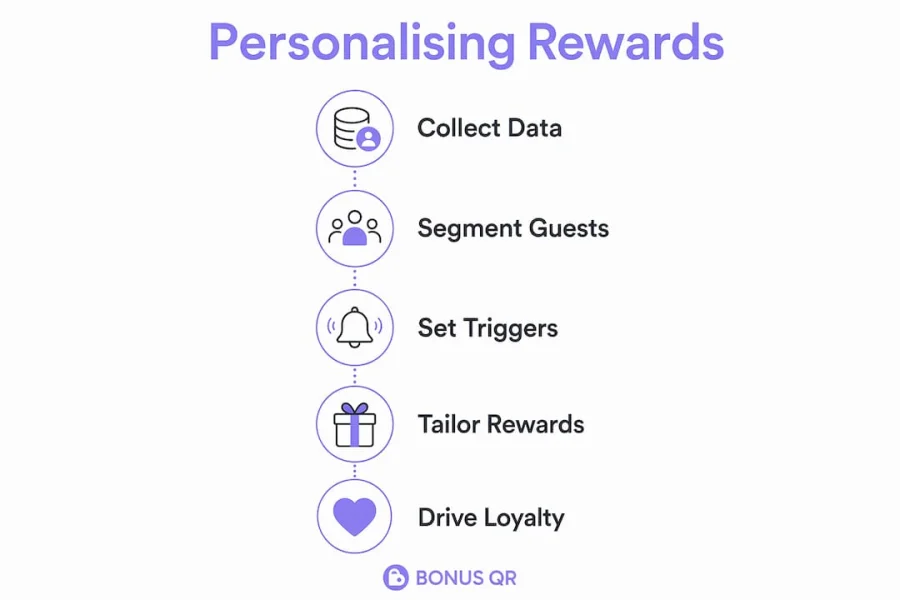
Guest segmentation is the process of grouping travellers by shared characteristics so that reward offers can be matched to what each group actually values. Behavioural and booking data are more reliable than demographic data alone, because they reflect what guests do rather than what they say they want.
A practical segmentation framework for hotel loyalty programmes covers four core profiles:
- Business travellers. These guests prioritise speed and convenience. Tailored rewards include express check-in, guaranteed room upgrades on arrival, and dining credits for solo meals. Spa discounts are less relevant unless the property data shows uptake.
- Family travellers. This segment responds to rewards that reduce friction and add perceived value, such as complimentary breakfast for children, late check-out, and activity credits. Points redemption for room upgrades is consistently popular.
- Wellness travellers. Spa access, fitness class bookings, and healthy dining credits resonate strongly. This segment is growing across APEC markets, as confirmed by the Marriott Bonvoy 2026 trends data.
- Occasion-driven guests. Anniversaries, birthdays, and honeymoons are high-value moments. Automated triggers that detect these occasions and deliver a room upgrade, a personalised amenity, or a dining experience create disproportionate loyalty relative to their cost.
Dynamic reward triggers are the next step beyond static segmentation. These are automated rules that fire a specific reward based on a real-time guest action. A guest who visits the spa twice in one stay receives a discount offer for their third visit before they check out. A business traveller who books five times in a quarter receives a suite upgrade on their sixth stay without needing to request it. These moments feel personal because they are responsive, not scheduled.
Pro Tip: Start with two or three segments and two or three triggers rather than trying to build a complete matrix from day one. Complexity is the enemy of execution. A well-run programme with four segments outperforms a poorly run programme with twenty.
The connection between tailored reward offers and guest retention is direct. When a reward reflects a guest’s actual behaviour, it signals that the property is paying attention. That signal is worth more than the monetary value of the reward itself, particularly for high-frequency travellers who have multiple programme options available to them.
How does guest-driven customisation build emotional loyalty?
Emotional loyalty is stronger and more durable than transactional loyalty. A guest who feels a sense of ownership over their stay experience is more likely to return and more likely to recommend the property than a guest who simply accumulates points. Cornell University’s research on psychological ownership and loyalty confirms this directly: guests who customise elements of their room environment demonstrate greater loyalty, driven by a sense of perceived control over their experience.
The practical applications of this finding are broader than most hoteliers realise:
- Room configuration choices. Offering guests the option to select pillow firmness, bed orientation, or furniture arrangement before arrival creates a sense of agency. The choice itself, not the outcome, is what drives the loyalty effect.
- Snack and minibar preferences. Allowing guests to pre-select their minibar contents or request specific snacks removes a common source of dissatisfaction and replaces it with a moment of positive anticipation.
- In-room technology preferences. Preferred room temperature, lighting settings, and streaming service logins saved to a profile make a return stay feel immediately familiar rather than generic.
- Dining and activity pre-selection. Guests who book a restaurant table or a spa treatment before arrival have already invested effort in their stay. That investment increases their commitment to the experience.
“Loyalty is enhanced when guests exert effort and customise their environment, turning service design into experiential rewards.” — Cornell School of Hotel Administration, 2025
The implication for your loyalty programme is that customisation options are themselves a reward. You do not need to discount to create loyalty. Giving guests control over their environment produces the same psychological effect as a free night, at a fraction of the cost. This reframes personalisation as a service design decision rather than a marketing spend decision, which changes how you should budget for it.
For properties looking to build guest engagement and retention through this approach, the key is making customisation options visible and easy to act on, ideally through a pre-arrival communication sequence that invites guests to shape their stay before they arrive.
Points vs. experiences: which loyalty model drives more engagement?
Traditional point-based loyalty programmes operate on a straightforward accumulation model: spend money, earn points, redeem for a free night or an upgrade. This model is familiar and easy to communicate, but it has a significant limitation. It treats every guest the same way, rewarding spend volume rather than guest preference. A business traveller who stays 40 nights a year and a leisure guest who stays twice accumulate points differently, but both receive the same catalogue of redemption options.
| Loyalty model | Primary driver | Guest engagement | Revenue impact |
|---|---|---|---|
| Points accumulation | Spend volume | Transactional | Direct, predictable |
| Experience-led rewards | Guest passion and preference | Emotional | Higher ancillary spend |
| Hybrid (points + experiences) | Spend and behaviour | Mixed | Broadest reach |
Wyndham Rewards’ approach illustrates what experience-led personalisation looks like in practice. The programme launched approximately 100 exclusive experiences in 2025, with the catalogue expected to exceed 300 in 2026. These experiences, which range from exclusive events to lifestyle perks outside the hotel stay, are designed to create emotional connections that a free night cannot replicate. Wyndham pairs this with a simplified fixed-tier points structure, so the programme remains easy to understand while the experiential layer adds perceived value.
Surprise and delight moments operate on a similar principle. A handwritten note, an unexpected room upgrade, or a complimentary amenity delivered at the right moment creates a memory that a points statement does not. These moments are most effective when they are triggered by guest behaviour rather than delivered on a fixed schedule, because the element of responsiveness amplifies the perceived personalisation.
Pro Tip: Audit your current redemption data to find out what your members actually redeem. If fewer than 30% of your active members have ever redeemed a reward, your programme has an engagement problem that more points will not solve. Experience-led options and surprise moments are often more effective at reactivating dormant members than bonus point promotions.
The shift from points to experiences does not require abandoning your existing programme structure. A hybrid model that retains points for everyday spend and layers in experience-led rewards for specific behaviours and milestones is the most practical path for most hotel groups. The types of rewards that drive the strongest emotional response are those that feel exclusive and personally relevant, not those with the highest monetary value.
Key takeaways
Personalising hotel rewards requires unified guest data, behavioural segmentation, and experience-led reward design working together, not as separate initiatives.
| Point | Details |
|---|---|
| Data infrastructure first | Unify CRM, PMS, and consent management before adding new data collection tools. |
| Segment by behaviour | Use booking and on-property behaviour to build segments, not demographics alone. |
| Customisation creates loyalty | Giving guests control over their environment drives psychological ownership and repeat visits. |
| Experiences outperform points | Experience-led rewards produce stronger emotional loyalty than point accumulation alone. |
| Real-time triggers matter | Dynamic reward triggers based on live guest actions outperform scheduled, static offers. |
Why personalisation fails more often than it should
I have worked with hotel groups at various stages of loyalty programme development, and the pattern I see most consistently is this: the technology investment happens, the data gets collected, and then the personalisation stops at the marketing email. The guest receives a relevant pre-arrival offer, checks in, and is then treated identically to every other guest by the front desk team. The disconnect between the digital promise and the physical experience is where loyalty is lost.
Frontline recognition is not a soft skill. It is an operational requirement. A front desk agent who greets a returning guest by name and acknowledges their last stay creates more loyalty in thirty seconds than a month of automated emails. The challenge is that this requires the PMS to surface the right information at the right moment, and the team to be trained to use it. Most properties have the data. Very few have the process.
The second failure mode I see regularly is over-reliance on discounting. When a programme runs out of ideas for personalisation, it defaults to percentage discounts and bonus point promotions. These erode margin without building genuine loyalty. Cornell’s research is clear on this point: perceived control and customisation produce stronger loyalty outcomes than financial incentives. The most effective programmes I have observed focus on giving guests choices, not giving them money off.
My practical advice is to start with consistency before you start with sophistication. Consistent recognition across every property in your portfolio, using the same guest profile, is the foundation. Once a guest knows they will be recognised wherever they stay, you have earned the right to layer in preference-based personalisation and experience-led rewards. Trying to build the sophisticated layer before the foundation is in place is the most common and most costly mistake in hotel loyalty programme development.
— Michal
How Bonusqr helps you personalise rewards at scale
Building a personalised loyalty programme does not require a technology team or a six-month implementation project. Bonusqr’s mobile and web loyalty platform gives hoteliers the tools to design and manage customisable reward programmes from a single dashboard, with no POS integration required. You can configure reward triggers based on visit frequency or spend thresholds, send targeted push notifications to specific guest segments, and manage digital coupon campaigns for occasion-based offers such as anniversary upgrades or dining credits. The platform supports electronic reward delivery directly to guests’ mobile devices, making redemption frictionless. For properties ready to move beyond generic points, Bonusqr provides the flexibility to tailor your programme to your guests without the complexity of enterprise-level systems.
FAQ
What does it mean to personalise hotel rewards?
Personalising hotel rewards means tailoring loyalty programme benefits to individual guest preferences, behaviours, and stay history rather than offering the same rewards to all members. This includes dynamic triggers, customisable stay options, and experience-led perks aligned with each guest’s travel priorities.
What data do you need to customise hotel loyalty programmes?
You need a unified guest profile that combines booking history, on-property spend, service preferences, and consent records. A CRM integrated with your PMS and a consent management platform, such as the combination used by Minor Hotels with Salesforce and OneTrust, provides the foundation for real-time segmentation and personalised offer delivery.
How does guest customisation affect loyalty?
Cornell University research confirms that guests who customise elements of their room environment, such as pillow type, snack preferences, or furniture layout, demonstrate greater loyalty due to psychological ownership. This effect is driven by perceived control, not by the monetary value of the customisation itself.
Are experience-led rewards more effective than points?
Experience-led rewards produce stronger emotional loyalty than point accumulation alone, particularly for high-frequency travellers. Wyndham Rewards’ experiential catalogue, which is expected to exceed 300 exclusive experiences in 2026, demonstrates that access to unique events and lifestyle perks creates engagement that a points statement cannot replicate.
How do you start personalising rewards without a large technology budget?
Begin by auditing your existing data flows to identify where guest preference signals are already captured but not used. Focus on two or three behavioural segments and two or three automated reward triggers. Platforms like Bonusqr allow you to launch a configurable digital loyalty programme without POS integration, making personalisation accessible for properties of any size.


