
 Deutsch
 Español
 Français
 Italiano
 Magyar
 Polski
 Slovenčina
 Čeština
Yes, a well-governed loyalty programme typically increases repeat visits and gives you centralised customer data across every location. Franchisors gain the most structurally, since they get brand-wide insight and coordinated campaigns, while franchisees see the day-to-day payoff in repeat footfall and higher average spend. Configurable digital loyalty platforms now remove much of the technical friction that once made multi-site rollouts difficult.
TL;DR:
- Set reward values, redemption rules, privacy terms, and marketing consent centrally, and check franchise agreements before launch because inconsistent local rules create compliance risks.
- Pilot in three to six representative locations for eight to twelve weeks, set success thresholds before launch, and review results weekly before expanding in waves.
- Use stamps or cashback when staff simplicity and easy auditing matter; points and tiers suit higher frequency or varied customer value but require more training.
- Start with a no POS system when terminals vary, then add POS integration selectively at high volume locations if automated point accrual justifies longer setup.
- BonusQR’s stated pricing runs from free to €69 monthly, while white label setup costs €690 plus €69 monthly; validate the reward model before investing.
Who gains: the franchisor vs the franchisee
A loyalty programme creates two different value streams, and understanding both helps you decide who should pay for what and who should control which decisions.
As the franchisor, you gain centralised customer data that spans every location, which supports brand-wide insight and campaigns that would be impossible to run location by location. You can spot which offers work, which locations lag, and where to invest marketing budget next.
As a franchisee, you feel the benefit locally: customers visit more often, spend more per visit, and respond to offers you can tailor to your own neighbourhood. Franchise-Info’s analysis of loyalty programme stakeholders notes that programmes work best when central governance sets the rules while local operators retain room to promote within them.
A shared rewards structure often aligns both sides well:
- A national onboarding bonus brings new members into the system under one consistent brand experience.
- Local, time-limited offers let individual franchisees drive footfall during slow periods without undermining brand consistency.
Choosing a programme model that fits your franchise
Not every reward structure suits every franchise, and the right choice depends on purchase frequency, average transaction size and how much complexity your staff can realistically manage.
- Points-based programmes suit higher-frequency, variable-spend businesses such as cafés or convenience stores, where customers accumulate value gradually.
- Visit-based stamp cards work well for simple, repeat-purchase models like coffee shops or quick-service restaurants, since the mechanic is instantly understood.
- Tiered programmes reward long-term loyalty and suit franchises with a wider spread between occasional and VIP customers, such as gyms or salons.
- Cashback or account credit keeps accounting simple across locations because the liability sits in one digital wallet rather than paper vouchers at each till.
Each model carries a different operational load. Points and tiers need more staff training and clearer redemption rules, while stamp cards and cashback are faster to teach and easier to audit centrally.
Pro Tip: Start with the simplest model your newest staff member could explain to a customer in one sentence; complexity can always be added once the programme proves itself.
Rollout checklist: governance, pilot, tech and training
A consistent rollout across multiple sites depends on sequencing decisions correctly, not just picking the right reward model.
- Establish governance centrally: decide who sets reward values, redemption rules and brand assets before any location goes live.
- Choose your technical approach: a POS-linked system suits franchises with uniform terminals, while a no-POS option avoids rebuilding integrations across mismatched legacy systems.
- Run a pilot across a representative sample of locations for at least eight to twelve weeks, long enough to capture genuine behaviour change rather than novelty visits.
- Train staff and distribute local marketing assets so every location promotes the programme the same way.
- Set up central reporting so data flows from every site into one dashboard, with a fixed review cadence.
Keep the pilot focused on learning, not scale:
- Pick three to six locations that represent different customer profiles, not just your busiest sites.
- Define success thresholds before launch, such as a minimum enrolment rate and a target repeat-visit uplift.
- Review pilot data weekly so you can adjust offers before wider rollout rather than after.
Once the pilot clears its thresholds, expand in waves rather than all at once, giving each new group of locations the same training and assets the pilot group received.
Measuring success: KPIs and reporting cadence
Franchises that treat loyalty data as a monthly afterthought tend to miss early warning signs. Build measurement into the programme from day one.
Primary KPIs to track from the start:
- Enrolment rate: the share of transactions where a customer joins or uses the programme.
- Repeat purchase rate: how often enrolled customers return within a set window.
- Visit frequency: average visits per member per month, compared against non-members.
- Average order value uplift: the spend difference between members and non-members.
Secondary KPIs worth tracking once the primary ones stabilise include redemption rate, member churn, cost per enrollee and a basic return-on-investment calculation comparing programme cost against incremental revenue.
Programmes with low marginal redemption costs, such as those run by hotels and airlines, have historically captured more loyalty value than most retailers, according to Wharton’s analysis of who benefits from loyalty programmes. That is a useful reality check for franchise retailers: expect steady, incremental gains rather than the dramatic returns seen in travel loyalty schemes.
Review pilot dashboards weekly, send franchisor reports monthly, and hold a full performance review quarterly.
Budgeting: typical costs and how franchisors share them
Loyalty programme costs usually fall into a few predictable categories, which makes budgeting easier than it first appears.
- Setup fees: one-off costs for configuring the platform and branding assets.
- Monthly SaaS fees: recurring platform access charges, often tiered by feature set.
- Per-member or per-transaction fees: variable costs that scale with programme activity.
- White-label or custom development: a larger one-off investment for a fully branded app experience.
Beyond platform fees, factor in reward liability (the value of points or cashback owed to members), local marketing spend and staff time for training and promotion.
Three common cost-sharing models exist: the franchisor absorbs the pilot cost entirely to prove the concept, a blended monthly fee is split across all locations regardless of size, or each location pays a per-site add-on tied to its own usage.
How a configurable SaaS platform matches franchise needs
The checklist above assumes you have a platform flexible enough to support a pilot, then scale without rebuilding from scratch. That is the gap configurable loyalty platforms like BonusQR are designed to close.
- Modular rewards let you launch stamp cards, points or cashback separately per location, then adjust the mix as data comes in.
- No-POS setup matters most during the pilot phase described above, since it avoids integration delays with mismatched terminals.
- Built-in analytics and marketing automation support the weekly and monthly reporting cadence your rollout plan depends on.
Freemium and premium tiers suit the pilot and early scale-up stages, while a white-label option fits once a franchisor is ready to roll a fully branded app out network-wide.
Pro Tip: Use the free or basic tier for your pilot locations before committing to white-label development, so you validate the reward model before investing in a branded app.
Legal and compliance considerations for franchise loyalty programs
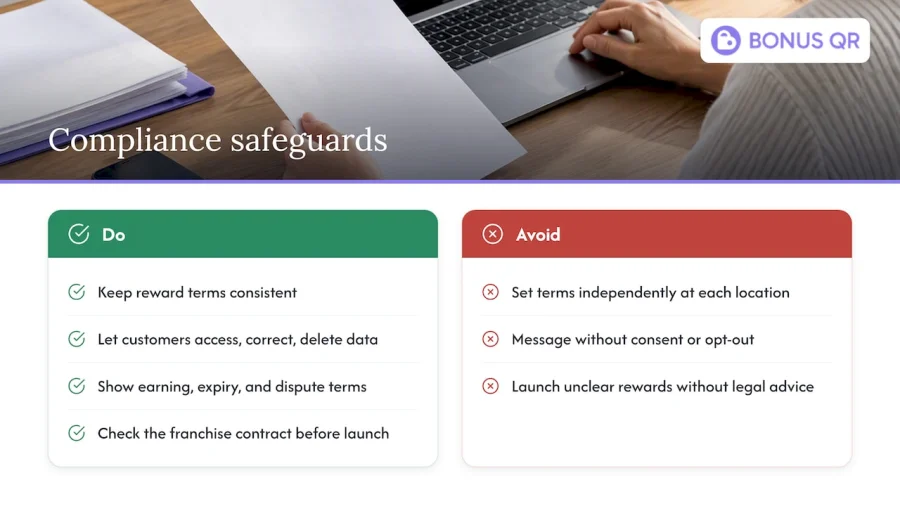
Running a loyalty programme across multiple franchise locations raises compliance questions that a single-site business rarely faces. Reward terms, expiry rules and privacy practices need to be consistent across every location, or you risk inconsistent treatment of customers who interact with your brand in different states or regions.
Customer data collected through enrolment, such as names, contact details and purchase history, falls under general data protection obligations, so your platform should allow customers to access, correct or delete their data on request. Clear, visible terms and conditions covering how points are earned, when they expire and how disputes are resolved protect both you and your customers.
Gift card and stored-value regulations can also apply to cashback or credit-based programmes, since account credit sometimes meets the legal definition of stored value depending on how it is structured. If your programme includes promotional messaging by text or email, consent and opt-out rules apply uniformly, regardless of which location sent the message.
Franchise agreements themselves may specify who controls programme rules, so check your franchise contract before launching any reward structure. Centralising rules at the franchisor level, rather than letting each location set its own terms, is the simplest way to keep the whole network consistent and reduce legal exposure. When reward structures or data practices are unclear, a conversation with a franchise attorney before launch is worth the time it takes.
Integrating loyalty programs with your existing IT and POS systems
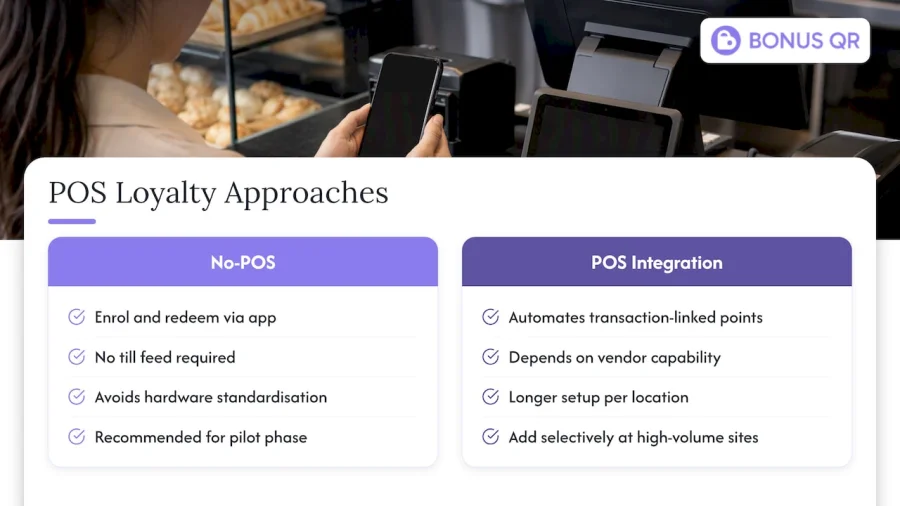
Franchise networks rarely run identical technology at every site, which is one of the biggest practical barriers to a consistent loyalty rollout. Some locations may run modern cloud POS systems, others older terminals, and a few might use none at all for smaller formats like kiosks or pop-ups.
A no-POS loyalty solution sidesteps this problem entirely by running enrolment and redemption through a mobile or web app rather than requiring a direct feed from the till. This matters most in networks where POS hardware varies by location age or franchise agreement vintage, since waiting for every site to standardise hardware before launching a loyalty programme can delay rollout by months.
Where POS integration is available and desired, it can automate transaction-linked point accrual, removing the need for staff to manually enter purchase amounts. The trade-off is a longer setup period per location and a dependency on your POS vendor’s integration capabilities.
For most multi-unit franchises, starting with a no-POS approach during the pilot phase, then adding POS integration selectively at high-volume locations later, balances speed with long-term accuracy. Mobile wallet support, such as Apple Wallet and Google Wallet, adds another layer of convenience without touching POS infrastructure at all.
Training and support for staff on loyalty program usage
A loyalty programme only works if the people at the counter understand it well enough to mention it naturally, not recite it awkwardly. Staff training should cover three things: how to enrol a new member in under thirty seconds, how to explain the reward structure in one sentence, and how to handle common questions about expiry or redemption.
Local marketing assets, such as counter cards, till-point signage and a short script for staff to use during checkout, keep the message consistent across locations without requiring every manager to write their own materials. Centralising these assets, rather than letting each site design its own, protects brand consistency while still giving local teams something ready to use on day one.
New hires need the same onboarding every existing team member received, so building loyalty programme training into your standard new-starter process matters more than a one-off launch event. A short refresher during slow seasons also helps, since staff enthusiasm for mentioning the programme tends to fade a few months after launch if nobody reinforces it.
Ongoing support works best when there is one clear channel, whether that is a franchisor help desk or a shared resource hub, where location managers can ask questions without waiting on a regional call.
Strategies for personalised engagement across your franchise
Generic blanket offers get ignored faster than personalised ones, and franchise networks have an advantage here: centralised data from every location can inform offers that feel local even when the campaign is designed centrally.
Segmenting members by visit frequency, average spend and location lets you send a different message to a lapsed customer than to a weekly regular. A customer who has not visited in six weeks responds better to a “we miss you” offer than to the same generic discount sent to everyone.
Push notifications and email tied to specific triggers, such as a birthday, an anniversary of first visit, or reaching a spend threshold, outperform scheduled blasts because they arrive at a moment the customer already finds relevant. Location-based offers, triggered when a member is near a specific site, add another layer of relevance without requiring any manual segmentation work from local staff.
The balance to strike is between central control of the message and local flexibility in timing. A franchisor-set template for a “welcome back” offer, which each location can trigger based on its own customer data, keeps personalisation consistent without turning every site into its own marketing department.
Scalability challenges across multi-location programmes
What works smoothly across five pilot locations can strain badly once a programme reaches fifty or more. The most common friction points are inconsistent local execution, fragmented reporting and reward liability that becomes harder to track as transaction volume grows.
Inconsistent execution usually traces back to training gaps rather than the platform itself, which is why standardised onboarding materials matter more as the network grows rather than less. A location that joins in month eighteen needs the same clarity a pilot location had in month one.
Fragmented reporting becomes a real problem once dozens of locations are generating their own data streams. Centralising rewards liability through platform-level wallets or digital credit systems, rather than paper vouchers issued at individual stores, keeps accounting manageable and gives franchisors one accurate view of outstanding obligations across the network.
Technical scalability is largely solved by choosing a cloud-based platform from the outset rather than retrofitting one later, since migrating customer data and reward balances mid-programme is far harder than starting with a system built for multiple locations. Phased rollout, the same approach recommended for the initial pilot, remains the safest way to scale: add new waves of locations only once the previous wave is stable, trained and reporting correctly.
A practical view on adoption and realistic milestones
The hardest part of a franchise loyalty rollout is rarely the technology. It is getting every location to execute consistently from week one. Expect a minimum pilot of eight to twelve weeks before judging results, and treat adoption by a majority of staff at launch as a realistic target rather than a disappointment.
— Michal
Launching your franchise loyalty programme with BonusQR
Everything in the checklist above, governance, pilot design, no-POS setup, staff training and reporting, maps directly onto what such loyalty platforms are designed to handle. Modular rewards let you launch a stamp card at pilot locations and a tiered programme elsewhere, without rebuilding the system each time. No POS integration is required to get started, which helps avoid delays caused by mismatched terminals across a network. Built-in analytics and marketing automation support the weekly pilot reviews and monthly franchisor reports needed in a rollout plan.
Our Free, Basic and Premium plans are suited to a pilot phase, and once you are ready to scale network-wide, our white-label option gives you a fully branded app experience. Current plans can be checked on the provider’s site to start a pilot on the plan that fits your location count.
FAQ
What are some examples of customer loyalty programs?
Common examples include points-based programmes where customers earn value per purchase, visit-based stamp cards for repeat-purchase businesses, tiered VIP programmes that reward long-term customers, and cashback or account credit systems. Franchises often combine a national points structure with location-specific promotional offers to balance brand consistency with local relevance.
What are the key trends shaping loyalty programs going forward?
Loyalty programmes increasingly integrate with mobile wallets, such as Apple Wallet and Google Wallet, and rely on push notifications to drive engagement without needing a physical card. Personalisation based on visit frequency and spend, rather than one offer for every member, is also becoming the standard approach rather than the exception.
What is a good free loyalty option for a small franchise location?
A free-tier loyalty platform that requires no POS integration is usually the fastest way for a small location to test a programme before committing budget. Our free plan is built for exactly this stage, letting you launch a basic stamp card or points system without upfront cost.
How much does a loyalty program typically cost?
Costs usually include a setup fee, a recurring monthly SaaS charge, and sometimes a per-member or per-transaction fee, with white-label app development as a larger one-off investment for franchises wanting a fully branded experience. Our own plans range from a free tier up to Premium at €69 per month, with white-label setup priced at €690 one-off plus a €69 monthly subscription for larger franchise networks.
How long should a franchise loyalty pilot run before expanding?
A pilot should run for a sufficient duration across three to six representative locations to capture genuine behaviour change rather than short-term novelty. This gives you enough data on enrolment, repeat visits and redemption to decide confidently whether to scale the programme network-wide.