You can see the problem in the morning rush. Fifteen people have walked into the café, ordered, paid, and left before lunch, yet none of them are linked to a name, a visit pattern, or a future offer. The owner knows the queue was busy, but not which customers might come back tomorrow, which ones only visit on Fridays, or which ones could be nudged into a second coffee with a simple reward.
That gap is where enterprise loyalty programs stop being a corporate idea and start becoming a practical growth system. The brands that treat every visit as a relationship usually have a better handle on repeat revenue, reward timing, and customer behaviour, while smaller businesses often treat each transaction as if it were brand new. Once that happens, footfall becomes anonymous noise instead of a measurable asset.
A useful way to understand this shift is to look at customer experience more broadly. The Vendmoore Enterprises CX guide is a good reminder that service quality and repeat business are tied together, not separate problems. Loyalty sits in the middle of that relationship, because it gives the business a repeatable way to recognise, reward, and measure customers.
Why Repeat Visits Are the Core Growth Lever
A busy independent café can feel healthy because the till keeps ringing. The harder question is whether those sales are building something durable, or whether the business is starting from zero again each morning. Repeat visits separate a shop that relies on chance from one that can read revenue with more confidence.
The economics are straightforward. Bringing in a brand-new customer usually takes more effort than keeping an existing one engaged, and retention compounds because every return visit adds more data, more margin potential, and more chances to sell an extra item or service. That is why loyalty programmes matter so much in brick-and-mortar businesses. They turn anonymous footfall into a trackable relationship.
The UK market makes that point clear. The UK Competition and Markets Authority found that Tesco Clubcard and Nectar together had around 23 million and 19 million active collector accounts respectively in 2023, which shows how normal loyalty participation has become at scale, not just in one brand, but across everyday shopping habits openloyalty loyalty program benchmark. The same benchmark notes that the four largest grocers accounted for about 75% of grocery sales in the UK in 2025 and that loyalty pricing was widely used to segment offers. That points to a simple shift, loyalty data is now part of core commercial strategy, not a side activity.
Practical rule: if the business cannot recognise a returning customer, it cannot reward one intelligently.
For cafés, salons, gyms, and retail stores, the lesson is even simpler. These businesses depend on frequent transactions, which means the value of one return visit can be larger than the value of another one-off campaign. A loyalty system works like the operating system that keeps those visits visible, repeatable, and measurable.
A modern enterprise loyalty programme now reaches this same logic without needing enterprise-heavy complexity. QR-based setups, API-first integrations, real-time updates, and modular rules make it possible for a café, salon, or gym to run the same kind of repeat-visit engine that larger brands use, just in a lighter form. The point is not corporate scale for its own sake. The point is to make every repeat visit easy to recognise and worth acting on.
The Vendmoore Enterprises CX guide is a useful reminder that service quality and repeat business are tied together, not separate problems. Loyalty sits in the middle of that relationship because it gives the business a repeatable way to recognise, reward, and measure customers.
What Makes a Loyalty Programme Enterprise-Grade
An enterprise loyalty programme is not defined by company size alone. It is defined by architecture. A paper punch card can reward repeat visits, but it cannot manage complex rules, tie into customer data, or recover cleanly when something fails. A basic points app is better, but it still often behaves like a closed box.
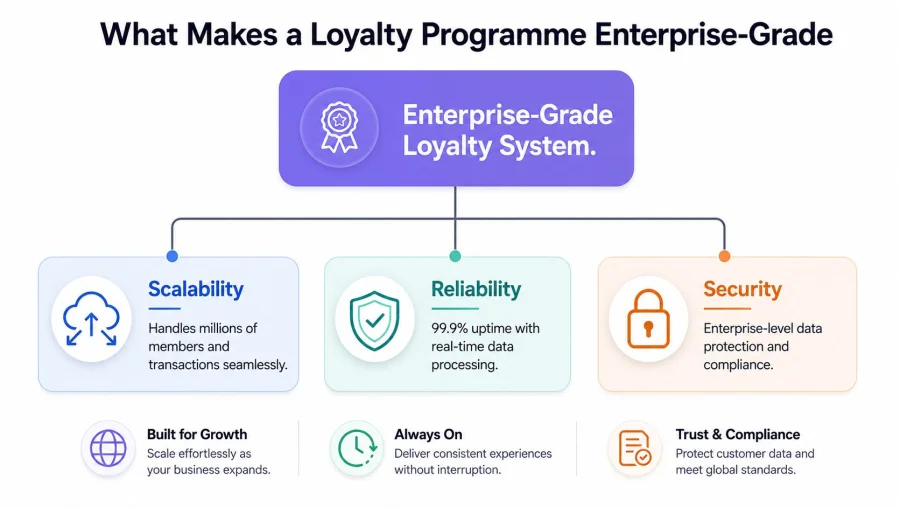
Enterprise-grade means the system is built from separate parts that can be updated without breaking the whole. The rules engine decides how customers earn and redeem. The points ledger records what they have earned. The API layer connects those events to the rest of the stack. That modular design matters because a failure in one part should not stop the whole programme from working.
The simple comparison
A punch card is easy to start, but it gives almost no data. A basic app gives data, but may not integrate well with CRM, POS, or marketing tools. An enterprise loyalty platform is designed to support reliability, security, and scalability at the same time, so the programme still works when volumes rise or channels multiply Yotpo enterprise loyalty platform criteria.
The modern definition is also broader than old-school chain retail. It covers omnichannel earn and redemption, flexible rewards, segmentation, and the ability to connect with other systems without rebuilding everything from scratch loyalty system architecture. In plain English, the same mechanics that support Tesco, Starbucks, or Sephora can now be delivered in a much lighter package for a single café, salon, or gym.
A loyalty programme becomes enterprise-grade when it can grow without becoming fragile.
The Core Building Blocks of an Enterprise Loyalty System
The easiest way to judge a loyalty platform is to treat it like a control room. Each part has a job, and each missing part creates a specific failure. That makes vendor conversations easier because the buyer can ask whether the platform can do the work, instead of getting lost in feature names.
Scalability and real-time performance
The platform should handle high transaction volumes with sub-second responses and process rewards instantly, especially at checkout enterprise loyalty real-time guide. If point posting lags, staff lose trust and customers lose interest. In a brick-and-mortar setting, delay makes the reward feel fake.
Integrations with CRM, ERP, and POS
A loyalty system is far more useful when it can connect to existing CRM, ERP, POS, CDP, and marketing automation tools enterprise loyalty real-time guide. Without integration, the business ends up copying data by hand or living with disconnected reports. That usually means broken customer profiles and clumsy campaigns.
Data and analytics
The platform should do more than count sign-ups. It should help the team understand who is active, what they buy, and which offers change behaviour. McKinsey's loyalty research also points to the importance of measuring breakage by customer segment, because a programme can alienate high-value customers if redemption is badly designed McKinsey loyalty research. Grant Thornton's view that many platforms still need export to other tools for deeper behavioural analysis only reinforces that point Grant Thornton loyalty analysis.
Security and GDPR-safe handling
Customer data must be handled carefully, especially in the UK where trust matters. Security is not a cosmetic feature, it is part of the programme's credibility. If customers worry about their personal details, sign-up friction rises and redemption activity falls.
Omnichannel support
The strongest systems let a customer earn in one place and redeem in another. That could mean scanning in-store, using a mobile profile, or receiving an offer after a visit. Omnichannel orchestration matters because a customer does not think in channels, they think in convenience.
Personalisation and segmentation
Not every member should see the same reward. The best platforms let a business segment customers by behaviour, frequency, or value, then tailor offers accordingly. BCG's loyalty ecosystem research supports that broader approach, because customers increasingly expect relevant benefits, not just generic discounts McKinsey loyalty ecosystems PDF.
Mobile wallet and pass integration
A reward has little value if customers can't find it quickly. Mobile wallet support keeps the programme visible between visits. That reduces friction and makes redemption feel like part of the normal shopping habit, not an extra task.
Quantifying the ROI of Enterprise Loyalty Programs
A loyalty programme only survives when the numbers hold up. The clearest way to judge it is by looking at a few levers together, not by focusing on sign-ups alone. Retention, redemption, basket size, and breakage all work together, so the question is whether the programme changes customer habits in ways that add up over time.
The case for that is already strong. A loyalty-programme summary citing Bain and Harvard Business Review says that a 5% increase in customer retention can increase profits by 25% to 95%, and that a 2% retention increase has the same profit effect as cutting costs by 10% loyalty programme statistics. Another loyalty-statistics summary citing LoyaltyLion reports that customers who redeem points spend 2.5 times more than non-members, that a customer who joins a loyalty programme is 68% more likely to purchase a second time, and that reward users show a 39% higher average basket size LoyaltyLion statistics summary.
| Lever | Reported effect | Where it shows up |
|---|---|---|
| Retention | 5% increase in customer retention can increase profits by 25% to 95% | More repeat visits and longer customer life |
| Cost control | 2% retention increase has the same profit effect as cutting costs by 10% | Less pressure on acquisition spend |
| Redemption | Customers who redeem points spend 2.5 times more than non-members | Higher basket value around reward use |
| Repeat purchase | Joiners are 68% more likely to purchase a second time | Faster move from first visit to second visit |
| Basket size | Reward users show a 39% higher average basket size | Bigger spend at the till |
A café owner can test the logic on a napkin. If one member comes in more often, buys the same drink, and sometimes redeems a reward that brings in a second item, the programme does not need dramatic growth to pay back. The programme is not there to replace every marketing cost. It is there to turn part of normal footfall into repeat behaviour that you can see in the till data.
The same logic helps with planning. A programme that is easy to measure gives you a cleaner way to compare member activity with non-member activity, then judge whether the extra visits are worth the rewards you give away. For a deeper look at software costs against expected lift, it helps to compare BonusQR pricing alongside repeat visits and redemption activity.
How QR Loyalty Delivers Enterprise Features Without Enterprise Cost
Many small businesses do not need a giant loyalty stack. They need the same architectural benefits, but delivered with less hardware, less setup, and less internal stress. A QR code on the counter, paired with a staff scan, can replace the kiosk, the printer, the card designer, and most of the manual admin in one workflow.
| Capability | Traditional enterprise stack | QR loyalty workflow |
|---|---|---|
| Customer enrolment | Separate forms, devices, or cards | Single scan and simple sign-up |
| Reward tracking | Multiple systems to reconcile | One profile for points, offers, and history |
| Staff effort | More device handling and manual steps | Fast scan at the till or counter |
| Flexibility | Harder to change once live | Easier to adjust rules and rewards |
| Visibility | Often spread across tools | Clear member view in one place |
That capability parity matters more than surface features. A business does not usually need a heavy enterprise deployment for a single location, and it definitely should not pay for hardware it won't use. What it does need is real-time processing, omnichannel visibility, and secure data handling, which can all be delivered through a lighter workflow.
The practical case for QR is straightforward. BonusQR, for example, lets brick-and-mortar businesses launch stamps, points, cashback, visit and spend thresholds, fixed discounts, welcome bonuses, birthday and seasonal coupons, with customers signing up via mobile or web and staff redeeming by scan. The important part is not the brand name, it is the fact that the architecture stays modular while the experience stays simple.
For retailers and service businesses, the best match is usually the system that reduces operational friction first. A loyalty app for retail stores can still support the same loyalty logic that bigger brands expect, without forcing the business to buy into unnecessary complexity.
A Practical Roadmap from Pilot to Full Rollout
A loyalty rollout should start small enough to reverse if needed. A two-week pilot in one location, or even one daypart, gives the team a real view of how customers behave when the offer is live. That is much safer than assuming a large launch will fix unclear reward logic.
The pilot should track a short list of signals. The most useful ones are sign-up rate, repeat visit frequency, redemption activity, staff adoption, and whether customers understand the reward. If those measures move in the right direction, the next step is expansion. If they do not, the business can adjust the reward structure before it scales.
Staff adoption is usually easier than owners expect when the workflow is simple. One scan, one screen, no new hardware, and no retraining on the till keeps friction low. The programme should feel like part of the existing checkout, not a separate project that slows the queue.
Migration is often simpler than it looks too. Businesses leaving a paper card or a weak app can move customer activity into a digital profile without asking staff to juggle multiple tools. Systems that do not require POS integration are especially useful here, because the pilot stays cheap to reverse if the reward does not land.
Practical rule: if the pilot needs a long internal training plan, the workflow is too complex for a small business.
A clean rollout path usually looks like this, in order. First, test the reward in one place. Second, check whether customers redeem. Third, confirm that staff can run it during a busy shift without slowing down. Fourth, add seasonal offers or segmentation only after the basics are working.
What This Looks Like in Cafés, Salons, Gyms and Retail
A café can run a stamp-style free coffee reward for morning regulars and mobile order pickup. The mechanic is simple, the channel is a QR scan, and the metric is whether the same customers return before lunch. The offer does not need to be fancy if the visit pattern is frequent.
A salon works better with visit thresholds and a birthday coupon. Stylists can tag customers in the CRM, then trigger a relevant offer after the right number of appointments. The metric is repeat booking, not just reward redemption.
A gym usually benefits from check-in driven points and a wallet pass for the membership card. If a member hasn't visited for a while, an automated win-back message can bring them back before the habit breaks. The measure that matters is visit cadence.
Retail needs a different shape. Basket-size thresholds and tiered perks can encourage larger orders without relying only on discounts. A post-purchase review request also turns a sale into a data point the business can use later.
Measuring What Matters and Your Next Step
A loyalty programme should be judged by behaviour, not by vanity. The most useful KPIs are active member share of revenue, redemption rate, visit frequency lift, and breakage by segment. The point is to find out whether the programme changes how people buy, not just how many people downloaded it.
That is why a platform's reporting matters as much as its rewards. A business that can inspect loyalty analytics stats can see which offers drive visits and which members are only collecting points without changing spend. For an operator comparing systems, it also helps to review how customer data flows into other tools, especially when working alongside resources such as manage Walmart orders with an API, which shows how structured integrations can support more controlled operations.
The next step should be small and practical. Start a free launch, test it in one location, and use the results to decide whether to keep, change, or expand the programme. If the business wants the loyalty system under its own icon, a white-label option gives that route without forcing a rebuild.
Strong loyalty does not come from complexity. It comes from giving repeat customers a reason to return, and giving the business a way to recognise them when they do.


