A discount management workflow is a structured system that controls how discounts are requested, approved, applied, and tracked to protect profit margins and support revenue growth. Without one, sales teams apply discounts inconsistently, finance loses visibility, and margins erode quietly over time. Tools like Salesforce, HubSpot, Zapier, and Make now make it practical for small and medium-sized businesses to build formal approval processes without enterprise-level IT budgets. The result is a system where sales reps, sales managers, and CFOs each play a defined role, and every discount decision leaves an auditable trail.
What does a discount management workflow actually require?
A discount management workflow is not simply a spreadsheet or a verbal agreement between a sales rep and their manager. The industry term for the broader discipline is pricing governance, and your workflow sits at its operational core. Getting the foundations right determines whether your process holds up under pressure or collapses the moment a rep needs to close a deal quickly.
The technology stack you need
Three technology layers form the backbone of any working discount approval process. First, a CRM system such as Salesforce or HubSpot captures the discount request at source, attaching it directly to the deal record. Second, automation middleware such as Zapier or Make routes the request to the correct approver based on predefined rules. Third, a structured request form collects the data your analytics will later depend on.

Structured data capture of the rep’s name, deal context, justification, and discount percentage requested is not optional. Without it, you cannot identify patterns, coach underperforming reps, or justify pricing decisions to your board.
The core data fields every discount request form should capture:
- Rep name and deal ID — links the request to a specific opportunity
- Customer name and segment — reveals whether discounting is concentrated in one account type
- Discount percentage requested — triggers the correct approval tier
- Commercial justification — forces reps to articulate the business case
- Deal close date — creates urgency and SLA accountability
- Competitor context — helps leadership assess whether the discount is defensive or unnecessary
Building your discount authority matrix
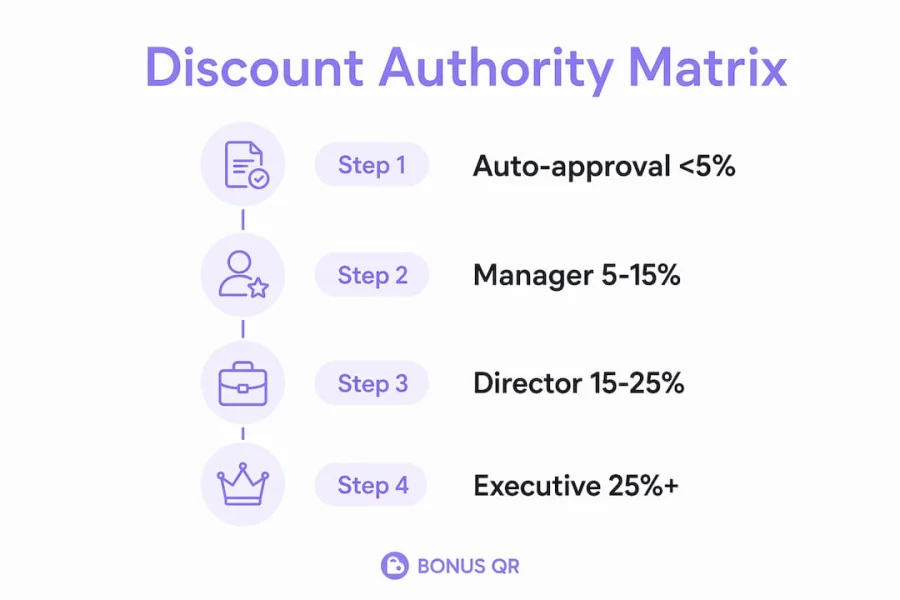
The discount authority matrix is the decision engine of your entire approval process. It defines who can approve what, and at what threshold the request escalates. Standard authority matrices enable automatic approvals under 5% and require CFO sign-off above 40%. That structure exists for a reason: it protects the business from both deal stalls caused by over-bureaucratisation and margin destruction caused by under-scrutiny.
| Discount Level | Approver | SLA Target |
|---|---|---|
| Under 5% | Auto-approved | Instant |
| 5%–15% | Sales Manager | Under 24 hours |
| 15%–30% | VP of Sales | Under 24 hours |
| 30%–40% | CFO | Up to 5 business days |
| Above 40% | CFO + CEO | Case by case |
Set SLA expectations before you go live. Approvers who do not know they are expected to respond within 24 hours will not do so.
Pro Tip: Have your discount authority matrix co-signed by both finance and sales leadership before you configure anything in your CRM. A matrix that only sales leadership endorses will be circumvented by finance, and vice versa.
How do you build a discount approval process step by step?
The practical implementation of a discount workflow breaks into five clear phases. Each phase builds on the previous one, so skipping ahead creates gaps that surface at the worst possible moment.
-
Build the discount request form inside your CRM. In Salesforce, this means creating a custom object or opportunity field set. In HubSpot, you use deal properties and a connected form. The form must be mandatory, not optional, before a rep can mark a deal as “negotiating.”
-
Apply tier-based approval logic. Configure your automation middleware to read the discount percentage field and route accordingly. Zapier and Make both support conditional logic that can handle multi-level chains. A 4% discount triggers auto-approval and a confirmation email. A 22% discount triggers a notification to the VP of Sales with full deal context attached.
-
Send contextual notifications to approvers. An approver who receives a bare “approval needed” message will delay. An approver who receives the rep’s name, the customer, the deal value, the justification, and the close date can decide in minutes. Tiered approval logic with notifications via Microsoft Teams or email, combined with escalation for unresponsive approvers, keeps deals moving without sacrificing control.
-
Handle all four outcomes systematically. Your workflow must account for approval, rejection, revision request, and timeout escalation. A rejection without a counter-offer leaves the rep stranded. Build a revision loop that allows the approver to suggest an alternative discount level and return it to the rep automatically.
-
Log every decision and generate performance reports. Every approval, rejection, and revision must write back to the CRM deal record. Weekly aggregated reports give leadership visibility into total discounts approved, average discount by deal type, and rejection rates by rep or segment.
Comparing manual vs automated discount workflows
| Factor | Manual Process | Automated Workflow |
|---|---|---|
| Approval speed | 1–5 days, inconsistent | Under 2 hours for standard tiers |
| Audit trail | Relies on email threads | Logged automatically in CRM |
| Policy compliance | Dependent on individual behaviour | Enforced by system rules |
| Analytics capability | Manual collation required | Dashboard-ready in real time |
| Escalation handling | Ad hoc, often missed | Triggered automatically on timeout |
Pro Tip: Start with two approval tiers, not five. A complex matrix that nobody follows is worse than a simple one that everybody respects. Add tiers only when your data shows you need them.
A clear approval workflow protects sales reps as much as it protects the business. When a rep can point to a system-approved discount, they are shielded from internal criticism and the customer cannot later claim the rep acted outside authority.
What are the most common discount workflow pitfalls?
Most discount workflow failures share a common root cause: the workflow was treated as a configuration task rather than a commercial policy decision. The technology is the easy part. The hard part is getting cross-functional agreement on what the policy actually is before you build anything.
The most frequent mistakes SMEs make when managing discounts:
- Treating the workflow as an IT project. If the sales director and CFO are not co-owners of the policy, the workflow will be bypassed or ignored within weeks of launch.
- No timeout or escalation rule. A deal stalls when an approver is on holiday and no escalation path exists. Build automatic escalation after 4 hours for standard approvals and 24 hours for senior approvals.
- Discount habituation. Frequent promotional discounting risks training customers to wait for offers before buying, permanently damaging their willingness to pay full price. Calculate breakeven lift before approving any recurring promotional discount.
- Inconsistent application across channels. A discount approved for a direct sales deal should not automatically apply to your e-commerce channel. Separate workflows for separate channels prevent this.
- No rejection rationale captured. If approvers can reject without explanation, you lose the data needed to coach reps and refine your pricing strategy.
“Most managers err by treating discount workflows as mere configuration tasks rather than strategic commercial policies. The workflow enforces the policy, but the policy must come first.”
Discounts above 40% cause permanent customer price expectation resets and signal a structural failure in pricing strategy or product-market fit. Any request at that level deserves the highest scrutiny, not a fast approval to close the quarter.
Shared ownership between sales and finance is non-negotiable. When finance owns the policy alone, sales teams find workarounds. When sales owns it alone, margins suffer. The discount governance framework must belong to both functions equally, with RevOps or a commercial director holding the process accountable.
How do you monitor and improve discount workflow performance?
A discount workflow that runs without review becomes a liability. Monthly monitoring of discount discipline patterns and annual pricing reviews with the CEO and CFO preserve discounts as growth instruments rather than reactive sales tactics. Without ongoing review, unauthorised discount drift erodes long-term profit margins quietly and consistently.
Setting up your review cadence
Three review cycles keep your discount tracking system healthy:
Monthly: Review the discount discipline dashboard. Look at average discount by rep, by segment, and by deal size. Identify reps who consistently request discounts at the top of their authority tier. That pattern often signals a pricing conversation problem, not a genuine competitive pressure.
Quarterly: Assess approval rejection rates and revision rates. A high revision rate suggests your authority matrix thresholds are misaligned with market reality. A low rejection rate with high average discounts suggests approvers are rubber-stamping requests.
Annually: Conduct a full strategic pricing review with executive leadership. Pricing governance is a cross-functional discipline, with CIO, CFO, CMO, and RevOps roles each owning parts of the discount strategy. No single department should drive pricing decisions in isolation.
| Review Frequency | Focus Area | Key Metric |
|---|---|---|
| Monthly | Discount discipline by rep and segment | Average discount percentage |
| Quarterly | Approval and rejection rate trends | Revision rate by approver |
| Annually | Strategic pricing and authority matrix | Pricing realisation vs list price |
Pro Tip: Add a “discount reason code” field to your request form from day one. Codes like “competitive pressure,” “volume commitment,” and “strategic account” let you segment your analytics without manual categorisation later.
Regular analytics dashboards that track total discounts approved, rejection reasons, and average discount by deal type give leadership the decision support they need to adjust authority matrices with confidence. Without this data, every matrix adjustment is a guess.
Modern businesses increasingly treat discounting as a strategic commercial tool rather than a sign of weakness. Controlled workflows stimulate demand without damaging price integrity. The goal is not to eliminate discounts but to make every discount a deliberate, data-informed decision. Explore discount strategies for retail to see how finance and sales roles collaborate effectively in practice.
Disciplined companies embed discount decisions within a clear governance hierarchy aligned to commercial strategy and brand positioning. They do not approve discounts in isolation. Every decision connects back to a pricing principle the business has agreed on at leadership level.
Key takeaways
A structured discount management workflow is the single most effective way for SMEs to protect margins, maintain pricing discipline, and give sales teams the speed they need to close deals without bypassing commercial controls.
| Point | Details |
|---|---|
| Authority matrix is foundational | Define approval tiers by discount size and get co-sign from finance and sales before configuring any system. |
| Automate routing, not just notifications | Use middleware like Zapier or Make to route requests to the correct approver automatically based on discount percentage. |
| Capture data from day one | Log rep name, deal context, justification, and discount level on every request to enable meaningful analytics. |
| Build escalation into every tier | Timeout escalation rules prevent deal stalls when approvers are unavailable, protecting both the rep and the business. |
| Review monthly, revise quarterly | Monthly dashboard reviews and quarterly matrix assessments keep your discount governance framework aligned with market reality. |
Why most smes get discount governance wrong
I have worked with a number of SME sales teams that had what looked like a discount approval process on paper. A manager had to sign off. There was an email thread. Finance was copied in. But none of it was systematic, and none of it was fast enough to be useful.
The uncomfortable truth is that most SMEs treat discounting as a sales problem when it is actually a commercial strategy problem. Sales teams discount because they are under pressure to close. Finance objects because margins are shrinking. Neither side has a shared framework for deciding when a discount is worth it and when it is not. The result is friction, inconsistency, and deals that close at the wrong price.
What I have found actually works is starting with the authority matrix before touching any technology. Get the CFO and the VP of Sales in a room, agree on the thresholds, and write it down. That document is worth more than any CRM configuration. Once the policy exists, the automation is straightforward.
The other thing I would push back on is the idea that speed and control are in conflict. A well-built automated workflow is faster than a manual email chain. A rep can get a sub-5% discount approved in seconds. A 20% discount can be reviewed and approved within two hours. That is faster than most manual processes, and it leaves a full audit trail. Speed and governance are not opposites. They are both outputs of a well-designed system.
Start small. Two tiers, clear SLAs, and a simple dashboard. Scale from there once you have data. Trying to build a five-tier governance framework on day one is how you end up with a system nobody uses.
— Michal
How Bonusqr supports your discount and loyalty strategy
Bonusqr gives SMEs a practical way to connect their discount management system with a broader customer retention strategy. The platform’s coupon management feature lets you distribute controlled discounts digitally, with full visibility into redemption rates and customer behaviour. Pair that with electronic rewards and stamp card programmes to shift customers away from pure price sensitivity and towards loyalty-driven purchasing. The result is a discount strategy that drives repeat business without training customers to expect permanent price reductions. Explore the full range of Bonusqr loyalty features to see how structured discount and loyalty management work together.
FAQ
What is a discount management workflow?
A discount management workflow is a structured process that governs how discounts are requested, approved, applied, and tracked within a business. It combines a discount authority matrix, CRM integration, and automation tools to protect margins and maintain pricing consistency.
How does a discount authority matrix work?
A discount authority matrix defines who can approve discounts at each percentage level, from auto-approval under 5% to CFO sign-off above 40%. It sets SLA expectations for each tier and triggers escalation when approvers do not respond within the defined window.
What tools do smes need for discount workflow automation?
SMEs need a CRM such as Salesforce or HubSpot for request capture, automation middleware such as Zapier or Make for routing, and a structured request form that captures rep name, deal context, justification, and discount level.
Why are discounts above 40% so risky?
Discounts above 40% cause permanent customer price expectation resets and signal a failure in pricing strategy or product-market fit. They must require the highest level of approval to prevent long-term brand and margin damage.
How often should you review your discount approval process?
Monthly reviews of discount discipline by rep and segment, quarterly assessments of approval and rejection rates, and an annual strategic pricing review with executive leadership keep your discount governance framework aligned with commercial goals.


