
 Deutsch
 Español
 Français
 Italiano
 Magyar
 Polski
 Slovenčina
 Čeština
Launching a loyalty programme doesn't automatically create loyal customers. A card can be beautifully designed, technically reliable, and still sit unused while regulars continue buying exactly as they did before.
The difficult part for small businesses isn't creating another points app. It's building a habit around a reward that customers understand immediately, staff can operate during a busy service, and owners can measure without expensive integrations. In the UK, consumers already know loyalty mechanics well, but familiarity hasn't solved the engagement problem. Participation is widespread, active use is much less consistent, so simplicity and timing matter more than feature count.
Why Most Loyalty Programmes Fail to Drive Repeat Visits
The popular advice is simple: launch a loyalty programme, collect sign-ups, and watch retention improve. That advice skips the most important question: do customers use the programme often enough to change their behaviour?
UK loyalty membership is already mature. Mintel reports that 80% of UK consumers belong to a customer loyalty or reward scheme, yet only 55% belong to at least four schemes, and 58% had actively used three or fewer during the previous six months. Those figures reveal a clear gap between joining and engaging. A customer may accept a card at a café, salon, or shop, then forget it exists because the reward is distant, the process is inconvenient, or the business never gives them a reason to return. (Mintel's UK customer loyalty research)
The scale of supermarket loyalty reinforces the point. A GOV.UK review found that loyalty-priced grocery products generated over £5 billion between November 2023 and January 2024, representing about 22% of total grocery revenue for supermarkets running those promotions. The same review found that 97% of surveyed shoppers belonged to at least one supermarket loyalty scheme, with an average of 3.1 memberships per person, while 21% held five or more. Customers understand collecting value and redeeming rewards, but a small business still has to earn a place in an already crowded routine. (UK loyalty programme findings for small businesses)
Sign-up volume is a weak success signal
A large member list can look encouraging while hiding poor commercial performance. If customers join but never return, the programme has created administration rather than repeat revenue. That's why small businesses should distinguish between:
- Enrolment, the number of customers who join.
- Activation, whether members complete a first earning action.
- Repeat behaviour, whether members visit again within a useful period.
- Redemption, whether customers reach and use a reward.
- Reactivation, whether an inactive member returns after a relevant prompt.
The UK market is financially motivated. Research summarised by Antavo reports that adults belong to an average of 4.7 loyalty programmes, while only 33% say they're more likely to join one than the previous year. The practical implication is important: sign-up volume alone is becoming less valuable, while customer-level signals such as visit frequency, spend thresholds, and coupon response become more useful for deciding who needs a reminder and what incentive makes sense. (UK loyalty statistics and programme trends)
Practical rule: A loyalty programme should make the next visit easier to choose, not merely make the previous purchase cheaper.
Habit beats complexity
A café generally needs a visible, understandable reason to return soon. A salon may need an appointment cadence. An independent retailer might want to encourage a larger basket or reconnect with customers who haven't visited recently. A complex points structure can support these goals, but complexity also creates explanation time, staff errors, and customer uncertainty.
The strongest starting point is usually one clear behaviour and one clear reward. Once customers use that mechanic regularly, the business can add targeted offers or another earning rule. Starting with tiers, multiple currencies, and several expiry conditions often creates a programme that looks complex to the owner but feels like work to the customer.
How Digital Loyalty Programmes Actually Work
A digital loyalty programme turns a familiar exchange into a trackable customer journey. The customer joins, receives a digital identity, earns value through a defined action, sees progress, and redeems a reward. The business records those interactions and uses them to decide which offers or reminders are relevant.
The customer journey
A practical QR-based flow usually looks like this:
- Sign-up: A customer scans a QR code displayed at the till, on a table card, in a window, or on printed promotional material.
- Profile creation: The customer provides only the details needed to operate the programme and receives a personal digital profile or QR code.
- Wallet access: Where supported, the loyalty card can be saved to Google Wallet or Apple Wallet, keeping it available on the customer's phone.
- Earning: A staff member scans the customer's code after a qualifying visit, purchase, or spend threshold.
- Progress: The customer can see stamps, points, visit history, or available rewards.
- Redemption: Once the defined condition is met, staff verify and redeem the reward through the same operational flow.
- Follow-up: The business can review activity and send a relevant reminder, promotion, or feedback request.
For a café, the qualifying action might be a drink purchase. The customer scans their personal code, the barista adds a stamp, and the updated balance appears immediately. The reward could apply to a defined drink rather than the whole menu, protecting margin while keeping the offer easy to explain.
A salon follows a different pattern. A visit-based reward might record each completed appointment, then offer a service add-on or fixed discount after the customer reaches the chosen threshold. The system should distinguish a completed appointment from a cancelled booking, otherwise the data won't reflect the behaviour the business wants to encourage.
What the business learns
Digital records show more than whether a paper card was presented. Depending on the platform and the information collected, the owner can identify frequent visitors, members approaching a reward, customers who redeemed a coupon, and members whose activity has slowed. Those observations support practical decisions, such as sending a quiet-period offer to lapsed regulars rather than discounting every customer.
The operational advantage depends on restraint. A digital system shouldn't turn every transaction into a lengthy data-entry exercise. The customer needs a fast scan, the employee needs a clear confirmation, and the owner needs a dashboard that highlights actions rather than burying them in reports.
Choosing the Right Programme Type for Your Business
The right mechanic follows the business's natural purchase rhythm. A customer who visits a café frequently and buys similar items doesn't need a complex points wallet. A retailer with varied prices may need spend-based earning, while a salon may benefit from rewarding completed appointments rather than individual pounds spent.
| Programme Type | Best For | Key Advantage | Implementation Complexity |
|---|---|---|---|
| Stamp-based | Cafés, bakeries, takeaways, and repeat services | Instantly understandable progress | Low |
| Points accumulation | Retailers and businesses with varied product values | Flexible rewards across different purchases | Medium |
| Cashback rewards | Businesses where customers value direct monetary value | Simple financial benefit | Medium |
| Visit thresholds | Salons, gyms, wellness services, and appointment-led businesses | Encourages a regular cadence | Low to medium |
| Spend-based triggers | Independent retail and higher-value services | Can encourage larger baskets | Medium |
Stamp-based programmes
Digital stamps work when the purchase pattern is frequent and reasonably consistent. A café can reward qualifying visits, while a bakery can use the same structure for selected products. Customers see how close they are to the reward, which creates a visible finish line.
The weakness is limited flexibility. If transaction values vary widely, giving the same stamp for every purchase may reward a low-value purchase as generously as a high-value one. A business can manage that by limiting the qualifying products or using a minimum spend rule.
Points and cashback
Points suit retailers with different prices, product categories, or promotional priorities. The business can award more value for selected products and create multiple redemption options. The trade-off is mental effort. Customers need to understand the earning rate, the value of each point, and the redemption threshold.
Businesses that want this flexibility can set up a points system, but the rules should remain easy to explain at the till. Cashback is more direct, though it can train customers to focus only on price and may place more pressure on margin than a carefully chosen product reward.
Visit and spend thresholds
Visit thresholds suit appointment businesses because the desired behaviour is often attendance, not a higher transaction. A salon might reward a sequence of completed appointments, while a gym could recognise consistent visits with a perk that doesn't undermine membership value.
Spend thresholds work better where increasing basket size is a priority. An independent retailer can offer a reward after customers reach a defined purchase level, then test whether the threshold encourages customers to add another item. The rule must be visible and attainable. If the customer can't quickly understand what counts, the incentive loses force.
Your Step-by-Step Implementation Checklist
A small business doesn't need a POS integration, dedicated hardware, or a long technical project to launch a useful programme. It needs a reward rule, a customer entry point, a staff routine, and a method for reviewing results.
Choose a platform
Start with the operational constraint. The platform should let customers join through a phone, issue a personal QR code, and allow staff to scan using an existing phone or tablet. Wallet support can reduce the need for a separate app, while independent operation keeps the programme usable alongside the till rather than making the launch depend on a complex integration.
Check these points before committing:
- Customer access: Can a new member join without downloading a dedicated app?
- Staff workflow: Can an employee scan and confirm an earning action quickly?
- Reward controls: Can the owner define qualifying products, visits, or spend?
- Data handling: Does the provider support the business's privacy and customer-rights obligations?
- Reporting: Can the dashboard show activity, redemptions, and inactive members?
For broader digital marketing planning, a resource such as the Sight AI small business SEO platform can help connect local search visibility with the promotional work surrounding the launch.
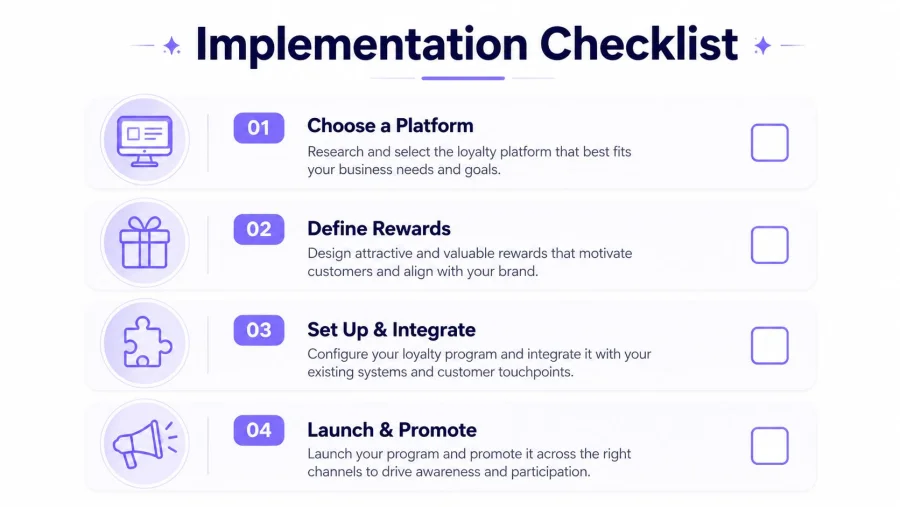
Define one reward rule
Choose the behaviour the business wants more often. A café might start with qualifying visits, a salon with completed appointments, and a retailer with a minimum basket value. The first version should use one earning rule and one reward, because staff and customers need to learn the routine before the business adds nuance.
The reward should feel relevant, not merely inexpensive. A café can offer a clearly defined drink, a salon can offer an add-on that has spare capacity, and a retailer can offer a useful fixed discount on a future purchase. The rule should also protect gross margin and avoid conditions staff must interpret differently.
Set up and train
Create the digital card, generate the joining QR code, configure the reward, and test the complete journey using staff accounts. Test both earning and redemption, including what happens if a customer scans twice or staff need to correct an error.
The business should then choose loyalty card software that matches its capacity, brief every employee, and place a short script beside the till. “Would you like to join our loyalty card? Scan this code and it'll be ready on your phone” is enough. Staff shouldn't deliver a lengthy sales pitch during a queue.
Launch and promote
Place the QR code where customers already pause, such as the till, counter, receipt area, treatment room, or collection point. Add it to the business's social profiles and local promotional materials, but keep the point-of-sale invitation as the main acquisition channel.
For the launch period, staff should mention the programme consistently and record common objections. If customers say the reward is unclear, simplify the wording. If employees forget to scan, improve the physical prompt and rehearse the workflow. A quiet launch with reliable execution beats a large announcement followed by inconsistent service.
Measuring Success and Staying Compliant
A loyalty dashboard can make a programme look active without proving that it changes behaviour. Total sign-ups are useful for understanding reach, but they don't tell the owner whether members return, redeem, or generate enough margin to justify the reward.
Track behaviour, not vanity
The most useful measures connect an action to a business objective:
- Activation: How many new members complete an earning action?
- Repeat visits: Do members return after joining, and does their visit cadence change?
- Redemption: Which rewards are used, and how long do customers take to reach them?
- Inactive members: Which previously active customers have stopped earning?
- Offer response: Do targeted campaigns produce visits or only generate clicks?
- Reward economics: Does the contribution from additional activity cover the value given away?
A small café might focus on repeat morning visits. A salon may compare completed appointment patterns. A retailer could examine whether spend thresholds lead to broader baskets without making the discount larger than necessary.
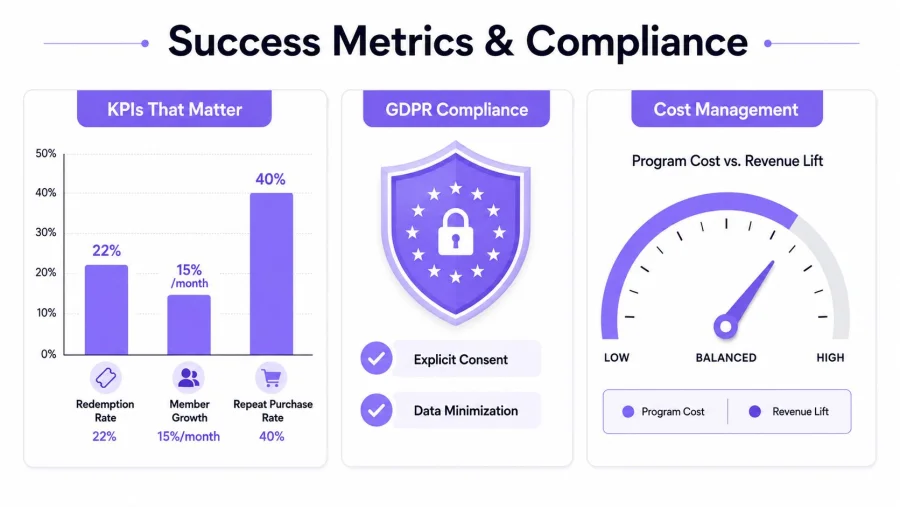
Measure the change in cadence, not the size of the database. A smaller group of active members can be more commercially useful than a large inactive list.
Build privacy into the design
The ICO explains that loyalty cards can reveal where customers shop, how much they spend, and what they buy, making the activity personal-data processing under UK GDPR. A business needs secure storage, a privacy notice, and a lawful basis for processing. (ICO guidance on data gathered by loyalty cards)
Collection should stay proportionate. The programme generally needs enough information to identify the member, operate rewards, and handle support requests, but unnecessary fields increase governance work without automatically improving performance. Any platform provider should have a written data-processing agreement, and the business needs a controlled process for access, correction, deletion, and consent withdrawal.
UK guidance also stresses opt-in, consent-based sign-ups, data minimisation, clear privacy information, and customer rights under the UK GDPR and Data Protection Act 2018. (Privacy checklist for loyalty programme providers)
Keep costs tied to learning
Free tiers can suit a first test, while paid plans may provide stronger analytics, campaigns, branding, or customer limits. White-label and custom builds can make sense when a business has enough operational demand to justify their additional management and development requirements.
The decision should be based on the next useful learning milestone. If a basic stamp programme can establish whether customers use the mechanic, there's little reason to begin with an expensive build. Owners should review platform fees, reward cost, staff time, and campaign expense together rather than judging software price in isolation.
Real-World Examples from Cafés, Salons, and Retail
Different businesses need different habits. A café wants a customer to think of the shop during a familiar daily routine. A salon needs customers to maintain appointments. A retailer may want customers to return for another category or reach a useful basket threshold.
A café that makes progress visible
A neighbourhood café can replace a paper card with a digital stamp card for a clearly defined drink category. The customer scans a counter QR code to join, saves the card to the phone, and presents it at each qualifying purchase. Staff add the stamp after payment, while the customer can see progress without carrying anything.
The important design choice isn't the technology. It's the short path between visits and reward. A customer who sees a nearly completed card has a reason to choose the café again, while the owner can identify members who were active and then stopped. A timely message can remind that group about a relevant offer, rather than discounting every visitor.
A salon that rewards completed appointments
A salon should avoid treating every pound as the same if its main challenge is irregular attendance. A visit-based programme can reward completed appointments, perhaps with a service add-on that supports the salon's capacity and customer experience.
The customer joins after an appointment, receives the digital card, and earns progress when the appointment is completed. Staff need a clear rule for cancellations and no-shows, otherwise the programme will record activity that doesn't support revenue. Birthday or seasonal offers can add warmth, but they should complement the appointment habit rather than replace it with constant discounts.
A retailer that encourages useful baskets
An independent retailer with varied product prices can use spend thresholds to make the next purchase more valuable. The offer should be framed around a future visit and set at a level that encourages an additional item without forcing staff to calculate complicated rewards.
The owner can test whether customers who join later purchase across more categories, whether members return after redeeming, and which thresholds remain understandable. If the data shows customers stop engaging before reaching the reward, the threshold or message needs adjustment. The programme should change in response to observed behaviour, not because a more elaborate structure sounds more advanced.
Why BonusQR Solves the Small Business Loyalty Challenge
BonusQR addresses the main friction points with a QR-based programme that doesn't require POS integration or extra hardware. Customers can use mobile or web access, receive a personal QR code, and keep offers available through Google Wallet or Apple Wallet. Businesses can configure stamps, points, cashback, visit rules, spend thresholds, welcome bonuses, birthday offers, and seasonal campaigns, then review customer and visit activity through built-in analytics.
For a small operator testing the model, the BonusQR web-based loyalty feature supports a low-friction starting point. The practical advantage is the ability to launch a simple habit first, then add campaigns or more specific rules only when customer behaviour justifies them.
Choose one repeat behaviour your business needs more often, configure a reward customers can understand in a sentence, and place a QR code where every customer can see it. Start with a low-friction digital loyalty programme, train staff to mention it naturally, and review active use and redemption each week. Explore BonusQR's free starting option and launch a measurable loyalty test without waiting for a POS project or a complex app build.