
 Deutsch
 Español
 Français
 Italiano
 Magyar
 Polski
 Slovenčina
 Čeština
A regular walks in three times a week, then one wet Tuesday the habit breaks. They pass the café, glance at the queue, and keep going to the place next door because there's no reminder in their pocket, no reward waiting, and no reason to choose the familiar over the convenient. That's the problem digital loyalty solves, not enrolment for its own sake, but keeping a known customer from drifting when attention is already split.
In the UK, that matters more than it sounds. 97% of UK shoppers were members of at least one loyalty scheme in 2024, and they averaged 3 memberships each according to the UK grocery-sector review. People already understand loyalty, but they're not looking for another card to lose. They want something quick, visible, and worth using.
What Digital Loyalty Means for a Local Business
At street level, digital loyalty is a simple swap. A paper punch card sits on the counter and depends on memory, while a digital version sits on a customer's phone, tied to a mobile identifier and a rule that records visits, spend, or another tracked action. That difference sounds technical, but it changes behaviour fast because the customer no longer needs to keep track of a flimsy card or remember what it was for.
A café owner sees this when a regular orders the same flat white every Thursday. With paper, the reward lives in the till drawer and the customer only benefits if they bring the card back. With a digital setup, the customer signs up once, gets a QR code or wallet pass, and the next scan records the visit immediately. The reward stays visible, so the programme doesn't disappear between purchases. For a simple starting point, a digital loyalty card program gives that structure without turning the business into a software project.
Why the format matters
The important shift is from a programme that exists on a counter to one that lives in a customer's phone. That means a business can track sign-ups, redemptions, and repeat visits without relying on staff to recognise faces or sort paper slips. It also means the offer can be tied to a specific action, such as visiting, spending over a threshold, or claiming a birthday reward.
Practical rule: if staff can't explain the reward in one sentence, the loyalty mechanic is too complicated for a local shop.
A salon and a café use the same logic, but the cadence is different. The café might reward frequent visits because repeat footfall is the habit it needs to build. The salon might reward spend over time because visits are less frequent and a higher-value basket matters more than raw traffic. The technology is the same, the behaviour target isn't.
The Core Building Blocks of Any Digital Loyalty Scheme
A workable digital loyalty scheme has four parts, and each one has to be clear before launch. The customer needs to know how they join, what counts as progress, how they earn value, and how they redeem it. If any of those pieces is fuzzy, the programme becomes decoration rather than retention.
Start with identity, then reward
The first block is customer identity. That can be a mobile number, a QR code, or a wallet pass, as long as staff can link the customer to one profile every time they return. Without that link, the business only has anonymous transactions, which makes repeat-visit tracking weak.
The second block is the reward mechanic. A coffee shop usually understands stamps quickly because the value feels concrete. A salon may need a spend-based reward because service tickets vary too much for a simple stamp counter to make sense. The rule has to fit the visit pattern, not the other way round.
Then decide the trigger and the hand-off
The third block is the trigger. That can be a visit, a spend level, a sign-up action, a birthday, or a seasonal offer. A trigger is what starts the reward logic, and it should be obvious enough that staff don't have to interpret it on the spot.
The fourth block is redemption. Many local programmes fall apart at this point. If customers must fill in a form, wait for approval, or ask a manager, the friction kills momentum. A good redemption flow is simple enough that staff can confirm it in seconds and customers can see the benefit immediately.
For operators building supporting content around the programme, it also helps to make the loyalty pass part of the customer journey rather than a standalone object. A practical example of that kind of thinking appears in TopFoodApp's guide to build a QR menu quickly, because the same logic, fast access, low friction, clear scan action, applies to both menus and loyalty.
A minimum viable programme needs one identity method, one reward rule, one trigger, and one redemption step. If any of those is missing, launch is too early.
Comparing Stamps, Points, Cashback, Thresholds and Wallet Passes
The best mechanic depends on how often people visit and how much time staff can spare at the till. A high-frequency coffee shop can run a lighter structure than a low-frequency salon because customers return often enough to feel progress quickly. A small retailer may need a more visible value cue because visits are less routine.
The points rewards program model works well when the business wants flexibility, but it's not the only useful option. Stamps are easier to explain. Cashback feels more tangible. Thresholds are strong when the owner wants to steer spend. Wallet-pass coupons are better when reminders and quick redemption matter more than deep accounting.
| Mechanic | Best fit | Customer effort | Cost to run |
|---|---|---|---|
| Digital stamps | Coffee shops, takeaways, fast repeat visits | Low | Low |
| Points | Mixed retail, cafés, multi-tier programmes | Medium | Medium |
| Cashback | Retailers and service businesses with clear spend values | Low to medium | Medium |
| Thresholds | Salons, gyms, higher-ticket services | Low | Low to medium |
| Wallet-pass coupons | Seasonal offers, birthday gifts, reactivation pushes | Very low | Low |
What works in practice
Stamps win on clarity. A barista can say, “Scan this, and the tenth coffee is free,” without needing a script. That's why stamps usually suit businesses where the same customer returns often and the reward horizon is short.
Points are more flexible but they ask more of the customer. They work when the business wants to mix earn rules, bonus events, and occasional boosts, but they can feel abstract if the points balance is never shown clearly. Cashback is stronger when the value needs to feel real immediately, especially in retail where basket size varies.
Thresholds work best when the operator wants to shape behaviour, not just reward it. A salon can set a spend threshold for a treatment upgrade or a product add-on, which helps increase basket value without shouting for a discount on every visit. Wallet passes are the easiest way to keep a reminder alive on the phone, which is why they often work well as a companion to another mechanic rather than the whole programme.
The most practical mix is often a simple primary rule plus one light secondary reward. A stamp card with a birthday coupon is easier to run than a complicated tier system. A points balance with a welcome bonus can feel richer without adding staff burden. The wrong move is to launch three mechanics at once and hope customers sort it out for themselves.
Why the UK Is Primed for QR-Based Loyalty
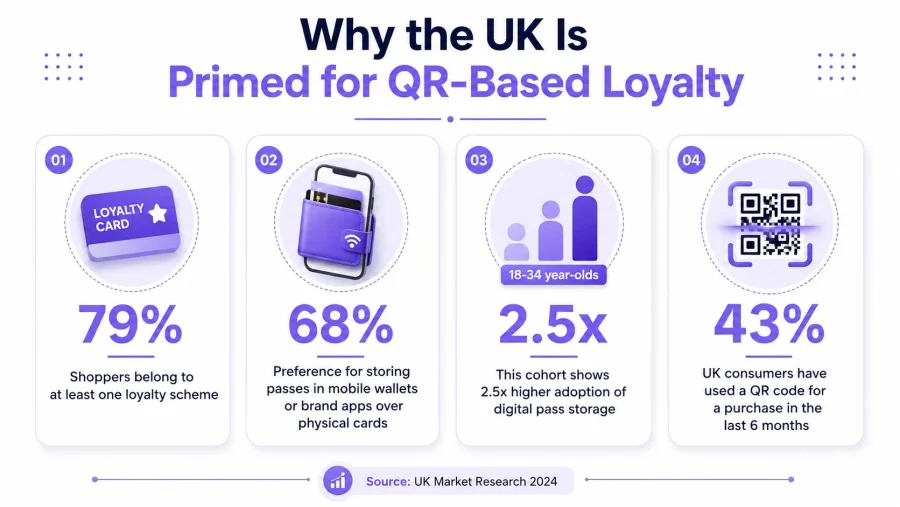
The UK is already saturated with loyalty schemes, which is exactly why simple activation matters more than sign-up volume. 55% of UK consumers belong to at least four schemes, yet 58% have actively used three or fewer in the past six months, according to Mintel's UK customer loyalty retailing report. In practice, that gap means many programmes are known but not used.
Digital storage has become normal
UK shoppers are already comfortable keeping loyalty in digital form. 43% of UK consumers prefer digital loyalty cards over physical ones, and another survey found a near-even split between physical cards, digital wallet cards, and dedicated brand apps LoyaltyPass UK loyalty statistics. QR-based loyalty fits that behaviour. It asks for one scan, not a new routine.
Age still shapes adoption. Mintel's UK customer loyalty retailing report shows younger shoppers are more likely to engage with digital formats than older ones. For a local operator, that changes the launch plan. Put the QR code where younger, mobile-first customers will notice it first, but keep the sign-up flow clear enough that older visitors do not need help from staff.
That is the trade-off in the UK market. Shoppers are programme-fatigued, but they still respond to value, especially when the benefit is easy to access at the counter. A QR-first setup works because it removes the friction around enrolment and puts the effort where it belongs, on making the first reward visible fast. If a customer can join, scan, and see a benefit without downloading a complicated app or repeating their details, the programme is more likely to move from dormant membership to regular use.
Launching Without a POS System
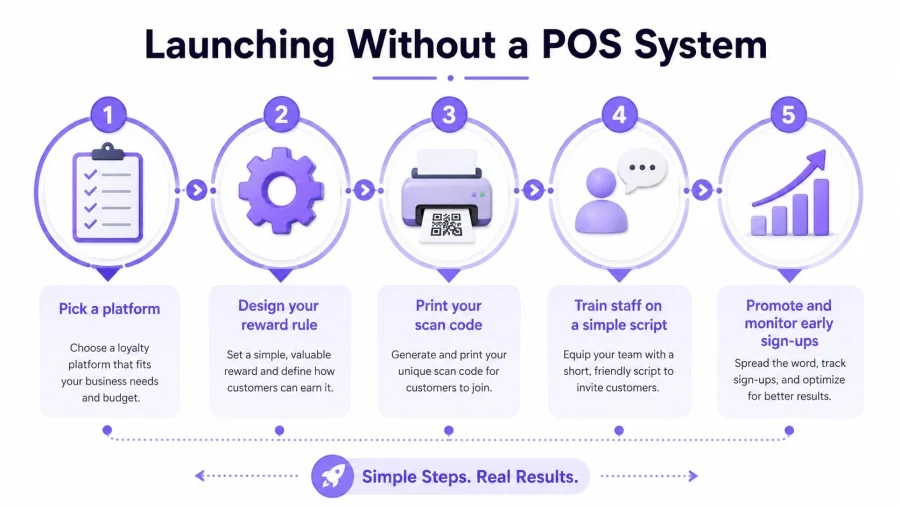
A non-technical owner doesn't need a till overhaul to get started. The simplest launch path is a QR-first setup where staff scan or confirm membership manually, the customer holds the pass on their phone, and the reward rule is handled inside the loyalty platform. That keeps the launch practical for small businesses that want speed instead of a long integration project.
The restaurant mobile loyalty system model fits this approach because it avoids the usual hardware drag. A customer can sign up on a phone, receive a QR code or wallet pass, and use it again without carrying paper. That's the level of simplicity a local shop needs if the team is small and the tills are already busy.
The launch sequence that actually works
First, the owner picks a platform that can issue a pass, track redemptions, and show a customer profile. Customers do nothing yet. The owner's job is to choose a tool that doesn't need a developer on day one.
Second, the reward rule gets written in plain language. Staff should be able to say it without glancing at a sheet. If the rule needs explanation every time, it's too complicated.
Third, the QR code gets printed and placed where people naturally pause, near the till, on the table, or on a counter tent. Bad Wi-Fi and clutter cause drop-off here, so the code has to be visible, large enough to scan, and not buried under other posters.
Fourth, staff get a simple script. The customer scans, signs up, and confirms the pass. The team then checks redemption in the same flow each time so no one improvises under pressure.
Fifth, the owner promotes the first-scan offer and watches early sign-ups. A welcome bonus helps, but only if it's easy to claim and easy to explain. If a customer has to search for the reward, the launch already lost momentum.
Keep the first version boring and reliable. Fancy features matter less than a clean first scan, a clear reward, and a staff team that remembers to mention it.
The common failure points are predictable. Weak Wi-Fi slows sign-up, lost paper cards create doubt, and staff forget to invite people into the programme when the queue gets long. A clean launch avoids all three by making the scan part of the checkout habit, not an extra task.
KPIs That Tell You Whether It Is Working
A loyalty dashboard can fill up with activity and still hide a weak programme. Sign-ups are useful, but they don't prove behaviour has changed. The useful question is whether members come back more often, spend more when they do, and stop sitting in the dormant pile.
The consumer side of this is stronger than many owners expect. A UK consumer research report found that 91% of loyalty programme members say they actively collect and redeem the rewards or points they earn Telegraph consumer-affairs coverage. That means visible value matters. If the reward is hard to see, the programme starts against the grain.
Weekly versus monthly review
Weekly checks should stay narrow. The operator only needs to look at members enrolled, scans made, redemption activity, and any sudden drop in staff participation. Those are the signals that tell whether the front end of the programme is still alive.
Monthly checks should be broader. Repeat visit rate, spend per active member, dormant share, and coupon performance show whether the programme is driving real business outcomes rather than collecting idle profiles. A dashboard that charts top customers and visit trends is useful here because it shows whether the same few people are carrying the programme or whether engagement is spreading.
Practical rule: if a dashboard only celebrates new sign-ups, it's tracking interest, not retention.
For operators who want a useful Monday routine, the review can stay to one page. Check sign-ups, scans, and redemptions first, then compare repeat visits and dormant members against the previous month. If coupon use is flat, the offer is probably too vague or too hard to reach. If scans are healthy but repeat visits aren't moving, the mechanic needs a clearer next step.
For teams that want a practical retention reference outside loyalty, Monopack ltd's guide on ways to retain catering clients is a useful reminder that repeat business comes from consistency, clarity, and timely nudges, not just from rewards. Loyalty data should feed decisions, not sit in a report nobody opens.
Practical Use Cases for Cafés, Salons, Gyms and Retailers
A coffee shop does not need to act like a gym, and a salon should not copy a supermarket scheme. The right programme reflects visit frequency, basket size, and how much explanation staff can realistically give at the counter. That's why the best local programmes stay narrow and specific.
A café usually does well with digital stamps plus a birthday drink. The rule is easy, the redemption is obvious, and the customer can see progress after only a few visits. A salon is better served by a spend-threshold reward on services, because the visit interval is longer and the basket is more variable. The reward should feel earned, not pushed.
A gym often needs a different mix, such as a fixed-discount welcome bonus and a wallet-pass referral incentive. New members need an immediate reason to stay engaged, while referrals work better when the invite is simple and mobile. For a retailer, cashback on slower days can help flatten footfall without turning the whole brand into a discount bin.
A practical route for local businesses is to keep the message lean and visible, then layer one seasonal campaign on top. That same principle shows up in Sendvo's local businesses direct mail solution, where the value comes from hitting the customer with a clear offer at the right time rather than piling on complexity. Loyalty works the same way.
The myth to avoid is that more data automatically means better loyalty. Under UK GDPR, common loyalty details like email, phone number, birthday rewards, purchase history, and redemption tracking are personal data, so the business has to collect proportionately and explain why. A simple, lawful, and well-timed scheme beats a bloated one that scares off sign-ups or creates admin the owner can't keep up with.
Digital loyalty works when it feels like a natural part of buying, not a separate project. Start with one clear reward, one scan flow, and one dashboard owners look at. If the goal is to turn walk-ins into regulars without adding tech headaches, BonusQR is built for QR-based sign-up, scan redemption, wallet passes, and simple reward rules that a small team can run next week.