Digital loyalty and rewards means giving customers a points, stamp, or tier system they access through a phone (usually a mobile wallet pass or a simple app) that rewards repeat visits and spending. For most small businesses, the right next step is not a big platform decision. It’s picking one simple mechanic (a digital stamp card is the easiest starting point) and one channel (Apple Wallet or Google Wallet passes remove the need for customers to download anything new).
Retention drives this decision more than acquisition ever will. Repeat customers can cost significantly less to serve than new ones, and a well-run programme lifts customer lifetime value (CLV) and repeat purchase rate within months, not years.
Start small. A digital stamp card with one clear reward beats a five-tier points system nobody understands. Launch, measure, then expand.
- Pick one mechanic: stamp card, points, or a single tier.
- Choose one channel: mobile wallet pass or a simple web-based pass.
- Set one goal: retention, visit frequency, or average order value.
- Consider a platform like BonusQR to get a working version live within days rather than months.
Key Takeaways
Digital loyalty programmes succeed when SMBs launch one simple mechanic on a wallet pass, measure repeat purchase rate and redemption rate, and iterate based on real customer behaviour rather than assumptions.
| Point | Details |
|---|---|
| Start with an MVP | Launch one mechanic (stamp card recommended) on a mobile wallet pass before adding complexity. |
| Retention beats acquisition | Keeping existing customers can cost substantially less than acquiring new ones. |
| Track five core KPIs | Monitor sign-up rate, active member rate, repeat purchase rate, redemption rate, and CLV. |
| Avoid overcomplication | Simple rules, connected data, and honest reward promises prevent early programme failure. |
| Use BonusQR to launch fast | BonusQR supports stamp cards, points, wallet passes, and analytics without requiring POS integration. |
Why digital loyalty and rewards pay off for small businesses
The maths favours you before you send a single reward. Acquiring a new customer typically costs far more than keeping an existing one, and that gap alone justifies most of the setup effort a loyalty programme requires.
The bigger driver, though, is what happens once someone’s in the programme. A bibliometric analysis of 300 studies published between 2021 and 2024 found personalisation and technology like AI and big data to be central drivers of both retention and repurchase intent. Retailers and restaurants use loyalty mechanics specifically to turn occasional buyers into regulars, and the pattern holds for service businesses too.
Within three to six months of a focused launch, expect:
- A measurable lift in repeat purchase rate among enrolled members.
- Higher average order value from members chasing a threshold reward.
- Better customer data quality, since sign-up captures contact details you didn’t have before.
- Early signal on which rewards actually motivate your customers versus which ones sit unused.
Statistic to remember: retention economics alone (the up to fivefold cost gap between keeping and acquiring customers) often justifies the entire cost of a basic programme in its first year.
What types of loyalty programmes work best for an MVP?
Six mechanics dominate the market, and you don’t need to evaluate all of them. You need to pick the one that matches your business rhythm.
Stamp or punch cards reward visit count rather than spend. They suit cafés, salons, and quick-service restaurants where the goal is simply “come back.” Points systems reward spend directly, which fits retail and higher-ticket service businesses better than pure visit counting. Tiers add status on top of points, appropriate once you have enough repeat traffic to make “gold” or “platinum” feel earned rather than arbitrary. Paid memberships work when you can offer genuine ongoing value, not just a discount wrapper. Referral-led programmes turn existing members into an acquisition channel. Exclusivity and experience rewards (early access, member-only previews) often beat discounts outright. Many members value exclusive access more than straightforward price cuts, and exclusivity costs you less margin than a percentage-off coupon.
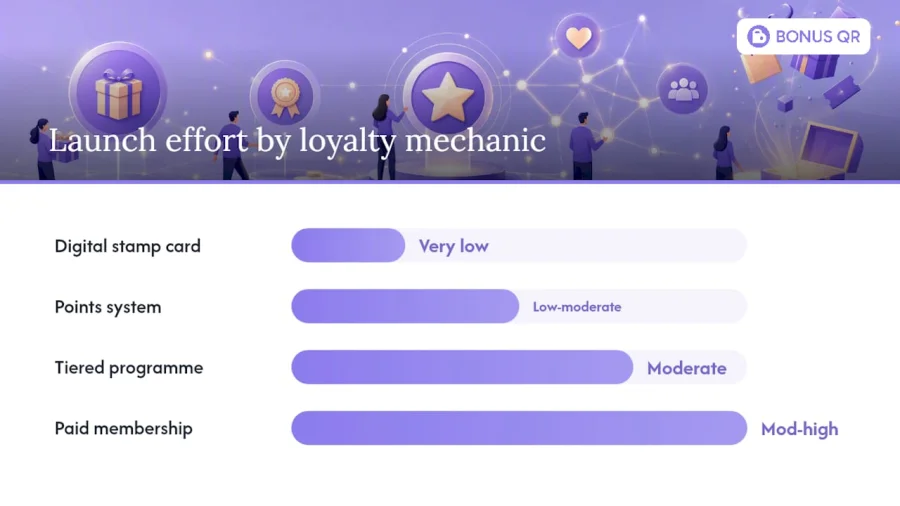
| Mechanic | Launch effort | Typical cost profile | Best-fit use case |
|---|---|---|---|
| Digital stamp card | Very low | Low, reward-only cost | Cafés, salons, quick visits |
| Points system | Low to moderate | Scales with redemption rate | Retail, higher-ticket services |
| Tiered programme | Moderate | Higher, needs segmentation | Established repeat customer base |
| Paid membership | Moderate to high | Requires ongoing value delivery | Businesses with recurring services |
For a first release, a digital stamp card on a mobile wallet pass wins on nearly every axis: fastest to launch, lowest cost, and easiest for customers to understand without instructions.
How do you plan and launch a digital loyalty programme?
Treat your first version as a pilot, not a finished product. Industry guidance is consistent on this point: programmes chasing too many goals at once tend to underperform, while those built around one clear objective get measurable results faster.
- Set one measurable goal. Retention, visit frequency, or average order value, not all three at once.
- Design the mechanic. Decide earning rules (per visit or per dollar), redemption rules (what the reward is and when it unlocks), and what data you’ll collect at sign-up.
- Map the UX flow. Sign-up, first stamp or point, redemption. Three steps, no more, for version one.
- Choose a pilot cohort. One location, one shift, or one customer segment. Run it for four to six weeks.
- Collect basic KPIs and feedback. Sign-up rate, return visits during the pilot window, and informal staff and customer feedback.
- Prepare launch assets. Card or pass design, QR code or shareable link, a one-line staff script, and an automated welcome message.
Before wider rollout, confirm you have:
- A tested QR code or pass link that works on both iOS and Android.
- Staff who can explain the programme in one sentence.
- A welcome message that triggers automatically on sign-up.
- A clear internal owner for questions and fixes during week one.
Pro Tip: Run your pilot in the location with your friendliest, most engaged staff first. Their enthusiasm becomes your programme’s word-of-mouth, and their feedback will surface UX problems faster than any survey.
Resist the urge to add tiers, referrals, and gamification before you’ve proven the basic loop works. Simplicity and clear rules are consistently linked to stronger retention than feature-heavy launches.
What should your loyalty technology actually support?
You don’t need a point-of-sale overhaul to run a credible programme. Many modern platforms operate as standalone tools, where staff manually trigger a stamp or scan a QR code rather than integrating with existing checkout hardware.
Core capabilities worth confirming before you commit to a platform:
- Stamp, points, and tier logic that you can configure without a developer.
- Apple Wallet and Google Wallet pass support, so customers don’t download a new app.
- QR code redemption and manual counter updates for businesses without POS integration.
- Real-time balance updates visible to both staff and customers.
- Push notification and email automation for welcome messages and nudges.
| Capability | Why it matters | SMB acceptance level |
|---|---|---|
| Wallet pass support | Removes app-download friction entirely | Very high |
| QR/manual redemption | Works without POS integration | High |
| Real-time analytics | Shows what’s working before you scale | High |
| CRM/e-commerce integration | Unifies customer view across channels | Moderate |
Roughly 80% of marketers already use platforms built around data unification and personalisation, which makes real-time analytics a baseline expectation rather than a premium add-on.
How do you keep members engaged beyond the sign-up?
Enrolment is the easy part. Keeping members active requires automation that responds to behaviour, not just the calendar. Behaviour-triggered messaging, such as a welcome series, a nudge when someone’s one visit from a reward, or a re-engagement message after 60 days of silence, consistently outperforms generic blanket promotions.
Discounts aren’t your only lever, and often aren’t your best one:
- Early access to new products or seasonal menus.
- Member-only events or previews.
- Recognition, such as a “top customer” shoutout or milestone badge.
- Progress streaks and limited-time double-point windows.
Gamification mechanics borrowed from other industries work well here. Interactive apps use progress bars and challenge-based rewards to keep users returning, and the same logic applies to a loyalty pass showing “2 more visits to your reward.”
Pro Tip: Send your near-threshold nudge (“one more visit for your free coffee”) within 48 hours of the customer’s last visit. Timing beats content here. A perfectly worded message sent two weeks late gets ignored.
Which KPIs actually tell you if it’s working?
Track five numbers and you’ll know within weeks whether to scale or rework the programme: participation rate (sign-ups as a share of total customers), active member rate (members who’ve engaged in the last 30 days), repeat purchase rate, redemption rate, and CLV.
Two quick calculations matter most. Repeat purchase lift compares purchase frequency for enrolled members against non-members over the same period. Redemption rate divides rewards claimed by rewards earned. This tells you if your reward threshold is realistic or set too high to feel achievable.
| KPI | Pilot phase target | Post-launch benchmark |
|---|---|---|
| Sign-up rate | Track only, no target | a notable share of transactions |
| Active member rate | Track only, no target | Rising month over month |
| Redemption rate | Should be positive | Steady, not declining |
This mirrors the operating discipline behind most successful programmes: listen, analyse, act, close the loop, and measure, repeated as a cycle rather than a one-off launch event.
What mistakes derail digital loyalty programmes?
Overcomplication kills more programmes than weak rewards do. Disconnected data turns loyalty into an isolated gimmick instead of a relationship tool, and slow reward fulfilment breaks trust fast.
- Too many tiers or rules before you’ve proven the basic loop works.
- Rewards too small or too hard to reach to feel worth the effort.
- No clear opt-out or plain-language explanation of data use.
Promise only what you can deliver, keep rules simple enough to explain in one sentence, and give members a real way to opt out. Trust, once broken by a programme, rarely comes back.
Why BonusQR fits the SMB launch plan
Everything covered so far, the stamp-card MVP, wallet pass support, no POS overhaul, real-time analytics, maps directly onto BonusQR’s feature set, which supports stamp cards, points, cashback, coupon distribution, and Apple and Google Wallet passes from a single dashboard.
The practical fit matters as much as the feature list. Setup is fast enough to go live within days, pricing runs on a freemium base with paid tiers as you grow, and white-label or custom app development options exist for businesses ready to scale beyond the MVP stage.
Pick the stamp card template, design your pass, generate a QR code, and switch on one welcome automation. That’s a working loyalty programme in an afternoon, not a quarter.
To start, choose the stamp card programme, configure your earning rule, and publish your first wallet pass before you overthink the rest.
What surprises most owners when they launch loyalty programmes?
Owners consistently underestimate how much staff buy-in matters. A perfectly designed reward structure fails if the person at the counter can’t explain it in one sentence.
Pro Tip: Script the staff pitch before launch, not after. “Scan this, get a stamp, tenth coffee’s free” beats a five-minute explanation every time.
Don’t wait for a perfect programme. Launch the simple version, measure what happens, and adjust.
Bonusqr: your fastest route from plan to live programme
Bonusqr is the practical shortcut for everything this guide has walked through. You get stamp cards, points, tiered cashback, and Apple and Google Wallet support without needing a POS overhaul or a development team, and you can launch a working pilot in days rather than negotiating a lengthy build.
That speed matters most for SMBs weighing in-house development against ready-made software: building your own system means months of engineering time before your first customer ever earns a reward. Bonusqr skips that entirely, with real-time analytics built in so you can track redemption and participation from day one, plus white-label options if you outgrow the free tier.
Set up your electronic reward programme today and have your first wallet pass ready for customers this week.
Frequently asked questions
What is digital loyalty and rewards in simple terms? It’s a system, usually accessed through a mobile wallet pass or app, that tracks customer visits or spend and automatically issues rewards like free items, discounts, or exclusive perks.
How much does a digital loyalty programme cost to start? Many platforms, including BonusQR, offer a freemium tier suitable for a first pilot, with paid subscription tiers as your member base and feature needs grow.
Do I need POS integration to run a loyalty programme? No. Many SMBs run effective programmes using QR code scans and manual staff updates, with no requirement to integrate or overhaul existing checkout hardware.
Which loyalty mechanic should I launch first? A digital stamp card on a mobile wallet pass is usually the fastest and lowest-cost option, since it needs no app download and customers understand it instantly.
How long should a loyalty pilot run before full launch? Four to six weeks is typically enough to see early sign-up trends, first redemptions, and staff or customer feedback worth acting on.
Sources
For deeper evidence and practical next steps beyond this guide:
- Customer loyalty and retention bibliometric analysis (MDPI)
- Loyalty programme best practices: what improves retention in 2026 (Customer Experience Magazine)
- Digital customer loyalty ideas for small businesses (RingCentral Blog)
- How to build customer loyalty: practical CX guide (Sogolytics)
- Guide to loyalty programmes for small businesses (Forbes)


