
 Deutsch
 Español
 Français
 Italiano
 Magyar
 Polski
 Slovenčina
 Čeština
Most advice on customer loyalty engagement starts with brand love. That's the wrong starting point for a local café, salon, gym, or shop. Customers usually aren't choosing between grand emotional relationships. They're choosing the place that's nearby, convenient, familiar, and easy to use again.
A loyalty programme should therefore do more than collect names or issue discounts. It should turn ordinary visits into a visible habit, make the next visit easier to justify, and show the owner whether customers are returning. A paper card can't do that. A complicated app won't do it either.
Rethinking Customer Loyalty Engagement for Physical Stores
Local businesses often waste time trying to manufacture an emotional connection that customers don't need before they return. A coffee shop earns repeat visits because the location works, the queue moves quickly, the order is reliable, and the customer knows what to expect. A salon earns them through convenience, recognition, and a smooth booking experience. A gym benefits when attendance becomes part of someone's routine.
That doesn't make branding irrelevant. It means brand preference is often built through repeated practical experiences, not created by a campaign about shared values. Recent UK-focused commentary notes that 47% of consumers say they're loyal to stores, not brands, while only 6% feel loyal to brands online, suggesting that convenience and location can matter more than emotional attachment in everyday shopping (UK loyalty commentary).
Store habit is the real battleground
A local owner should ask a more useful question than “How can the business create brand love?”
The better question is: What will make a customer return to this specific location instead of choosing the next convenient option?
That answer usually includes:
- A clear reason to return: The customer knows what benefit follows another visit.
- Minimal effort: Joining, earning, and redeeming don't require a lengthy form or a separate physical card.
- Visible progress: The customer can see how close they are to a reward.
- Relevant prompts: Offers appear when they're useful, not as a constant stream of generic promotions.
- Operational consistency: Staff understand the process and can complete it without slowing service.
A programme that rewards a purchase but doesn't encourage another visit is just a discount mechanism. Effective customer loyalty engagement connects the reward to a repeatable behaviour, such as visiting during a quiet period, trying a profitable product, or returning within a sensible time.
Practical rule: For a physical business, convenience is part of the reward.
Stop measuring affection and measure behaviour
The UK market already has broad loyalty participation. YouGov reports that 9 in 10 Brits belong to one or more loyalty schemes, with the average shopper belonging to 4.7 schemes (YouGov's UK loyalty-schemes report). That doesn't mean every scheme receives regular attention. It means customers are comfortable joining programmes, while the business still has to earn active usage.
For a small operator, the priority isn't building a grand membership club. It's identifying whether enrolled customers visit again, redeem rewards, respond to offers, and spend enough to justify the cost of engagement.
Owners who want a simple overview of digital programme options can also launch a loyalty program with taap.bio, particularly when comparing low-friction alternatives to traditional cards.
Moving Beyond the Paper Punch Card
The paper punch card looks inexpensive because its visible cost is low. Its hidden costs are harder to see. Cards get lost, stamps fade, customers forget them, and staff have no reliable record of who visits most often. When a customer reaches the final punch, the business may not even know whether that person returned because of the programme or happened to complete the card.
A QR-based profile changes the mechanics. The customer scans a code, opens a mobile or web experience, and can see the reward balance without carrying another object. The business can record visits or spending, present the next reward clearly, and connect loyalty with useful information such as a menu, price list, news, reviews, or reservations.
The gap between joining and using
Membership alone is a weak success metric. A UK loyalty report found that 55% of consumers belong to at least four schemes, while 58% actively used three or fewer during the past six months, showing the distance between sign-up and active usage (UK loyalty usage report).
That gap matters even more for small businesses. A customer may join at the till because the offer sounds attractive, then forget the programme before the next visit. A digital profile helps, but technology alone won't fix an unclear or unrewarding structure. The business still needs a reward that feels attainable and a reminder that arrives at a useful moment.
A practical digital system should remove friction at each stage:
- Joining: The customer scans one code rather than downloading a specialist app immediately or completing a long registration.
- Earning: Staff apply a stamp, points balance, cashback amount, or visit record through a simple scan.
- Checking: The customer sees progress on a phone instead of asking staff to inspect a card.
- Redeeming: Staff scan and confirm the reward without introducing new hardware.
- Returning: Wallet passes, push notifications, or email reminders keep the programme visible.
Businesses comparing paper cards with a digital alternative can review this guide on fixing a broken punch card loyalty programme without breaking the bank.
Digital doesn't mean complicated
The strongest implementation is often the least ambitious one. A café might begin with a visit-based reward and a welcome offer. A salon might record appointments and provide a coupon for a future service. A gym could use attendance milestones rather than points for every type of interaction.
Digital profiles also give the owner a useful place to communicate beyond rewards. A customer can access opening times, menus, booking details, or current news from the same mobile experience. That makes loyalty part of the visit rather than a separate marketing task.
The trade-off is that digital programmes require staff training and customer explanation. A QR code hidden behind the till won't create engagement. It should appear at the ordering point, on receipts or tables where appropriate, and in the confirmation message after sign-up. The process must be obvious enough that staff can explain it in one sentence.
Designing Reward Structures That Actually Drive Visits
A reward should match the customer's buying rhythm. A coffee shop can use a simple visit mechanic because customers may return frequently. A beauty salon shouldn't copy that structure if visits are naturally less frequent and each transaction carries more value.
Market research indicates that UK consumers increasingly prefer immediate financial rewards through cashback over traditional points, particularly under cost-of-living pressure (UK loyalty market research). That preference doesn't make points or stamps obsolete. It means delayed value needs a clear reason to remain attractive.
Choose the mechanic before choosing the prize
Digital stamps work well when the behaviour is frequent and easy to count. The customer understands the exchange immediately, and staff don't need to calculate a complicated balance.
Points suit businesses with varied products, different price levels, or several reward choices. They give the owner more flexibility, but unclear conversion rules can make the programme feel remote or difficult to understand.
Cashback provides immediate, concrete value. It can be persuasive where customers are price-conscious, although the business needs firm rules so cashback doesn't reduce margin on every transaction without encouraging additional visits.
Threshold rewards connect the benefit to a defined action, such as spending above a level, visiting during a quieter period, or combining selected products. They're useful when the business wants to influence basket size or visit timing.
| Venue type | Best primary mechanic | Why it works |
|---|---|---|
| Café or quick-service restaurant | Digital stamps with a modest welcome reward | The customer can understand the benefit during a frequent purchase cycle. |
| Full-service restaurant | Points or spend thresholds | The structure can recognise different order values and encourage a return occasion. |
| Beauty salon | Visit milestones or service-specific coupons | The reward can support the next appointment without forcing an artificial weekly rhythm. |
| Gym or fitness studio | Attendance milestones with personalised offers | Progress can reinforce the routine while targeted offers support underused services. |
| Retail or grocery shop | Cashback, points, or category-linked coupons | Customers can receive relevant value across varied products and spending patterns. |
Make the reward financially defensible
The reward cost should be judged against the behaviour it creates, not against the transaction that earns it. A discount given to a customer who would have returned anyway may just reduce revenue. A targeted incentive that fills a quiet period or brings back an inactive customer can serve a stronger commercial purpose.
Owners should define the desired behaviour first:
- Increase frequency: Reward another visit within the normal buying cycle.
- Lift average spend: Use a threshold that encourages a larger basket without feeling punitive.
- Fill quiet periods: Attach an offer to selected days or times.
- Promote a service: Use a coupon that introduces a profitable or underused option.
- Recover lapsed customers: Send a time-limited, relevant incentive after inactivity.
A useful guide to the underlying structure is this resource on creating a rewards programme that boosts loyalty. The central principle is simple: the programme should reward a behaviour the business wants more often, not merely hand back money for behaviour that already happens.
Activating Rewards Through Personalised Communication
A customer can't act on a reward they've forgotten. A café customer may join on a Monday, earn progress on Wednesday, and fail to remember the programme by the following week. A salon client may value a birthday coupon but never see it if the offer remains buried in an old email.
The practical answer is communication tied to customer behaviour. A customer who has just joined should receive a clear welcome message. Someone who has made progress should see the next milestone. Someone who hasn't returned for a meaningful period should receive a relevant win-back prompt, not the same generic discount sent to everyone.
A customer journey with fewer forgotten moments
Consider a neighbourhood café. A new customer scans the QR code and receives a welcome bonus. After the next visit, the message confirms the updated balance and reminds the customer what remains before the next benefit. When the customer's usual pattern changes, the café can send a quiet-period offer rather than waiting for the customer to disappear completely.
That sequence doesn't require a large campaign team. It requires useful triggers and restrained messaging:
- Welcome message: Explain how earning works and show the first available benefit.
- Progress reminder: Confirm the balance after a visit so progress feels tangible.
- Birthday coupon: Offer a personal reason to return during the relevant period.
- Seasonal offer: Promote a product or service that fits the time of year.
- Win-back message: Contact inactive customers with a clear, limited action.
- Feedback request: Ask for a review or comment after a positive interaction.
Emarsys reported that 73% of UK consumers considered themselves loyal to certain retailers, brands, and stores in 2022, while its UK research stressed the importance of personalised experiences and relevant recognition over generic discounts (Emarsys UK customer loyalty research). Personalisation doesn't require an elaborate profile. It can begin with the customer's visit history, preferred service, reward status, or the timing of the last interaction.
Put the offer where the customer already looks
Mobile wallet passes can reduce the distance between the reward and the next visit. Google Wallet and Apple Wallet can keep a loyalty pass available on the customer's phone, rather than requiring a search through old messages or a remembered login.
That convenience still needs restraint. Too many notifications train customers to ignore the channel. Each message should answer one practical question: Why should this customer visit now?
The answer might be a reward that's ready, a service the customer has used before, or an offer suited to a quiet period. It shouldn't be a random promotion with no connection to the customer's behaviour.
A local business should also give customers a straightforward way to manage communications and explain why data is being used. Trust supports long-term engagement more effectively than a high volume of untargeted messages.
Measuring What Matters for Brick-and-Mortar Retention
Total sign-ups are easy to display and easy to misunderstand. They show that an offer attracted attention, but they don't show whether customers returned, redeemed rewards, or generated enough value to cover the programme's cost.
Physical businesses need a smaller set of measures tied to actual trading outcomes. The most useful dashboard connects customer identity with visits, spending, redemption, and reactivation. It should help an owner decide which mechanic to keep, which offer to stop, and which customer group needs attention.
Build a behaviour-led scorecard
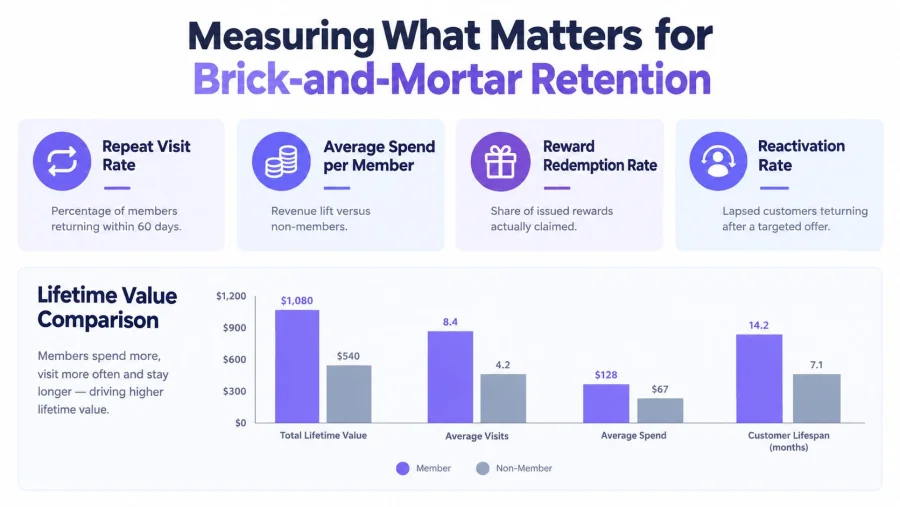
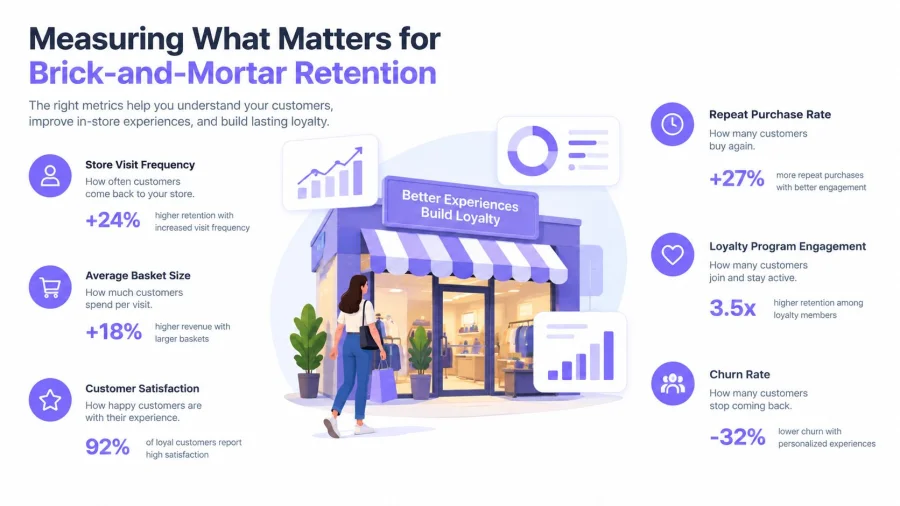
Repeat visit rate shows whether enrolled customers return within the business's normal buying cycle. A café and a salon shouldn't use the same time window, because their natural visit patterns differ.
Redemption rate indicates whether rewards are understandable and desirable. A low rate may mean the reward is too distant, poorly communicated, or irrelevant. A very high rate may signal that the offer is too generous or that customers would have bought without it.
Visit frequency reveals whether engagement changes behaviour over time. Owners should compare customer groups consistently rather than celebrating a single busy promotion.
Average spend per member helps identify whether members purchase more, choose different products, or receive discounts on existing purchases. This measure needs to be read alongside margin and redemption cost.
Reactivation rate tracks whether an inactive customer returns after a targeted message. It gives win-back campaigns a commercial purpose instead of treating open rates as the final outcome.
Top-customer retention protects the relationships that matter most to the business. A programme should identify valuable regulars and help staff recognise their needs without making every interaction feel automated.
Measure the visit created, not the message sent.
Connect first-party data with financial decisions
A digital loyalty profile can help a business see which customers visit, what they redeem, and how different offers perform. That first-party information is valuable because it comes from the business's own interactions rather than an anonymous audience estimate.
Antavo's 2026 UK Loyalty Statistics report says 91% of UK programme owners actively track loyalty ROI, and those that do report an average 5.4x ROI. The same report says 74% cite customer data as a key satisfaction driver (Antavo's UK loyalty statistics). Those figures reinforce a practical lesson: measurement and useful customer data should be designed into the programme from the beginning.
Owners who need a clearer financial framework can use this guide to calculate customer lifetime value. The calculation doesn't need to become an accounting project. It should help answer whether a retained customer's future contribution justifies the reward, communication cost, and staff time.
A simple engagement dashboard can include:
- Active members: Customers who have earned or redeemed within the chosen reporting period.
- Repeat visits: Returning customers compared with their earlier visit behaviour.
- Reward cost: The value of redeemed benefits, separated by campaign.
- Revenue contribution: Member spending reviewed with discounts and margin in mind.
- Reactivation: Customers returning after an inactivity-triggered message.
A practical guide to these measures is available in this customer engagement measurement guide for small businesses. The owner doesn't need dozens of metrics. The owner needs enough evidence to improve the next promotion.
Launching a Frictionless Programme with BonusQR
Small businesses often delay digital loyalty because they assume it requires new terminals, a full point-of-sale integration, or a lengthy technical project. That assumption turns a manageable retention tool into an imagined infrastructure programme.
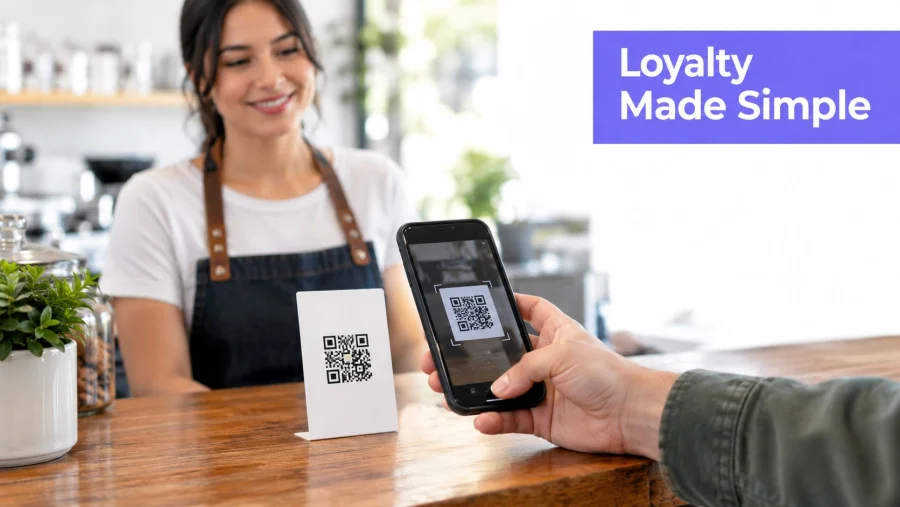
A frictionless launch starts with the existing operation. The business chooses one reward mechanic, places a QR code where customers naturally notice it, trains staff to scan and redeem, and checks the first customer journeys for confusion. The programme can become more advanced after the basic behaviour works.
A workable launch sequence
- Choose one commercial objective. Decide whether the first programme should increase visits, support quiet periods, lift spend, or reactivate customers.
- Select the simplest matching mechanic. Use stamps for frequent purchases, a threshold for basket growth, or a coupon for a defined return action.
- Write the customer explanation. Staff should be able to explain joining and earning in a short sentence.
- Place the QR code in the service flow. Counter signage, tables, receipts, booking confirmations, and packaging can all support discovery where appropriate.
- Test redemption before promotion. Staff should know how to confirm a reward without interrupting the queue or disputing the balance.
- Review the first results. Track active usage, repeat visits, redemptions, and customer questions before adding more rules.
BonusQR provides a QR-based digital profile where businesses can configure stamps, points, cashback, visit or spend thresholds, fixed discounts, welcome bonuses, birthday coupons, and seasonal offers. Customers can join through mobile or web, while staff scan and redeem without extra hardware or a required POS integration. The platform also supports Apple Wallet and Google Wallet passes, automated push or email campaigns, ready-to-print materials, analytics, and GDPR-safe data handling.
That capability doesn't remove the need for judgement. An owner still has to choose a sustainable reward, explain the value clearly, and check whether the programme changes behaviour. The advantage of a low-friction setup is that testing becomes practical. A café can begin with one campaign, a salon can connect rewards to appointments, and a retailer can compare cashback with a threshold without rebuilding the till system.
The most cost-effective programme is rarely the one with the most features. It's the one staff can operate consistently and customers can understand immediately.
A paper card may record a transaction, but it won't show whether the customer is becoming a regular. Owners of cafés, restaurants, salons, gyms, and local shops can start with one measurable objective, one clear reward, and one frictionless digital journey. Visit BonusQR to assess the available loyalty tools, set up a QR-based programme, and turn the next customer visit into a trackable opportunity for retention.