The usual advice about customer feedback software starts with an NPS survey and a dashboard. For a busy local business, that's often the wrong starting point. A polished chart can't explain why a regular stopped coming if that customer never answered the question.
A better starting point is the quiet exit. Make feedback a quick step inside a loyalty visit, give someone responsibility for the reply, and judge the system by what happens afterwards.
Most Customers Never Tell You What Went Wrong
A regular finishes a coffee that took too long, puts the cup down and leaves without mentioning the wait. The barista sees an empty table, not an unhappy customer. The owner may hear about it only when a public review appears.
In the Consumer Council's consumer problems report, 50% of people experienced a consumer problem in the previous twelve months, but only about 22% submitted a complaint; among those who didn't complain or were unsure, 47% considered it too much hassle, 39% thought it pointless, and 23% didn't know whom to contact.
Silence isn't a satisfaction score
For cafés, salons, gyms and shops, customer feedback software should first remove barriers to speaking up. A long questionnaire won't help someone who already considers complaining a chore.
The practical design has to address three obstacles:
- Effort: Let the customer select an issue without writing an account of the visit.
- Doubt: Show who will respond and when, then deliver on that promise.
- Uncertainty: Put the feedback route beside the reward, receipt or appointment details.
Optional anonymity matters too. Some customers want the owner to know about a problem without starting a personal conversation. Their comments still deserve attention, even when individual follow-up isn't possible.
Practical rule: No response means no information. It doesn't mean the visit went well.
Owners learning how to measure customer satisfaction should separate silent customers from satisfied ones. For public complaints, TheBestReputation's guidance on how to turn negative feedback into trust offers useful context for responding constructively.
The useful system is straightforward: an accessible question, a small operating scoreboard, sensible buying criteria and a loyalty record that works without a new till.
What Customer Feedback Software Does on the Shop Floor
Customer feedback software asks for a reaction at a known moment, stores the reply against a person or visit where possible, and routes the next action, such as a service fix, review request or return offer.
That last part separates a useful workflow from an electronic suggestions box. A stored comment needs an owner and a next step. Otherwise, staff have moved the unread paper pile onto a screen.
Four ways a shop collects feedback
| Method | When you ask | Who usually replies | What you learn | Follow-up |
|---|---|---|---|---|
| Paper comment card | During or after the visit, if the card is still in the bag | Whoever bothers to write | A comment with no name or visit attached | Rarely, unless they left a phone number |
| Email survey the next day | Hours after they have left | People who still open mail and remember the visit | A score, often from the most pleased or most annoyed | Possible if an address and appropriate consent were stored |
| Public review site only | Whenever the customer feels like posting | A minority, skewed to strong feelings | A public rating strangers will read | Public reply, no private visit record |
| QR at the till linked to a loyalty profile | At payment, redemption or the end of the appointment | Customers already holding their phone for the reward | A score or issue tied to that visit and that member | Private fix, review request or a return offer on the same profile |
A paper comment card has a place when customers prefer an offline route. But unless it captures useful context, the owner can't distinguish a passing visitor's complaint from a regular's warning that they won't return. Someone must also collect, read and record the cards.
A next-day email survey offers room for detail. It's better suited to a considered appointment than a hurried takeaway, but it requires a usable address and an appropriate basis for contact. The customer must also reconstruct a visit that's no longer in front of them.
A public review helps prospective customers make decisions. On its own, though, it doesn't provide a private conversation or a reliable connection to the service record. Staff may struggle to identify which booking, shift or purchase produced the complaint.
A loyalty-linked QR prompt places the question where the customer is already checking a reward. The reply can remain attached to that visit, so authorised staff don't have to ask the customer to explain everything again.
The minimum useful workflow
The form should contain a short question or selectable issue, an optional comment and a visible response promise. The resulting record should sit beside stamps, points or visit history, with a clear status showing whether someone has acted.
A practical handover needs:
- A named owner: The duty manager handles service issues rather than assuming someone else will.
- Enough context: Staff can identify the relevant appointment, redemption or visit.
- A recorded outcome: The customer's reply, staff action and follow-up remain connected.
NPS, CSAT, CES and a simple Likert scale are optional question formats. They measure recommendation, satisfaction, effort or agreement, but none replaces the work of resolving a problem.
For this job, the last table row is the strongest starting point unless identifying the customer isn't possible. An anonymous route can remain available alongside it.
The Five Numbers That Show Feedback Is Working
A high average score can hide a weak listening process. If only enthusiastic members answer, the dashboard describes the business's fans, not everyone who visits.
UK customer-experience consultancy insight6 reports a 23% response rate across clients using its real-time feedback tool. That's a broad client figure, not a target that every café or salon should adopt.
Feedback numbers worth checking each week
| Number | How to read it | Trap | First move |
|---|---|---|---|
| Response rate | Completions divided by invitations | Treating one company-wide percentage as normal for every shop | Split by channel, timing and survey length |
| Completion versus invitation | Finishes among people actually asked | A flood of asks with almost no finishes | Shorten the form before adding reminders |
| Issue-reporting rate | Visits or members who flag a problem | Assuming more issues always means worse service | Check whether asking just got easier |
| Resolution time | Hours until a fix or a personal reply | One busy site hidden inside a chain average | Report by location and service type |
| Return after a fix | Later visits among people whose issue was resolved | Counting a coupon scan as proof the problem is gone | Compare with similar customers who weren't followed up |
Response rate needs a consistent denominator. A QR poster's presence doesn't prove everyone saw an invitation. Staff-delivered invitations, opened prompts and completed forms should remain distinguishable rather than being mixed into a flattering percentage.
Completion needs closer inspection too. An abandoned form suggests friction, while invalid or duplicate replies can inflate apparent participation. Owners should compare channels, trading periods and customer groups before celebrating a rise.
Issue-reporting rate can increase for a good reason. Adding a discreet route may reveal complaints that customers previously kept to themselves. The owner should examine the actual issues before concluding that service has deteriorated.
Measure the recovery, not just the reply
Resolution time should distinguish a personal acknowledgement from a completed fix. A message saying that the manager is checking a booking is useful, but it isn't the same as correcting it. Both stages should remain visible.
The final measure concerns behaviour after resolution. Did the customer return, and could they see an outcome, such as a corrected appointment or a service update? Owners can track loyalty program performance alongside that follow-up rather than treating feedback as a separate report.
A redeemed coupon proves that someone redeemed a coupon. It doesn't prove that the service problem disappeared.
Small samples need restraint. Before changing a menu, stylist rota or class timetable, managers should check that the pattern persists across comparable visits. Where practical, comparing similar customers with and without follow-up helps separate an intervention's effect from normal behaviour.
The weekly habit is simple: read unresolved issues first, inspect scores second, and fix poor completion before sending more reminders.
What to Buy and What to Leave Out
The purchase should begin with a pass-fail test, not a tour of colourful dashboards. The right tool should support the way staff already work at the counter, without creating another job that nobody has time to maintain.
Must-haves before extras
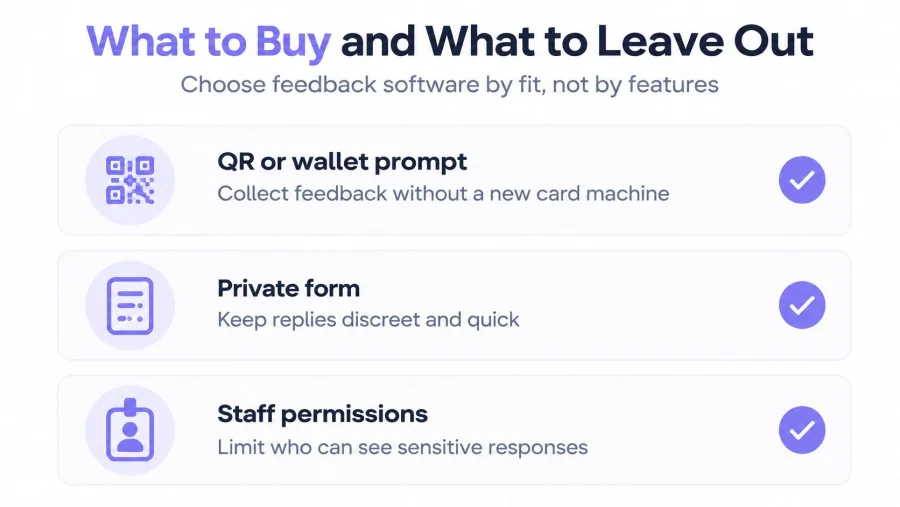
Buying criteria at a glance
| Criterion | Category | Pass test |
|---|---|---|
| QR or wallet prompt | Must-have | Works on the customer's own phone with no new card machine |
| Short private form | Must-have | A question plus a one-tap issue, designed to finish in under a minute |
| Staff permissions | Must-have | Each role sees only the comments it needs |
| Visit history on the member profile | Must-have | The reply shows next to the visit and reward record |
| Review request for satisfied customers | Must-have | Triggered after a positive reply, without removing the public review option for others |
| Export and deletion on request | Must-have | An admin-screen workflow, rather than an informal email chase |
| Birthday or seasonal coupons | Nice-to-have | Added only after the operating scoreboard is established |
| Enterprise suite with dedicated analyst | Leave out | Needs long setup and survey logic the team won't maintain |
A private form should feel discreet, not secretive. Customers should understand who can read their comments, and staff should have only the access their role requires. A junior employee doesn't need unrestricted access to sensitive complaints.
Birthday coupons, automatic customer groups, news, push notifications and multiple-store management become useful once staff can maintain the basic habit. Buying them early can distract from the harder question: does anyone reliably act on a poor reply?
BonusQR's Free plan costs $0 forever, with no card and no commitment required. Billing every three months saves up to 11%, every six months up to 16%, and annually up to 22%. Longer billing makes sense only after the business has tested the workflow, not merely because the discount looks attractive.
The relevant cost includes staff administration. A cheaper subscription isn't cheaper in practice if someone must repeatedly copy replies between systems or reconcile customer records by hand.
Keep the customer record proportionate
The Information Commissioner's Office analytics guidance treats personal-data analytics as potentially high-risk processing and sets out the need to assess risks through a Data Protection Impact Assessment before deploying high-risk processing.
Joining feedback to visits, spend or coupons deserves particular care before profiling or automated campaigns begin. The business should document what moves between systems, why it's needed, who can access it and when it will be deleted.
- Collect for a purpose: Skip fields that won't change a service decision.
- Separate identities from trends: Keep contact details apart from aggregated reporting where practical.
- Set retention rules: Raw comments may need a shorter life than trend-level statistics.
- Support customer rights: Correction, export, deletion and lawful-basis records need workable procedures.
More fields can make a segment appear more precise while also making collection excessive or unfair. For this particular job, the final test remains practical: if the tool can't place a reply beside a visit without a till integration, it's the wrong fit.
How Feedback Turns into Repeat Spend
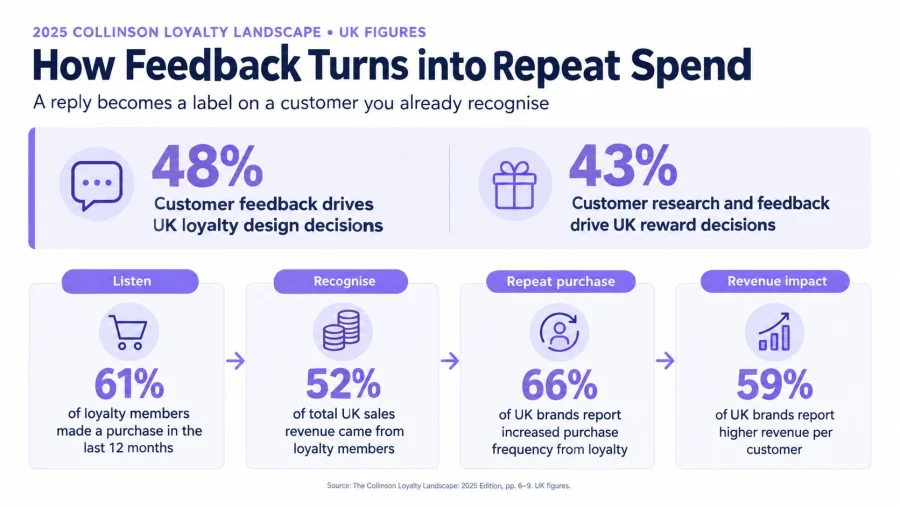
A feedback reply is more useful as context on a recognised customer than as an isolated research result. It tells the owner which relationship needs attention, while visit history shows whether that attention made a difference.
The 2025 Collinson Loyalty Landscape reported that UK loyalty members generated 52% of total sales revenue on average, 61% of registered members purchased during the previous twelve months, and 66% of brands experienced increased purchase frequency while 59% saw higher revenue per customer after using loyalty programmes.
Recover the relationship before offering a discount
Say a regular salon customer reports that the welcome felt rushed. The first useful action is a personal acknowledgement and a check with reception, not a generic money-off message.
The member record gives staff continuity. At the next appointment, the receptionist can confirm the corrected arrangement without making the customer repeat the complaint. A reward can support the return, but it shouldn't stand in for the fix.
A different situation calls for a different response. A café customer who used to visit regularly but has gone quiet may need a relevant invitation back. Visit gaps help distinguish that person from someone who joined once and never established a pattern.
Target behaviour that can actually change
BonusQR shows which offers perform best and helps identify the most loyal customers. Its visit history and customer segmentation support more selective follow-up, and a business can send a push notification to its top 10% of customers in two taps.
That ability should encourage restraint rather than more broadcasts:
- Recover known regulars: Match the response to the issue and their previous relationship.
- Win back lapsed members: Use a relevant offer for a changed visit pattern, not a blanket discount.
- Separate acquisition from retention: Compare new joiners with returning customers when reviewing monthly activity.
A crowded trading day can conceal weak retention if most customers are new. Monthly joining and returning-customer statistics help the owner distinguish fresh interest from an established customer base.
Owners can compare loyalty programs for small shops around the behaviour that matters: visits, spend thresholds or a suitable reward structure. A stamp card may fit a coffee habit; a spend reward may suit a retailer with mixed basket values.
The commercial test is incremental behaviour, not redemption alone. A reward earns its place when it changes the next visit or basket. If it merely discounts a purchase the customer would have made anyway, the business has subsidised existing demand.
Feedback Loops for Cafés Salons Gyms and Shops
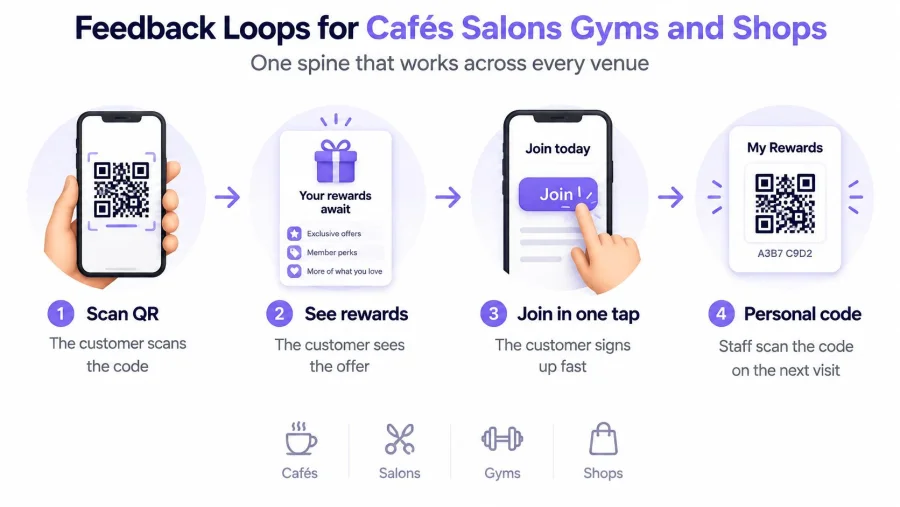
The customer journey can stay familiar across very different venues. Customers scan the store's QR code, see available rewards, create an account with one click and receive a personal QR code. On later visits, staff scan that personal code to award or redeem rewards and can see the process details.
Cafés and salons
At a café, the feedback prompt follows a stamp or free-drink redemption. A customer flags a wait-time problem without having to challenge the barista in front of the queue.
The duty manager checks the relevant morning's visits and responds within the chosen next-day service promise. The useful response explains what happened and what will change, rather than blaming the rush.
At a salon, the request arrives after the appointment, not while the customer is still in the chair. That gives a colour client space to mention a poor welcome without an awkward conversation beside the stylist.
Reception owns the reply and checks it within the same next-day routine. At the later gloss appointment, staff can see whether the arrangement was corrected and whether the customer returned.
Gyms and independent retailers
At a gym, the prompt follows class check-in or attendance. A member selects overcrowding, and the response reaches the manager responsible for that class rather than every coach.
Customer groups help keep follow-up relevant. The manager checks the complaint and answers within the stated next-day window, while restricting sensitive comments to staff who need them.
At a shop, the ask sits at the bagging point. A receipt, counter sign or bag insert keeps the route available whether the customer pays by contactless card, phone or cash.
The shift lead checks a stock, queue or service complaint and answers within the same response window. There's no need to make the feedback process part of the payment terminal.
Make review requests part of an honest service habit
In a Barclays survey of 2,000 UK customers and 500 businesses, 60% of consumers trusted online reviews, rising to 71% among people aged 18–34; 45% of small and medium-sized businesses said reviews exposed operational weaknesses and 54% said review sites helped improve customer service, while 52% of smaller businesses said they were likely to respond within 24 hours, compared with 30% of larger businesses.
BonusQR automatically sends a Google review request when a customer is satisfied. Businesses should keep the public review route available to everyone, avoid asking for a particular rating and never make a reward conditional on a positive review. Private recovery is a service channel, not a way to suppress criticism.
After registration, the system also automatically sends a welcome coupon, such as a welcome drink, discount, free coffee or another reward chosen by the business. That offers a reason to return while staff learn where the initial customer experience needs work.
The useful distinction is timing. The reward recognises membership; the feedback asks about service; the review remains the customer's independent account.
Start with One Question After the Visit
The first test doesn't need an elaborate survey programme. It needs a clear moment, an accessible prompt and someone who will answer.
A small launch the team can maintain
- Choose the moment. The owner selects redemption or the end of an appointment, rather than interrupting the service itself.
- Keep the question focused. The prompt asks whether the visit was worth returning for. An unfavourable answer opens a short issue list and an optional comment.
- Place the QR visibly. Staff put it on the counter, receipt or table tent where customers already have their phones out.
- Assign the reply. A named team member checks low scores that day and works to the published response promise.
- Offer a review route. Satisfied customers receive an invitation to leave an honest Google review, without pressure over the rating.
- Connect the visit. The response sits alongside a stamp, points balance or welcome reward, rather than in an unrelated spreadsheet.
A reply that sets a clear expectation
Suggested reply: Thanks for flagging the wait. The manager will check the collection queue with the shift team today. A further update will follow tomorrow, including any change to the handover process.
The message acknowledges the issue, names the check and gives a next step. Staff should adapt it to the actual problem rather than sending an apology that promises nothing specific.
After a short trial, the owner reviews participation, reported issues and subsequent visits. Tiers, referrals and seasonal promotions can wait until staff can operate the basic process consistently.
Start with BonusQR's free setup, which requires no credit card, or book its free consultation to choose a suitable loyalty approach. The practical next move is to print the QR, brief the till team and invite the next customers to respond while the visit is still fresh.


