
 Deutsch
 Español
 Français
 Italiano
 Magyar
 Polski
 Slovenčina
 Čeština
A coupon distribution strategy works when it ties three things together: a measurable objective, the right customer segment, and the channel most likely to reach them. Before you design any offer, set the objective, pick the segment, and choose one channel to test. Research comparing rewards and individually targeted coupons shows how much targeting matters, and platforms such as BonusQR exist precisely to make that targeting manageable for small and mid-sized businesses.
TL;DR:
- Individually targeted coupons generated three times the total spending of loyalty point rewards after usage frequency was controlled, supporting tiered offers over blanket discounts.
- Measure incremental revenue against a no coupon holdout, and calculate return by dividing net margin after discount and delivery costs by those total costs.
- Use SMS for urgent offers only with explicit consent; email suits retention, while direct mail can reach lapsed customers who ignore digital messages.
- Cross channel redemption can improve perceived service and revenue, but retailers should confirm checkout support, brief staff, disclose stock limits, and monitor inventory daily.
- Set discount and spending caps before launch, enforce one use per customer with no stacking, and pause campaigns if redemptions or stockouts exceed forecasts.
Why clear goals come before any coupon design
A coupon with no defined objective is just a discount. Before you write a single offer, decide what outcome you are buying with that margin.
Most campaigns map to several goals:
- First-time conversion: turning browsers or new sign-ups into paying customers.
- Cart recovery: winning back shoppers who added items but did not check out.
- Retention: keeping existing customers buying at their normal pace.
- Average order value (AOV) lift: encouraging bigger baskets through threshold discounts.
- Reactivation: bringing back customers who have gone quiet.
Each goal needs its own measure of success. First-time conversion lives or dies on redemption rate against new sign-ups. Cart recovery is best judged by incremental revenue, the sales that would not have happened without the nudge. AOV campaigns should be tracked against basket size before and after the offer, and retention campaigns against renewal or repeat-purchase rates over a suitable follow-up period.
Set a realistic target before launch, not after. If your channel’s historical redemption rate is modest, do not plan a campaign around an unrealistically high target. Build in governance guardrails too: a maximum discount depth, a spending cap for the campaign, and a decision point for pausing it early if results fall well short of target. These guardrails protect margin and give you a clean benchmark for the next campaign.
Which coupon type fits your situation
Not every coupon mechanic suits every goal, and picking the wrong one wastes both budget and customer attention.
- First-purchase coupons: a percentage discount or a small fixed amount off, used to lower the barrier for someone buying from you for the first time.
- Cart recovery coupons: a modest fixed-value or percentage discount sent shortly after an abandoned basket, often paired with free shipping.
- Loyalty or retention coupons: smaller, recurring rewards tied to a points balance or visit count, designed to reinforce an existing habit rather than create a new one.
- Referral coupons: a dual-sided reward, giving something to both the referrer and the new customer, which tends to work best as a fixed amount.
- Flash or limited-time coupons: a steeper, short-lived percentage discount used to clear stock or create a short demand spike.
Fixed-value discounts work well on lower-priced items where a percentage would look trivial, and they are easier to budget precisely. Percentage discounts scale naturally with basket size, which makes them better suited to cart recovery and AOV campaigns where order values vary widely.
As a conservative starting point, keep first-purchase and loyalty discounts modest, pair cart-recovery discounts with free shipping, and reserve steeper flash discounts for genuine clearance situations. Any discount should be checked against gross margin before it goes live. A steep discount on a product with a narrow margin can leave little once payment processing and fulfilment costs are counted.
Choosing the right distribution channels for each coupon
The best coupon mechanic can still fail if it reaches customers through the wrong channel. Each channel has a different mix of cost, reach, and measurability.
- Email: low cost per send, strong for retention and reactivation, but increasingly filtered or ignored by inactive subscribers.
- SMS: high open rates and fast delivery, well suited to time-limited flash offers, though it carries a per-message cost and strict consent requirements.
- Push notifications and in-app messages: near-instant delivery to engaged app users, ideal for cart recovery and loyalty nudges, with no extra send cost once the app is in place.
- Social media: good for broad first-purchase offers and brand reach, but harder to target precisely and to attribute redemptions.
- Website banners and pop-ups: catch browsing visitors at the point of decision, useful for first-purchase and cart recovery.
- QR codes and digital wallet passes: bridge offline and online, letting a printed flyer or in-store sign hand off to a trackable digital coupon.
- In-store POS prompts: effective for loyalty and repeat-visit rewards, with redemption instant and friction-free.
- Direct mail: higher cost per contact, but strong for reactivation of lapsed, higher-value customers who no longer open digital messages.
When choosing between channels, run through a short checklist: does this channel reach the segment you are targeting, what does each contact cost, how much friction sits between seeing the offer and redeeming it, can you measure the result cleanly, and do you have consent to contact this customer this way. SMS and email both require explicit opt-in in most markets, so your contact list should already reflect that before you plan volume.
For QR and wallet-based coupons, keep the technical set-up simple: generate a unique code or pass per campaign (not per customer, unless you are personalising face value), test the scan-to-redeem path on both iOS and Android, and make sure the pass updates automatically if the offer or expiry date changes. Our guide to digital loyalty cards covers this wallet-pass mechanic in more depth.
Targeting and personalisation: why broad coupons underperform
Sending the same coupon to everyone is the easiest option and usually the least effective one. Customer data lets you narrow the offer to the people most likely to act on it, and the gap in results is not small.
Common segmentation approaches include:
- Lifecycle stage: new, active, at-risk, or lapsed, each needing a different message.
- Behavioural triggers: an abandoned cart, a browsed-but-not-bought item, or a missed repeat-purchase window.
- RFM analysis: scoring customers by recency, frequency, and monetary value to prioritise who gets the richest offers.
- High-value versus lapsed segments: protecting margin on your best customers while using sharper discounts to win back the ones at risk of leaving entirely.
Comparative research on loyalty programmes found that individually targeted coupons generated three times greater total expenditure than points-based rewards once usage frequency was controlled for. That gap suggests personalised offers deserve a bigger share of your coupon budget than broad, one-size-fits-all discounts, even though broad campaigns are quicker to launch.
Personalisation does not have to mean a different offer for every customer. Three practical tactics cover most cases: vary the face value by customer tier (a lapsed high-value customer might get a steeper discount than a recently active one), trigger to send automatically from a specific behaviour such as cart abandonment, and reference the actual product or category the customer engaged with rather than a generic store-wide message. Our article on personalised loyalty programmes goes further into structuring these tiers.
Timing and expiry: how long a coupon should live
How long you give a customer to redeem a coupon changes both the response rate and the sense of urgency, so it is worth setting deliberately rather than defaulting to an arbitrary expiry period out of habit.
- Cart recovery coupons: keep the window short enough to preserve urgency while allowing the customer time to reconsider.
- First-purchase coupons: allow enough time for new customers to compare options before committing.
- Flash or clearance coupons: use a short window to support a sense of scarcity.
- Loyalty and retention coupons: align the expiry with a natural repeat-purchase cycle rather than an arbitrary date.
Phrase the expiry clearly and specifically (“expires Friday at midnight” works better than “limited time”) and send a reminder before the deadline rather than only at the last moment, which can feel like pressure rather than a helpful nudge. For campaigns where late redemption still has value, consider a staged structure: the full discount during an initial period, followed by a smaller fallback discount for a limited time. This captures slower responders without extending the original urgency window.
Redeeming across channels and what it means for stock
A coupon that only works online, when your customer wants to redeem in-store, is a coupon that gets abandoned. A quasi-experimental study on omnichannel coupon redemption found that letting customers redeem across both online and offline channels improves perceived service quality and, in many cases, revenue performance compared with restricting redemption to a single channel.
That flexibility carries an operational cost, though. Research into digital coupon promotion and inventory strategy shows that coupon campaigns can lift omnichannel brand profit under the right pricing and consumer-valuation conditions, but they can also shift store inventory needs in ways that catch retailers off guard, particularly when a coupon drives an unexpected surge in in-store demand for an item stocked mainly for online fulfilment.
Before launching any omnichannel coupon, run through an operational checklist:
- Confirm your point-of-sale system can recognise and apply the code or QR pass without a manual override.
- Brief store staff on redemption rules, including what happens if stock runs out mid-campaign.
- Set clear customer-facing messaging about product availability so a redeemed coupon does not end in disappointment at the till.
- Monitor stock levels daily for the campaign’s duration, not just at the end.
Protecting margin: governance rules that prevent coupon abuse
Every coupon campaign needs guardrails that stop a well-intentioned discount from quietly eroding margin.
Standard governance rules worth applying as default:
- Single use per customer, enforced at the account or email level, not just per code.
- No stacking with other active promotions unless you have deliberately modelled the combined discount.
- Minimum spend thresholds where appropriate, so the discount scales with basket size rather than applying to a token purchase.
- Channel quotas, capping how many redemptions a given channel or audience segment can claim.
- Strict expiry enforcement, with codes deactivated automatically rather than relying on staff to catch expired ones.
Watch for warning signs once a campaign is live: a redemption rate far above forecast, unexpected stock-outs on a specific item, or a drop in average order value that suggests customers are using the coupon on top of purchases they would have made anyway. Any of these should trigger an immediate review, and sometimes a pause.
Pro tip: Keep a kill switch ready, a single setting that disables a coupon code instantly, and always pre-test a new offer on a small segment before rolling it out to your full list.
Measuring results and running uplift tests
A coupon campaign without measurement tells you nothing beyond “some people used it.” The metrics that actually matter are redemption rate, incremental revenue, return on investment, the change in average order value, and retention uplift among customers who redeemed versus those who did not.
- Track redemption rate against the audience size the coupon was sent to, not against total customers.
- Measure incremental revenue by comparing a treatment group that received the coupon against a holdout group that did not.
- Calculate ROI as the margin generated minus the discount cost and delivery cost, divided by that total cost.
- Watch AOV change to see whether the coupon shifted basket size, not just purchase likelihood.
- Check retention uplift over a suitable follow-up period to see if the coupon created a habit or just a one-off transaction.
A quasi-experimental study on multichannel coupon redemption found that redemption flexibility across channels affects both perceived service quality and revenue outcomes, which is a useful reminder that redemption channel is itself a variable worth testing, not just an operational afterthought.
Set up tracking before launch: a unique coupon code or identifier per channel and segment, UTM parameters on every digital link, and a fixed cadence (weekly during the campaign, then a final review at close) for checking results against your original target.
A step-by-step checklist for launching a coupon campaign
- Pre-launch: confirm the objective, target segment, coupon mechanic, discount depth, distribution channel, governance rules, and measurement plan.
- Build: create the campaign assets, generate unique codes or configure the QR pass and wallet integration, and set the expiry logic.
- Schedule: plan the send times and any reminder messages, and brief store staff if in-store redemption is involved.
- Launch: go live on the chosen channel, confirming tracking (UTM links, unique codes) fires correctly from the first send.
- Monitor: check redemption rate and stock levels daily against your governance triggers.
- Review: compare final results to your original target, note what worked, and archive the learnings for the next campaign.
Automating coupon distribution with triggers and events
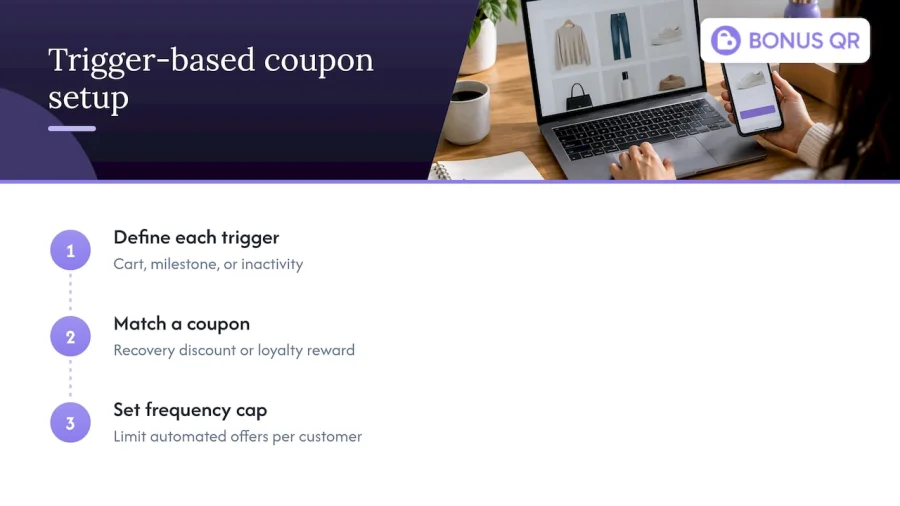
Manually sending coupons does not scale past a handful of customers, which is why most effective programmes run on automation rather than one-off sends. Trigger-based automation fires a coupon the moment a defined event happens: a cart sits abandoned, a customer reaches a visit milestone, or a subscriber has not purchased for a defined period.
Event-driven automation works the same way but reacts to a broader set of signals, such as a birthday, a loyalty tier upgrade, or a product restock a customer previously searched for. The advantage over scheduled broadcast sends is timing: a coupon sent promptly after a relevant action may perform better than one sent later to a static list.
Setting this up well requires three things: a clear definition of each trigger event, a coupon mechanic matched to that specific moment (a cart-recovery discount for abandonment, a loyalty reward for a visit milestone), and a cap on how often any single customer can receive an automated coupon, so the system does not flood an engaged customer with offers every time they browse. Most loyalty platforms, including BonusQR, handle this kind of trigger logic natively, which removes the need to build custom automation scripts from scratch.
Staying compliant when you distribute coupons
Coupon campaigns sit under the same consumer protection and marketing consent rules as any other promotion, so a few points are worth checking before you launch rather than after a complaint arrives.
Any SMS or email coupon requires explicit opt-in consent from the recipient, and every message needs a clear, working way to unsubscribe. The expiry date, minimum spend, and any exclusions on a coupon should be stated plainly and should match what actually happens at checkout, since advertising one discount and applying a smaller one is a straightforward consumer protection problem. If a coupon is restricted to new customers only, that restriction needs to be enforced consistently and stated clearly, not applied selectively.
Where a campaign involves customer data, such as purchase history used to personalise an offer, the usual data protection obligations for your market apply, including a lawful basis for processing that data and a way for customers to see or delete it on request. These obligations vary by jurisdiction, so when in doubt, check with a professional familiar with your specific market rather than relying on general guidance. None of this should stop you running targeted campaigns, it simply means consent and accuracy need to be built into the process from the start, not bolted on afterwards.
Preventing fraud and abuse in coupon campaigns
Coupon abuse usually falls into a few predictable patterns: one customer creating multiple accounts to claim a new-customer discount repeatedly, codes being shared publicly beyond the intended audience, or bots scraping and redeeming codes faster than real customers can.
The governance rules already covered, single use per customer, no stacking, and expiry enforcement, handle most of this on their own. Beyond that, a few extra checks help: tie redemption to a verified account or payment method rather than just an email address, rate-limit how many times a single IP address or device can attempt a code in a short window, and monitor for a sudden cluster of redemptions from the same postcode or payment detail. If a flash offer suddenly spikes in redemptions within minutes of launch, that is usually a sign the code has leaked beyond its intended channel, and the kill switch mentioned earlier is the right response.
What retailers get wrong with coupons, and when to upgrade your tools
The most common mistake is launching a coupon with no defined objective, just a general sense that a discount might help. A close second is applying the same discount to every customer regardless of value or history, and a third is weak governance, no cap on redemptions and no plan for what happens if the numbers run away from forecast.
The signal that it is time to move beyond spreadsheets and manual sends is usually operational: you are rebuilding the same coupon logic for every campaign, you cannot see redemption data without exporting several reports, or you want personalised, trigger-based offers but have no system to automate them. That is the point where a dedicated loyalty platform, with built-in coupon management, automation, and analytics, starts to save more time than it costs.
— Michal
Running your coupon strategy through BonusQR
Everything in this checklist, segmented targeting, trigger-based automation, QR and wallet-pass redemption, and clean campaign analytics, is what we built BonusQR to handle without custom development. Set up a stamp card, points system, or coupon module in one place, track redemption in real time, and layer in push notifications for the trigger-based sends covered above.
Our pricing page lists Free, Basic, and Premium plans, so you can start small and scale as your campaigns grow. Larger retailers wanting their own branded app can look at our white-label setup, and online stores running on WooCommerce or Shopify can see how coupons sit alongside our ecommerce loyalty features.
FAQ
What is the 3-3-3 rule for marketing?
Definitions of the 3-3-3 rule vary across marketing contexts, so there is no single agreed version for coupon campaigns specifically. In general promotional use, it often refers to limiting a message to three key points, delivered across three touches, within a short time window, but you should treat this as a loose guideline rather than a fixed standard.
Is couponing still an effective tactic in 2026?
Yes, coupons remain a core promotional tool, particularly when targeted rather than broadcast to an entire list. Research into individually targeted coupons shows they can generate substantially higher spending than generic rewards, which is why segmentation and automation matter more now than the discount size alone.
How do coupon users typically find and collect large volumes of coupons?
Heavy coupon users typically combine several sources: retailer loyalty apps, email and SMS sign-ups, manufacturer websites, and browser extensions that surface active codes at checkout. Businesses can reduce uncontrolled stacking from this behaviour by enforcing single-use and no-stacking rules at the account level.
Can you give an example of a discount pricing strategy?
A common example is a tiered cart recovery sequence: offer free shipping first, then a discount if the cart is still abandoned, with the code expiring after a clearly stated period. This matches discount depth to urgency while keeping the overall margin impact predictable.
What does BonusQR cost to set up a coupon programme?
BonusQR offers a Free plan alongside paid Basic and Premium subscriptions for ongoing coupon and loyalty management. Businesses wanting a fully branded app can add a one-off white-label setup fee, or commission custom app development priced from the figures listed on our custom app page.