
 Deutsch
 Español
 Français
 Italiano
 Magyar
 Polski
 Slovenčina
 Čeština
A café owner stands at the till with two ageing iPads, a queue building, and a regular trying to redeem a reward from the Belly loyalty program. The app stalls. The customer gives up, taps a bank card, and walks away without using the reward they'd earned.
That's the moment a loyalty tool stops being loyal to the business.
For many small merchants, Belly didn't fail all at once. It became awkward. Staff had to explain it too often. Customers forgot the app. Hardware lived on the counter like a relic from an earlier phase of digital retail. Meanwhile, the rest of the business moved on to newer POS tools, simpler QR workflows, and lower-friction customer journeys.
Plenty of cafés, salons, gyms, and local shops still are. They're not looking for another bloated platform. They need a replacement that customers will use, staff can explain in seconds, and owners can launch without turning loyalty into a side project.
Why Many Small Businesses Are Looking Beyond Belly
The Belly loyalty program made sense in a very specific era. Dedicated in-store tablets felt modern. Digital punch cards felt smarter than paper. For a while, that was enough.
It isn't enough now.
The trigger moment is usually operational, not strategic
Most owners don't wake up planning a loyalty migration. They reach a point where the system starts slowing the counter down. A member asks whether points are still valid. Staff fumble through a check-in flow. The internet drops for a minute. Someone says they forgot their login. That tiny delay repeats all week.
Loyalty should feel invisible when it works. When it doesn't, it interrupts the sale.
A lot of small businesses tolerated that friction because replacing loyalty software sounded painful. But sticking with a legacy setup is often worse. Counter hardware ages. Support gets harder to reach. Newer POS systems don't slot in neatly. Data sits in the wrong place.
Practical rule: If staff need to explain the loyalty process more than the reward itself, the system is too heavy for a small business.
UK customer behaviour has moved on
The wider UK market has already made one thing clear. Loyalty is mainstream now, not experimental. A government review found 97% of UK shoppers were members of at least one supermarket loyalty scheme, shoppers averaged 3 memberships, and 21% held 5 or more supermarket schemes. The same review found average member savings of 17% to 25% on loyalty-price promotions across five major supermarkets, showing just how normal loyalty has become in everyday purchasing behaviour (UK government review of grocery loyalty pricing).
That doesn't mean customers want one more clunky app. It means they already understand rewards and have very little patience for friction.
The real decision isn't Belly or nothing
Most merchants looking up the Belly loyalty program aren't doing product research out of curiosity. They're trying to solve a practical problem fast.
They need to answer five questions:
- Can customer data be exported cleanly
- Can rewards carry over without confusion
- Can staff learn the new flow quickly
- Can customers join without downloading yet another app
- Can the new system work without dedicated counter hardware
That's the migration brief. Belly just happens to be the trigger.
What the Belly Loyalty Program Was and How It Worked
Belly was built for local merchants that wanted digital loyalty without building a custom app. It became known as a tablet-based rewards system used by cafés, retailers, salons, gyms, and other neighbourhood businesses.
How the Belly loyalty program worked at the counter
The basic workflow was simple.
A customer signed up using an email address or phone number. At checkout, they checked in on an in-store iPad. That action gave them points or credit towards rewards. As they kept visiting, the account provided higher-value perks.
For a café, that might mean free drinks after a set number of visits. For a salon, it might be a discount or add-on service. For a gym, it could be a member perk tied to repeat attendance.
The experience felt cleaner than a paper card because customers didn't need to carry anything physical. Belly handled the digital account, the point balance, and the reward ladder in one place.
Why it appealed to small businesses
At the time, Belly solved an obvious problem. Paper punch cards were easy to lose, easy to fake, and hard to track. Belly gave merchants a digital alternative that looked more modern and gave them at least some customer data in return.
Businesses trying to build rewards on a tighter budget still face that same decision today. A practical starting point is this guide to Affordable customer loyalty programs, especially for owners comparing old-school punch systems with lighter digital options.
A short timeline that matters
Belly arrived during the period when digital loyalty for small merchants still felt novel. In the UK, the broader loyalty market had already moved from stamp collecting to card-based systems over decades, including Green Shield Stamps in 1958, their withdrawal in 1991, Tesco's loyalty work from 1993, and the launch of Tesco Clubcard in February 1995, widely cited as the first nationwide supermarket loyalty card in the country (history of UK retailer loyalty cards).
That context matters. Belly belonged to the next stage after plastic loyalty cards. But today's most practical systems have moved again, towards QR codes, mobile web access, and wallet-based convenience.
Here's the simple version of Belly's later history as many merchants experienced it:
- Early phase: local businesses adopted it as a digital check-in loyalty tool
- Middle phase: it built recognition and merchant familiarity
- Later phase: platform priorities shifted away from the small-business use case that made it useful in the first place
- End phase: merchants were left looking for replacements instead of improvements
That's why migration isn't theoretical. For businesses still anchored to the Belly model, replacement is the actual job.
Belly Features, Strengths and Real Limitations
Belly wasn't a bad idea. It was an early digital loyalty product built around the needs of independent merchants. The trouble is that its design assumptions now show their age.
Where Belly was genuinely strong
The best part of the Belly loyalty program was usability at first touch. Staff could usually understand the iPad check-in flow fast, and customers could see points adding up after each visit.
Its core strengths looked like this:
- Simple front-counter interaction: one device, one check-in flow, one visible loyalty moment
- Tiered rewards: merchants could create a basic path from smaller rewards to bigger ones
- Basic customer marketing: businesses had access to simple outreach tools tied to membership
- Recognisable model: customers understood the idea quickly because it mirrored a punch-card habit in digital form
For an earlier generation of coffee shops and salons, that was enough to get started.
Where the model started breaking down
The limitations are harder to ignore now.
First, Belly depended heavily on dedicated hardware. That sounds manageable until the tablet freezes, the stand goes missing, the battery fails, or the counter gets redesigned. Hardware dependency is a hidden tax.
Second, it wasn't built around the scan habits customers now expect. People already know how to use a phone camera. They don't want another sign-up loop or a dedicated app if a QR flow can do the same job faster.
Third, data mobility was never the cleanest part of the system. For small businesses, that matters. A loyalty database is only valuable if it can be exported, segmented, and reused.
Merchants also started colliding with integration gaps. Newer POS tools, email platforms, booking systems, and lightweight CRM workflows moved one way. Belly's model stayed tied to an older setup.
Belly Features at a Glance
| Feature Category | Strength | Limitation |
|---|---|---|
| Check-in flow | Easy for staff to grasp on a tablet | Dependent on a dedicated in-store device |
| Rewards | Tiered offers were straightforward to configure | Less flexible than modern QR-first programmes |
| Marketing | Basic member communication existed | Lacked deeper automation and broader workflow depth |
| Data and operations | Better than paper for basic tracking | Export and integration workflows could feel restrictive |
A useful benchmark for modern alternatives is whether the loyalty system works in a browser-first environment instead of demanding heavy hardware. That's where a loyalty feature mobile web app model is closer to how small businesses operate now.
Belly made digital loyalty easier than paper. It did not make loyalty effortless.
A quick self-check helps here. If the current system depends on old tablets, awkward exports, and frequent staff explanations, the problem isn't just age. It's fit.
The Honest Case Against Sticking With a Legacy Loyalty Platform
Some owners assume any digital loyalty platform is automatically better than paper or QR. That's the wrong benchmark. The right benchmark is whether customers use it without slowing the sale down.
App fatigue is real at the counter
Small businesses see the same pattern over and over. A customer likes the idea of rewards, but not enough to dig for a forgotten app, recover a login, or wait while a tablet loads. In the UK, loyalty saturation is already high. The average shopper belongs to 4.7 loyalty schemes, but only actively engages with 1 to 4 of them, and 57% of consumers say they become frustrated when rewards take too long to become usable (UK loyalty programme statistics).
That should change how owners design rewards. Faster first redemption usually beats a long delayed payoff.
Unused rewards aren't harmless
A legacy system can make owners feel organised while reducing actual redemption. That's a problem. UK loyalty data shows 26% of loyalty points go unredeemed, representing about £3 billion in annual value. For operators, the practical lesson is simple. Redemption design matters because dormant rewards create liability without necessarily driving repeat visits (UK loyalty statistics).
If rewards sit trapped behind clunky mechanics, the programme may look active in reports while staying weak in real life.
Small businesses need operational usability, not just reward logic
The next issue is usability. UK research found 59% of consumers prefer small, immediate rewards, 30% forget to use their cards, and nearly three in five shoppers encountered loyalty-scheme issues in the past six months (UK loyalty programme survey).
That's why old loyalty software often underperforms in cafés, salons, and gyms. The issue isn't only reward structure. It's whether the customer can access the reward with no friction. For businesses also trying to improve retention beyond points, these feedback systems for guest retention are worth reviewing because they address the part many loyalty stacks ignore after the sale.
The blunt conclusion is this. If a customer already has a phone in hand, a fast scan usually beats an app-based check-in flow from an earlier software era.
Belly vs BonusQR Side by Side for Modern SMBs
For a busy owner, the cleanest way to judge a migration is to compare operating realities, not brand language. Belly belongs to a tablet-first generation. BonusQR is built around QR-led loyalty for brick-and-mortar businesses that want rewards without a heavy CRM layer.
Belly vs BonusQR feature comparison
| Attribute | Belly | BonusQR |
|---|---|---|
| Setup style | More dependent on hardware, account setup, and staff process | QR-led setup designed for fast in-store launch |
| Hardware | Usually tied to a tablet-style counter flow | Can run through printed QR, phone, or tablet |
| Customer join flow | Often feels like a dedicated platform journey | Sign-up and use can happen through a mobile-friendly path |
| Reward mechanics | Familiar digital punch-card logic | Supports stamps, points, cashback, visit and spend thresholds, discounts, welcome bonuses, birthday and seasonal coupons |
| Data handling | Customer data may need more effort to extract and repurpose | Built to support practical export and campaign use |
| Marketing tools | Basic member communication | Includes automated push and email campaign options |
| Wallet access | Older app-centred model | Supports Apple Wallet and Google Wallet passes |
| Fit for local services | Worked for SMBs in its early period | Built for cafés, salons, barbershops, gyms, and local retail without requiring POS integration |
What matters most in a real shop
A modern replacement needs to solve five things at once.
First, it has to remove hardware fragility. A printed QR at the till is easier to replace than a failing tablet.
Second, it has to cut customer friction. Camera scan beats app hunt.
Third, it has to keep reward rules flexible. A café may want stamps. A salon may prefer visit thresholds. A gym may need timed offers to reactivate quiet members.
Fourth, it has to fit around the existing business instead of demanding a technical project. That matters more than a long feature list.
Fifth, it should help owners keep the loyalty relationship usable after sign-up, not trap it in one narrow workflow.
The strongest loyalty systems for small businesses don't try to look impressive. They try to disappear into the normal checkout flow.
For modern SMBs, that's the side-by-side. Not digital versus paper. Not old brand versus new brand. Friction versus use.
Migrating From Belly to BonusQR in a Working Week
Migration feels bigger than it is. For most small businesses, this isn't a software transformation. It's a short operational reset.
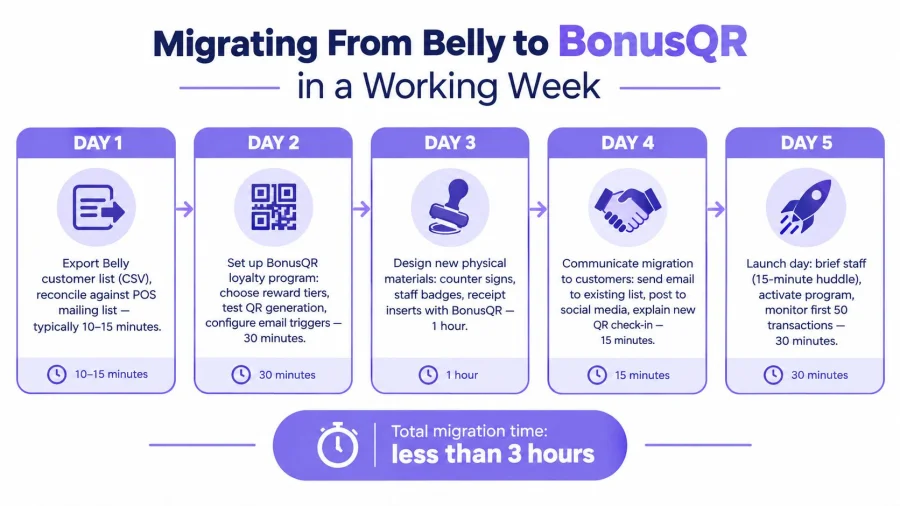
Day 1 to Day 3
Start with the customer list.
On Day 1, export the Belly member database as CSV and compare it against the current POS or mailing list. Remove duplicates. Flag obvious VIPs and recent regulars. The point isn't perfect data hygiene. The point is preventing customer confusion during the switch.
On Day 2, create the new reward structure. Keep it simpler than the old one. A coffee shop might use a visit-based reward. A salon might reward repeat bookings. A gym might offer a welcome-back incentive for lapsed members. Then generate the in-store QR materials.
On Day 3, upload the cleaned customer list and map any legacy balances into the new programme where practical. If a business wants a smoother handover, VIPs should get a direct message that confirms their rewards are still recognised.
Day 4 to Day 7
Day 4 is communication day. Put the message in plain language. The old loyalty flow is being replaced. Rewards are carrying over where applicable. The new process is quicker at the counter.
Day 5 should be a soft launch. Staff use the scanner, test the join flow, and watch where customers hesitate. Most problems show up fast. Fix signage before full rollout.
Day 6 is the public flip. Put the QR live at the till, on the counter, and near the door. Remove old Belly hardware so staff don't drift back into a half-switched process.
Day 7 is review day. Check first redemptions, spot inactive members, and send a small reactivation nudge. Businesses comparing platform costs during this step can see membership tiers before locking in a new setup.
Two migration mistakes to avoid
- Keeping old and new systems live too long: that confuses staff and splits customer behaviour
- Overcomplicating the replacement reward structure: the relaunch should feel easier, not more clever
The businesses that switch cleanly are usually the ones that treat migration like a one-week checklist, not a three-month tech project.
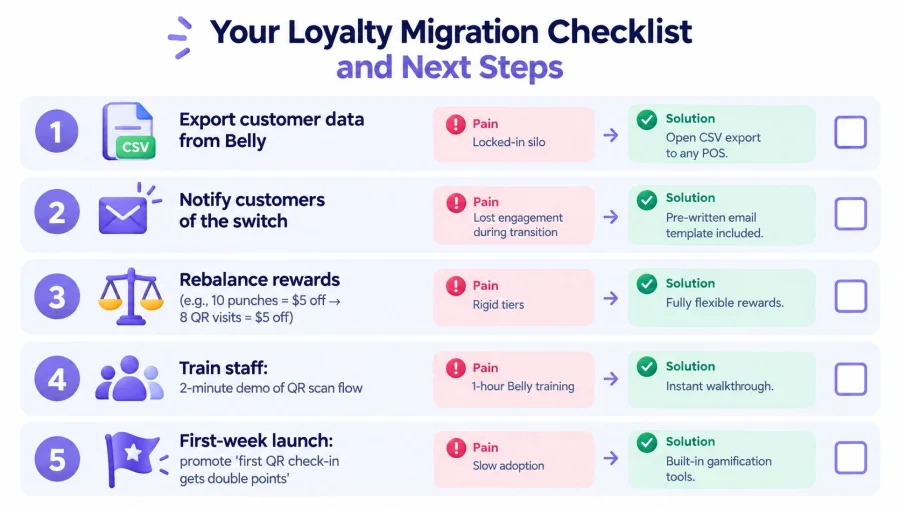
Your Loyalty Migration Checklist and Next Steps
Most Belly replacements fail for one reason. The owner swaps software but keeps the same friction. A better migration fixes the process, not just the logo on the screen.
The checklist that actually matters
- Export customer data: pull member records out of the old system while access still exists
- Reconcile lists: compare loyalty contacts with POS, booking, or email records
- Decide what carries over: points, visits, or a one-time goodwill reward for regulars
- Simplify the reward path: shorten the route to first usable value
- Prepare printed QR materials: counter card, window sticker, receipt insert, staff prompt
- Train staff in one short huddle: joining and redeeming should be explainable in a few sentences
- Send the switch message: tell customers what changes and what doesn't
- Launch one live date only: avoid a messy overlap period
- Review early redemption behaviour: fix weak reward thresholds quickly
- Follow up with inactive members: restart the habit while the relaunch is still fresh
Compliance points owners shouldn't ignore
Loyalty data isn't just marketing data. It has compliance consequences.
Under HMRC rules, if loyalty points are collected and later swapped for vouchers redeemable with the business, no VAT is due at the point of redemption under VAT Notice 700/7 on business promotions. HMRC also states that where a retailer gives customers a free loyalty card that allows reduced-price purchases, only the consideration received is taxable, which means reward structure affects the VAT base under the HMRC VAT manual on loyalty and affinity cards.
Data handling matters too. The ICO says a business with a loyalty card scheme doesn't need to pay a data protection fee provided it does not share or trade the information, including use within a group for another purpose or research on customer habits based on purchase data, according to the ICO guidance for the wholesale and retail sector. The ICO also highlights the security risk of loyalty data and notes it fined Marriott Hotels £18.4 million in 2020 after hackers accessed loyalty card information, in its guidance on data gathered by loyalty cards.
That means the replacement decision isn't only about convenience. It's also about data control, cleaner processes, and lower exposure.
A loyalty platform should help a business keep customers close. It shouldn't create extra risk, dead rewards, or counter friction.
If the Belly loyalty program is still hanging around in the business, this is the week to remove it. Export the data. simplify the reward logic. launch the QR flow. train the team. move on.
A small business doesn't need a nostalgia project. It needs a loyalty system customers will use on an ordinary Tuesday. The next step is straightforward. Set a migration date, clean the customer list, and launch a simpler rewards flow this week.