
 Deutsch
 Español
 Français
 Italiano
 Magyar
 Polski
 Slovenčina
 Čeština
Audience segmentation is defined as the process of dividing a broad group of people into smaller, distinct groups based on shared characteristics, so you can deliver more relevant and personalised marketing communications. The five core types are demographic, geographic, psychographic, behavioural, and firmographic segmentation, each serving a different purpose depending on your campaign goals. Segmented email campaigns can increase revenue by up to 760% compared to non-segmented ones. That figure alone makes the importance of audience segmentation impossible to ignore. Whether you run a local retail shop or manage campaigns for a growing brand, understanding how to segment your audience is the single most effective step you can take towards better targeting and stronger customer retention.
What is audience segmentation and what are the main types?
Audience segmentation is the practice of grouping people by shared traits so your messaging reaches the right person at the right moment. Without it, you broadcast the same message to everyone and convert far fewer of them. The five core segmentation types prioritised by marketers are demographic, geographic, psychographic, behavioural, and firmographic characteristics.
The table below shows how each type differs in practice.

| Segmentation type | Key traits | Typical data inputs | Common marketing use |
|---|---|---|---|
| Demographic | Age, gender, income, education | CRM records, survey data | Offer targeting, product positioning |
| Geographic | Country, city, postcode, climate | IP data, delivery addresses | Local promotions, regional pricing |
| Psychographic | Values, lifestyle, interests | Surveys, social listening | Brand storytelling, content tone |
| Behavioural | Purchase history, engagement, loyalty stage | Web analytics, POS data | Triggered emails, loyalty rewards |
| Firmographic (B2B) | Industry, company size, revenue | LinkedIn, CRM enrichment | Account-based marketing, sales outreach |
Demographic segmentation is the most common starting point because the data is easy to collect. However, it is also the weakest predictor of purchase intent on its own. Psychographic and behavioural segmentation add depth because they reveal why people buy, not just who they are.
Behavioural segmentation is particularly powerful for loyalty programmes. A customer who visits your café three times a week behaves very differently from one who visits once a month. Treating them identically wastes both your budget and their attention.
Pro Tip: Combine at least two segmentation types for every campaign. Pairing demographic data with behavioural signals, such as purchase frequency and average spend, produces segments that are far more predictive than either type alone.
An emerging approach worth noting is community-based segmentation. Experts recommend building segments around organic communities formed by shared language and culture, because behaviour within these groups is more predictive than demographics alone. A fitness brand targeting British South Asian women, for example, will achieve better results by understanding cultural values and community norms than by relying on age brackets.
How does audience segmentation differ from customer and market segmentation?
These three terms are often used interchangeably, but they describe distinct processes with different scopes and objectives. Confusing them leads to poorly targeted campaigns and wasted spend.
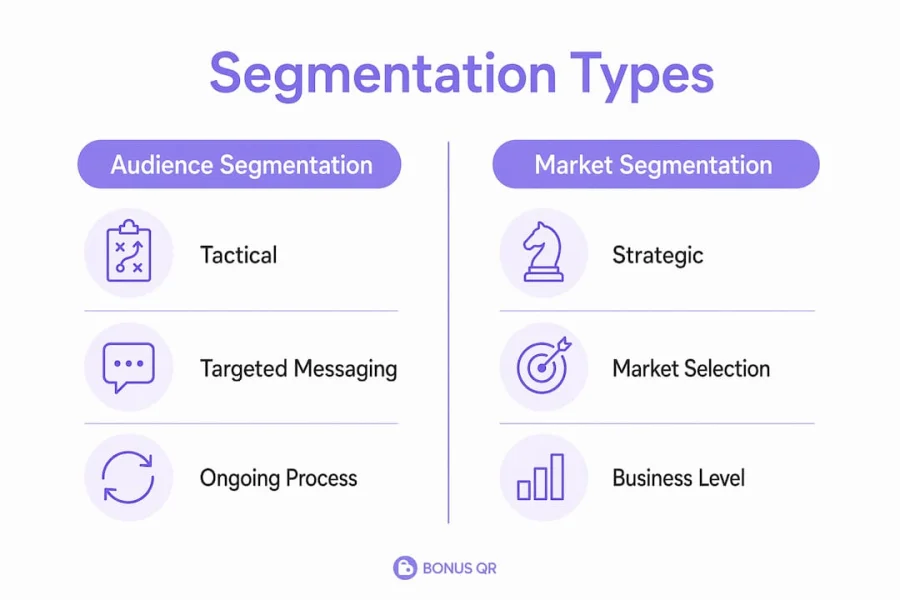
Market segmentation is a strategic, high-level process for deciding which markets to serve. It happens at the business planning stage and shapes product development, pricing, and distribution decisions. You use it to decide whether to enter the student market or the professional market, not to write a specific email subject line.
Audience segmentation is a tactical, continuous exercise focused on how to communicate with the people you have already decided to reach. It operates at the campaign level and updates regularly as behaviour changes. Critically, it includes anonymous visitors and prospects, not just known customers.
Customer segmentation relies on known individuals with transaction history. It requires identifiable customers and existing purchase data. Audience segmentation, by contrast, can work at the top of the funnel where you know very little about the individual beyond their browsing behaviour or social media activity.
Here is a quick comparison to clarify the distinctions:
- Market segmentation: Strategic. Decides who to serve. Uses macro data such as industry size, geography, and competitive positioning. Happens infrequently.
- Audience segmentation: Tactical. Decides how to communicate. Uses behavioural, demographic, and psychographic signals. Runs continuously.
- Customer segmentation: Operational. Focuses on known buyers. Uses transaction history, loyalty data, and CRM records. Feeds retention and upsell campaigns.
Understanding these differences matters because each type requires different data sources and different teams. Your strategy team owns market segmentation. Your marketing team owns audience segmentation. Your CRM team owns customer segmentation. Blurring these boundaries produces confused briefs and inconsistent messaging.
For a deeper look at the customer-specific side of this, the guide on customer segmentation for SMEs covers the operational layer in detail.
What is the recommended process for audience segmentation?
Effective audience segmentation follows five clear steps: audit your data, define segment attributes, build the segments, map them to the customer journey, and test and refine with pilot campaigns. Skipping any step produces segments that look good on paper but fail in practice.
Step 1: Audit your data
Start by cataloguing every data source you hold. This includes website analytics, email engagement rates, point-of-sale records, social media insights, and any survey responses. The goal is to identify what you actually know about your audience versus what you assume. Most businesses discover significant gaps at this stage.
Step 2: Define segment attributes
Choose the attributes that matter most for your specific campaign goal. A retention campaign for a coffee shop might prioritise visit frequency and average spend. A new product launch might prioritise age, location, and past category purchases. Attributes must be measurable, not guesswork.
Step 3: Build the segments
Group your audience using the attributes you have defined. Integrating data across email, web, and point-of-sale into a single source of truth enables complete profiles and predictive segmentation. A customer data platform (CDP) or a well-configured CRM system handles this integration. Without a unified view, you risk sending conflicting messages to the same person across different channels.
Step 4: Map segments to the customer journey
Each segment sits at a different stage of the funnel. A first-time visitor needs awareness content. A repeat buyer needs a loyalty reward. A lapsed customer needs a re-engagement offer. Mapping segments to journey stages ensures your message matches the person’s current relationship with your brand. The guide on customer retention workflows explains how to align segments with retention stages in practice.
Step 5: Test and refine
Run pilot campaigns with your new segments before committing your full budget. Measure open rates, click-through rates, conversion rates, and revenue per segment. Expect some segments to underperform. Refine the attributes and retest. Segmentation is not a one-time exercise. It is a continuous process that improves with every campaign cycle.
Pro Tip: Use behavioural and lifecycle segments for automated messaging. Behavioural segments update automatically, keeping your triggered emails and push notifications relevant without manual intervention. Static demographic segments go stale quickly and require regular manual updates to stay accurate.
A common pitfall is treating your initial segments as permanent. Customer behaviour shifts with seasons, economic conditions, and product changes. Build a review cycle into your calendar, at minimum quarterly, to reassess whether your segments still reflect reality.
What are the current trends shaping audience segmentation in 2026?
The most significant shift in 2026 is the move away from third-party cookie data towards zero-party and first-party signals. Zero-party data is information customers voluntarily share with you, such as preferences submitted through a loyalty programme quiz or a product recommendation tool. This data is more accurate and more trusted than inferred data from third-party sources.
Community-based segmentation is gaining traction as a result. Rather than grouping people by age or postcode, this approach builds segments around shared cultural identity, language, and values. A segment defined by “British South Asian parents aged 28–45 who prioritise organic food” is far more actionable than “parents aged 28–45.”
Segments should be based on organic communities formed by shared language and culture. Behaviour within these communities is more predictive than demographics alone. For segments to be actionable, they must be observable, meaningful, accessible, and stable. Without meeting these four criteria, a segment is theoretical, not practical.
Pulsar Platform, Audience Segmentation Strategy Guide
The four-criteria test from the quote above is worth applying to every segment you build. Observable means you can detect the segment using measurable data. Meaningful means the segment behaves differently enough to justify separate messaging. Accessible means you can actually reach them through your available channels. Stable means the segment persists long enough to justify the investment.
Another important distinction is the difference between segmentation and buyer personas. Segmentation is quantitative and data-driven. Personas are qualitative and fictional. Personas are useful for building empathy in creative teams, but they should never replace data-driven segments when making targeting decisions. Confusing the two leads to campaigns built on assumptions rather than evidence.
For practical guidance on building personas alongside your segments, the resource on creating buyer personas explains how the two tools complement each other without overlapping. Similarly, if you are still working out who your audience is before segmenting, the guide on identifying your target audience is a useful starting point.
Key takeaways
Audience segmentation works because it replaces broad, generic messaging with targeted communications built on real behavioural and demographic data, producing measurably higher engagement and revenue.
| Point | Details |
|---|---|
| Definition is precise | Audience segmentation divides a broad group into smaller groups by shared traits for targeted messaging. |
| Five core types exist | Demographic, geographic, psychographic, behavioural, and firmographic segmentation each serve distinct campaign goals. |
| Segmentation differs from personas | Segmentation is data-driven and quantitative; personas are qualitative and should not replace segment data. |
| Five-step process applies | Audit data, define attributes, build segments, map to journey, then test and refine continuously. |
| Dynamic segments outperform static ones | Behavioural and lifecycle segments auto-update, keeping automated campaigns relevant without manual intervention. |
Why most businesses get audience segmentation wrong
I have worked with marketing teams across retail, hospitality, and professional services, and the same mistake appears repeatedly. Businesses invest time building segments, then treat them as permanent fixtures. They define a “young urban professional” segment in january, run one campaign, and never revisit it. Six months later, the segment no longer reflects the actual audience, but the messaging has not changed.
The second most common error is confusing a buyer persona with a segment. A persona is a story. A segment is a data set. You need both, but they serve different purposes. Using a persona as the basis for targeting decisions without underlying data is like navigating by a hand-drawn map when GPS is available.
The third error is under-investing in data integration. Businesses often hold rich behavioural data in their loyalty platform, their email system, and their point-of-sale system, but these sources never talk to each other. The result is fragmented profiles and contradictory messaging. A customer who just made their fifth purchase in a month should not receive a “we miss you” re-engagement email. That kind of error destroys trust faster than any competitor can.
My strongest recommendation is to start with behavioural segmentation, even if your data is limited. Visit frequency, average spend, and last purchase date are three signals that most businesses already hold. Build your first segments from those three inputs, map them to your customer journey, and run a single pilot campaign. The results will tell you more than any persona workshop ever could. From there, layer in psychographic and community-based signals as your data matures.
— Michal
How Bonusqr supports personalised customer engagement
Audience segmentation tells you who to target and what to say. Bonusqr gives you the tools to act on that knowledge at scale. The platform’s electronic reward features let you configure points, cashback, and stamp card rewards that respond to specific customer behaviours, such as visit frequency or spend thresholds. Real-time analytics and reporting show you how each segment is responding, so you can refine your approach without waiting for a monthly report. Push notifications and automated campaign triggers mean your segmented messages reach customers at the right moment, through their mobile or web app, without manual effort. For businesses ready to put segmentation into practice, Bonusqr provides the infrastructure to make personalised loyalty marketing work from day one.
FAQ
What is the audience segmentation definition in simple terms?
Audience segmentation is the process of dividing a broad group of people into smaller groups based on shared characteristics such as age, behaviour, or values, so you can send more relevant marketing messages to each group.
How do you segment an audience effectively?
Follow five steps: audit your existing data, define the attributes that matter for your campaign goal, build the segments, map each segment to a stage in the customer journey, and test with a pilot campaign before scaling.
What are the main benefits of audience segmentation?
Segmented campaigns produce significantly higher engagement and revenue than non-segmented ones. The primary benefits are more relevant messaging, reduced wasted spend, and stronger customer retention over time.
What are audience segments in a loyalty programme context?
In a loyalty programme, audience segments are groups of customers defined by behaviour such as visit frequency, average spend, or loyalty tier. These segments receive different rewards and communications based on their actual relationship with the brand.
How does audience segmentation differ from market segmentation?
Market segmentation is a strategic decision about which markets to enter. Audience segmentation is a tactical, ongoing process focused on how to communicate with the people within those markets, including anonymous prospects at the top of the funnel.