
 Deutsch
 Español
 Français
 Italiano
 Magyar
 Polski
 Slovenčina
 Čeština
For most small and mid-market businesses, a SaaS or white-label loyalty platform beats building custom or hiring an agency, because it launches in days, keeps costs predictable, and still scales as you add tiers or locations. Bonusqr fits that brief for owners who want mobile-first rewards without a POS overhaul. Read the checklist below, then run the decision rubric before you book a demo.
TL;DR:
- Loyalty platforms should handle core mechanics like points, tiers, and coupons without technical workarounds to ensure daily staff and customer engagement.
- Integration with POS, e-commerce, CRM, and analytics tools must be seamless, with real-time data export and security standards to avoid manual processes.
- For small or medium businesses, SaaS loyalty platforms offer quick setup in days, predictable costs, and options for white-labeling as they grow.
- Implementation timelines vary from 1 to 3 weeks for SaaS, 4 to 8 weeks for mid-market, and 3 to 6 months for enterprise setups.
- Bonusqr qualifies as a fast, cost-effective SaaS option with core mechanics, mobile-first design, and scalability options, suitable for businesses seeking rapid launch.
What should loyalty program software actually do?
Before comparing vendors, decide what “good” looks like. Most buyers get distracted by flashy dashboards and miss the mechanics that determine whether staff and customers actually use the thing daily.
A capable platform needs to handle the core loyalty mechanics without workarounds: points accrual, tiered status, one-off awards, referral tracking, and coupon distribution. If any of these require a developer to configure, that’s a red flag at the demo stage, not a problem to solve later.
Beyond mechanics, look for genuine campaign automation. Earning rules should adjust by product, spend threshold, or visit frequency, and redemption should work in-store and online without duplicate logic. Yotpo’s buyer’s guide lists integrations, flexibility, and analytics as the three factors that separate usable platforms from ones that stall after launch.
Integration reach matters just as much as the loyalty features themselves:
- E-commerce and POS connections that sync purchase data automatically
- CRM and email or CDP integration so loyalty data feeds your existing marketing stack
- Omnichannel support so points earned in-store show up in the app and vice versa
- Real-time analytics with exportable reports, not just an in-platform dashboard
- White-label branding and API access for businesses that outgrow templates
- Baseline security and compliance standards, covering data privacy and payment handling
Pro Tip: Ask any vendor to show you a live export of member data, not a screenshot. If the export takes a support ticket, that’s your future every time you need a report.
Consumers now expect more than a discount code. Forrester’s research found that shoppers increasingly want personalised rewards and experiences, which means your shortlist should weigh personalisation depth as heavily as price.
Which loyalty platform model fits your business?
Loyalty software splits into four broad operating models, and picking the wrong one causes more failed launches than any missing feature. Almonds AI’s buyer’s guide frames this as the first decision to make, before any feature comparison.
- SaaS platforms suit single-location or multi-site retailers, cafés, and service businesses that need to launch fast. Setup usually takes days to a few weeks, pricing is subscription-based, and customisation happens through settings rather than code.
- API-first engines fit teams with in-house developers who want full control over earning rules and a composable stack. Open Loyalty’s guide notes these platforms prioritise real-time rules and omnichannel scale, but they demand ongoing engineering time.
- Full-service LMSPs (loyalty management service providers) hand strategy, design, and technical build to an outside team. This works for brands with budget but no internal loyalty specialist, though it adds cost and slows iteration.
- Promotion engines bolt onto an existing commerce stack purely to run discounts and coupons. They’re cheap but rarely support tiers or referral logic well.
AI-driven personalisation and predictive analytics tend to live in SaaS and API-first platforms first, since both depend on clean, centralised customer data that full-service builds sometimes fragment across vendors.
How do you choose the right loyalty program software?
Start by matching criteria to your business stage. A single café choosing between stamp cards and a points system needs a different rubric than a ten-location retailer merging three legacy databases.
Run through integration readiness first. If your POS or e-commerce platform can’t pass purchase data automatically, you’ll be doing manual entry within a month, and staff will stop bothering.
Before signing anything, get clarity on the commercial terms:
- How does pricing scale when member counts or locations grow?
- Is there a migration or data export fee if you leave?
- What SLA covers uptime and support response times?
- Who owns the customer data, contractually?
- Can you export full transaction history in a standard format, on demand?
Watch for red flags that surface in demos more than in sales decks: point balances that don’t reconcile cleanly across channels, vague answers about data ownership, or a “we’ll build that for you later” response to a feature you asked about live.
Pro Tip: Bring your messiest use case to the demo, not your simplest. Ask the vendor to show a customer earning points online, redeeming in-store, and moving up a tier, all in one flow. If they hesitate, that gap will show up with real customers.
For enterprise reviews, Gartner’s vendor comparisons offer a useful second opinion once you’ve narrowed your shortlist to two or three names.
How long does loyalty program implementation take?
Timelines vary sharply by model, so plan around the scenario that matches your setup rather than a generic “a few weeks” estimate.
- Quick SaaS launch (1 to 3 weeks): configure earning rules, brand the app, import your existing member list, and run a soft launch with staff before opening to customers.
- Mid-market rollout (4 to 8 weeks): add POS and CRM integrations, migrate historical points balances, and validate that tier thresholds carried over correctly before going live.
- Enterprise or full-service build (3 to 6 months): custom development, multi-system data migration, and phased regional rollouts extend the timeline considerably.
Whatever the scenario, migrate members, balances, and tier status as a single validated batch, then spot-check a sample of accounts manually before announcing the switch. Run a pilot campaign for two to four weeks with a small customer segment to catch redemption bugs before your full base sees them. The most common launch problem isn’t the software, it’s incomplete data migration, so build in a reconciliation step rather than assuming the import worked.
How does BonusQR match this checklist?
Bonusqr covers the core mechanics buyers actually need: points collection, digital stamp cards, tiered cashback, fixed discounts, and coupon management, all configurable without a POS overhaul. Push notifications and automated campaigns handle the engagement side that a bare points system misses.
- Setup typically runs in days rather than months, since no POS integration is required to launch
- Freemium and tiered subscription pricing let small businesses start free and upgrade as membership grows
- White-label and custom app development are available for businesses that outgrow a shared template
- Real-time analytics and Apple/Google Wallet support come built into the core platform
This fits businesses best when they want a mobile-first rollout without a lengthy technical project. A single café or a five-location retail chain both fit this profile more comfortably than an enterprise needing bespoke API logic.
What loyalty trends should shape your platform choice now?
AI personalisation only works with clean, centralised loyalty data, which is why Antavo’s research links AI adoption directly to programme satisfaction. Avoid vendor lock-in and favour composable platforms if growth looks likely. Ease of management and analytics readiness matter more than a long feature list you’ll never fully use.
— Michal
Ready to launch your loyalty program?
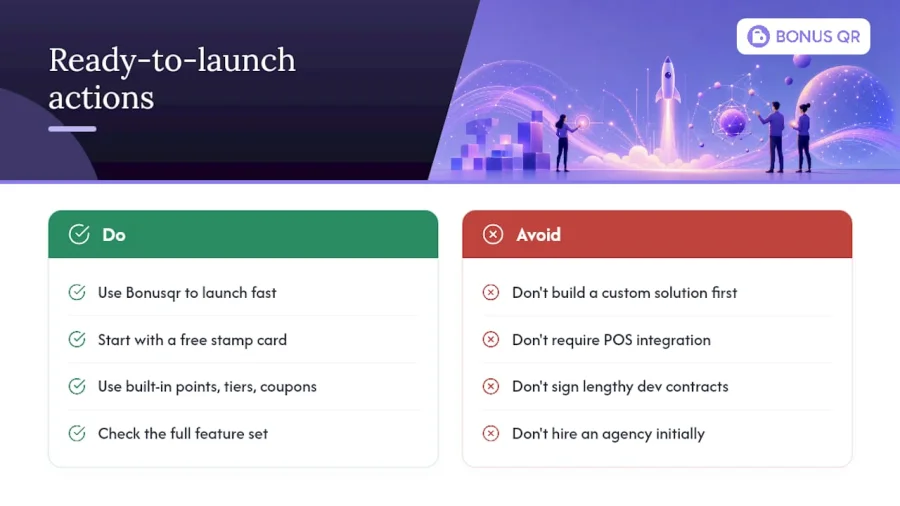
Bonusqr gets you live faster than a custom build and cheaper than hiring an agency to run your rewards programme, because there’s no POS integration requirement and no lengthy development contract standing between you and launch day. You get the mechanics covered in this guide, points, stamp cards, tiered cashback, coupons, and push notifications, in one dashboard, with a free tier to start and white-label options once you’re ready to scale.
Check the full feature set to see how it maps against your own shortlist, or start with a free stamp card program if you want the simplest possible launch this week.
Where to read more on loyalty program software
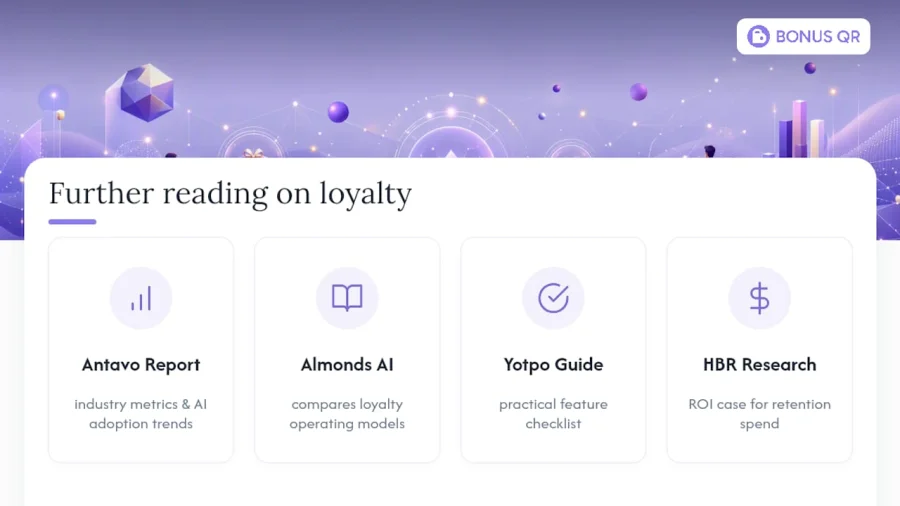
For deeper research, Antavo’s Global Customer Loyalty Report covers industry metrics and AI adoption trends. Almonds AI’s buyer’s guide compares operating models in more depth. Yotpo’s buyer’s guide offers a practical feature checklist, and HBR’s research grounds the ROI case for customer retention spend.