
 Deutsch
 Español
 Français
 Italiano
 Magyar
 Polski
 Slovenčina
 Čeština
A lot of local businesses are running coupon ads that feel busy, expensive, and hard to measure. The owner boosts a post, prints a stack of flyers, adds a discount to a menu board, and then waits. Some redemptions come in, but nobody can say which offer worked, which channel brought in the customer, or whether the campaign protected margin.
That is the problem with advertising with coupons. The discount isn't usually the issue. The lack of structure is.
A café, salon, gym, or neighbourhood retailer can make coupons work. But profitable campaigns don't start with “10% off” or a rushed Instagram graphic. They start with a business decision. Who should this offer move, what behaviour should it change, and how will staff redeem it without slowing down the till or front desk?
Done well, coupons become more than a promotion. They become a repeatable acquisition and retention system that can lift spend, bring lapsed customers back, and feed a loyalty database the business owns.
The Modern Coupon Strategy Before You Launch
A coupon campaign needs a foundation before it needs artwork. The three pillars are goals, offers, and margins. If one is missing, the campaign usually turns into broad discounting that trains customers to wait for the next deal.
For local businesses, that foundation matters because coupon users often spend more and come back more often when the offer structure is right. Coupon users spend 35% more than non-users, and 93% of consumers would likely return to a retailer that offers regular discounts according to coupon usage data compiled by Electro IQ. That makes coupons powerful, but only when the offer supports a clear objective.
Start with one job for the campaign
A coupon should do one primary job. Not three.
If a salon wants new clients, a first-visit offer makes sense. If a café wants to raise basket size, a bundle offer works better. If a gym wants to reactivate dormant members, the message and timing need to feel like a re-engagement campaign, not a generic public discount.
A simple way to choose the right campaign goal is to ask which of these problems hurts most right now:
- Quiet footfall periods: Use a time-bound incentive to shift demand into slow hours.
- Low average spend: Build the offer around bundles, upgrades, or minimum-spend thresholds.
- Customer drop-off: Send a “come back” offer to people who haven't visited recently.
- Weak first-visit conversion: Lower the friction for trial with a welcome voucher.
Practical rule: One campaign, one main outcome. If staff can't explain the purpose in one sentence, the offer is too vague.
Match the offer to the behaviour
Not all discounts behave the same way. A percentage discount feels broad, but it can be wasteful on already-popular items. A fixed-value offer is clearer, especially for services. A “buy one, get one” style offer can work well in food and drink because it encourages group visits and impulse add-ons.
A few examples make the trade-offs clearer:
| Business type | Better objective | Better coupon style | Watch out for |
|---|---|---|---|
| Café | Increase spend per visit | Meal deal, drink plus pastry, spend-threshold reward | Discounting best-selling low-margin items |
| Salon | Acquire first-time clients | New-client fixed discount on a specific treatment | Applying the offer to premium services with long appointment times |
| Restaurant | Fill quiet windows | Midweek or off-peak set-menu coupon | Running the same offer on peak evenings |
| Retail shop | Move specific stock or lift repeat visits | Category-based voucher or next-visit coupon | Using one blanket discount across the whole shop |
The strongest coupon isn't always the largest. It's the one that moves behaviour without teaching customers to expect permanent markdowns.
Protect margin before anything goes live
Too many small businesses work out the maths after the campaign starts. By then, staff have already told customers the offer is available, social posts are live, and pulling it back feels awkward.
Margin protection starts with three checks:
Know what the coupon applies to.
Put boundaries around products, time slots, or services.Know the customer action required.
Set a first visit, minimum spend, bundle purchase, or return-visit condition.Know the redemption limit.
If an offer can be reused endlessly, the promotion can effectively become the new normal price.
A good test is whether the offer still works if the most deal-sensitive customer uses it exactly as written. If the answer is no, the terms are too loose.
Avoid the generic campaign trap
Generic coupons often fail because they're aimed at everyone and therefore meaningful to no one. A “15% off anything this week” style promotion may generate attention, but it also attracts bargain hunters who may never return and can dilute perceived value.
That's especially risky in categories that rely on trust, routine, and brand feel. A beauty business, premium café, wellness studio, or specialist food retailer needs offers that feel deliberate, not desperate.
A coupon should answer a business question. It shouldn't just create activity.
The best-performing campaigns usually look less flashy than expected. They're targeted, easy to redeem, and built around a specific commercial outcome. That's what makes advertising with coupons profitable rather than noisy.
Designing Coupons That Actually Convert
A high-performing coupon has three parts. The hook, the offer, and the action.
Most underperforming coupons fail because one of those parts is weak. The headline is bland, the value is unclear, or redemption takes too much effort. If a customer has to read tiny terms, search old emails, or ask staff to manually honour a screenshot, conversion drops.
The hook needs to stop the scroll or glance
Weak coupon:
“Special offer available now”
Stronger coupon:
“Free pastry with any large coffee before 11am”
The second version works because it's concrete. It names the reward, the condition, and the time window. A salon could do the same with “£10 off your first facial this week” or “Complimentary add-on with any colour appointment on Tuesday and Wednesday”.
Clarity beats cleverness. A local business doesn't need wordplay. It needs instant comprehension.
The offer must feel simple at first glance
People decide quickly whether a coupon is worth using. That means the visual hierarchy matters:
- Headline first: State the benefit in large text.
- Offer details second: Explain exactly what's included.
- Conditions third: Keep terms short and readable.
- Call to action last: Tell the customer what to do next.
The most common design mistake is trying to squeeze in too much. Multiple offers on one coupon, too many exclusions, or cramped text usually weakens response. One coupon should promote one action.
A clean structure often looks like this:
- Top line: “Welcome back”
- Main benefit: “Free coffee with any breakfast order”
- Condition: “Valid Monday to Thursday until 11am”
- Action: “Scan to save to your phone”
The action should be frictionless
Many traditional coupon ads still lose people. The customer sees the offer, intends to redeem it, then forgets, misplaces it, or can't find it at the counter. QR codes solve that only if they lead somewhere useful.
A direct business-owned experience works better than sending people off to a third-party directory. Nearly 54% of smartphone users obtain coupons directly from the business offering them, based on Invesp's digital coupon benchmark. That matters because control over the coupon lifecycle improves consistency, branding, and follow-up.
The best QR code on a coupon doesn't just open a webpage. It captures intent and gives the business a way to recognise the customer later.
A practical QR flow should do four things:
- Open instantly on mobile
- Save the offer without log-in friction
- Make redemption easy for staff
- Connect the offer to a customer profile or loyalty record
That's why businesses looking for effective coupon strategies usually move away from static one-off promo codes and towards QR-based redemption tied to a customer record.
Before and after coupon structure
Here's the difference in plain terms:
| Weak coupon | Strong coupon |
|---|---|
| “Discount available” | “20% off your first haircut” |
| Tiny terms block | One clear line of conditions |
| Generic stock image | Real product or service context |
| QR code to homepage | QR code to saved offer or loyalty wallet |
| No expiry emphasis | Visible expiry or limited-use cue |
The strongest coupon design feels obvious. Customers know what they get. Staff know how to redeem it. The business knows how to track it.
That's the standard worth aiming for. Anything more complicated usually creates friction that kills redemption before the customer reaches the till.
Choosing Your Coupon Advertising Channels
The best channel depends on the job the coupon needs to do. Print, digital, in-store, and local partnerships all have a place. The mistake is treating them as interchangeable.
For acquisition, visibility matters. For retention, direct access matters. For walk-in conversion, timing matters.
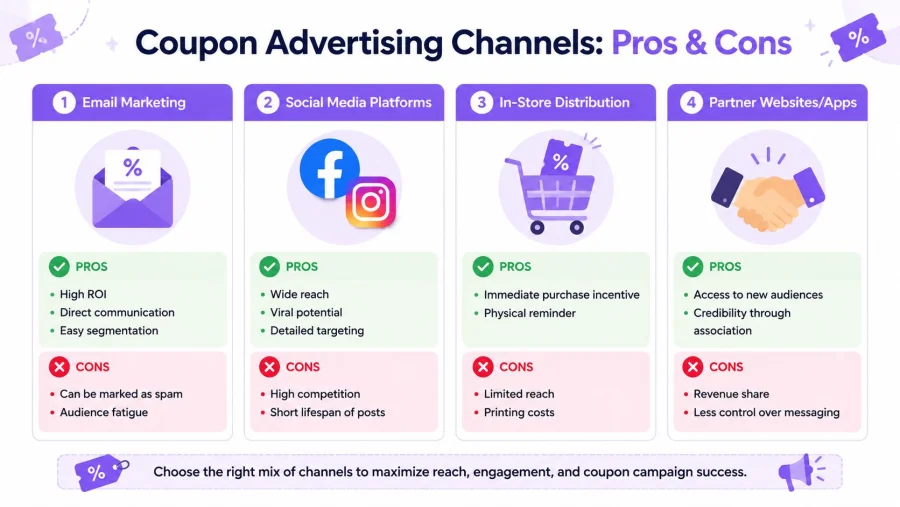
Social and email for speed and targeting
Social media matters because customers already expect to see offers there. In the UK, 72% of consumers expect brands to share discount offers and sales on social media, according to WordStream's advertising statistics reference. For a local café, salon, or restaurant, that makes social a practical acquisition channel, especially for nearby audiences who may act quickly.
Email works differently. It's less about discovery and more about reminding people who already know the business. Email is useful for:
- Rewarding regulars: Send offers that recognise previous visits.
- Filling quiet periods: Promote a specific daypart or underbooked time.
- Reactivating lapsed customers: Use a personal, direct message rather than a broad ad.
Social is public. Email is controlled. That distinction matters when the business wants to avoid showing the same discount to every customer.
Print and in-store for local intent
Print still has a role when the catchment area is tight. A flyer, receipt insert, takeaway bag sticker, menu insert, or self-mailer can work well for neighbourhood businesses because redemption often happens close to the point of discovery.
In-store materials are even simpler. A poster at the till, a tent card on tables, or a window sign can turn existing footfall into repeat visits.
The key trade-off is tracking. Print and in-store are easier to miss-measure unless each placement uses a separate code, QR, or redemption rule.
| Channel | Best use | Main strength | Main risk |
|---|---|---|---|
| Social media | New customer reach | Fast distribution and local targeting | Offers disappear quickly in the feed |
| Existing customer retention | Direct communication and segmentation | Overuse can cause fatigue | |
| Neighbourhood awareness | Physical visibility | Harder attribution without unique tracking | |
| In-store | Upsell and repeat visit prompts | Seen at purchase moment | Limited to current visitors |
| Partnerships | New but relevant audiences | Borrowed trust | Less control over presentation |
Partnerships can outperform broad discount platforms
Neighbouring businesses often make better coupon partners than mass deal sites. A gym and smoothie bar, a salon and café, or a bookshop and coffee shop can exchange value without competing directly.
The benefit is context. The audience is already local, and the recommendation feels closer to a personal endorsement than a generic deal listing.
A good partnership offer should be narrow and reciprocal:
- Make it relevant: Match the partner's audience habits.
- Keep redemption simple: Staff should recognise the offer immediately.
- Use separate tracking: Each partner needs its own code or QR route.
A channel isn't “good” because it's popular. It's good when it reaches the right customer at the right moment with an offer that matches intent.
Most small businesses get the best results from a blended approach. One direct channel for existing customers, one public channel for discovery, and one in-location touchpoint to catch people already close to buying.
Launching and Tracking Your Campaign Performance
A coupon campaign without tracking is just a discount with paperwork. The ad might feel busy, staff might mention that “a lot of people used it”, but the business still can't answer the important questions. Which channel produced redemptions? Which offer brought in first-time customers? Which campaign increased basket size rather than just reducing margin?
That's why modern couponing has moved away from paper-first systems. Digital coupons achieve 77% higher redemption rates than paper vouchers, with an average redemption rate of 7% or higher, while paper channels have a global redemption rate of only 0.85% of all coupons issued, based on UK and global coupon data gathered by PromoCode. Higher redemption is valuable only if the business can see what happened after the redemption.
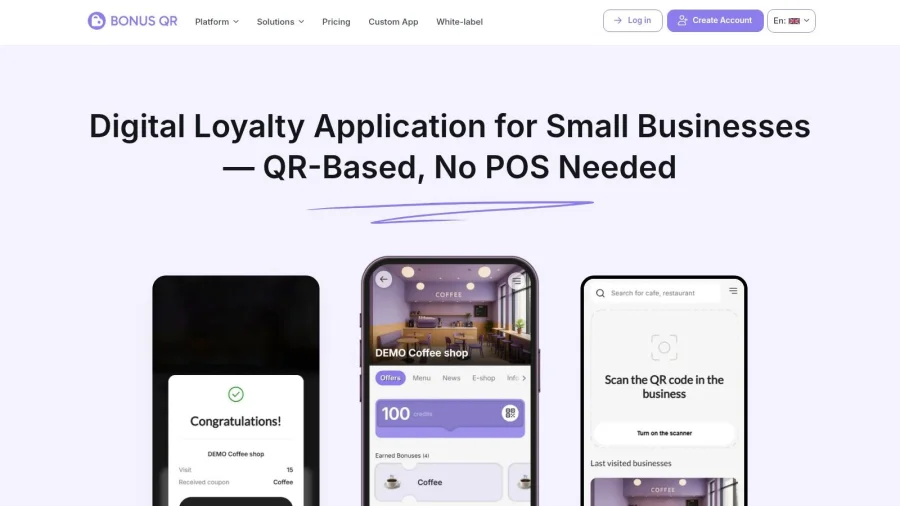
Track four numbers that matter
A small business doesn't need a complex reporting stack. It needs a few operational metrics that staff and managers can act on.
Redemption rate
This shows whether the offer and channel were compelling enough to trigger action.Cost per redemption
Add the media spend, design cost, print spend, and incentive cost. Then compare that with the number of redeemed offers.New customer acquisition
Separate first-time redeemers from existing customers. A “successful” campaign can look busy while only discounting people who would have bought anyway.Average spend impact
Check whether coupon users spend only the discounted amount or add more items, upgrades, or future visits.
These numbers don't need a boardroom presentation. They need to be visible enough to guide the next campaign.
Make redemption easy for staff
The fastest way to ruin a campaign is to create friction at the counter. If employees need to inspect screenshots, type manual codes, or ask a manager to approve each use, queues form and consistency disappears.
A workable redemption process has a few traits:
- Staff recognise the offer immediately
- The validation method is standardised
- The redeemed coupon can't be reused accidentally
- The customer record updates at the same moment
That's where a QR-based loyalty workflow helps. Instead of treating the coupon as a loose promotional object, the business treats it as part of a customer profile. The discount is validated quickly, and the campaign data is logged without extra admin.
Use data to improve the next campaign, not just report the last one
Tracking matters because it changes decisions. A business might discover that a morning coffee coupon drives strong redemption but poor spend, while an afternoon bundle offer brings fewer redeemers but better tickets. Or a salon may find that one offer generates first bookings while another mostly rewards existing regulars.
Those are useful distinctions. They shape budget, channel choice, staffing, and the next promotion.
For businesses that need help connecting ad activity to measurable local results, especially in beauty and wellness, Beautysecrets.agency advertising services offers a helpful reference point for how paid promotion can support booked appointments rather than vanity metrics.
If the business can't tell whether a coupon created a customer or only reduced the price for an existing one, the campaign hasn't been measured properly.
Build a dashboard that answers practical questions
A reporting view should answer operational questions fast:
| Question | What to look for |
|---|---|
| Which offer brought in the most new customers? | First-time redemptions by campaign |
| Which channel produced the cheapest redemptions? | Spend versus redemptions by source |
| Which coupon increased average order value? | Spend per redeemed transaction |
| Which customers came back after redeeming? | Repeat visit behaviour after campaign use |
Tools that surface BonusQR loyalty insights make that analysis easier because they connect redemptions, visit behaviour, and customer records in one place rather than across spreadsheets and till notes.
That visibility turns advertising with coupons into a system. The business stops guessing and starts adjusting.
Optimising Your Strategy with Customer Segmentation
The most profitable coupon campaigns stop treating every customer the same. A first-time visitor, a regular, and someone who hasn't returned in weeks shouldn't see identical offers.
Segmentation fixes that. It doesn't require enterprise software or a data team. It requires basic customer history and the discipline to send different offers to different groups.
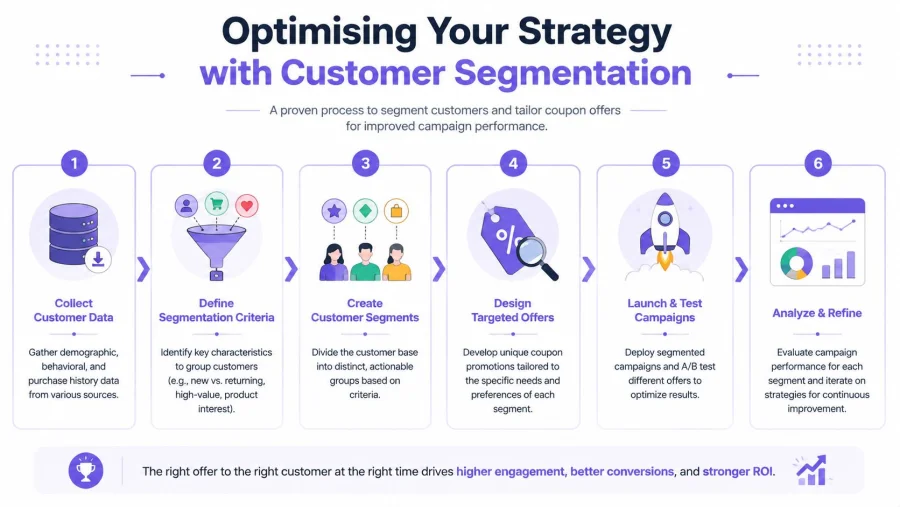
Three segments worth building first
Most brick-and-mortar businesses can start with three practical groups.
New customers
A first-visit offer should reduce hesitation without overspending on acquisition. For a café, that might be a welcome treat attached to a first purchase. For a salon, it could be a fixed discount on a defined introductory service.
The message should feel like onboarding, not bargain-bin promotion.
Lapsed customers
These are people who used to visit and stopped. They often respond well to a reminder paired with a relevant incentive. The offer doesn't need to be dramatic. It needs to be timely and specific.
A good reactivation message sounds like recognition. It doesn't sound like a public sale.
VIP or high-value regulars
These customers usually don't need broad discounts. They need appreciation, access, and occasional exclusivity. Reward them too aggressively with blanket coupons and the business gives away margin it didn't need to lose.
A better approach is to offer something premium, early, or personalised.
Personalised coupons feel less like advertising and more like service.
Use behaviour, not guesswork
Segmentation should come from actions the business can observe:
- Visit history: New, active, drifting, or inactive
- Spend pattern: High-value, moderate, price-sensitive
- Product preference: Coffee buyer, lunch customer, colour client, massage client
- Timing habit: Weekday mornings, weekend afternoons, off-peak users
That turns couponing into behavioural targeting rather than blanket promotion.
A restaurant, for example, may reward weekday lunch regulars differently from occasional dinner guests. A gym may send a comeback offer to members who stopped scanning in. A student-focused venue might also look at category-specific offers such as University student savings to understand how clearly defined audience deals can be framed without confusing the wider customer base.
Build campaigns that feel relevant
Different segments need different framing.
| Segment | Better message angle | Better coupon behaviour |
|---|---|---|
| New customer | “Try us” | Low-friction first purchase incentive |
| Lapsed customer | “We'd love to see you again” | Time-sensitive return offer |
| VIP customer | “Exclusive for regulars” | Reward or perk without heavy discounting |
Once a business has that structure, campaign planning gets easier. The owner no longer asks, “What discount should we post this week?” The better question is, “Which customer group needs a nudge, and what's the lightest offer that will move them?”
Platforms with BonusQR segmentation features support this by grouping customers based on visit and spending behaviour, which makes targeted offers easier to organise and far less manual.
That's where coupon advertising becomes more mature. The discount is no longer the centrepiece. The relationship is.
The Fine Print Legal Rules and Smart Expiration Dates
A coupon should never make staff argue with customers. Clear terms prevent that.
The fine print doesn't need to be dense or intimidating. It needs to remove ambiguity. When terms are missing, front-line staff end up making exceptions on the spot, and the campaign becomes inconsistent.
Terms every coupon should cover
Most local businesses should include these basics in plain language:
- Who can use it: One per customer, first-time customers only, loyalty members only, or named segment only.
- When it applies: Include valid dates, excluded days, and any time-of-day restrictions.
- What it covers: State the service, product range, or minimum-spend condition clearly.
- What it can't combine with: Say whether other promotions, set menus, packages, or member pricing are excluded.
- How it's redeemed: Show whether the customer must scan, present the coupon before payment, or save it to a wallet first.
Short terms build trust because customers know what to expect before they arrive.
Clear terms protect margin and protect staff. They also make the business look organised.
Choose expiration dates that create urgency without irritation
Expiry date strategy is practical psychology. Too short, and customers miss the window and feel annoyed. Too long, and the coupon loses momentum and gets forgotten.
A useful rule of thumb is to match the expiry to the purchase cycle. Fast-frequency businesses such as cafés can use shorter windows because customers make decisions quickly. Higher-consideration services such as beauty or wellness may need longer breathing room so customers can book.
A business should ask:
- Is this an impulse purchase or a planned visit?
- Does the customer need to schedule time?
- Is the goal immediate footfall or slower nurture?
That usually leads to a smarter expiry choice than copying whatever another business did.
Keep urgency real
Artificial urgency backfires when every campaign says “last chance” and nothing really ends. Customers learn the pattern.
Real urgency comes from genuine limits. A weekday-only redemption window, a seasonal product tie-in, a limited welcome offer, or a quiet-hour incentive all feel more believable because they connect to actual operations.
Automatic reminders before expiry can help too, especially when the business wants to recover near-missed conversions without retraining customers to wait indefinitely.
From Coupons to Customers for Life
Advertising with coupons works best when the business stops treating coupons as isolated discounts. A profitable campaign starts with a clear goal, uses an offer that fits the margin, appears in the right channel, and gets tracked all the way through redemption and repeat behaviour.
That's the shift. Old couponing was loose, hard to measure, and easy to misuse. Modern couponing is operational. The business knows who received the offer, who redeemed it, what they spent, and whether they came back.
For coffee shops, salons, restaurants, gyms, and retailers, that changes the value of every campaign. A coupon no longer exists just to create a short-term spike. It becomes a bridge into loyalty, follow-up marketing, and better customer segmentation.
The simplest path is to use a system that connects offers directly to real customer profiles, lets staff redeem them in seconds, and shows the performance without spreadsheet chaos.
BonusQR gives brick-and-mortar businesses that setup in a practical, low-friction format. It helps turn QR-based coupons, loyalty rewards, and customer data into one repeatable growth engine. For any owner who wants fewer guesswork promotions and more measurable repeat business, it's a strong place to start.