
 Deutsch
 Español
 Français
 Italiano
 Magyar
 Polski
 Slovenčina
 Čeština
A customer who scans a welcome QR code, visits twice, becomes a regular and refers friends isn't showing one fixed level of loyalty. Each behaviour needs a different prompt, reward and success measure. Treating every customer with the same points offer wastes budget and leaves useful signals hidden.
The UK market makes this distinction urgent. EY reported in May 2025 that value had become twice as important as brand in purchasing decisions among UK consumers. A separate ServiceNow survey found that 67% of UK consumers felt less loyal to brands than two years earlier, while 33% prioritised the cheapest option. Loyalty still matters, but customers increasingly need visible value, relevant service and reasons to return.
These eight brand loyalty levels map the journey from first discovery to measurable retention and community. Each stage gives cafés, salons, gyms and retailers a practical BonusQR move, a focused KPI set and one next-stage action. The approach favours low-friction QR enrolment, useful rewards and evidence-led improvement over blanket discounting.
1. Stage 1 Awareness, the first-time visitor
Awareness is the first measurable loyalty stage, not loyalty itself. A person may discover a café through local search, pass a salon, tour a gym or enter a shop after a recommendation. Their first decision is practical: is returning easy, clear and worthwhile?
A BonusQR welcome bonus gives that first interaction a trackable next step. A café can place a QR code on the receipt and offer a simple first-scan reward. A salon might display it at reception with a service-related benefit. A gym can invite trial visitors to join before they leave, while a retailer can print the code on a bag or place it beside the till.
Keep the offer understandable in a few seconds. “Join and receive a welcome reward” gives staff a message they can repeat quickly. A points ladder with exclusions creates questions before the relationship has developed.
Build a measurable first step
Track QR scans, completed sign-ups, first reward redemptions and the source of each enrolment. Separate codes or placements for a receipt, menu board, window poster and till display show which discovery point produces action. Scans measure attention. Later visits indicate whether the first experience earned another chance.
Give staff a short script covering three points: what the customer receives, how redemption works and what happens next. The process should fit the existing checkout, reception or membership workflow rather than interrupt it.
- Use visible placements: Test the till, entrance, menu, receipt and staff phone.
- Make the reward immediate: A free add-on, stamp or service upgrade is easier to understand than delayed value.
- Review source quality: Compare sign-ups with later visits, not scans alone.
- Change one variable at a time: Test the offer and placement separately so the result remains useful.
Practical rule: Awareness rewards should remove hesitation, not train customers to wait for a heavy discount.
The next-stage action is a timely reminder showing progress towards a second visit. For a café, that might follow the first purchase. A salon can prompt the next appointment, while a gym or retailer can point to the next relevant reason to return. Measure whether the new member comes back, then use that result to shape the Engagement offer.
2. Stage 2 Engagement, the occasional repeat customer
The second visit is the test. The customer has joined the programme and returned, yet the business has not become part of a routine. A café may see someone comparing its service with another lunch option. A salon client may be deciding whether to book again. A gym member may still be weighing attendance against the household budget.
Give this customer a specific next reason to return. A progress-based drink reward, a relevant product bonus or access to an introductory fitness class can make the next action clear. The offer should support a normal purchase, booking or visit rather than turn every interaction into a discount claim.
A digital customer stamp card system suits this stage because it shows progress without complex pricing rules. BonusQR can record the action, display the balance and give staff a simple way to confirm redemption.
Segment the follow-up by behaviour. A weekday coffee buyer needs a different prompt from a weekend brunch customer. A salon message should reflect booking history, while a gym message can relate to attendance patterns. Use the customer's selected preferences to limit updates to relevant products, treatments, classes or events.
Track the handoff to the next visit. The useful KPIs are second-visit rate, time between visits, active member rate, reward redemption and offer response by segment. Review these measures by purchase category and visit pattern, then compare which message produces an actual return rather than relying on scans or opens.
For a café, BonusQR might send a morning reminder after a first lunch purchase. A salon can prompt a suitable follow-up appointment, and a gym can suggest a class that matches recent attendance. The timing should fit the existing checkout, reception or membership workflow.
- Reward a defined action: Measure a return visit, booking or category purchase.
- Keep redemption quick: Staff should scan and confirm without manual calculations.
- Make progress visible: Show the stamp count, balance or next reward in plain language.
- Limit complexity: Save tiers and status benefits for customers whose visits have become predictable.
A customer at this stage needs proof that returning is easy and worthwhile. Once the pattern stabilises, the programme can recognise deeper commitment.
3. Stage 3 Habit Formation, the regular customer
A regular customer has stopped weighing alternatives for every purchase. The café fits a morning route, the salon is the expected treatment provider, the gym belongs in the weekly schedule, and the retailer is the default for a familiar need. At this stage, loyalty depends on protecting that routine while giving customers a reason to increase their involvement.
Set the programme around behaviour you can observe. BonusQR supports smarter points redemption, visit thresholds, spend thresholds and tiered benefits. A coffee shop might offer members early access to seasonal beans. A salon could provide priority booking or a birthday treatment upgrade. A gym might recognise attendance milestones with a guest pass or access to a special class.
The trade-off is clear: stronger benefits can increase recognition, but they also add cost. Compare each benefit with the behaviour it is meant to influence. A frequently redeemed perk may still weaken margins if it shifts customers toward low-margin purchases. An experience-based benefit, such as early access or priority service, may reinforce the relationship with less discounting.
Make progress easy to understand. Customers should see their current status, the action that leads to the next level and the benefit they will receive. A regular who reaches a new tier should get a clear message through the existing checkout, booking or membership workflow, rather than finding the benefit by accident.
Track visit frequency, average spend, reward liability, tier movement and dormant-member rate. Review these KPIs by customer behaviour and purchase category. Remove benefits that create expense without changing visits, bookings or spend.
- Choose a measurable milestone: Use visits, bookings or spend according to the business model.
- Automate personal moments: Birthday, anniversary and milestone messages reduce staff workload.
- Ask for preferences: A short question is more reliable than guessing what regulars value.
- Set a next-stage action: Invite suitable regulars to give feedback or make a referral once their pattern is stable.
A café can send a member-only seasonal offer after several morning visits. A salon can present priority booking when clients consistently rebook. A gym can offer a guest pass after a sustained attendance pattern. Each action should fit the staff process and give the customer a clear reason to return.
Habit grows through dependable value and occasional recognition, not constant promotion.
4. Stage 4 Advocacy, the loyal brand ambassador
Advocacy appears when customers create value beyond their own purchase. They recommend a café to colleagues, review a salon after a good appointment, bring a friend to the gym or tell others about a product they trust. Some know staff by name and offer useful feedback without prompting.
The practical goal is to make that contribution easy to recognise and measure. BonusQR referral tracking can show who creates introductions instead of relying on staff memory. Reward the outcome that matters, such as a referred customer completing a first visit, rather than an unqualified click.
A café could give a regular early access to a seasonal tasting and ask for feedback. A salon could invite a trusted client to review a new service, with consent for any public feature. A gym might let an established member preview a class and bring a guest. These actions build participation while keeping the offer inside the existing booking, checkout or membership workflow.
Reward contribution without making advocacy feel bought
Track referral invitations, referred customers who complete a visit, review volume, event participation and advocate retention. These measures distinguish activity from useful advocacy. Keep recognition separate from payment where possible. A thank-you message or private preview may suit one customer, while a structured referral reward may suit another.
- Recognise early contribution: Appreciate a useful introduction or thoughtful review before a customer becomes a high-volume advocate.
- Set a clear referral milestone: Tie a small benefit or access to one completed introduction.
- Protect trust: Never pressure customers to post scripted praise or support claims they cannot verify.
- Give staff discretion: A modest upgrade can feel personal when it reflects a real relationship.
- Invite practical influence: Ask advocates to comment on services, products, events or opening hours.
Advocacy involves a real trade-off. A tightly scripted ambassador programme offers control but can make recommendations feel artificial. A looser programme sounds more credible, yet it still needs clear rules for brand representation, privacy and reward eligibility.
Review advocates for value beyond referrals. A customer who gives useful feedback, attends events and brings suitable guests may merit earlier retention attention when visits begin to fall. That next-stage action connects community participation with measurable customer continuity.
Trust grows when recognition follows genuine contribution, not when every interaction becomes a sales request.
5. Stage 5 Retention Optimisation, the sustained high-value customer
Retention optimisation focuses on customers whose relationship value could be lost when their routine changes. Recent spending alone is an incomplete signal. A salon client with a regular booking pattern, a gym member with a long history or a café customer who visits frequently may all need attention before they disappear.
Build the working view around lifetime value, visit trend, category preference and inactivity. BonusQR analytics can help staff identify valuable customers and changes in visit behaviour. Set an alert for the point at which a visit becomes unusual. A café manager can send a personal note, a salon team can suggest a suitable appointment time and a gym can ask whether a member needs help returning.
The best retention action depends on the reason for the gap. Use retention by segment, days since last visit, reactivation, average value after win-back and reward cost to judge whether the response works. A lapsed customer may need scheduling help, service recovery, a reminder or easier access. A large discount can recover one purchase while reducing margin and teaching customers to wait for offers.
Use known preferences to make the message relevant. Mention a favourite drink, preferred stylist, regular class or previously purchased category when the record supports it. Ask returning customers what changed, but keep the question quick enough for staff to use during a normal visit.
- Define high value properly: Base it on cumulative relationship value, not only recent spend.
- Set practical alerts: Match the inactivity point to the business's normal visit cycle.
- Test the response: Compare reminders, service recovery, access and incentives.
- Record the reason: Store useful feedback so the next contact is more informed.
- Brief the whole team: Staff should know why a customer is receiving attention and what to offer.
Retention requires judgement. A personal check-in may suit a regular café customer, while a gym member may respond better to help choosing a class. Review reward cost alongside recovered visits and value after reactivation.
A win-back offer can recover a transaction. A useful conversation can recover the relationship.
6. Stage 6 Community Building, the connected customer network
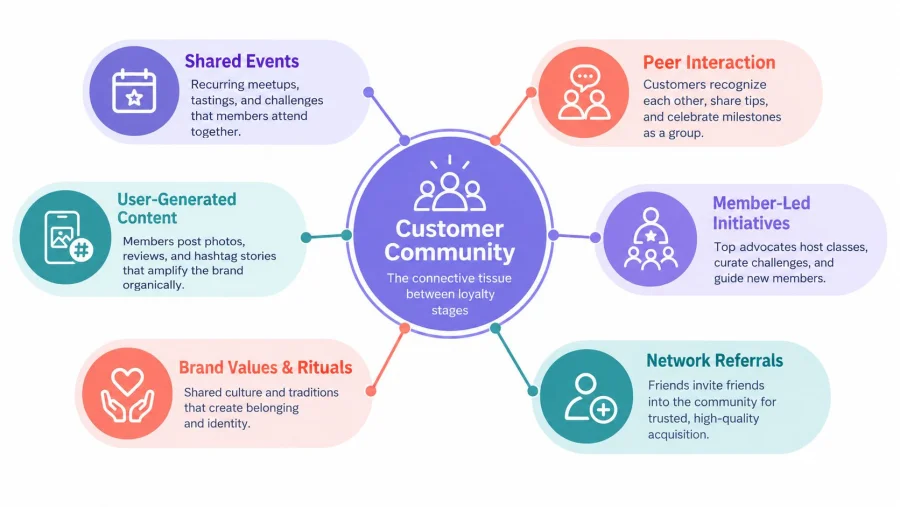
Community adds a third relationship: customers connect with the business and with one another. A café might host a tasting evening, a gym might run a members-only group for encouragement and class updates, a salon might share styling ideas in a private space, and a retailer might invite customers to demonstrations or local events.
Participation can take different forms. Some members will post, while others will attend, react or follow without posting. Give each person a comfortable reason to join rather than treating visible activity as the only sign of value.
Invite existing advocates first. They already understand the service and can set the tone for new members. Before opening the space widely, the owner should define its purpose, acceptable behaviour and moderation responsibilities. WhatsApp suits quick local updates, while an email community or app feed may give the team more control over announcements and content.
Make belonging practical
Measure event attendance, active participation, repeat visits linked to community activity, referrals from members and member retention. Group size alone says little. A smaller audience that attends, responds and recommends the business can contribute more than a large group with no activity.
- Seed useful conversation: Ask about product preferences, class goals, local recommendations or service questions.
- Offer low-effort participation: Reactions, polls and attendance can count as meaningful involvement.
- Celebrate members respectfully: Get permission before sharing names, images or achievements.
- Create a recurring rhythm: Regular events or updates are easier to remember than occasional bursts.
- Moderate quickly: Remove harassment, misleading claims and promotional noise.
Community needs staff time. Poor moderation can weaken trust faster than a small programme, so assign an owner, set response expectations and decide which issues require escalation. Use BonusQR messages to promote relevant events, with enough restraint to avoid turning the community into another stream of promotions.
The next-stage action is to connect participation with measurable loyalty behaviour. Track whether community members attend, refer friends, book appointments or make purchases after taking part. That link helps a café, salon, gym or retailer decide which activities deserve more staff time and which should be changed or stopped.
7. Platform Capabilities and Cross-Stage Features
A loyalty programme works across stages only when customer signals and staff actions stay connected. A café might collect stamps at the till, a salon may track bookings, and a retailer may monitor spend. Separate spreadsheets, message lists and social media records obscure whether customers are progressing or just receiving promotions.
BonusQR supports this workflow with welcome bonuses, stamps, points, cashback, visit and spend thresholds, fixed discounts, birthday coupons and seasonal rewards. Customers can join by mobile or web, receive a personal QR code and view points, rewards and visit history in one profile. The profile can also contain menus, price lists, news, reviews and reservations.
Configure features around the next behaviour
Start with the signal the business can act on. Staff scan and redeem in the app, with no POS integration or extra hardware required. Google Wallet and Apple Wallet passes keep offers available, while printable materials and guided setup help small teams present the programme during service.
- Welcome bonus: Turn first discovery into an identifiable member.
- Stamps and visits: Encourage the next visit for cafés, salons and other frequent-service businesses.
- Points and spend thresholds: Recognise varied basket values in retail.
- Tiered cashback or membership: Show progression as customers deepen their relationship.
- Automated campaigns: Send birthday, seasonal, milestone, feedback and win-back messages.
- Analytics: Review customer, coupon and visit trends before adding another rule.
Track feature adoption by stage, time-to-second-visit after activation, reward redemption, repeat-visit rate and movement between stages. The next-stage action is to enable one additional rule only after baseline conversion stabilises. For example, a café can begin with QR enrolment and one welcome reward, then add a visit threshold. A salon can start with rebooking prompts before introducing birthday offers. This sequence limits staff training and makes each change easier to evaluate.
8. Key Metrics, best practices and common pitfalls
A loyalty programme earns its place in daily operations when staff can run it during a busy service and managers can trace progress from discovery to retention. Review whether first-time visitors return, whether regulars stay active, whether rewards are used and whether advocates introduce new customers.
Use a focused KPI set: scan-to-sign-up conversion, second-visit rate, visit interval, reward redemption, average spend, tier movement, referral completion, inactivity, reactivation and retention by segment. The priority differs by business. A café may watch visit intervals, a salon rebooking and lapse detection, a gym attendance consistency, and a retailer category purchases or spend thresholds.
BonusQR's stamps and points analytics can show reward activity and customer movement. Assign each metric an operational response before reviewing the dashboard. A lapsed salon client may receive a rebooking prompt, while a café can test a reminder after the usual visit interval. If no action follows a metric, remove it from the routine.
Avoid the programme failures that waste loyalty
UK consumers already recognise loyalty schemes. YouGov research cited by SAP Emarsys found that 9 in 10 Britons belonged to at least one loyalty programme, with supermarkets leading at 82% enrolment, and the research also reported that discounts, incentives, rewards, strong service and personalisation influenced loyalty for many respondents. A small business competes with established habits, so enrolment should be quick and the reward easy to understand. Inflation-related pressure also makes value important, but broad discounting can reduce margin.
Practical safeguards are simple:
- Don't reward enrolment forever: Tie benefits to visits, spend, referrals or useful feedback.
- Don't hide the balance: Show customers what they have and the next available action.
- Don't send generic offers: Match timing and content to category and lifecycle stage.
- Don't ignore staff: Give employees a short sign-up explanation and clear redemption steps.
- Don't measure only membership: Active visits and completed actions matter more than database size.
- Don't let points expire without warning: State deadlines and send reminders early.
The next-stage action is a monthly transition review. Choose one weak movement, test one change and retain it only when customer behaviour improves without reducing margin or service quality. Salons can adapt these retention strategies for hairstylists when designing rebooking and client follow-up routines.
8-Stage Brand Loyalty Comparison
| Item | 🔄 Implementation complexity | 💡 Resource needs & ⚡ Efficiency | 📊 Expected outcomes | Ideal use cases | ⭐ Key advantages |
|---|---|---|---|---|---|
| Stage 1: Awareness – The First-Time Visitor | Low, QR rollout, basic staff prompts | Low, QR assets, small welcome incentive, brief staff training ⚡ | Quick sign-ups and first purchases; discoverability data | New locations, walk-in retail, cafés, salons | Low-friction enrollment; fast conversion to trials |
| Stage 2: Engagement – The Occasional Repeat Customer | Medium, automation + segmentation setup 🔄 | Medium, CRM data, messaging content, A/B testing resources | Increased visit frequency, higher redemption rates 📊 | QSRs, fitness studios, retailers seeking repeat visits | Personalisation drives frequency and referrals |
| Stage 3: Habit Formation – The Regular Customer | Medium–High, tiers, personalised flows, events | Higher, tier benefits, loyalty UX, event logistics 💡 | Predictable revenue, higher CLV, reduced price sensitivity | Frequent-visit businesses (coffee, gyms, salons) | Strong retention, higher spend, predictable demand |
| Stage 4: Advocacy – The Loyal Brand Ambassador | High, referral systems, VIP events, recognition programs 🔄 | High, event budgets, rewards, staff empowerment | Strong word-of-mouth, high-quality referrals, near-zero churn 📊 | Brands aiming for organic growth and ambassadors | Advocates drive cost-effective acquisition and UGC |
| Stage 5: Retention Optimization – The Sustained High-Value Customer | High, predictive modelling, concierge workflows | High, analytics, dedicated staff, omnichannel tools ⚡ | Lower churn, maximised lifetime value, proactive win‑backs | Luxury, subscription, high-touch service businesses | Best ROI via retention; prevents costly defections |
| Stage 6: Community Building – The Connected Customer Network | High, platform features + active moderation 🔄 | High, community managers, events, content budgets 💡 | Higher retention, viral growth, abundant UGC 📊 | Niche brands, fitness, hobbyist communities | Network effects create strong switching costs |
| Platform Capabilities & Cross-Stage Features | Variable, central platform reduces bespoke work | Medium, platform subscription, integrations, training ⚡ | Consistent automation, unified analytics across stages | Businesses wanting end‑to‑end loyalty orchestration | Automates campaigns, predictive insights, omnichannel reach |
| Key Metrics, Best Practices & Common Pitfalls | Low–Medium, governance and reporting setup 🔄 | Medium, analytics tools, training, QA processes | Clear KPI tracking; fewer execution errors; faster optimisation 📊 | Program owners and analysts setting standards | Actionable measurement and playbook to avoid common mistakes |
Turn the Next Visit Into the Next Level
Brand loyalty levels are useful because they turn a vague ambition, “make customers more loyal”, into an operating routine. A first-time visitor needs a clear welcome. An occasional repeat customer needs a reason to return. A regular needs recognition, an advocate needs influence and a high-value customer needs protection from avoidable churn. A community member needs belonging that remains connected to real visits, bookings, purchases or referrals.
The UK evidence supports a careful approach rather than a points-only strategy. SAP Emarsys found that 73% of UK consumers said they were loyal to certain retailers, brands and stores in 2022, compared with 55% in 2021, before the measure eased to 64% in 2023 and 67% in 2024. The same source found that 71% valued discounts, incentives, rewards, strong service and personalisation, while inflation had caused 56% to leave brands they had previously supported. Participation exists, but businesses must keep proving relevance.
Retailer loyalty and product loyalty also aren't identical. UK research reported 47% loyalty to retailers compared with 33% loyalty to brands. That difference matters for cafés, salons, gyms and local shops, where convenience, staff relationships and service quality may influence repeat behaviour more than product identity.
Start with one observable behaviour
A practical launch sequence looks like this:
- Identify the stage: Separate new members, occasional visitors, regulars, advocates and inactive high-value customers.
- Choose one progression signal: Use a second visit, completed booking, attendance milestone, spend threshold or successful referral.
- Attach one relevant reward: Select a free add-on, priority access, experience, cashback or personalised offer that fits the margin.
- Measure movement: Review the stage KPI rather than relying on total sign-ups.
- Add complexity only when justified: Introduce tiers, win-back flows, referrals or community events after the basic journey works.
BonusQR gives brick-and-mortar businesses a straightforward way to begin with QR sign-up and a welcome bonus, then add stamps, points, cashback, visit or spend thresholds, milestone messages, birthday offers, referrals and win-back campaigns as the data develops. Customers can use a personal QR code, while staff scan and redeem in the app without POS integration or extra hardware.
Cafés, salons, gyms and retailers can start free with BonusQR, print a QR code, launch a simple rewards journey and review the first customer behaviours before expanding it. A small team doesn't need to build every loyalty level at once. It needs to make the next visit easy, measure what happened and improve one level at a time.