
 Deutsch
 Español
 Français
 Italiano
 Magyar
 Polski
 Slovenčina
 Čeština
Brand loyalty levels are the discrete stages customers pass through, from first awareness to active advocacy, marked by distinct thinking, feeling and buying behaviour at each point. The two most useful frameworks are the cognitive-affective-conative-action model and the five-rung loyalty ladder. Both give you a way to match KPIs and tactics to exactly where a customer sits, rather than treating “loyal” as a single, vague label.
TL;DR:
- Customers in the cognitive stage recognize the brand but have not formed a preference, so reach and recall metrics are most relevant.
- Moving customers from first-time buyers to repeat buyers depends on personalization, timely follow-up, and offering meaningful, targeted rewards.
- True loyalty builds through product quality, experience, trust, community, and emotional attachment, rather than solely through discounts or incentives.
- Measuring loyalty accurately requires combining behavioral data with attitudinal measures like NPS, not just tracking repeat purchases or discounts used.
- Implementing stage-specific tactics with a platform like BonusQR accelerates progression, especially for small teams lacking in-house engineering.
What are the main brand loyalty levels frameworks?
Most marketers reach for one of two mental models when mapping customer loyalty tiers, and picking the right one depends on whether you need theoretical grounding or an operational tool your team can act on this quarter.
The cognitive-affective-conative-action model treats loyalty as a four-phase build. Cognitive loyalty means a customer knows and recognises your brand but hasn’t formed a preference. Affective loyalty is liking, an emotional pull towards you over rivals. Conative loyalty is intent, the customer plans to buy again. Action loyalty is the behaviour itself, repeat purchase paired with a willingness to overcome obstacles to keep buying. This sequence is well established in consumer brand loyalty research and gives you the theoretical backbone for any measurement plan.
The loyalty ladder, in its most common five-rung form, is the practitioner’s version of the same idea: prospect, first-time buyer, repeat buyer, loyal customer, advocate. Its appeal is simplicity. Each rung maps to a threshold you can actually track in a CRM or loyalty platform, which is why most implementation guides recommend starting here rather than with a six or seven-rung variant.
Beyond these two, you’ll encounter narrower typologies worth knowing:
- Transactional loyalty, driven almost entirely by price and discounts, with little emotional attachment.
- Emotional loyalty, built on identity, values or a sense of belonging to the brand’s community.
- Incentivised loyalty, where points, cashback or tier status do the heavy lifting.
- Ethical loyalty, where customers stay because a brand’s sourcing, sustainability or politics align with their own.
Each typology implies different tactics: transactional loyalty responds to promotions, emotional loyalty responds to storytelling and community, and confusing the two is where many loyalty programmes waste budget.
Mapping what customers think, feel and do at each stage
Diagnosing where a customer actually sits requires observable markers, not guesswork. Here’s how the two dominant models line up against real behaviour and the metrics that catch it.
Cognitive stage customers have seen your brand, perhaps clicked an ad or walked past your shop, but haven’t bought yet. The signal here isn’t sales, it’s reach and recall: impression frequency, branded search volume, social mentions. There’s no purchase KPI to lean on because there’s no purchase yet.
Affective stage customers have usually made one purchase and reacted positively, or they’ve formed a favourable impression through content, reviews or word of mouth without buying. The tell-tale KPI is early engagement: email open rates, app downloads, first-visit dwell time, and a rising favourability score on brand surveys.
Conative stage customers intend to buy again. This is where a customer adds items to a wishlist, joins your loyalty programme, or returns to browse without purchasing. Watch for repeat site visits, loyalty sign-up rate, and stated purchase intent in surveys, which is exactly why Net Promoter Score works well as an attitudinal anchor here, before behaviour catches up.
Action stage customers repeat-purchase and, crucially, tolerate friction to keep doing so, driving further despite a closer competitor, waiting for restock rather than switching. Repeat purchase rate, purchase frequency, and referral rate are your core metrics here.
Translating this onto the ladder gives you cleaner operational thresholds:
- Prospect: has engaged (visited, followed, subscribed) but never purchased. KPI: engaged non-buyers as a percentage of total reach.
- First-time buyer: one transaction completed. KPI: conversion rate from prospect to buyer.
- Repeat buyer: two or more purchases within a defined window, commonly a few months depending on your category. KPI: repeat purchase rate.
- Loyal customer: sustained purchase frequency above your category’s average, often three-plus purchases per year for retail, weekly visits for cafes and gyms. KPI: purchase frequency band, customer lifetime value (CLV).
- Advocate: refers others, leaves reviews, or engages unprompted with brand content. KPI: referral rate, review volume, Net Promoter Score.
The practical value of holding both models side by side is translation. If your data team reports on “conative” customers and your loyalty platform reports on “repeat buyers,” you need to know these are, in most programme designs, the same cohort described two different ways. Getting that equivalence right stops teams from double-counting or missing a segment entirely when reports get compared across departments.
What drives customers up the levels, and how do you measure it?
Progression between brand loyalty levels rarely happens because of one lever pulled hard. It happens because several drivers reinforce each other over time.
- Product quality and consistency — the baseline. Without this, no amount of clever marketing moves anyone past the cognitive stage for long.
- Experience — every interaction from checkout speed to support response time, shown to sit closer to the loyalty outcome than the original brand offer in recent meta-model research on loyalty antecedents.
- Trust — built through transparency, reliable delivery, and honest handling of mistakes.
- Identity and self-brand connection — the customer sees the brand as part of who they are, not just what they buy.
- Community — shared spaces, user-generated content, or events that make customers feel part of something.
- Incentives — points, cashback and tiers, useful for activation but weakest on their own for sustaining loyalty long-term.
Pro Tip: Track cohorts, not aggregates. A blended “repeat purchase rate” across your whole customer base hides the difference between someone buying because they love you and someone buying because your competitor is temporarily out of stock.
Measurement gets tricky because attitudinal and behavioural loyalty don’t always move together. A customer can repeat-purchase purely because you’re the cheapest option nearby, which looks identical to genuine preference on a repeat-rate dashboard. This is why combining NPS or attitudinal surveys with behavioural metrics like repeat rate and CLV matters, rather than relying on either alone.
The most common measurement mistake is treating discount-driven frequency as loyalty. If a customer only returns when there’s a coupon, cancel the discount and watch the relationship evaporate; that’s incentivised loyalty, not affective or action loyalty, and it inflates your numbers without building anything durable.
How do you move customers up the loyalty ladder?
Tactics need to match the stage a customer is actually in, not the stage you wish they were in.
For cognitive and first-purchase stages, onboarding is everything. A slow, confusing first experience kills progression before it starts. Simplify sign-up, deliver a clear first-purchase incentive, and follow up within 48 hours while the interaction is still fresh.
For repeat-buyer stages, personalised re-engagement outperforms blanket promotions. Send offers based on actual purchase history rather than generic seasonal blasts, and track how repeat visit checklists and digital retention tactics affect frequency over a defined test window.
For loyal-customer stages, tiered benefits work because they give customers something to aspire to beyond the next transaction. Recognition matters as much as the reward itself, a birthday message or early access can outperform a discount of equal cash value.
For advocate stages, community and co-creation take over. Customers at this level want to feel involved, not just rewarded. Review prompts, referral schemes, and inviting feedback on new products all deepen the identity connection that keeps people from drifting to a competitor on price alone.
A few design principles apply across every stage:
- Make rewards meaningful rather than trivial. A £2 discount on a £50 spend rarely changes behaviour.
- Use exclusivity carefully. Tiers should feel earned, not arbitrary.
- Recognise customers publicly where appropriate. Status matters more than most programme designs assume.
- Run small A/B tests on offer structure before rolling out programme-wide.
- Track cohorts over time rather than snapshotting loyalty once a quarter.
- Set a minimum viable tier and expand complexity only when your data shows a genuine behavioural break, not before.
What does the research say about which factors matter most?
A meta-analysis covering 588 elasticities across 290 studies and more than 348,000 consumers found that love-based and attachment-based brand relationships tend to produce the strongest ties to customer brand loyalty, though the strength varies by brand type and how loyalty is measured.
Emotional attachment consistently outperforms purely transactional bonds as a predictor of long-term loyalty, but the effect is moderated by brand type and whether the measure captures attitude or behaviour. A luxury or identity-driven brand sees a much sharper elasticity from attachment than a commodity category does.
The practical takeaway: don’t apply the same loyalty strategy to a grocery chain and a fitness studio. Align your investment in identity and community work to categories where emotional attachment plausibly drives repeat behaviour, and measure attitudinal shift, not just transactions, so you can see the effect before it shows up in revenue.
What marketers get wrong about brand loyalty levels
The most common mistake is measuring only what’s easy to measure, repeat purchase rate, and calling it loyalty. That number can’t tell you whether a customer stays out of preference or habit born from convenience. Weak KPIs built entirely on discount redemption rates make programmes look successful right up until the discount stops.
Quick wins exist without a full rebuild: fix a clunky onboarding flow, add one genuinely personalised touch (not just a first-name merge field), and introduce a simple tier that recognises loyal customers rather than just paying them off. Platforms that let you A/B test offers and segment cohorts quickly turn these into testable hypotheses rather than guesses.
— Michal
How BonusQR helps you execute stage-mapped loyalty tactics
Matching tactics to the right loyalty stage takes infrastructure most small teams don’t want to build from scratch. BonusQR gives you the features to run tiered programmes, stamp cards, and points systems alongside push notifications and real-time analytics, so you can see which cohort is moving between rungs without stitching together spreadsheets and a separate email tool. Custom branding keeps the experience recognisably yours rather than generic.
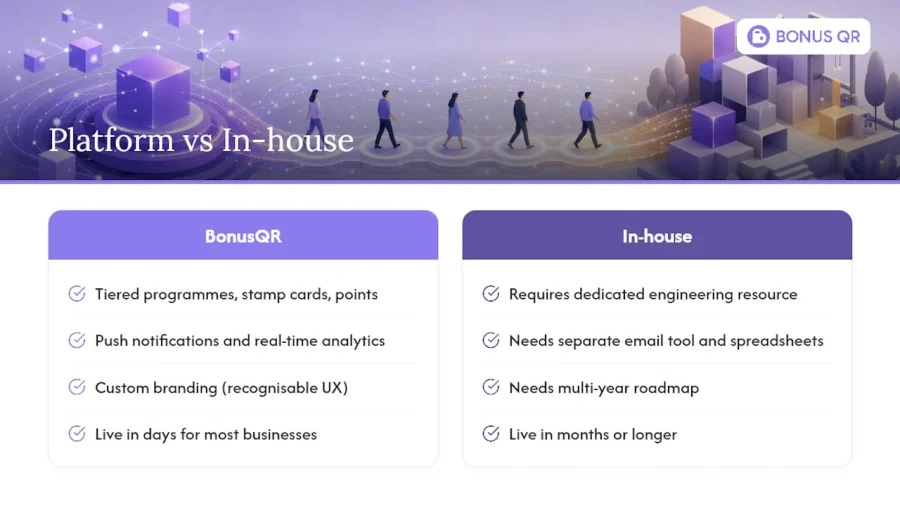
Building this in-house makes sense only once you have dedicated engineering resource and a clear multi-year roadmap; for most retailers, cafes, gyms and service businesses, a ready platform gets stage-mapped tactics live in days rather than months. If you run a services business, the loyalty application built for service providers shows how tiered benefits and recognition slot into a booking-driven model. Set up a free account and start mapping your own customers to their real loyalty stage at Bonusqr.