
 Deutsch
 Español
 Français
 Italiano
 Magyar
 Polski
 Slovenčina
 Čeština
This article gives you a working set of sample loyalty programmes, sector-specific templates, and a measurement framework you can apply this quarter. Trust signals worth noting: the 2026 EY Loyalty Market Study shows what customers actually value, while platforms like Bonusqr let you build most of these mechanics without a developer. Read on for templates and a quick launch checklist.
TL;DR:
- Loyalty programs should be chosen based on customer frequency and value, with points best for moderate purchases and stamps for high-frequency, low-cost visits.
- Shortening reward fulfillment, simplifying redemption options, and providing clear expiry policies are crucial to avoid customer frustration and disengagement.
- The most valued rewards are discounts and cash-like points, while experiential perks generally have less impact despite their popularity among businesses.
- Metrics such as incremental revenue, retention lift, and payback period are more indicative of success than enrolment numbers or total points issued.
- Integrating loyalty data with CRM and marketing systems enhances targeting and automation, but privacy and transparency in data collection are essential from the start.
The main loyalty programme models (and when each one earns its keep)
Every loyalty scheme you’ve ever joined is a variation on five basic models. Picking the right one matters more than picking the right rewards, because the model dictates your costs, your data, and how customers perceive fairness.
Points-based (earn and burn) is the model most people picture first. Customers earn points per pound or per visit and redeem them against future purchases. It’s flexible and easy to explain, but it can feel abstract, especially if the redemption threshold sits too far away. A café offering 1 point per £1 spent, redeemable at 100 points for £5 off, works because the maths is simple enough to do in your head at the till.
Tiered programmes reward cumulative spend or visits with escalating status, think Bronze, Silver, Gold. Tiers work brilliantly for businesses with a genuine gap between casual and committed customers, such as gyms, airlines, or hotels. The catch: tiers only motivate if the climb feels achievable. Set the first tier too high and casual customers disengage before they ever start.
Paid or membership programmes ask customers to pay upfront for guaranteed perks, free delivery, member pricing, early access. These generate immediate revenue and tend to build the strongest loyalty because customers have already committed money. They only work where the perceived value clearly exceeds the fee, and they’re a harder sell to price-sensitive or older customers, who the EY study found are less willing to pay for programme access.
Value or behaviour-based programmes reward actions beyond spend: referrals, reviews, social shares, sustainable choices. A beauty brand might give points for recycling empty containers. These programmes build brand affinity rather than pure transactional loyalty, and they cost little to run since the “reward” often doubles as marketing.
Stamp or visit-based cards are the simplest model of all: buy nine coffees, get the tenth free. They demand almost no explanation and work exceptionally well for high-frequency, low-ticket purchases, cafés, car washes, petrol stations. Digital stamp cards remove the “I lost my card” problem entirely and let you message customers when they’re close to a reward.
Coalition programmes pool rewards across unrelated businesses, letting members earn or spend points across a shared network. These need scale and partnership infrastructure most independent businesses don’t have, but a scaled-down version, a few complementary local businesses cross-honouring rewards, can work well for retail parades or town centre associations.
- Points programmes suit frequent, moderate-value purchases where flexibility matters more than status.
- Tiered programmes suit businesses with a real difference between light and heavy users.
- Paid membership suits businesses that can offer a clear, recurring perk (free shipping, member pricing).
- Value-based rewards suit brands wanting engagement beyond the transaction.
- Stamp cards suit high-frequency, low-cost purchases needing minimal explanation.
Sample loyalty programmes worth stealing from
Rather than naming specific competitor brands, here are transferable mechanics drawn from real-world programme patterns across sectors, grouped by what they’re built to achieve. Each one includes the mechanic and the single idea worth lifting for your own scheme.
1. The “third visit unlocks a gift” stamp card. A hairdresser gives a free deep-conditioning treatment on a customer’s third visit, no explanation needed, no threshold maths. Steal this: front-loaded rewards convert new customers into repeat customers faster than a distant tenth-stamp payoff.
2. Tiered spend with a status name customers actually want. A boutique gym labels its tiers “Starter,” “Committed,” and “Elite,” with Elite members getting priority class booking. Steal this: name tiers around identity, not just spend level, so customers aspire to move up.
3. Birthday-month automatic reward. A independent bookshop emails a £5 voucher the month of a customer’s birthday, no action required. Steal this: automated, no-effort rewards generate goodwill disproportionate to their cost.
4. Punch card with a bonus mission. A car wash gives a stamp per wash, but a bonus stamp for referring a friend. Steal this: layering a referral mission onto a familiar mechanic increases new customer acquisition without a separate campaign.
5. Paid membership with free delivery. A local grocer charges a small annual fee for free same-day delivery on all orders. Steal this: paid tiers work when the perk solves a recurring annoyance (delivery fees) rather than offering vague “exclusive” access.
6. Points that convert to cash-like credit. A pet store lets points redeem directly as store credit at checkout, no separate rewards catalogue. Steal this: the EY study found consumers rank cash-like point redemption among their most-favoured reward types, well above merchandise catalogues.
7. Micro-reward for app check-in. A juice bar awards 5 bonus points simply for opening the app in-store, before any purchase. Steal this: micro-rewards create frequent small wins that keep the app in daily rotation.
8. QR scan-to-earn at the till. A bakery uses a QR code scan instead of a physical card or app login. Steal this: reducing the earn action to a single scan removes the biggest friction point in loyalty adoption.
9. Partner access tier. A yoga studio’s top tier includes a discount at a partnered health food shop nearby. Steal this: local partner perks cost little and expand perceived value beyond what one business can offer alone.
10. Petrol station cents-off stamp system. Fuel retailers commonly offer per-gallon discounts that stack with visit frequency, redeemable instantly at the pump. Steal this: instant, visible discounts at the point of redemption outperform delayed catalogue rewards.
11. Restaurant “mystery reward” spin. A restaurant loyalty app occasionally surprises members with a random small reward after ordering. Steal this: unpredictability, used sparingly, increases app opens without inflating the average reward cost. For more restaurant-specific mechanics, see these restaurant rewards ideas.
12. Retailer double-points weekends. A clothing retailer runs occasional double-points weekends tied to slow sales periods. Steal this: time-boxed point multipliers can shift footfall into off-peak periods without a permanent discount.
13. Subscription box with loyalty-linked perks. A coffee subscription gives points for referrals redeemable against future boxes. Steal this: combining subscription revenue with a lightweight loyalty layer increases retention without new infrastructure.
14. Fitness studio streak rewards. A studio rewards members for attending three weeks in a row with a free guest pass. Steal this: rewarding consistency (not just spend) reinforces the habit that keeps memberships renewed.
15. Salon “refer three, get one free” mission. Rather than a flat referral bonus, the reward unlocks after three successful referrals. Steal this: mission-style thresholds create sustained engagement rather than a single one-off action.
16. E-commerce free-shipping unlock. An online retailer gives loyalty members a permanent free-shipping threshold lower than non-members. Steal this: a tangible, recurring convenience often beats a one-off discount for online-only businesses.
17. Steal this: Simplicity itself can be the reward, especially for older or less tech-engaged customers.
18. Hotel experiential upgrade tier. A boutique hotel chain offers room upgrades as a top-tier perk rather than a discount. Steal this: experiential rewards work as differentiation, but the Antavo Global Customer Loyalty Report notes they should sit alongside savings, not replace them.
What customers actually want (and where programmes go wrong)
Customers want their rewards fast, visible, and easy to use, not buried in a catalogue or locked behind a confusing points ladder. The 2026 EY Loyalty Market Study found that discounts and cash-like point redemption remain the most valued reward types, even as programmes add experiential perks like member-only events.
A majority of organisations offer member-exclusive events, though only a small minority of consumers name those events as their favourite perk. The gap between what businesses build and what customers actually want is one of the clearest signals in the entire study.
That gap matters because it’s expensive to close in the wrong direction.
Mobile visibility compounds the problem. Younger customers lean heavily on apps to track and redeem rewards, while older customers engage less through digital channels and prefer simplicity to feature depth, a split the EY data captures clearly across age groups.
Statistic worth remembering: loyalty apps see notably higher usage among younger consumers compared to older ones, which means your engagement channel should match your customer base rather than defaulting to “build an app for everyone.”
The most common design mistakes fall into three buckets:
- Slow reward fulfilment. If a customer has to spend £500 before seeing any benefit, they’ll disengage long before reaching it. Shorten the first reward’s earn path deliberately.
- Confusing expiry policies. Points that vanish without warning generate resentment disproportionate to their cost. If you must expire points, alert customers well in advance.
- Overcomplicated redemption. A rewards catalogue with dozens of options sounds generous but often paralyses customers. One or two clear redemption paths outperform ten vague ones.
Fixing these doesn’t require rebuilding your programme from scratch. It requires making value visible earlier, sending timely nudges before points expire, and leaning on micro-rewards, small, frequent wins, rather than one distant grand prize.
Metrics that prove your loyalty programme is working
Loyalty programmes live or die on measurement, and the metrics that matter aren’t the ones most dashboards show by default. Enrolment numbers look impressive in a board meeting but tell you almost nothing about whether the programme is profitable.
Five metrics actually matter:
- Incremental revenue per member: the additional spend a member generates compared with a matched non-member, isolating the programme’s real effect rather than crediting it with sales that would have happened anyway.
- Retention lift: the percentage-point difference in repeat-purchase rate between members and non-members over the same period.
- Engaged member rate: the share of enrolled members who actively earn or redeem within a rolling 90-day window, not just the total sign-up count.
- Member lifetime value (LTV) lift: the projected difference in total customer value between loyal members and comparable non-members.
- Payback period: how long it takes the programme’s incremental revenue to cover its running costs, including rewards issued and platform fees.
Benchmarks give you something to aim for rather than guessing in the dark. According to loyalty ROI research, member revenue uplift commonly falls within a moderate range, mature programmes typically return several times their running cost, and payback periods generally span from a few months up to about one and a half years.
To run the calculation yourself: take incremental revenue per member, multiply by your engaged member count, then subtract total programme cost (rewards issued, platform subscription, staff time). Divide the result by monthly programme cost to estimate your payback period in months.
Finance teams will ask for exactly these figures, not vanity metrics like total downloads or points issued. Frame your pitch around incremental revenue and payback period, and you’ll get a faster yes than any slide about “engagement.”
Loyalty programme templates by sector
Each template below gives you the model, the earn rule, the redemption path, a launch offer, and one KPI to track from day one. Adapt the specifics; keep the structure.
1. Retail (points-based). Earn 1 point per £1 spent, redeemable at 100 points for £5 off. Launch offer: double points in the first month of enrolment. Implementation: an app or web widget works well since retail customers browse and shop across channels; POS integration is optional if you track purchases via receipt scan or staff entry. KPI to track: engaged member rate at 90 days. For inspiration, see these retail loyalty programme examples.
2. Café or restaurant (stamp-based). Buy nine drinks, get the tenth free, tracked via digital stamp card. Launch offer: a free stamp for first sign-up. Implementation: card-first is often enough here, no app download needed at the till, though a companion app boosts repeat visibility. KPI to track: average visits per member per month.
Pro Tip: Put the QR code for stamp collection directly on the receipt or till screen. Removing the extra step of “find the app” roughly doubles sign-up rates compared with a poster on the wall.
3. Fitness or wellness (tiered with streak mission). Members earn tier status by monthly visit count, with a bonus mission reward for three consecutive weeks attended. Launch offer: fast-track to Silver tier for founding members. Implementation: app-first is worth the investment here since fitness customers already expect a companion app for bookings. KPI to track: retention lift among Silver-and-above members versus casual visitors.
4. Services (referral and review based). Reward customers for reviews and referrals rather than spend, since service businesses often have low visit frequency. Launch offer: a bonus reward for the first referral within 30 days of enrolment. Implementation: web-based enrolment via a booking confirmation email works without an app. KPI to track: referral conversion rate.
5. E-commerce (paid membership with free shipping). Charge a modest annual fee for a lowered free-shipping threshold and early access to sales. Launch offer: a discounted first-year membership fee for new sign-ups. Implementation: web-first, integrated at checkout, since e-commerce customers rarely need a separate app for a shipping perk. KPI to track: member LTV lift against non-members over a 12-month window.
Your launch checklist from plan to go-live
- Confirm the technical setup: choose your platform, connect payment or POS data if needed, and test the earn-and-redeem flow end to end before any customer sees it.
- Draft privacy basics: write plain-language terms covering what data you collect and how points expire, and get them reviewed before launch.
- Train staff on the mechanics: front-line staff need to explain the programme in one sentence, or customers won’t bother enrolling.
- Plan your launch communication: email, in-store signage, and a simple sign-up incentive all need to go live the same day.
- Set your MVP scope: launch with one core mechanic (points or stamps) rather than every feature at once; add tiers or missions once baseline engagement is proven.
- Schedule your first review: check engaged member rate and payback period at the 90-day mark, then run one small experiment (a new mission, a shorter earn path) each quarter.
Connecting your loyalty programme to CRM and marketing tools
A loyalty programme sitting in isolation from your customer database wastes most of its value. The real gain comes when points activity, purchase history, and contact details flow into the same system you use for email and SMS campaigns.
Integration typically works in one of two ways. Either your loyalty platform pushes data into an existing CRM, or the loyalty platform itself doubles as a lightweight CRM, storing purchase frequency, reward status, and contact preferences in one place. For small and medium businesses, the second route usually costs less and takes less time to set up, since it avoids syncing two separate systems.

Once loyalty data sits alongside contact and purchase history, automated marketing becomes far more precise. You can trigger a birthday reward automatically, send a nudge when points are about to expire, or flag your top-tier members for a separate, higher-touch campaign. None of that requires manual list-building if the systems are connected properly.
The practical test is simple: if a staff member has to export a spreadsheet to send a loyalty-related email, the integration isn’t working yet. Platforms built with marketing automation baked in, rather than bolted on afterward, avoid that problem entirely.
Legal and privacy considerations you shouldn’t skip
Loyalty programmes collect personal data, purchase history, contact details, sometimes birthdays and location, which means privacy obligations apply from day one, not as an afterthought once you scale.
At minimum, tell customers clearly what data you collect, why you collect it, and how long you retain it. Consent for marketing communications, email and SMS in particular, generally needs to be separate from consent to join the rewards programme itself; bundling the two together is a common compliance mistake.
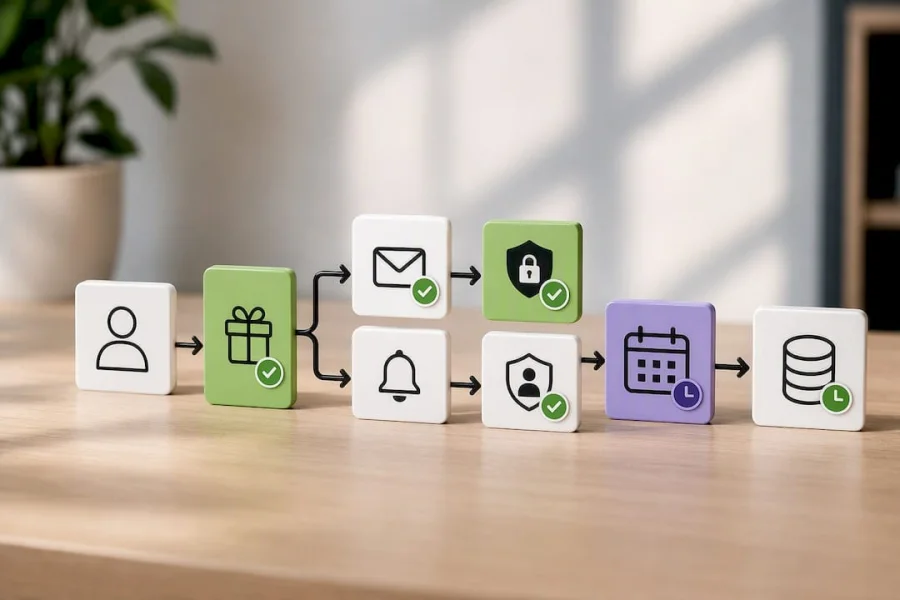
Points expiry policies carry their own fairness expectations. If you expire unused points, disclose the timeframe upfront and give advance warning before expiry, rather than silently zeroing out balances. Customers who feel a reward was taken from them without notice tend to churn entirely, not just complain.
If your programme involves a paid membership tier, be explicit about renewal terms, cancellation rights, and refund conditions. Fee-based programmes attract more regulatory scrutiny than free ones, since money is changing hands directly.
None of this replaces proper legal review for your specific market and business type. Treat this as the baseline checklist to bring to that conversation, not a substitute for it.
A practical view on building versus buying your loyalty programme
, the pattern across every sample programme above is the same: the mechanics are simple, but the operational grind of running them well, tracking expiries, sending timely alerts, syncing purchase data, is where most businesses underestimate the effort.
A SaaS platform earns its cost when you need to launch quickly and don’t have engineering time to spare. Building custom software only makes sense once you know precisely which mechanic works for your customers, because custom builds are expensive to change once shipped. consistently shows the same lesson: businesses that started with a simple stamp card or points system, then added complexity gradually, outperformed those that tried to launch a fully tiered, gamified programme on day one.
Be honest about time-to-value. A basic points or stamp programme can go live within days on the right platform. A custom-built system with bespoke tiers and integrations takes months, and most of that time goes into edge cases you won’t discover until real customers start using it. reinforces that starting lean and iterating beats building everything up front.
— Michal
How Bonusqr turns these templates into a live programme
Every template above, stamp cards, points, missions, tiered status, maps directly onto features already built into Bonusqr’s platform. You don’t need a POS integration to start, and you can run a card-first stamp scheme or a full points-and-tiers programme from the same account as your business grows.
For businesses leaning toward the simplest model, the digital stamp card option gets a café or salon-style programme live within days, not months. If mobile visibility and proactive alerts matter more to your customer base, the mobile and web app tools handle push notifications, expiry reminders, and redemption tracking without extra development work. shows how quickly businesses move from template to live programme once the platform handles the technical grind.
Start with one mechanic, measure engaged member rate at 90 days, then expand. Register for a free account and build your first sample programme into a live one this week.