Choosing from the many types of loyalty cards feels overwhelming. A paper punch card is easy, but it gets lost, can't tell a business who the customer is, and gives staff no real visibility into what's working. Full digital systems sound better, yet many small businesses assume they need expensive tills, custom apps, or a developer to set everything up.
That's where most owners get stuck. They know they need something better than “buy 9, get 1 free”, but they don't want to create admin headaches or another thing staff forget to use at the counter. A loyalty programme only helps if it fits real shop-floor behaviour.
The UK market makes that choice more urgent. Loyalty cards are still the most common form of incentivised loyalty, with 41% of UK consumers actively using loyalty cards or schemes to express brand loyalty, according to SAP Engagement Cloud data cited in 2025 industry reports, while 48% of UK consumers show incentivised loyalty overall through rewards and perks. That's why getting the format right matters. In a mature market shaped by Tesco Clubcard since 1995, customers already understand the value exchange of rewards, points, and perks.
This guide cuts through the noise. It breaks down 10 practical types of loyalty cards, explains where each one works best, and shows how to launch each model fast without overcomplicating the setup. For owners thinking beyond discounts alone, the Vendmoore Enterprises CXM guide is also a useful reminder that loyalty works best when it supports the wider customer experience.
1. Points-Based Loyalty Programmes
Points programmes work because customers can see progress. Spend, earn, redeem. That logic is familiar from Starbucks Rewards, McDonald's MyMcDonald's app, and the Boots Advantage Card, so there's very little education needed at the counter.
For retailers, salons, and food businesses with varied basket sizes, this is often the cleanest option. A customer who spends more earns more, which feels fairer than a flat visit-based stamp.
Where points work best
In UK retail and hospitality, personalised rewards are already a core feature for 63% of loyalty programme owners, and 53% plan to expand that capability within the next three years. The same UK market analysis says consumers rate ease of use at 53%, great discounts at 39%, and simple understanding at 37% as top loyalty requirements. Programmes built around exclusive benefits reach a 79% customer loyalty rate in that analysis. Those figures make points attractive when a business wants both simplicity and room for smarter offers later.
Points fail when redemption feels too distant. If customers think “I'll never get there”, they stop caring.
Practical rule: Keep the earn-and-redeem logic easy enough for staff to explain in one sentence.
A café could reward hot drinks and food differently. A salon could award points on every treatment, then let clients redeem against add-ons. A grocery shop can use points to push higher-margin categories without changing shelf prices.
Quick implementation
- Set a simple earn rule: Start with one clear earning method so staff don't need a script.
- Make rewards reachable: Offer smaller rewards before premium ones so customers feel momentum.
- Show balance clearly: A digital profile works better than making customers ask at the till every time.
- Use QR instead of manual entry: A scan-based setup cuts friction and speeds up checkout.
- Build from one platform: BonusQR makes it easy to boost customer loyalty with points without needing POS integration.
2. Stamp Visit-Based Programmes
Some businesses don't need points. They need habit.
That's why visit-based programmes still work so well for coffee shops, smoothie bars, barber shops, nail salons, and quick-service counters. The reward is obvious. Buy often, get one free. Customers don't have to calculate anything.
Physical stamp cards have one major weakness. They disappear into wallets, bags, coat pockets, and washing machines. A digital stamp card fixes that while keeping the same familiar mechanic.
Why simple often wins
The UK's Department for Business and Trade reported that 68% of small hospitality firms still operate without integrated POS systems, while Office for National Statistics consumer surveys in 2025 found that 74% of UK shoppers expect effortless digital loyalty tracking even in low-tech stores. That gap matters. Many businesses need a loyalty setup that works without till integration but still feels digital to the customer.
A stamp model is often the fastest bridge between old and new. Staff scan a QR code, the visit is recorded, and the customer keeps progress on their phone instead of a paper card.
Keep the reward tied to the purchase customers already make most often. Don't make a coffee buyer chase a reward they don't actually want.
Quick implementation
- Choose one repeat behaviour: For example, one stamp per coffee, haircut, lunch combo, or class visit.
- Match the reward to the habit: Free coffee after coffee purchases works better than an unrelated discount.
- Use slow days strategically: Double-stamp Tuesdays can shift demand without broad discounting.
- Avoid paper-only systems: Lost cards create frustration and staff disputes.
- Switch to digital stamps: BonusQR offers customizable loyalty stamp cards that keep the familiar format while removing card-loss problems.
3. Tiered VIP Loyalty Programmes
Tiered programmes turn loyalty into status. Silver, Gold, Platinum. The names vary, but the psychology doesn't. Once customers feel they're close to a higher tier, they often change behaviour to keep moving.
This is why Sephora, Marriott Bonvoy, Hilton Honors, and British Airways Executive Club all use some form of tiering. It works especially well when a business has clear high-value regulars and wants to protect margin by giving the best rewards to the right customers.
What tiering does better than flat rewards
A 2024 UK survey of professionals found that loyalty programmes generate five to seven times more revenue than implementation cost, and tiered structures are often used to increase exclusivity and spend in the UK market, according to Statista's loyalty programme analysis. That doesn't mean every small business needs tiers. It means tiers make sense when there's enough customer spread between occasional buyers and top spenders.
A salon can reserve priority booking or premium perks for frequent clients. A gym can give advanced class access to higher members. A restaurant can grant better benefits after repeated monthly visits.
The mistake is making tiers too complicated. Three levels are usually enough. Four can work. More than that usually confuses both customers and staff.
Quick implementation
- Limit the ladder: Keep tier names and thresholds easy to understand.
- Reward status, not just spend: Priority booking, early access, and exclusive offers feel stronger than constant discounting.
- Add a grace period: Customers shouldn't lose a tier instantly after one slower month.
- Show progress visually: Tier tracking works better when customers can see how close they are.
- Blend cashback with status: BonusQR can help businesses implement cashback loyalty inside a more premium tiered structure.
4. Cashback Percentage Rebate Programmes
Cashback is one of the easiest loyalty models to explain because the reward looks like money. Spend today, get credit back for later. Tesco Clubcard has trained UK shoppers to understand this kind of value, even when the mechanics behind it vary.
This model suits price-sensitive categories, but it also works well for businesses with strong repeat cycles. Pharmacies, groceries, beauty retail, and takeaway businesses often benefit because customers can quickly see the value building.
The main trade-off
Cashback feels strong to customers, but owners need to protect margin. If every transaction gets the same rebate, the programme can become an automatic discount instead of a behaviour-shaping tool.
That's why cashback works best when it's selective. A café might give stronger return on food bundles than on low-margin drinks. A salon can offer credit on premium treatments while excluding already discounted packages. A retailer can turn cashback into store credit only, which keeps the reward inside the business.
UK consumer research also shows that 86% of participants rate financial rewards, simplicity, and ease of interface as important or very important, while 80% are more likely to engage with brands offering personalised experiences through smart loyalty systems. That combination makes cashback powerful when the programme is simple on the surface and targeted behind the scenes.
A good cashback programme should feel generous to the customer and controlled to the owner.
Quick implementation
- Start with store credit: Future-purchase credit is easier to manage than direct cash payouts.
- Focus on margin-safe categories: Don't apply the same rebate to everything by default.
- Show earned credit instantly: Customers redeem more when the value is visible.
- Use campaigns, not constant generosity: Temporary boosted cashback can fill quiet periods.
- Keep the rules short: If staff need a cheat sheet, the setup is too complex.
5. Spend Threshold Programmes
Spend-threshold loyalty is blunt in a good way. Spend a certain amount, earn a reward. That can be “spend this month, get credit”, “spend this weekend, get a perk”, or “hit the basket target, get a bonus”.
This model is useful when a business wants to raise average order value, not just visit frequency. Restaurants use it for group orders, retailers use it for basket building, and gyms can use it around packages, retail extras, or class bundles.
Why thresholds change customer behaviour
Research into loyalty behaviour shows that 73% of loyalty programme members modify how much they spend at a specific store to maximise rewards, according to Queue-it's 2026 loyalty statistics. That matters for any owner trying to move customers from “small regular purchase” to “slightly larger regular purchase”.
A wine bar can set a threshold around shared plates and drinks. A beauty business can encourage clients to add retail products onto treatment appointments. A convenience store can drive multi-item baskets with a simple “spend and earn” campaign.
Quick implementation
- Choose one target behaviour: Larger baskets, monthly repeat spend, or category bundling.
- Set visible milestones: One threshold is good. Multiple thresholds work if they're easy to follow.
- Use urgency: Monthly or weekend windows push action better than open-ended promises.
- Track progress digitally: Customers respond better when they can see how close they are.
- Tie rewards to profitable follow-up purchases: Credit for future spend often works better than one-off giveaways.
6. Referral Advocacy Loyalty Programmes
Referral programmes turn regular customers into a sales channel. Done properly, they bring in new customers who already trust the business before they walk through the door.
This is the right model for salons, gyms, studios, clinics, and local hospitality businesses where personal recommendation already drives buying decisions. Dropbox, Uber, and Airbnb are well-known examples, but the same principle works on a smaller high-street scale.
What makes referrals work
Most referral schemes fail because the reward is either weak or hard to claim. If a customer has to remember a code, fill a form, or explain the deal to staff, the momentum disappears.
A gym can give both people a free class credit. A salon can reward the existing customer after the new client completes a first appointment. A café can make a referral reward simple enough to explain in one sentence at the till.
The best referral systems also answer one practical question: who referred whom? Without proper tracking, businesses end up guessing, and staff end up making exceptions.
Quick implementation
- Reward both sides: The new customer needs a reason to try. The existing customer needs a reason to share.
- Track by QR or unique link: Manual referral tracking gets messy fast.
- Trigger asks at the right moment: Ask after a positive visit, not before trust exists.
- Use milestone rewards: Extra rewards after several successful referrals can keep momentum going.
- Train staff on the script: If staff can't explain it clearly, customers won't use it.
7. Birthday and Seasonal Coupon Programmes
Birthday rewards feel personal even when they're automated. That's why they punch above their weight for many small businesses. The customer reads the message as recognition, not just promotion.
This model works especially well for cafés, restaurants, salons, wellness businesses, and retail stores with gift-friendly products. Costa Coffee Club, Marks & Spencer Sparks, and Starbucks all use occasion-based offers because timing matters.
Personalisation without complexity
UK loyalty research shows that 65% of shoppers are willing to share personal data for value-adding personalisation. That gives businesses room to collect useful details like date of birth, as long as the value exchange is obvious and the data handling is careful.
A birthday treat can bring back lapsed customers with very little discount pressure. Seasonal offers do the same around Christmas, Valentine's Day, Mother's Day, summer, or back-to-school periods.
This type of programme also fits businesses that don't want to discount all year. Instead of constant offers, they can send targeted coupons tied to occasions that already make sense.
The best birthday reward isn't always the biggest one. It's the one that feels easiest to use.
Quick implementation
- Ask for birth date with purpose: Tell customers what they'll get in return.
- Keep redemption windows reasonable: A full birthday month is easier than a single day.
- Personalise the message: Use the customer's name and keep the wording warm but short.
- Plan seasonal campaigns early: Build offers before demand peaks, not during the rush.
- Automate delivery: Manual birthday sending always breaks once the business gets busy.
8. Fixed Discount Purchase Promotions
Fixed discount programmes are simple and dangerous in equal measure. Customers understand them immediately. Owners often overuse them.
A straight discount is effective when the goal is speed. Join the programme, get member pricing. That can lift sign-ups fast in cafés, convenience retail, takeaway, and service businesses where the purchase decision happens quickly.
Use discounts with discipline
UK data shows that six out of ten consumers explicitly want discounts in return for joining loyalty programmes. That makes fixed discounts appealing, especially at sign-up. But if every loyalty interaction becomes a routine price cut, the business trains customers to wait for deals instead of building real loyalty.
The answer is selectivity. Member pricing on specific categories can work. A fixed discount on high-margin add-ons can work. Time-limited discounts for members-only windows can work.
What usually doesn't work is “10% off everything forever”. That becomes margin leakage, not a strategy.
Quick implementation
- Use targeted categories: Start with products that can absorb the discount.
- Make it member-only: The exclusivity is part of the value.
- Avoid stackable chaos: Keep rules clean so staff know what applies.
- Use fixed discounts for activation: Welcome offers are often stronger than permanent broad discounts.
- Review margin impact regularly: If the offer is popular but unprofitable, it needs adjusting.
9. Gamified Achievement Loyalty Programmes
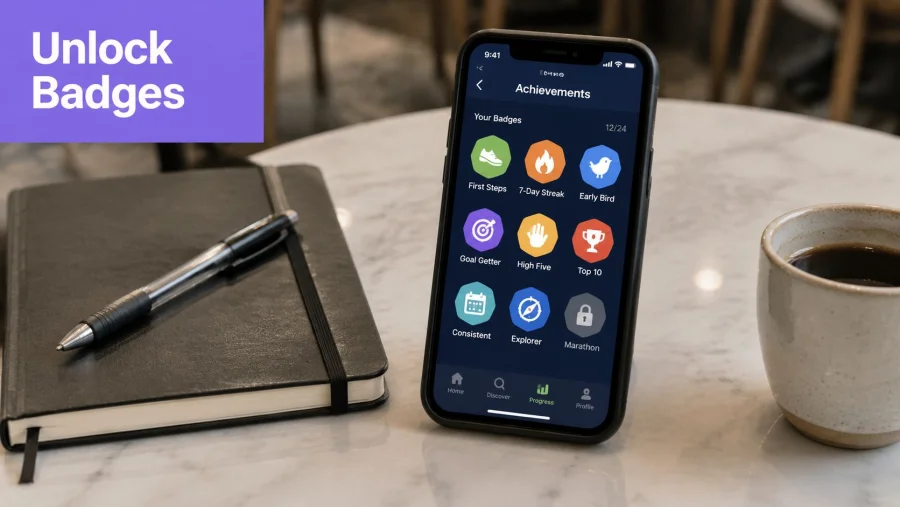
Gamified loyalty moves beyond discounts and into behaviour design. Badges, streaks, challenges, milestones, and mini-goals can keep customers engaged even when the financial reward is modest.
This works best when customers already identify with the activity. Nike Run Club, Fitbit, Duolingo, and challenge-led Starbucks campaigns all show the same principle. People like progress, recognition, and completion.
When gamification is worth using
For a gym, a streak for weekly attendance can be more motivating than another small discount. For a café, a seasonal challenge around trying different drinks can add fun without cutting price on every order. For a salon, badges tied to regular treatment plans can reinforce consistency.
The risk is overdesign. Small businesses don't need complex game mechanics. They need one or two simple progress triggers customers understand immediately.
The UK market also has a clutter problem. The average household is enrolled in 18.4 loyalty programmes but actively engages in only 8.4, according to the Colloquy Loyalty Census summary published by Macorr. Gamification only helps if it simplifies engagement and gives customers a reason to come back, not another system to ignore.
Quick implementation
- Keep the game simple: Streaks and badges beat overcomplicated missions.
- Reward progress visibly: Customers need to see movement quickly.
- Tie challenges to real habits: Weekly visits, monthly class goals, or seasonal product trials work well.
- Refresh regularly: Old challenges become invisible.
- Mix fun with value: Recognition alone helps, but pairing it with a practical reward usually works better.
10. Subscription Membership Programmes
A subscription loyalty model asks customers to pay for access to better value. Amazon Prime, Costco, Pret A Manger's Club Pret, and PureGym all use this structure in different ways. The appeal is predictable revenue for the business and clear recurring benefits for the customer.
This isn't the first loyalty model most small businesses should launch. But it can be powerful for brands with frequent usage and a strong core offer.
Where paid loyalty makes sense
A coffee business with daily regulars may be able to package recurring drink benefits. A gym can combine access with premium perks. A beauty or wellness business can bundle treatments, booking priority, and members-only pricing.
Subscription models fail when the value is vague. Customers need to understand the benefit quickly and feel they can realistically use it. If the customer has to calculate whether it's worth it every month, churn follows.
UK programme operators also care more about practical outcomes than novelty. In UK retail and hospitality, 63% of programme operators report being satisfied or very satisfied with current systems, citing ROI, sales contribution, and customer popularity as key reasons. Paid membership only belongs in that mix when the business can prove clear ongoing value.
Quick implementation
- Start with a strong repeat-use category: Daily drinks, classes, or recurring services are easier to justify.
- Make the headline benefit obvious: One standout perk sells better than a long list of weak ones.
- Offer monthly and annual choices: Different customers prefer different commitment levels.
- Send value reminders: Members need regular proof they're using the programme.
- Test before scaling: A limited paid tier can show whether demand is real before wider rollout.
10 Loyalty Card Types: Quick Comparison
| Programme | Implementation Complexity 🔄 | Resource Requirements ⚡ | Expected Outcomes 📊 | Ideal Use Cases 💡 | Key Advantages ⭐ | Key Drawbacks |
|---|---|---|---|---|---|---|
| Points-Based Loyalty Programmes | Low–Medium, clear rules, POS/CRM integration | Moderate, tracking, redemption engine, customer UI | Steady lift in repeat purchases, higher AOV and LTV | Coffee shops, restaurants, retail & grocery | ⭐ Transparent progress; adaptable; measurable | Points hoarding, needs ongoing calibration |
| Stamp / Visit-Based Programmes | Very Low, simple stamp logic | Low, physical/digital card, minimal tech | Increased visit frequency and habit formation | Small merchants, cafés, salons, fitness studios | ⭐ Very simple; low overhead; highly visual | Doesn't reward high spend; limited segmentation |
| Tiered / VIP Programmes | Medium–High, multi-level rules & communications | High, CRM, personalised rewards, analytics | Higher spend per customer; aspiration-driven retention | Hospitality, retail, beauty, high-repeat businesses | ⭐ Drives upsell and premium loyalty | Complex to manage; risk alienating lower tiers |
| Cashback / Percentage Rebate Programmes | Low, straightforward percentage logic | Moderate, wallet/accounting, POS integration | Immediate perceived value; repeat purchases from price-sensitive customers | Retail, grocery, cafés, card-linked offers | ⭐ Clear value proposition; easy to market | Direct margin impact; may attract deal-seekers |
| Spend Threshold Programmes | Medium, time-based tracking & notifications | Moderate, real-time tracking, messaging systems | Short-term urgency; higher transaction sizes and concentrated spend | Seasonal retail, restaurants, grocery promotions | ⭐ Drives both frequency and basket size | Can cannibalise margin; tracking complexity |
| Referral / Advocacy Programmes | Medium, tracking attribution and rewards | Moderate, referral codes, fraud controls, analytics | New customer acquisition with higher conversion & LTV | Gyms, cafés, subscription services, salons | ⭐ Low CAC; viral growth potential; high-quality leads | Needs critical mass; potential for fraud/abuse |
| Birthday & Seasonal Coupon Programmes | Low–Medium, automation for dates and campaigns | Low, data capture, automated delivery channels | Predictable spikes around occasions; strong conversion | All retail/service businesses (cafés, salons, stores) | ⭐ Highly personalised; emotionally resonant; automated | Requires accurate data; recurring expectation of offers |
| Fixed Discount / Purchase Promotions | Low, simple POS/discount rules | Low–Moderate, pricing rules, exclusion handling | Immediate conversion uplift; impulse purchases | Retail, grocery, cafés, restaurants | ⭐ Easy to explain and apply; immediate gratification | Erodes margin; attracts bargain hunters if overused |
| Gamified / Achievement Programmes | High, game mechanics, UX and ongoing content | High, development, design, analytics, content updates | Strong engagement and habit formation; shareability | Gyms, fitness apps, cafés, restaurants, consumer apps | ⭐ Boosts emotional engagement and viral sharing | Complex to design; needs continual maintenance |
| Subscription / Membership Programmes | High, billing, entitlement and customer support | High, billing platform, fulfilment, retention teams | Predictable recurring revenue; higher customer commitment | Gyms, frequent-purchase cafés, services, clubs | ⭐ Recurring revenue; higher switching costs; LTV lift | High adoption barrier; must continuously deliver value |
Launch Your Perfect Loyalty Programme in Minutes
Understanding the different types of loyalty cards is only the first step. The main challenge is choosing a model that matches how customers buy, how staff work, and how much complexity the business can manage day to day.
For many small businesses, the wrong loyalty setup fails for predictable reasons. It asks too much from staff. It gives rewards that are too hard to earn. It relies on paper cards that go missing. Or it tries to copy a big-brand app when the business doesn't have the budget, time, or POS setup to support it.
That's why the best starting point is usually the simplest workable model. A café may do best with digital stamps. A salon may need points plus birthday offers. A retailer may benefit more from cashback or spend thresholds. A gym may get better results from tiered access or a subscription structure. The point isn't to choose the fanciest programme. It's to choose one customers understand quickly and staff can run without friction.
The UK loyalty market already shows what customers expect. More than 60% of UK consumers participate in at least one loyalty programme, according to Statista's 2024 reporting cited in industry coverage. At the same time, many small businesses still operate without integrated tills, and many owners remain cautious about digital tools because of privacy concerns and setup friction. That's exactly why hybrid, QR-based loyalty systems are gaining attention. They offer digital tracking without forcing a business into a full tech rebuild.
There's also a compliance angle that owners shouldn't ignore. ICO reporting in 2025 found that 42% of small business data breaches stemmed from poor handling of customer data on loyalty platforms, and Federation of Small Businesses reporting in 2025 showed that 59% of UK SMEs were hesitant to adopt digital loyalty because of privacy concerns. For some businesses, a minimal-data approach is the right starting point. For others, personalisation is worth it, but only if the platform keeps data handling disciplined and aligned with UK GDPR principles such as data minimisation and the right to erasure.
BonusQR is one relevant option for businesses that want a practical middle ground. It supports stamps, points, cashback, visit and spend thresholds, fixed discounts, birthday and seasonal coupons, and other loyalty formats from one dashboard. It doesn't require expensive hardware or complex POS integration, which matters in businesses where staff's involvement is limited to scanning a customer QR code at the counter. Customers can track rewards in one profile, and businesses can run targeted offers without building a custom app from scratch.
For owners who've been putting this off, the next move is straightforward. Pick one loyalty model based on buying behaviour, launch it initially, and improve it once customers start using it. A programme that runs cleanly beats a clever one that nobody understands.


