A café owner watches the morning footfall, counts several new faces, and still sees a disappointing result at the end of the week. The advertising budget brought people through the door, but many bought once and disappeared. The salon filled a few quiet appointments with a discount, yet the customers never returned. The gym generated enquiries, but only a fraction became regular members.
That is the practical problem behind the question, what is client acquisition? It isn't posting on social media or buying Google Ads. Client acquisition is the measurable system a business uses to turn an unfamiliar prospect into a paying customer, then give that customer a reason to return.
For a local business, a first transaction is only the beginning. Sustainable growth depends on the journey from discovery to visit, first purchase, repeat behaviour, and eventually referral. A business that measures only new leads can mistake activity for progress. A business that tracks profitable repeat customers can see which marketing actually strengthens the operation.
The Reality of Winning New Customers Today
A high-street business can appear busy and still struggle to grow. A restaurant may have a full dining room on a Saturday, while weekday tables remain empty. A beauty salon may attract new clients through introductory offers, but fail to secure another booking before the first appointment ends. The owner sees movement, yet the numbers don't produce dependable profit.
Client acquisition gives that activity a structure. It connects the money spent on advertising, local partnerships, signage, events, staff selling time, and promotions with the number of new customers gained. It then asks a more useful question: did those customers return often enough to justify the cost of winning them?
UK marketing research reports that 57% of UK small businesses cite customer acquisition as their greatest challenge, 46% struggle with marketing technology adoption, and only 24% have formal retention strategies. Those figures are reported by The Marketing Blog's UK marketing statistics overview, and they describe a familiar gap. Many owners work hard to create demand, but fewer have a simple process for recognising first-time customers and bringing them back.
Practical rule: A new customer isn't an acquisition success until the business knows what the customer cost, what the first purchase contributed, and what will encourage the next visit.
A café can start with a local search listing, a clear offer, and a friendly first service. The acquisition system becomes stronger when the customer can join a loyalty programme at the till, receive a useful welcome reward, and hear from the café at a sensible time. A salon can apply the same principle by recording treatment preferences and prompting a future booking rather than allowing the relationship to end at checkout.
Owners looking for a broader framework can use this tactical playbook for 2026 to compare acquisition activities, measurement, and follow-up. For local operators, the practical lesson is simple: marketing creates the opportunity, but the customer experience and retention process determine whether that opportunity becomes profitable.
A useful starting point is this guide to small business growth strategies, especially where acquisition needs to connect with repeat visits. The business shouldn't aim merely to generate more attention. It should build a repeatable path from attention to revenue and from revenue to customer value.
Mapping the Local Acquisition Funnel
For a physical business, the acquisition funnel isn't a neat sequence of clicks. It is a chain of small decisions that must survive real-world friction. A potential customer needs to notice the business, trust the offer, make the journey, enter the premises, complete a first purchase, and remember the experience positively enough to return.
UK guidance on brick-and-mortar acquisition describes the process as reach, visit, first purchase, and repeat purchase, rather than a simple focus on one-off lead volume. The UK marketing benchmark discussion from Abmatic supports this conversion-efficiency view.
Discovery must lead to a clear reason to visit
Discovery happens through local search, a shopfront, recommendations, community groups, social content, direct mail, or a nearby partnership. The channel matters less than the next step. A search listing should make the location, opening times, category, and offer easy to understand. A pavement sign should answer why a passerby should enter now rather than later.
A vague message such as “great service and quality products” gives people little to act on. A specific seasonal treatment, a convenient collection option, or a clearly explained first-visit reward gives discovery a practical direction.
The visit has physical friction
A digital prospect can click instantly. A local prospect may need to change direction, find parking, wait for a table, feel comfortable entering alone, or decide whether the price is acceptable. Businesses can reduce this friction with visible pricing, accurate opening information, welcoming staff, easy booking, and a premises that delivers what the marketing promised.
The first visit also reveals whether the offer attracts the right audience. Heavy discounting can create footfall without creating a customer who values the normal product or service. A relevant offer attracts a better fit and gives staff a natural opening to explain the broader experience.
The first purchase is the data-capture moment
The till, reception desk, booking form, or membership conversation provides the most important opportunity in the funnel. The customer should be invited to join a useful relationship, not pressured into surrendering information for no clear benefit.
A simple sign-up can connect the customer with a reward, digital receipt, booking reminder, menu, class update, or product news. The permission and value should be clear. Without that connection, the business may never know whether the customer was new, whether the visit followed an advert, or how to invite a return.
Repeat behaviour completes acquisition
A customer becomes commercially valuable through subsequent behaviour. The business can encourage that behaviour with a timely reminder, a relevant reward, a service recommendation, or a reason to visit during a quieter period. A café might promote a weekday reward, while a gym might follow an introductory session with a helpful class suggestion.
Businesses comparing lead-generation approaches can also review Hooked's industry lead generation page, then adapt the principle to physical conversion. Leads matter, but the local funnel only works when the journey ends in profitable repeat activity.
The Financial Metrics That Actually Matter
Client acquisition becomes easier to manage once owners stop treating every new customer as equally valuable. A customer who makes one low-margin purchase after an expensive campaign has a different financial effect from a regular who returns frequently and recommends the business.
Three measures bring that difference into focus:
- Customer Acquisition Cost: Total sales and marketing spend divided by the number of new customers gained during the same period.
- Lifetime Value: The total profit a customer contributes across the relationship, not just the revenue from the first transaction.
- Payback Period: How quickly the profit generated by a customer covers the cost of acquiring that customer.
The measures should be calculated by channel where possible. A local search campaign, a referral offer, a leaflet drop, and a community partnership may all produce customers, but their costs and customer quality can differ significantly.
CAC shows what a new customer costs
A 2026 UK SME benchmark places average CAC at £274 for eCommerce and £1,450 for fintech, showing how acquisition costs vary sharply between lower-friction purchases and complex, high-trust decisions. These figures come from AskBIZ's UK CAC benchmark. They aren't direct targets for a café, salon, gym, or retailer, but they demonstrate why sector context matters.
A local owner can calculate a basic CAC by adding the relevant campaign spend, creative costs, agency fees, and attributable staff time, then dividing the total by new customers. If a campaign generates many enquiries but few first purchases, the acquisition cost per customer will be higher than the cost per lead suggests.
LTV determines whether CAC is sustainable
Lifetime value is where retention changes the commercial picture. Consider two customers who each make the same first purchase. One never returns. The other visits regularly, buys a higher-margin add-on, and brings a friend. Their initial acquisition cost may be identical, but their value to the business is not.
Many UK SMEs use a 3:1 LTV to CAC ratio and a payback period under 12 months as useful sustainability aims, as described in UK paid advertising guidance from Gilkes Media. That isn't a universal rule. A business with strong cash flow, high margins, or a longer customer relationship may set different thresholds, while a low-margin retailer may need tighter control.
Conversion rates locate the leak
A funnel diagnosis should separate:
- People who noticed the business.
- People who visited or made contact.
- People who completed a first purchase.
- First-time customers who returned.
- Returning customers who increased frequency, spend, or referrals.
A weak result at each stage requires a different response. Poor discovery may call for stronger local SEO or signage. Weak visits may indicate unclear offers or inconvenient opening information. Weak first purchases may reveal pricing or service problems. Weak repeat behaviour usually points to an absent follow-up process rather than a shortage of awareness.
The most useful weekly review isn't “how many people saw the advert?” It is “which source produced first-time customers, what did they cost, and what happened after the first visit?” That question keeps attention on unit economics rather than vanity metrics.
Choosing the Right Acquisition Channels
A local business rarely needs the loudest channel. It needs a channel that reaches nearby people with a credible reason to visit and allows the business to measure what happens next.
Broad paid social can create attention quickly, but attention isn't the same as intent. A café may pay to reach people well outside its practical trading area. A salon may attract users who like the creative but won't travel, book, or pay the standard price. Paid search often captures stronger intent, yet competitive terms can become expensive and still fail if the landing page, phone response, or booking process creates friction.
Organic local search has a different trade-off. It takes time to build, but a well-maintained profile can capture people already looking for a nearby service. Accurate categories, photographs, reviews, opening hours, service pages, and clear booking options do more for local conversion than a stream of generic posts.
A channel comparison for physical businesses
| Channel | Main strength | Common weakness | Practical measurement |
|---|---|---|---|
| Paid search | Captures active local intent | Costs can rise in competitive categories | New customers by campaign and search term |
| Paid social | Builds awareness and supports visual offers | Reach may include people outside the trading area | First purchases linked to a specific offer |
| Organic local search | Supports discovery without paying for every visit | Requires accurate information and ongoing work | Calls, directions, bookings, and tracked visits |
| Community partnerships | Transfers trust between local organisations | Results can be difficult to attribute | Partner-specific codes or QR links |
| Targeted direct mail | Reaches defined local areas with a physical prompt | Printing and distribution require planning | Redemption and subsequent repeat visits |
| Referral activity | Uses existing customer trust | Needs a clear reward and tracking method | Referred sign-ups and completed first purchases |
UK research challenges the assumption that mail is obsolete. JICMAIL's Q2 2025 dataset found that mail items are noticed and kept, and can also drive acquisition behaviour, according to its Q2 2025 results webinar. For a local operator, targeted mail can work particularly well when the audience is defined by location and the offer has a clear redemption path.
A postcard for every household may waste budget. A targeted campaign for a relevant neighbourhood, paired with a trackable offer and a sensible follow-up, gives the business a better test. The same discipline applies to community partnerships with schools, workplaces, sports clubs, and complementary retailers.
For businesses developing educational or search-led acquisition, the Wispra artisan client attraction guide offers another perspective on using useful content to attract a defined audience. Local owners can combine that approach with practical QR code marketing ideas for small businesses, provided each code leads to a measurable action rather than a generic homepage.
The strongest mix usually combines discovery, trust, and follow-up. A business can use local search to capture intent, partnerships or mail to create a physical prompt, and a loyalty or referral process to make the second visit measurable.
Turning First Visits Into Lifelong Loyalty
The most cost-effective acquisition strategy often begins after the first sale. If a business pays to win a customer and then makes no effort to create a second visit, the business keeps paying to replace customers who could have become regulars.
Retention-linked acquisition changes the calculation. A customer who returns contributes more value without requiring the same initial advertising expense again. The effective CAC becomes easier to manage when the business increases the profit generated by each acquired customer.
UK consumer research indicates that 88% of adults belong to at least one loyalty scheme, while other UK-focused research places active participation at about 80% of adults and estimates the UK loyalty market at over £4.5 billion annually, according to UK loyalty programme statistics from LoyaltyPass. Participation is widespread, so a local scheme must be simple, relevant, and easy to use. A complicated points system won't compete well with a clear reward that customers can understand at the till.
The first transaction should start the relationship
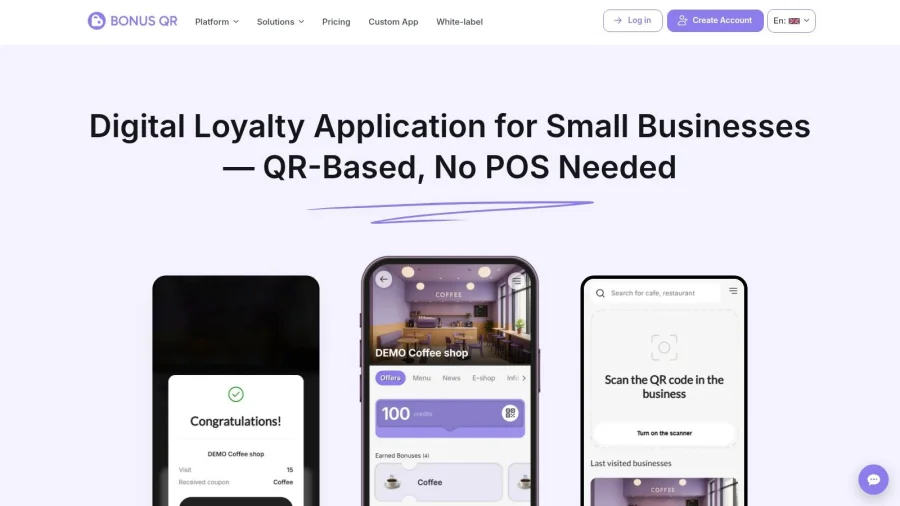
Paper cards are familiar, but customers lose them, forget them, or leave them at home. A QR-based system can connect sign-up, visit history, rewards, and communication in one mobile experience. The business can invite the customer to join immediately after payment, explain the reward plainly, and avoid a lengthy registration process.
BonusQR is one option for this model. Its platform lets brick-and-mortar businesses configure stamps, points, cashback, visit and spend thresholds, fixed discounts, welcome bonuses, birthday and seasonal coupons, then manage the experience through QR codes without requiring POS integration or additional hardware.
Rewards should create habits, not just reduce price
A welcome reward can encourage sign-up, but the ongoing rule should support profitable behaviour. A café might reward visits rather than discount every drink. A salon might create a service threshold or seasonal incentive. A gym might use attendance milestones, referral rewards, or a member benefit that supports class participation.
The reward needs a clear business purpose:
- Increase frequency: Encourage a return during a quieter trading period.
- Protect margin: Use a bonus, upgrade, or threshold instead of an unrestricted discount.
- Support referrals: Give existing customers a simple way to invite someone relevant.
- Improve information: Use visit history and preferences to make later messages more useful.
- Recover attention: Send a timely reminder when a customer appears to have stopped visiting.
Automated push or email campaigns can make the follow-up consistent, but timing and relevance matter more than message volume. A customer who receives a helpful reminder or a birthday benefit may feel recognised. A customer who receives constant generic promotions may ignore every message.
Businesses can use this small business playbook for increasing customer lifetime value to connect loyalty activity with margin, frequency, and customer experience. The central principle is that loyalty isn't a separate marketing project. It is the mechanism that helps acquisition produce a longer and more valuable relationship.
Common Acquisition Mistakes to Avoid
Local owners often make acquisition harder by measuring the wrong outcome. A campaign can produce impressive reach, busy social feeds, or a queue of discount hunters without generating durable profit.
Mistake one is treating discounts as the strategy
A deep first-visit discount can fill empty capacity, but it may also attract people whose only reason to buy is the low price. When the offer ends, they disappear. The business then repeats the promotion, trains customers to wait, and puts pressure on margin.
A better offer has a reason and a boundary. A welcome reward can introduce the normal experience without reducing every future purchase. A spend threshold can increase basket value. A time-limited quiet-period incentive can move demand without making the standard price look artificial.
Mistake two is counting leads instead of customers
An enquiry isn't a completed acquisition. A social follower isn't a paying customer. A coupon download isn't proof of profit. The business needs a defined conversion event, such as a first purchase, completed booking, or paid membership.
The campaign record should identify the source, cost, first transaction, and subsequent behaviour. Staff can use separate codes, landing pages, booking questions, or QR links to make attribution practical rather than perfect.
Mistake three is allowing first-time visitors to vanish
The data blind spot appears at the till. The customer pays, leaves, and becomes anonymous again. No permission is captured, no reward is offered, and no visit history exists. The business must then spend again to recreate the same opportunity.
A useful sign-up should provide immediate value, and staff should explain it in one sentence. The customer shouldn't need to understand marketing technology. They only need to know what they receive and how to use it.
Mistake four is buying tools before fixing the offer
Technology can't repair slow service, unclear pricing, poor availability, or an experience that fails to match the advert. A loyalty platform may record visits, but it won't make an unsuitable reward attractive. Owners should first identify the customer behaviour that needs to change, then choose the simplest tool that can measure and support it.
Building Your Sustainable Growth Engine
Sustainable acquisition is a connected operating system, not a single campaign. The system should show how people discover the business, what makes them visit, what converts the first transaction, and what brings them back.
A local owner can audit the current process with a short checklist:
- Define the first purchase. Decide exactly what counts as a new customer for the café, salon, gym, restaurant, or shop.
- Calculate channel CAC. Add attributable campaign and sales costs, then divide by new customers rather than enquiries.
- Check the physical journey. Review signage, opening information, pricing, booking, waiting time, service, and payment.
- Capture permission at checkout. Offer a clear reason to join a loyalty or communication programme.
- Set a repeat-visit trigger. Choose a reward, reminder, threshold, or referral prompt that supports profitable behaviour.
- Review customer cohorts. Compare customers by acquisition source and observe which groups return.
- Remove weak activity. Stop campaigns that produce attention without first purchases or repeat value.
Growth discipline: The right question isn't how many people saw the promotion. It is whether the promotion created customers who return at a cost the business can sustain.
A practical first test can stay small. One offer, one location, one customer segment, and one tracking method give staff a manageable routine. The owner can then compare first purchases, repeat visits, reward redemptions, and margin before expanding the campaign.
The strongest local businesses don't treat loyalty as a last-minute add-on. They build it into acquisition from the first interaction, so every new customer has a clear path towards a second visit and a longer relationship.
Local business owners can start by mapping the current funnel, calculating customer acquisition cost, and choosing one repeat-visit behaviour to improve. A simple QR-based loyalty process can make sign-up, rewards, visit history, referrals, and follow-up easier to manage without adding hardware or unnecessary complexity. Businesses ready to turn more first-time visitors into profitable regulars can explore BonusQR and begin with a focused loyalty campaign built around the customers and trading patterns that matter most.


